
The technology partner behind your RHTP initiative
States committed to specific, scored technology outcomes to win this money. Now someone has to build them, against a spend clock, in places that carry no engineering bench.
Digital Scientists designs and builds the systems that deliver those commitments. NeverAlone is our proof. We built it and we run it, supporting 26,000+ patients across 130+ facilities in 7 states today.
Our proof, running in production today
All 50 states hold an award. $10 billion obligated for FY2026, from $147M to $281M. Every one of them committed to technology outcomes that someone now has to deliver.
The clock
Start where you actually are
This page is written for people who have to deliver something technical against this money, not for a policy audience. Three situations, three different next steps.
You hold an award
A hospital, health center, EMS agency or ACO with subaward money and a scope you now have to deliver, probably without an engineering team. The clock matters more than the strategy.
Talk to us →You buy on behalf of many
A state office of rural health, hospital association, health information exchange or innovation center serving a group of small awardees. No single award funds a platform. Together they do.
See how the ecosystem works →You are writing the next application
Technical sections get written two to four weeks before a deadline and nobody researches a delivery partner in that window. Alabama publishes Year 2 opportunities in November and December 2026.
Understand the scoring first →What we build
Six things, all of them in production somewhere today. Each one maps to a factor CMS scores and to an approved use of funds.
Virtual care and treat in place
Provider on demand at the point of care, escalation, documentation, and proof of diversion.
Interoperability and data infrastructure
State HIE connection, identity matching, terminology mapping, EHR integration.
Consumer-facing care technology
Devices and interfaces the people this program funds will actually use.
Clinical AI and documentation
Ambient documentation, assessment support, triage, back-office automation.
Revenue cycle and risk adjustment
Capturing revenue already earned, which is what keeps an initiative alive after 2030.
Multi-tenant platforms
One solution funded once, used by every organization in a region, data isolated per tenant.
The problems this money has to solve
Your award describes outcomes, not software. These are the problems underneath those outcomes, the CMS factors each one earns against, and what we have already delivered in production against the same problem.
Treatment in place
Patients get moved for conditions that could have been handled where they already are, and every transfer costs the patient, the family and the system.
We build the path from a person at the point of care to a licensed provider in minutes: the device, the provider network credentialed state by state, escalation and hand-off, documentation that survives an audit, and the measurement that proves the transfer was avoided.
96% treat in place for 26,000+ patients across 130+ facilities in 7 states, provider reached in under 3 minutes. We built the platform and we operate it.
NeverAloneVirtual care command centers
Clinical coverage is organized facility by facility and shift by shift, so no one has a single view and scarce specialists cannot be pooled across a region.
We build the layer that lets a small clinical team cover many sites at once: multi-site monitoring, intelligent alerting, routing and triage, and connectivity to whatever monitors and systems each site already has.
Remote monitoring across simultaneous cases at 99.9% vital-sign accuracy and under two second refresh, with universal monitor connectivity. Evaluated by the Geneva Foundation for forward military medical care.
GuardianPatient engagement
The technology gets bought, deployed, and then not used. CMS scores execution rather than purchase, so a device sitting unused earns nothing and the gap shows up at the next recalculation.
We design for the populations this program actually funds. Passwordless, no learning curve, the staff member as operator rather than the patient, and the caregiver treated as a first-class user rather than an afterthought.
A tablet built for seniors and adults with intellectual and developmental disabilities, deployed across 130+ facilities. Extended into IDD care through a $2.8M state grant we supported from proposal through delivery.
Patient engagement platformsRevenue cycle management
Grant money does not fix an operating margin. A rural organization that is still losing money on every encounter in 2030 will not keep whatever the grant built.
We build the systems that recover revenue the organization has already earned: assessment accuracy, documentation to coding, denial prevention and revenue integrity. This is the work that decides whether an initiative outlives the funding.
$10M in recovered revenue and $2M in annual quality incentives from assessment optimization. Separately, $10M+ in risk adjustment improvement at over 90% accuracy with patient review 50 times faster.
MDS and PDPM · RAF and HCCValue-based care platforms
States committed to value-based arrangements and to better integration for people covered by both Medicare and Medicaid. Rural providers are expected to operate under those arrangements with no analytics to tell them who needs attention.
We build the decision layer above the systems of record: claims and clinical ingestion, risk stratification, intervention triggers routed to the person who can act, and tracking of whether the intervention actually changed the outcome.
A predictive intervention platform tracking $63.7M in patient spending, with enrolled patients showing a 39% cost reduction against those not enrolled.
Congruity Health · Value-based careInteroperability and data infrastructure
Nothing connects. The new system does not talk to the record, the record does not reach the state exchange, and interoperability is a scored factor that gets re-examined every year.
We handle exchange onboarding and data use agreements, patient identity matching, terminology mapping and transport standards, and the conformance work that continues after go-live. Being technology agnostic is a scored requirement, not a sales posture.
60+ systems audited, mapped and consolidated, returning the organization to CMS compliance in under six months with a 25% reduction in technology footprint. Separately, 400+ public datasets from 30+ sources unified into one platform.
Ecosystem modernization · EHR integrationClinical workforce capacity
You cannot recruit your way out of a rural workforce gap, and no grant changes that. The only lever inside your control is how many hours each clinician spends away from patients.
We build the systems that give those hours back: ambient documentation, assessment support, scheduling, and back-office automation. This is where practical AI earns its place, measured in clinician hours rather than in pilots.
Ambient documentation running in production, cutting clinical documentation from 45 minutes to 5. Assessment time down 40 to 60 percent for the coordinators who own it.
HealthContext.AI · Ambient scribesOne platform, many health systems
A state funds seventeen rural hospitals at a few hundred thousand dollars each. Seventeen separate procurements against seventeen separate designs spends the money without leaving anything that connects, and none of those awards is large enough to fund a real platform alone.
We build multi-tenant. One solution, funded once, used by every health system in the group, with each organization keeping its own data isolation, its own configuration and its own reporting. It changes what a small award can buy, because the cost of the platform is shared and only the configuration is local. The natural sponsor is the state office, the hospital association or the health information exchange that already reaches all of them.
One multi-tenant platform supporting 26,000+ patients across 130+ facilities in 7 states and eight distinct care populations. Facilities outside the original network now license it directly, which is the same architecture serving unrelated organizations.
Multi-tenant deploymentWe built it. We run it. Every day.
Most organizations bidding into this program can describe what they would do. NeverAlone is a 24/7 clinical safety net for senior and post-acute care teams that we designed, engineered, and still operate in production. It is not a portfolio piece we walked away from.
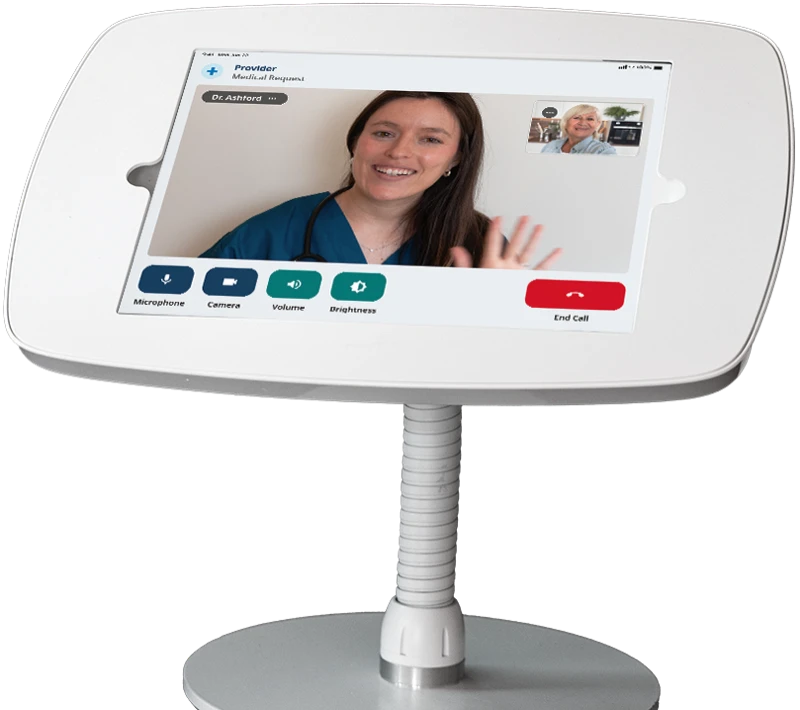
One button. A resident, a family caregiver or a staff member presses it and reaches a licensed provider in under three minutes, around the clock, on a purpose-built device with no password and no learning curve.
That is the easy part to describe and the hard part to operate. Five years of running it is how we know what actually decides whether these programs work: provider licensure state by state, escalation and hand-off, documentation that survives an audit, and rollout across facilities with uneven connectivity.
It also became a durable asset for the organization that funded it. Facilities outside the original network license it today, which is exactly the outcome anyone spending five years of federal money should be planning toward.
We support it 24/7
When a nurse needs clinical backup at 3am, the platform has to work. We are accountable for uptime and reliability, not just code quality. That is the same accountability a funded initiative needs in year three when CMS asks what happened.
We manage the complexity
Third-party provider networks, multi-state licensing, HIPAA compliance and real-time clinical workflows. These are the parts of a rural initiative that look small in an application and decide whether it works.
We keep expanding it
Pharmacy integration, EHR connectivity, new care settings. PointClickCare and Gehrimed are in production, with MatrixCare and Netsmart through FHIR, HL7 and ADT.
From prototype to operating platform
-
90 daysPrototype to a working MVP
-
2021Independent living pilot
-
2022Care management platform, then a $2.8M state-funded expansion into IDD care
-
2023Deployed across 130+ facilities in 7 states
-
TodayEight care populations, and facilities outside the original network licensing it
“The ability to reach rural patients at the press of a button has been transformative, significantly reducing travel time for our nursing staff.”
Ryan McElhinny, CEO, Stonerise Home Health and Hospice

What transfers to an EMS initiative, and what does not
Our 96 percent is measured in post-acute settings, not in EMS field triage. We say so because the people reviewing these initiatives are clinicians and the distinction matters.
Transfers directly
On-demand connection to a licensed provider, sub-three-minute response, the documentation layer, device design for non-technical users, and multi-site operations.
Does not transfer
Field triage protocols, medical direction and ambulance disposition. Those belong to your medical leadership, and we build to your protocol rather than importing ours.
More production proof in the same setting
HealthContext.AI
Ambient clinical documentation running inside NeverAlone, cutting documentation from 45 minutes to 5.
MDS and PDPM optimization
$10M in recovered revenue and $2M in annual quality incentives across a national post-acute network.
RAF and HCC coding
Patient review 50 times faster at over 90 percent accuracy, with $10M+ in risk adjustment improvement.
Ecosystem modernization
60+ systems audited and mapped, return to CMS compliance in under six months, 25 percent footprint reduction.
Take the two-page partner brief with you
The scored factors we build against, what runs in production today, how an engagement is funded, and the licensing option. Two pages, printable, and nothing to fill in. Forward it to whoever else has to agree.
Built to handle PHI, because it already does
Cybersecurity is a funded and scored part of this program, and several states wrote security assessments into their applications. Our platforms carry protected health information in production today.
HIPAA compliant in production
NeverAlone handles PHI for 26,000+ patients across 7 states. This is an operating posture, not a policy document.
NIST and HIPAA-aligned controls
AES-256 encryption at rest, TLS 1.2 and above in transit, role-based least-privilege access, centralized logging, and static and dynamic security testing in the build pipeline.
AWS, HIPAA-eligible services, under a BAA
We execute a business associate agreement before any access to systems or PHI, including for any partner we bring on.
What we do not claim
We are not SOC 2 Type II certified and we are not HITRUST certified. If your program requires either, we scope it as explicit work tied to your production launch rather than implying it is already done.
Start small, and fund most of it from the grant
The first two steps are ours to absorb. After that, training and technical assistance is an approved use of funds, so planning and architecture can be paid for by the award rather than out of margin.
Introduction
A conversation about what your organization committed to and where the delivery risk sits. No deck.
Working Session
A one-day workshop that aligns stakeholders, maps the opportunities inside your funded scope, and picks the highest-return place to start. Any state.
Details →Assessment
Four weeks, fixed fee. Quantified return, technical feasibility, and a business case your board and your state program office can both read.
Details →Blueprint
One to four weeks turning a funded commitment into a solution architecture, a validated plan and a budget. The document that makes a technical section defensible.
Details →Build and operate
Production engineering with a senior US team, then the support that keeps it running. You own the code, the IP and the roadmap from the first commit.
Details →Readiness review
Forty-five minutes against your own funded scope. We read what your state and your organization committed to before the call.
What you are scored on
Which technical score factors your funded scope earns against, and which of those are initiative-based, meaning your state has to show follow-through to keep the points.
Where it will slip
The parts most likely to run late, and why. Usually provider licensure, exchange integration, or an adoption assumption nobody costed.
What fits the clock
What can realistically be in production before your obligation deadline, and what honestly belongs in the next budget period.
What the grant can pay for
Whether the work is fundable under training and technical assistance, and what would have to be true for that.
You keep the notes whether or not we work together. If we are not the right partner for your scope, we will say so on the call rather than after the contract.
What can realistically happen before the deadline
The honest answer, because the schedule is the thing most likely to go wrong. Note the distinction CMS draws: money earmarked for future spending is not considered spent. It has to be paid out.
Weeks, not months
A readiness review, a working session and a Blueprint can be complete inside eight to twelve weeks, and each of them is a contracted, payable engagement rather than an earmark. Where the scope really is virtual clinical coverage, NeverAlone onboards in under two weeks.
This budget period
A first production deployment on an existing platform, integration with systems you already run, and the measurement needed to evidence the initiative. Enough to show CMS follow-through rather than intent.
Next budget period
Net-new multi-site platforms, exchange integration across a region, and anything requiring provider licensure in new states. Planning it now is what makes it deliverable then, and the planning itself is fundable.
You can license NeverAlone directly
Not every funded scope needs an architecture engagement. If the commitment is virtual clinical coverage, the platform is available as a licensed product, it onboards in under two weeks, and it is priced well below the traditional telehealth platforms. That matters when you are working against an obligation deadline rather than a roadmap.
Use our provider network
We partner with provider groups credentialed in the states we serve, including behavioral health, and match them to your location. You get clinical coverage without recruiting for it.
Or use your own
If you already have providers, the platform runs on your network instead. Most organizations we talk to assume a virtual care product means outsourcing their clinicians. It does not have to.
Or both
Your clinicians during the day, a partner network overnight and at weekends. Covering nights and weekends is usually the actual gap, and it is the one staffing cannot close.
Licensing is not a dead end either. It is the same platform we build on, so a subscription today can become an integrated, owned system later without starting again. Paired with the care coordination billing described below, that is what carries a program past 2030.
Decide now what you will still own
This program funds five federal fiscal years and then stops. That boundary is the most important date in any plan written today, and it is the one least likely to appear in a vendor proposal.
Some states have already written the cliff into their own plans. Georgia's approach assumes staffing transitions onto other CMS funding in year three, which is a state saying out loud that the money runs out before the need does.
We build so the answer is the third one below. It is also why our contracts assign the code, the intellectual property and the roadmap to the client from the beginning rather than at the end.
Rented
The capability stops at the boundary. Whatever the initiative achieved goes with it, and the score it earned is not repeatable.
Bought
You own a maintenance obligation you now have to staff and fund alone: hosting, licensing, support, and the upgrade that arrives in year four.
Built and transferred
You own an asset, your team can run it, and the cost of ownership was budgeted before the first invoice. In the best case it earns revenue. Facilities outside the original network license NeverAlone today, which is what that looks like in practice.
Grant money builds it. Care coordination billing runs it.
RHTP funds cannot duplicate or supplant existing federal, state or local funding, so the program will not pay for a service Medicare already reimburses. Read that rule the other way round and it points straight at how these programs survive 2030.
Now, 2026 to 2030
The grant pays to build it
- The platform and the devices
- Enrollment and consent workflow
- Contracting a credentialed provider network
- Staff training
- The coding and billing capacity most rural organizations do not have
Allowable, and much of it sits under training and technical assistance.
After the money stops
Billing pays to run it
- Chronic care management (CCM)
- Principal care management (PCM)
- Remote physiologic monitoring (RPM)
- Behavioral health integration (BHI)
Existing Medicare and Medicaid mechanisms. The revenue does not stop in 2030.
Providers often underuse payment mechanisms for care coordination services due to lack of awareness or capacity in coding and billing. Collecting this additional revenue could help offset the costs of the community health providers and sustain these projects.
CMS, Rural Health Transformation Program funding opportunity, population health infrastructure example initiative
This is why we treat the provider network, the documentation layer and the coding capacity as one system rather than three projects. A virtual care program that cannot produce billable, defensible documentation has an expiry date on it. Ours already does: ambient documentation runs inside NeverAlone in production, and separately we have recovered more than $10M in risk adjustment for a post-acute operator at over 90 percent accuracy.
The program itself, in detail
Two reference pages for anyone who needs the mechanics rather than the pitch. Both are sourced to the CMS funding opportunity.
How the program works
The eleven approved uses of funds, the two halves of the $50 billion, all sixteen scored factors with their weights, the annual recalculation, and what happens to money a state does not spend.
Read the mechanics →Who does what
States, program consultants, subrecipients, aggregators and vendors. The four routes a technology partner can reach the work, the eight initiatives CMS published, and the interoperability standard behind the data score.
See the ecosystem →FY2026 obligation by state, all fifty
| State | FY2026 obligation |
|---|---|
| Alabama | $203.4M |
| Alaska | $272.2M |
| Arizona | $167.0M |
| Arkansas | $208.8M |
| California | $233.6M |
| Colorado | $200.1M |
| Connecticut | $154.2M |
| Delaware | $157.4M |
| Florida | $209.9M |
| Georgia | $218.9M |
| Hawaii | $188.9M |
| Idaho | $186.0M |
| Illinois | $193.4M |
| Indiana | $206.9M |
| Iowa | $209.0M |
| Kansas | $221.9M |
| Kentucky | $212.9M |
| Louisiana | $208.4M |
| Maine | $190.0M |
| Maryland | $168.2M |
| Massachusetts | $162.0M |
| Michigan | $173.1M |
| Minnesota | $193.1M |
| Mississippi | $205.9M |
| Missouri | $216.3M |
| Montana | $233.5M |
| Nebraska | $218.5M |
| Nevada | $179.9M |
| New Hampshire | $204.0M |
| New Jersey | $147.3M |
| New Mexico | $211.5M |
| New York | $212.1M |
| North Carolina | $213.0M |
| North Dakota | $198.9M |
| Ohio | $202.0M |
| Oklahoma | $223.5M |
| Oregon | $197.3M |
| Pennsylvania | $193.3M |
| Rhode Island | $156.2M |
| South Carolina | $200.0M |
| South Dakota | $189.5M |
| Tennessee | $206.9M |
| Texas | $281.3M |
| Utah | $195.7M |
| Vermont | $195.1M |
| Virginia | $189.5M |
| Washington | $181.3M |
| West Virginia | $199.5M |
| Wisconsin | $203.7M |
| Wyoming | $205.0M |
| All 50 states | $10.0B |
Source: USAspending.gov, Assistance Listing 93.798 (Rural Health Transformation Program), pulled 16 August 2026.
A six-part series on delivering Rural Health Transformation initiatives
Written for the people who now have to build what their state promised. All six are published.
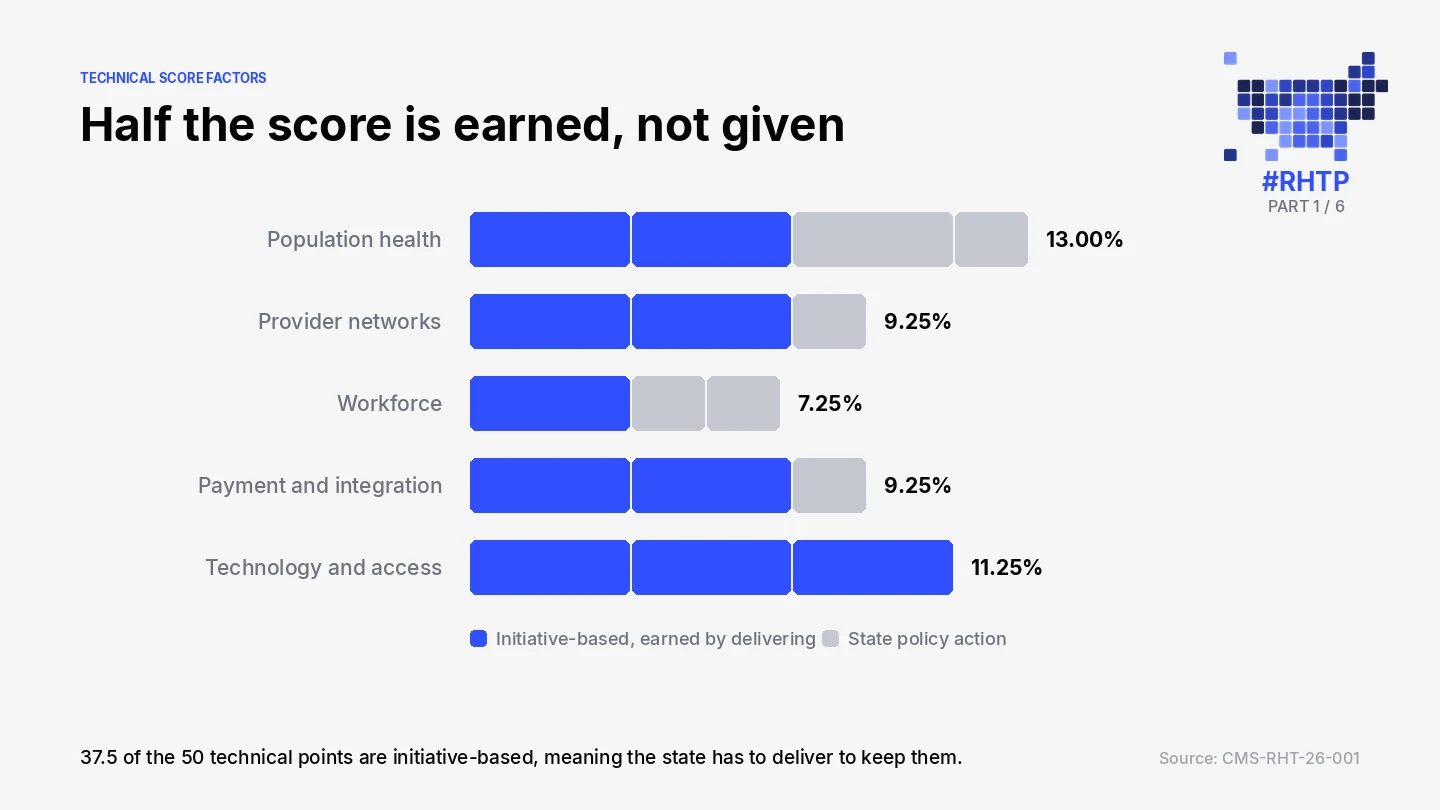
How Rural Health Transformation Program funding is scored
The eleven approved uses, the two halves of the $50 billion, and why your state's score is recalculated every year.
August 17, 2026
Who does what in the Rural Health Transformation Program
States, program consultants, subrecipients and aggregators. Where the money moves, and who actually builds.
August 17, 2026
Treat in place versus transport
Remote care and EMS are two of the highest weighted factors CMS scores. What the build actually involves.
August 17, 2026
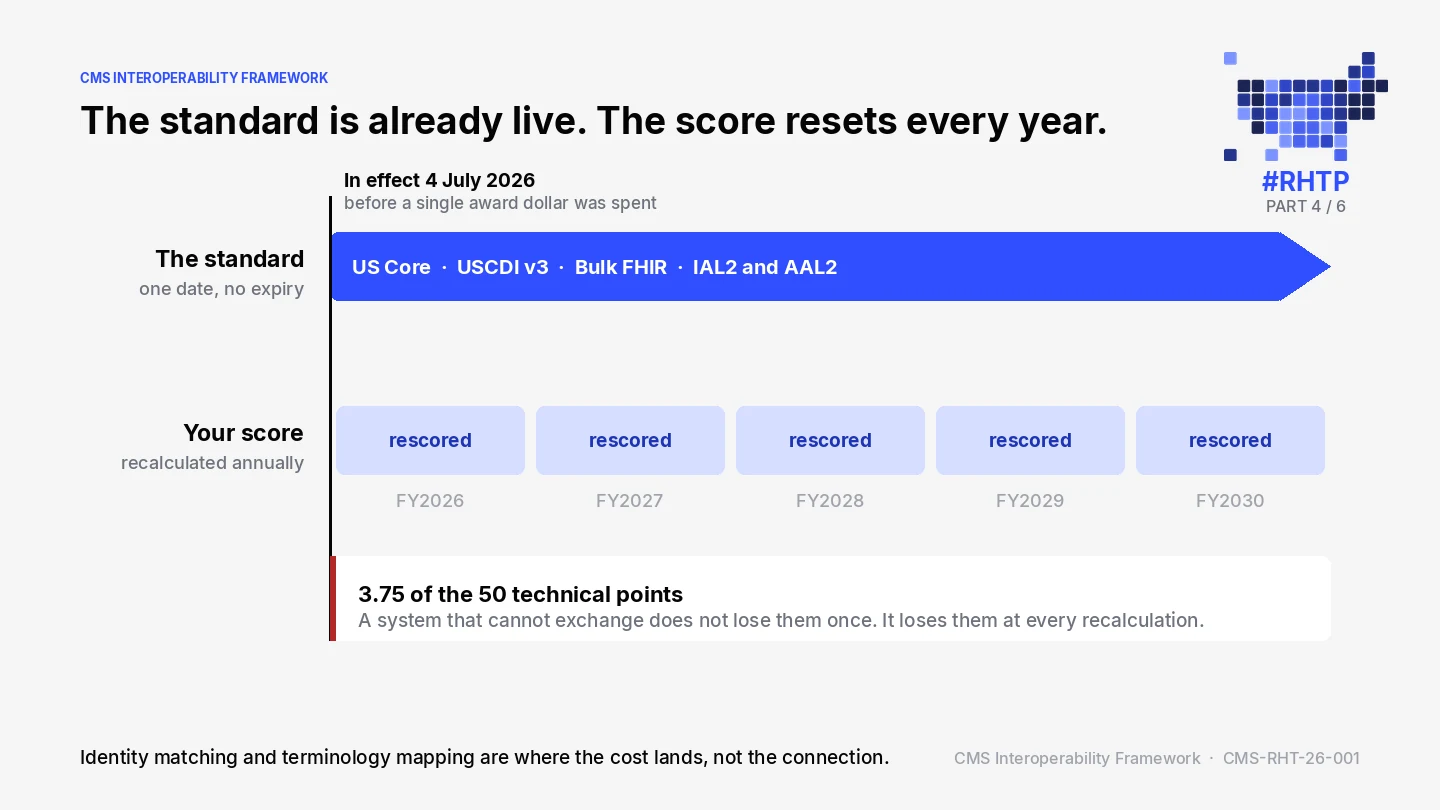
Interoperability is scored, so vendor agnostic is a requirement
A testable standard already in effect, what reaching a state exchange really costs, and what owning your data has to mean.
August 17, 2026
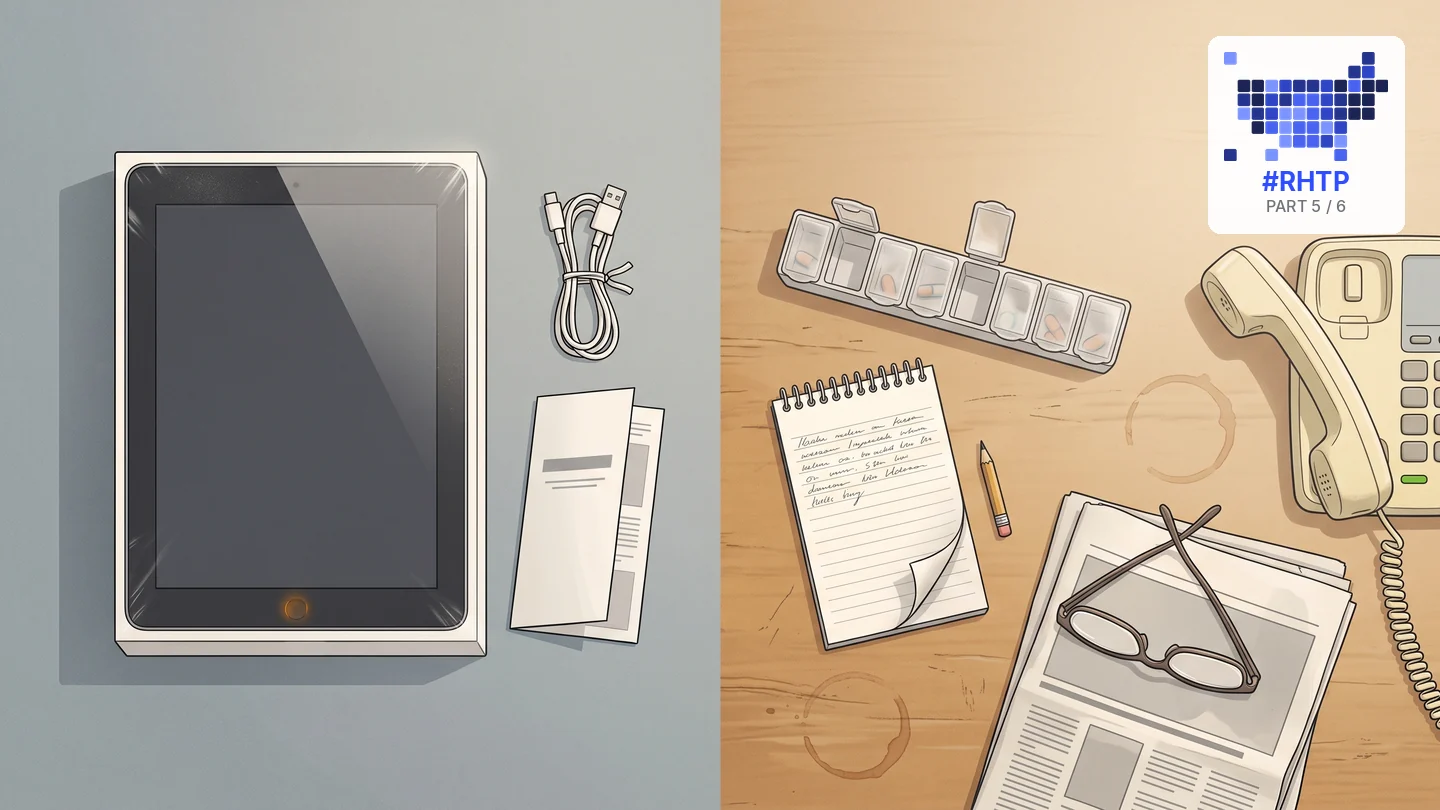
Why rural patients don't use the healthcare technology bought for them
Adoption is what earns the points, not purchase. Six reasons it fails, and the four decisions that change it.
August 17, 2026
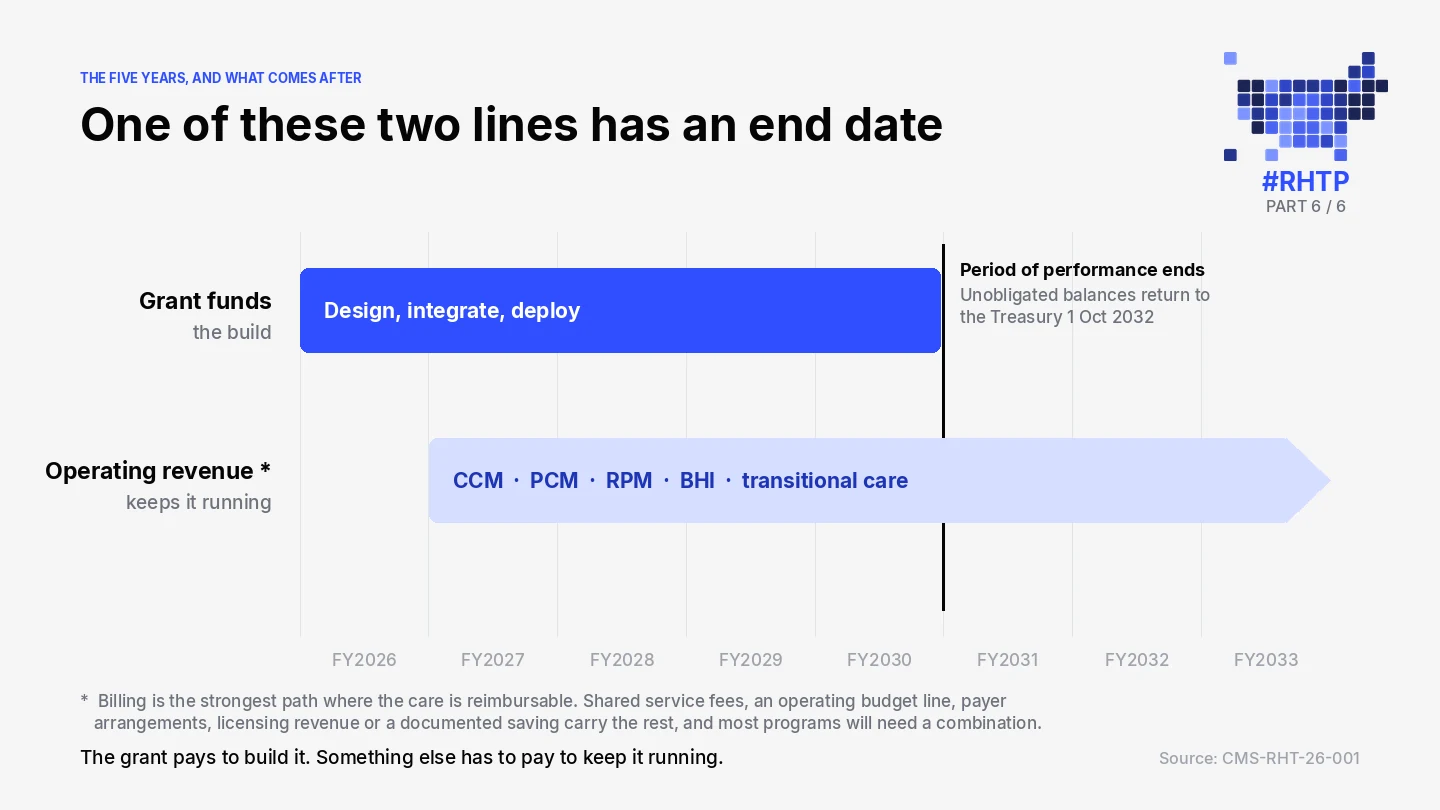
What happens when the RHTP money stops
Three ways it ends, the cost of ownership nobody budgets, and why the non-supplanting rule points at billing.
August 17, 2026
Discovery: understanding how care actually works before you build
A three-part series by Maria Ines Zelaya.
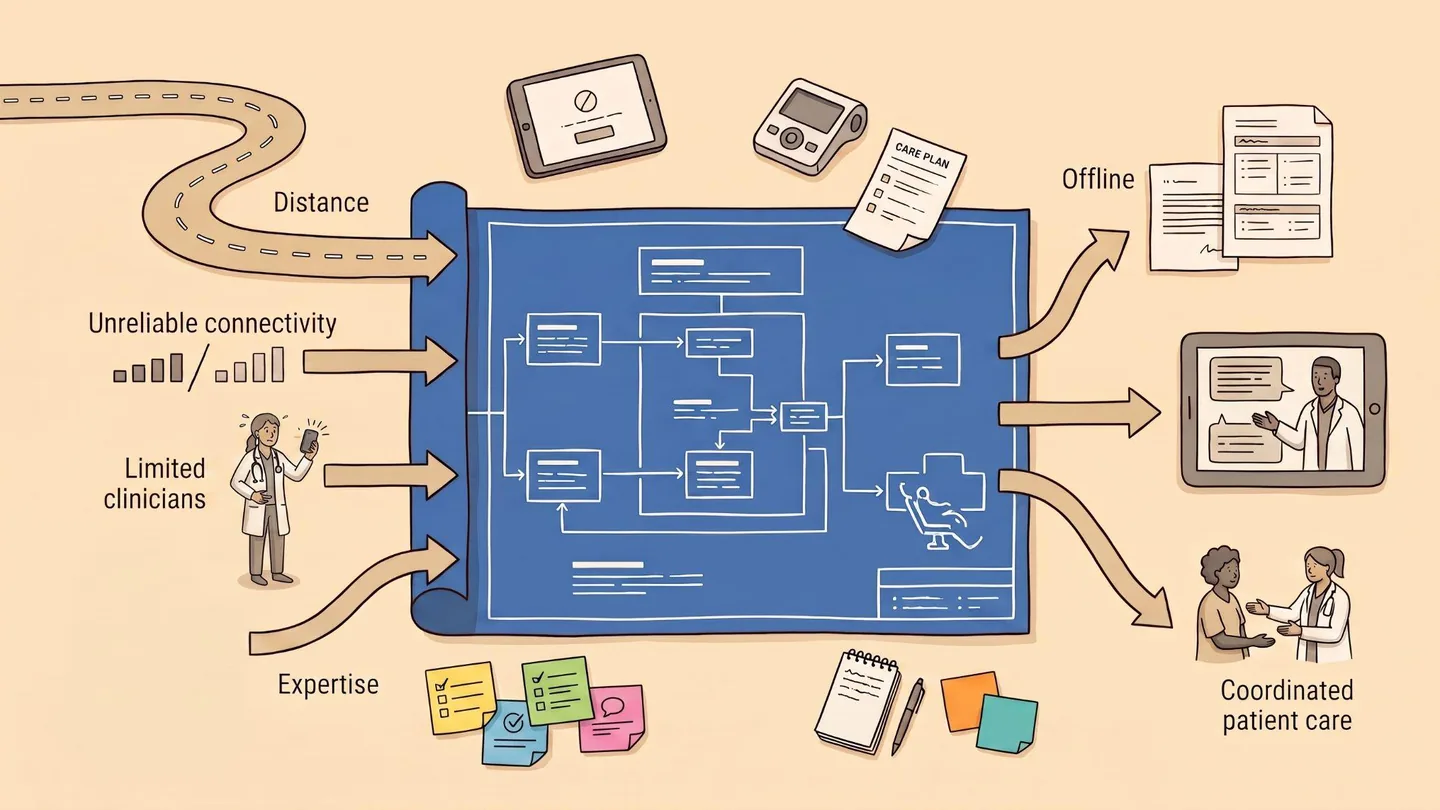
What would we build if we started with rural healthcare?
Five questions from our work in rural communities, from early warning to access to expertise.
September 23, 2026
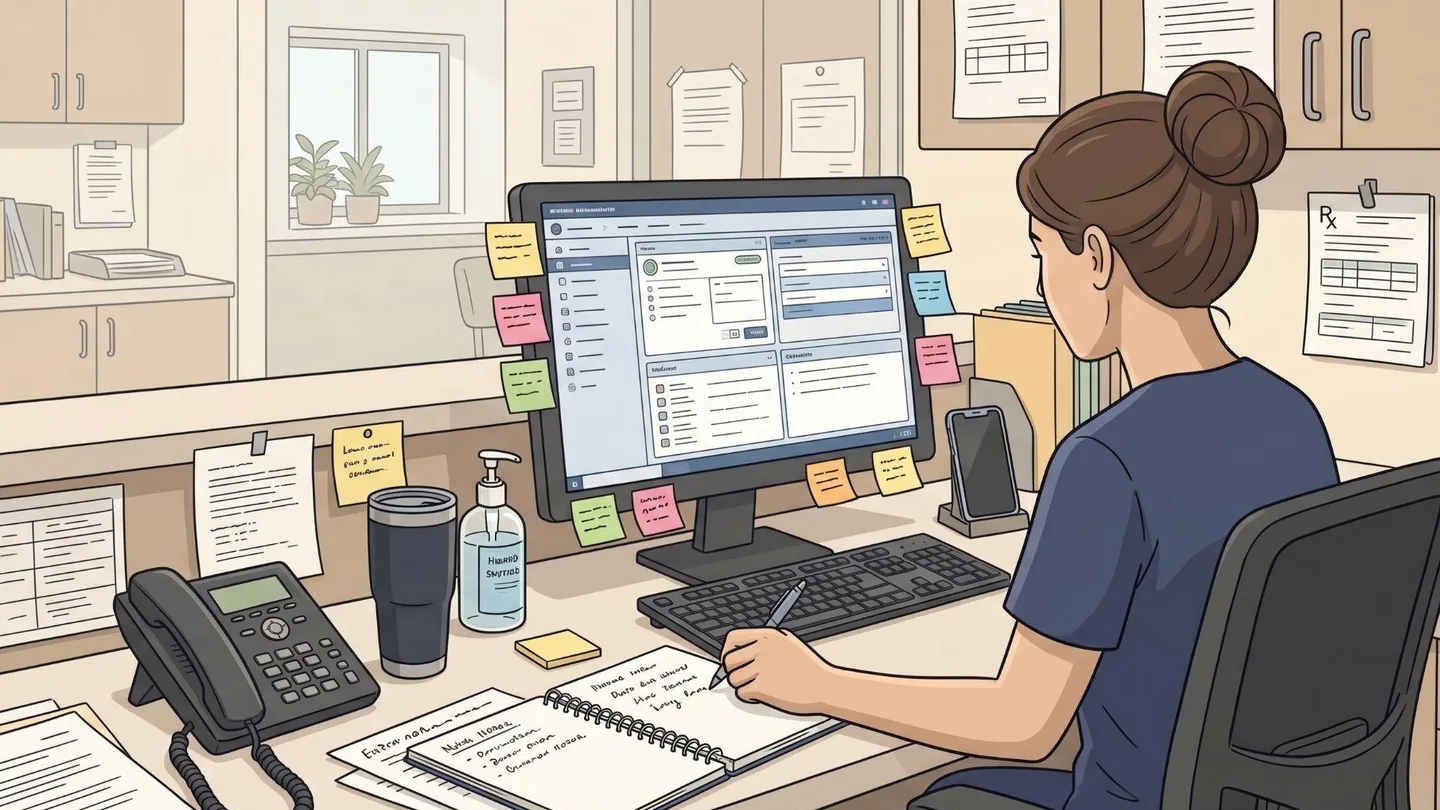
RHTP funding and discovery: understanding how care actually works before you buy technology
Your award describes outcomes. It does not describe software. What to settle before the money goes to technology.
September 23, 2026
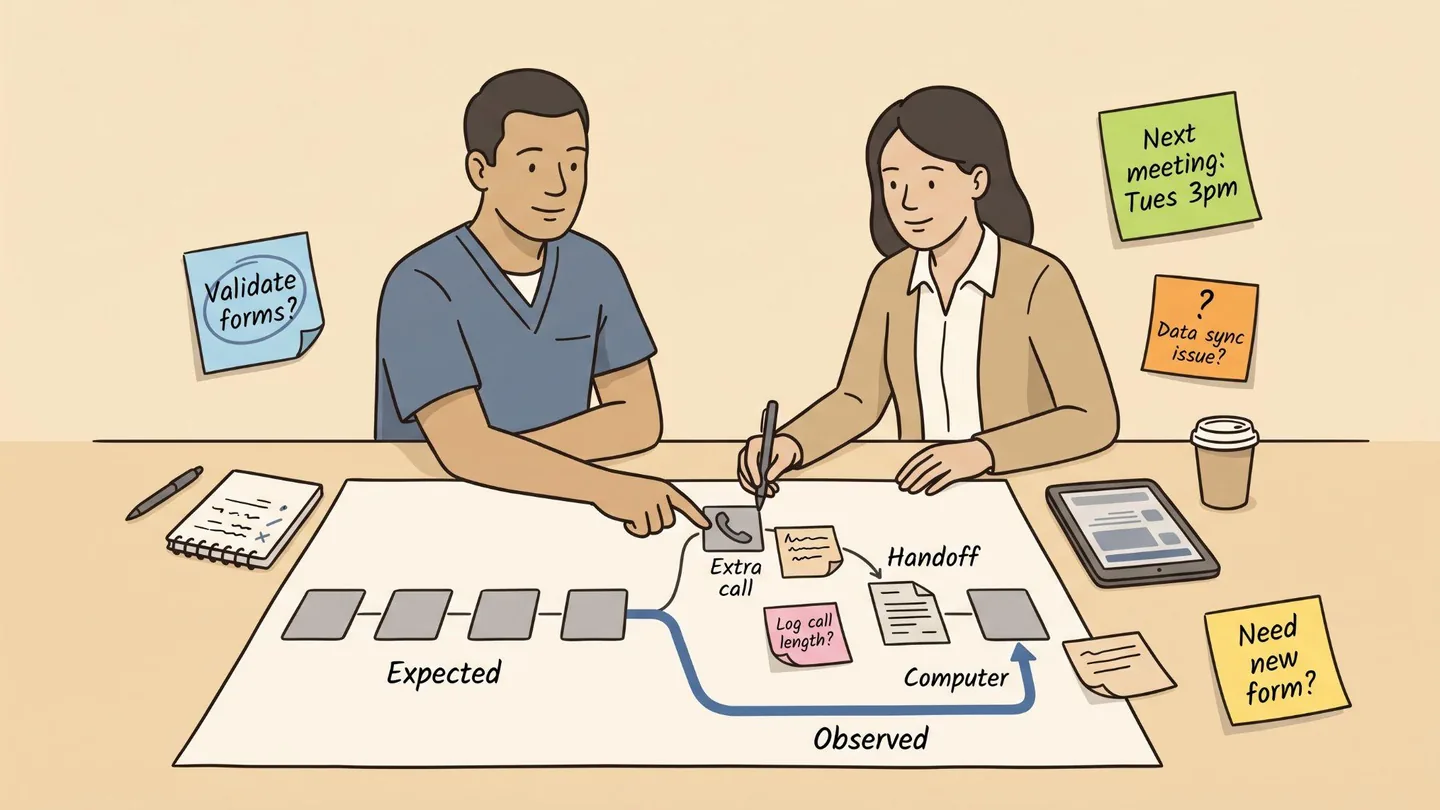
Discovery in rural healthcare: user research before you build
Observe care where it happens, prototype before you commit, and design for the conditions that actually exist.
September 23, 2026
Request a readiness review
Forty-five minutes against your own funded scope. We will tell you what we think is hard about it and what we would watch out for. No cost, no deck, and you keep the notes either way.
Request a readiness reviewNot ready to talk? Read the two-page partner brief, no form required.
Or call: 404.654.3855