
From Messy Data to Measurable Outcomes
10 steps from raw healthcare data to production insights. Our healthcare data analytics consulting and engineering services deliver unified data pipelines, operational visibility, and reporting automation with hard dollar ROI, not dashboards that collect dust.
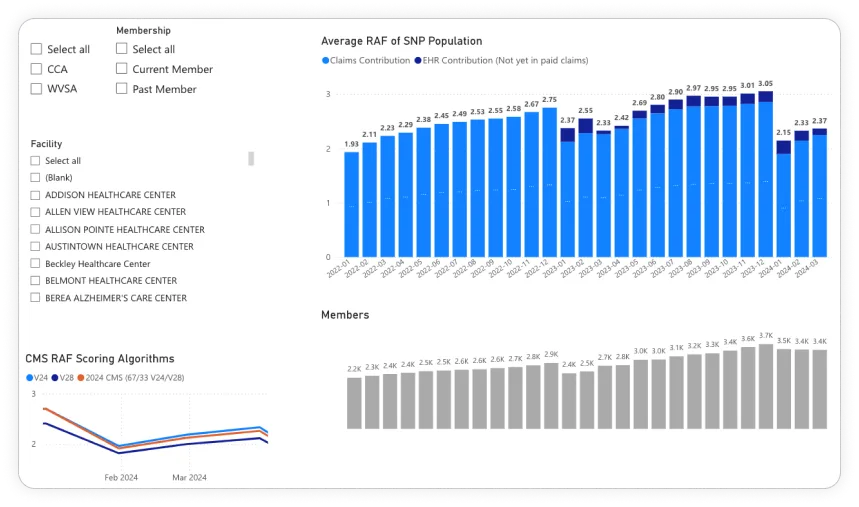
Data analytics and visualization platform for healthcare insights






Healthcare organizations are drowning in data they can't use.
Most healthcare providers have data scattered across dozens of systems: EHRs, claims platforms, billing software, lab systems, IoT devices, and operational databases. The result: clinical staff spending hours on manual reporting, revenue leaking through missed codes and preventable denials, and leadership making decisions without the data they need.
of healthcare data is unstructured, locked in clinical notes, faxes, and PDFs where traditional analytics can't reach it.
average number of separate data systems a mid-size health system must integrate for a complete patient and financial picture.
estimated annual revenue leakage at a typical multi-site provider from missed HCC codes, undercoded MDS assessments, and preventable claim denials.
per month spent by clinical staff on manual compliance reporting that could be automated with proper data infrastructure.
Healthcare Data Infrastructure
End-to-end data engineering solutions purpose-built for healthcare's complexity: from raw data ingestion to executive-ready analytics.

Data Aggregation
Unify data from EHRs, claims systems, medical devices, labs, and operational databases into a single source of truth. We normalize disparate formats, HL7, FHIR, CCDA, X12 EDI, and proprietary feeds, into clean, queryable datasets.
ETL Pipelines
Extract, transform, and load data reliably and at scale with automated pipelines built on Apache Airflow, Spark, and dbt. Both batch and real-time streaming for clinical and operational data flows.

Data Lakes & Warehouses
Scalable storage architecture for structured and unstructured healthcare data. We design medallion architectures (bronze/silver/gold) on AWS S3, Redshift, Snowflake, and Delta Lake, ready for analytics and AI.
Analytics & BI
Dashboards and reports that give stakeholders actionable insights in real time. Custom builds in Tableau, Power BI, or bespoke interfaces, connected to live data, not yesterday's export.
Real-Time Analytics
Stream processing for time-sensitive clinical and operational data. Real-time census tracking, bed management, staffing optimization, and clinical alerting, not batch reports that arrive too late.
Data Quality & Governance
Automated data validation, cleansing, and standardization pipelines. HIPAA-compliant access controls, audit trails, data lineage tracking, and PHI de-identification from day one.
Where Healthcare Data Engineering Creates Value
RAF/HCC Code Mining
AI-assisted analysis of EHR and claims data to identify missed diagnosis codes and optimize risk adjustment scores. We recovered $2.4M+ in compliant revenue for one client.
Data Normalization
Standardize data from EHRs, claims, labs, and devices into consistent, analytics-ready formats using HL7 FHIR and CCDA standards. Critical for organizations running multi-EHR environments.
SDOH Visualization
Transform social determinants data into interactive population health maps and dashboards. Built for Duke Health's SDOH research program.
Compliance Reporting
Automated cross-platform reporting for CMS, HEDIS, MIPS, and state regulatory requirements. Eliminate the manual spreadsheet cycle that drains clinical staff hours every quarter.
Population Risk Stratification
Segment patient populations by risk level using predictive analytics to prioritize interventions, allocate resources, and improve value-based care performance.
Claims Analysis & Denial Prevention
Identify denial patterns, revenue leakage, and revenue cycle optimization opportunities. Proactive denial prevention powered by payer-specific intelligence.
See how data engineering recovered $2.4M in missed RAF codes.
Read the Case Study →Data Engineering in Production
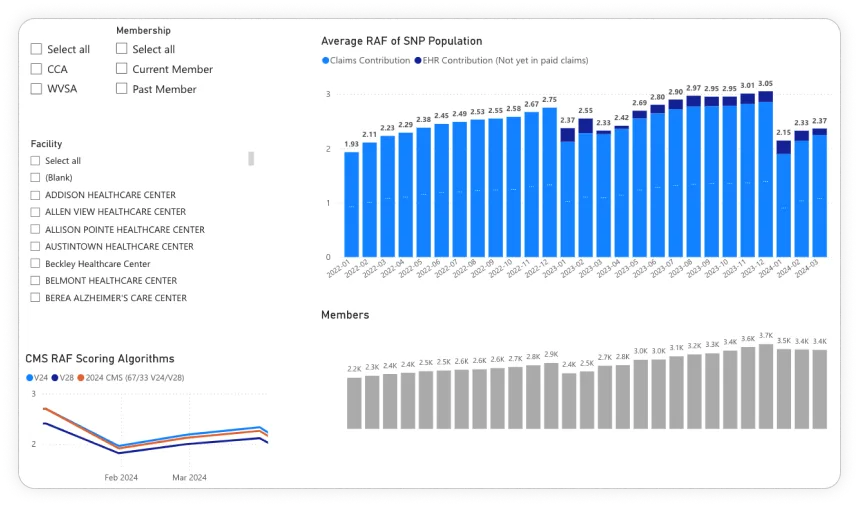
RAF Score Optimization with Data Engineering
Built data pipelines that analyze EHR and claims data to identify missed HCC codes, ensure accurate RAF scores, and capture chronic conditions.
Revenue Impact
Missed Code Detection
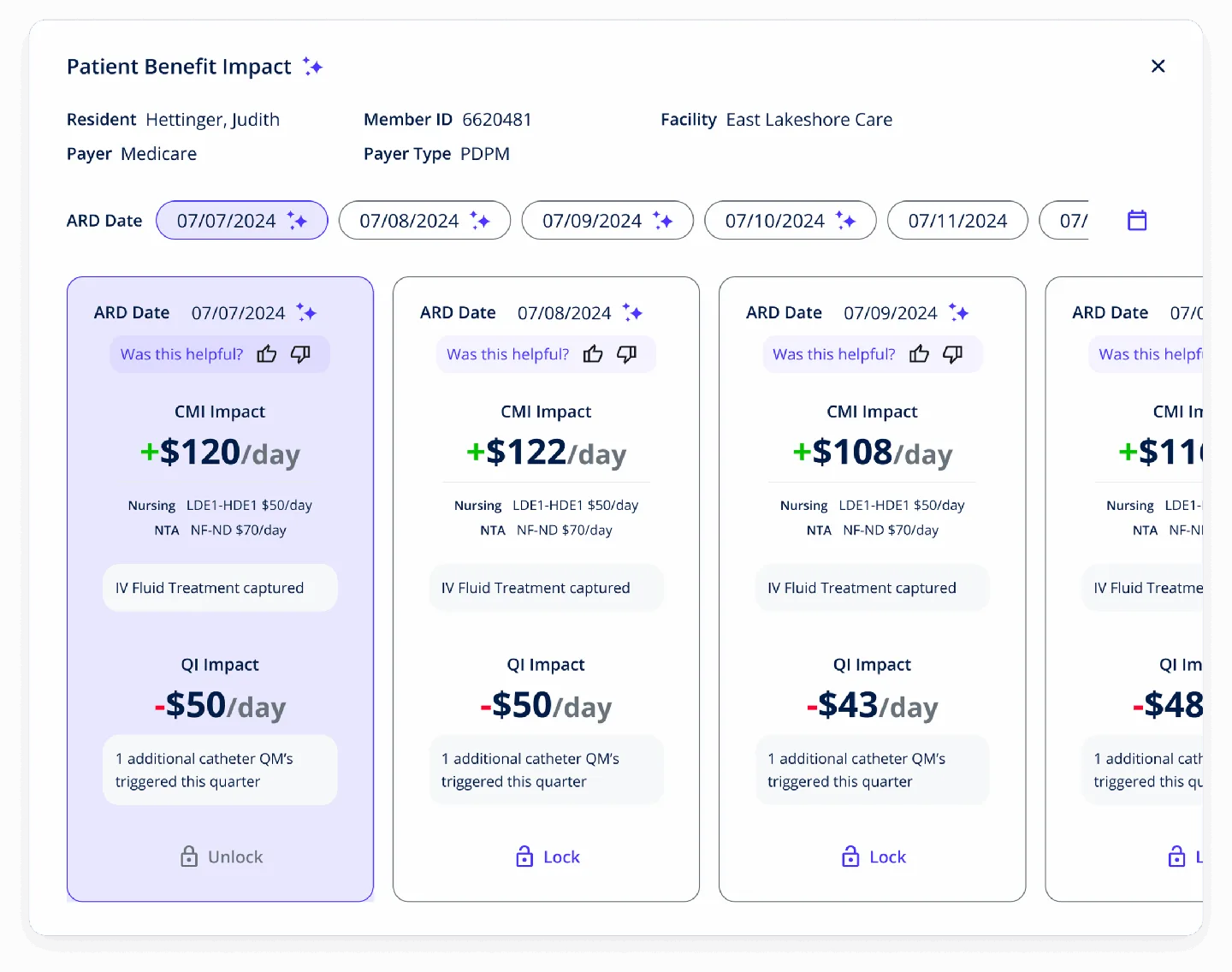
MDS/PDPM Revenue Optimization
AI-powered MDS coding optimization for one of the nation's largest post-acute care providers.
PDPM Revenue
Quality Incentives
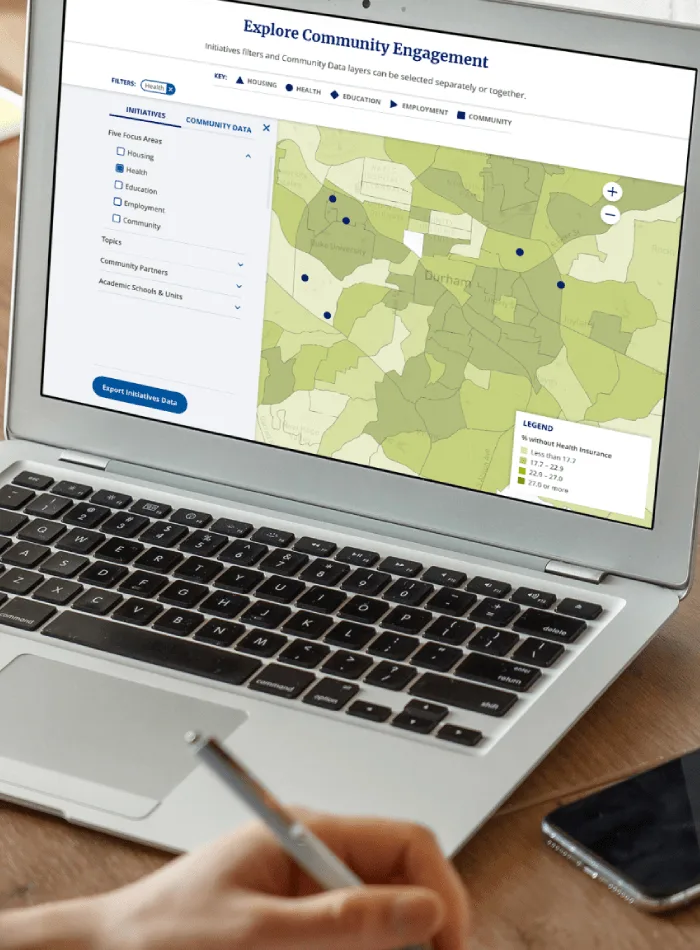
Duke Health SDOH Research Platform
Interactive SDOH data visualization platform and customized CRM helping Duke Health strengthen community partnerships and target interventions.
View Case Study →From Data Chaos to Insights in 8 Weeks
Phase I
Discover
What data do we have?
Data Foundation
Audit every EHR, claims system, & database
Solution Design
Map gaps, quality issues, & ROI opportunities
Phase II
Experiment
Does the pipeline work?
Hypothesis & Scope
Architecture design, ETL mapping, KPI definition
Build & Validate
Prototype pipeline tested on your data
Phase III
Engineer
Make it real.
Pipeline Development
Production ETL, validation, error handling
Systems Integration
EHR connectors, data lake, warehouse layers
Dashboard & BI
Analytics connected to live, validated data
Production Deploy
Phased rollout with stakeholder validation
Phase IV
Optimize
Make it better.
KPI Accountability
Measure outcomes, prove ROI, expand sources
Continuous Improvement
Advanced analytics, AI, team training (BOT)
We're not learning healthcare on your dime.
We've built and operated healthcare AI in production. This is a regulated space, HIPAA, EHR integrations, CMS requirements, and we deliver the complete value chain.
10+ Years Building AI
One team, concept to scale. We deliver all 10 steps from messy data to measurable outcomes.
Calendar Year ROI
Hard dollar returns, not experiments. $10M+ PDPM. $10M+ RAF. 45 min → 5 min documentation.
Senior US Team, AI-Accelerated
US-based senior architecture and development, amplified by AI for throughput and quality. Same timezone, HIPAA-compliant.
EHR Integrations
PointClickCare, Epic, Gehrimed
Partners, Not Vendors
Co-creation model
End-to-End Support
Build-Operate-Transfer
Learning Systems
Your data = your moat
"I have worked with many technology teams during my career, and Digital Scientists is one of the best. They take the time to understand the customers' needs, deliver innovative solutions, are always professional, and work with your team as a true partner to achieve success."
Amy Severino
Chief Innovation Officer, CommuniCare Health Services
Built on Production-Grade Infrastructure
Our healthcare data engineering teams work across the full modern data stack, selecting the right tools for each client's scale, compliance requirements, and existing infrastructure.






Data Processing & Orchestration
Apache Airflow, Apache Spark, dbt, AWS Glue, Python, SQL
Storage & Data Platforms
AWS S3, Amazon Redshift, Snowflake, Delta Lake, PostgreSQL
BI & Visualization
Tableau, Power BI, custom React dashboards, Metabase
Healthcare Standards
HL7 FHIR, CCDA, X12 EDI, ICD-10, CPT, SNOMED CT
Cloud & Infrastructure
AWS (primary), Azure, HIPAA-compliant hosting, VPC isolation
EHR Integrations
PointClickCare, Epic, Gehrimed, custom API connectors
Ready to unlock your healthcare data?
30-minute call. No pitch. Just honest assessment of what's possible for your organization.
Or call: 404.654.3855
Data Governance & PHI Security
Healthcare data requires rigorous governance. We build data infrastructure with HIPAA compliance, access controls, audit trails, and data lineage tracking from day one.
Learn more about our security approach →
Data Analytics Works Best With
Healthcare AI Development
Turn your data infrastructure into AI-powered clinical and operational intelligence.
Predictive Analytics
Risk stratification, readmission prediction, and clinical outcome forecasting.
EHR Integrations
Bidirectional data flow with PointClickCare, Epic, Gehrimed, and custom EHR systems.
Population Health
Data-driven population health management, care gap identification, and outcomes tracking.
Revenue Cycle AI
AI-powered denial prevention, claims optimization, and revenue integrity.
Interoperability
HL7 FHIR, CCDA, and custom APIs for seamless data exchange across systems.
Related Insights
From Our Blog


Common Questions About Healthcare Data Analytics
What is healthcare data analytics?
Healthcare data analytics is the practice of collecting, integrating, and analyzing data from clinical, financial, and operational systems to improve patient outcomes, reduce costs, and optimize operations. It spans everything from basic reporting dashboards to advanced predictive models that identify at-risk patients or forecast revenue impact. The foundation is data engineering, building the pipelines and infrastructure that make analytics possible at scale.
How long does it take to build a healthcare data pipeline?
Our process moves from discovery to production insights in approximately 8 weeks. The first two weeks focus on data source auditing and architecture design. Weeks 3-6 cover pipeline development, data loading, and dashboard creation. Weeks 7-8 are validation and launch. Complexity varies based on the number of source systems, data volume, and compliance requirements, but we prioritize getting actionable insights into stakeholders' hands quickly.
What's the ROI of healthcare data engineering?
Our clients have achieved $20M+ in verified ROI from healthcare data engineering projects. Specific examples include $2.4M+ in compliant revenue recovery from RAF/HCC code mining, $10M+ in PDPM optimization, and 45-minute clinical documentation workflows reduced to 5 minutes. The key is targeting high-impact use cases first, missed diagnosis codes, preventable claim denials, and manual reporting bottlenecks, where data engineering delivers hard dollar returns within the first calendar year.
What healthcare data standards do you support?
We work across the full spectrum of healthcare data standards: HL7 FHIR for modern API-based interoperability, CCDA for clinical document exchange, X12 EDI for claims and eligibility transactions, and standard medical coding systems including ICD-10, CPT, SNOMED CT, and LOINC. Our interoperability solutions ensure your data infrastructure can communicate with any system in the healthcare ecosystem.
How do you ensure HIPAA compliance in data pipelines?
Security is built into our data infrastructure from day one, not bolted on after the fact. Every pipeline includes encryption at rest and in transit, role-based access controls, comprehensive audit trails, data lineage tracking, and PHI de-identification capabilities. We deploy on HIPAA-compliant cloud infrastructure with VPC isolation. Learn more about our security approach.
What's the difference between a data lake and a data warehouse?
A data lake stores raw data in its original format, structured, semi-structured, and unstructured, at low cost and massive scale. A data warehouse stores cleaned, structured data optimized for fast queries and reporting. In healthcare, you typically need both: a data lake to capture the full breadth of clinical, claims, and operational data, and a data warehouse (or lakehouse) to serve analytics and BI dashboards. We design medallion architectures that combine the best of both approaches.
Can you integrate with our existing EHR system?
Yes. We have production integrations with PointClickCare and Gehrimed on platforms we operate. Epic is integrated in an R&D environment. For Cerner, MatrixCare, and other systems we integrate via HL7 FHIR APIs, ADT feeds, and custom data exchange, and we can build custom connectors for any EHR or practice management system with an API or data export capability. Our EHR integration approach focuses on bidirectional data flow, pulling data for analytics while pushing insights back to the clinician's workflow where they can act on them.