
Quality measures: HEDIS, Stars and SNP reporting
Digital Scientists builds the data work behind quality programs: HEDIS supplemental data feeds, NCQA Special Needs Plan Model of Care reporting, and MDS quality measures with Five-Star tracking. For CommuniCare we extracted HEDIS MY2023 supplemental data against NCQA measure specifications and mapped care management workflows to the SNP Model of Care. We don't replace your certified HEDIS engine; we feed it clean data and build the reporting around it. Most plans start with a 4-week assessment or a Blueprint.
Updated

HEDIS supplemental data extracted for CommuniCare
Recovered to date on CommuniCare's MDS platform
Forecast PDPM revenue on the same platform
Systems audited for CommuniCare Advantage



Can you build HEDIS supplemental data feeds?
Yes. We extracted HEDIS MY2023 supplemental data for CommuniCare against NCQA measure specifications, pulled from the clinical systems where the evidence actually lives. The certified engine calculates the measures; we make sure the right data reaches it.
HEDIS, the Healthcare Effectiveness Data and Information Set, is NCQA's standard set of plan quality measures. Supplemental data is the clinical evidence, such as a lab result or a screening note, that claims alone miss. Most gap closures that slip past year end were documented somewhere; nobody got the record into the feed.
The work is mostly data: building the member universe for each measure, mapping source fields to the specification, matching members across EHRs, and generating evidence packages an auditor can trace back to the source. This is one piece of what we build for health plans and Medicare Advantage plans.
What we do and don't do for HEDIS
| Work | Status | Where it comes from |
|---|---|---|
| Supplemental data extraction against NCQA measure specifications | Delivered | CommuniCare, HEDIS MY2023 |
| Member universe and cohort construction for plan reporting | Delivered | CommuniCare plan reporting |
| Evidence packages in HTML and PDF, generated from source data | Delivered | CommuniCare compliance reporting |
| Chart abstraction support: chart evidence pre-pulled and linked for abstractors | Capability | Built on the evidence linking we delivered for risk adjustment |
| Certified measure calculation and NCQA audit submission | Not us | Your certified HEDIS engine and your auditor |
Status is what we have delivered for a named client, or capability we have not yet run for HEDIS.
Can you map our care management workflows to the SNP Model of Care?
Yes. For CommuniCare, a Medicare Advantage special needs plan, we mapped care management workflows to the NCQA SNP Model of Care and generated the documentation from the work itself, not from a template.
The Model of Care is the plan's written description of how it serves its special needs members: who they are, how care is coordinated, which providers are in the network and how quality is measured. CMS approves it and NCQA reviews it, so every claim in it has to point at a real workflow.
Workflow maps as code
Care management workflows drawn as diagrams under version control, so the map changes when the process does.
Mapped to the factors
Each step tied to the Model of Care element it satisfies, so gaps show up before a reviewer finds them.
Documents generated, not retyped
Google Docs, HTML and PDF built from the source diagrams and data, served on a protected site for the team.
Universe reports from one source
The same data mart that fed CommuniCare Advantage's CMS Universe Report, so audit numbers match the dashboards.
Can software track MDS quality measures and Five-Star impact before the assessment closes?
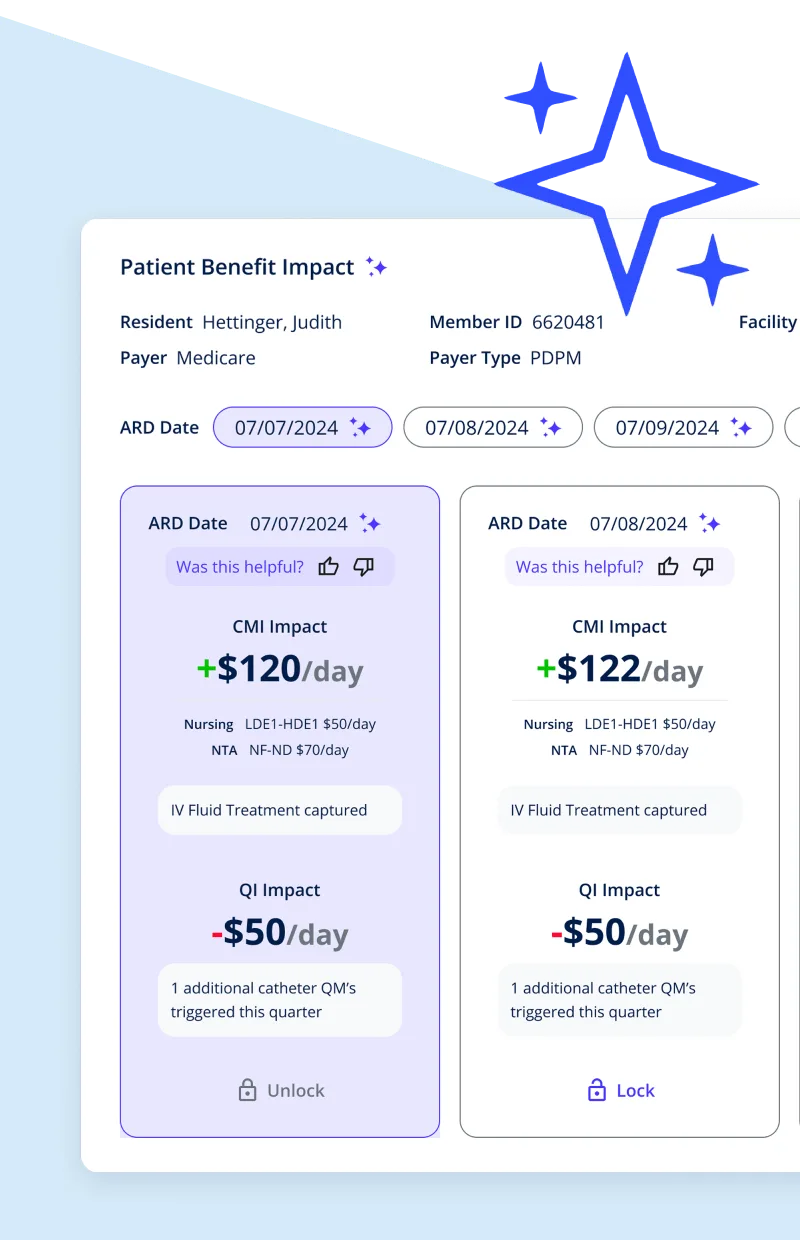
Yes. The MDS platform we built for CommuniCare tracks quality measures in real time, with numerators, denominators and Five-Star points for short-stay and long-stay residents, and shows coordinators how a decision affects both payment and quality.
MDS quality measures come from the Minimum Data Set assessments every skilled nursing facility files with CMS, and they drive the quality domain of the Five-Star rating. When a coordinator compares Assessment Reference Dates, the platform shows the effect on case mix, payment and quality measures side by side. Events that touch a quality measure are prioritized by urgency and look-back window.
The platform runs on PointClickCare data and has recovered $10M+ to date, with $24M+ in forecast PDPM revenue. We built it from April 2024 and handed it to CommuniCare's own team on a build-operate-transfer plan. See MDS and PDPM.
Recovered to date
Forecast PDPM revenue
Quality measures tracked in real time
Clinical triggers scanned
Where does quality data come from, and how do you make it hold up?
From the clinical and operational systems you already run, matched to one record per member. We integrate with any system that has an API, a standard interface or a reliable export, and we've run PointClickCare and Netsmart (GEHRIMED) data in production.
The hard part is rarely the measure logic. It's the member who shows up under two Medicare Beneficiary Identifiers in two EHRs, or a field that means one thing in the data dictionary and another in practice. At CommuniCare we built cross-EHR patient matching before any report was trusted. Every number traces back to its source row, so a reviewer can follow it. See healthcare data engineering.
The output goes where your team already works: a file for the certified engine, an evidence package for the auditor, a dashboard for the quality lead. When a source changes, the pipeline flags it before the numbers drift.
Clinical sources
PointClickCare, Netsmart (GEHRIMED), lab and claims files
Measure specifications
NCQA HEDIS, NCQA SNP Model of Care, CMS MDS quality measures
Matching
Cross-EHR member matching across MBIs and source IDs
Outputs
Supplemental data files, evidence packages, Power BI and web dashboards
Quality and reporting work
CommuniCare Health Services
$10M+ recovered to date; $24M+ forecast PDPM revenue
An MDS platform on PointClickCare data that tracks quality measures and Five-Star impact for coordinators. Built from April 2024, then handed to CommuniCare's own team.
See the work
CommuniCare Advantage
Back to CMS compliance in under six months
A Medicare Advantage special needs plan: an audit of 60+ systems, an 11-vendor EHR selection, then a data mart and Power BI reporting, including the Universe Report for CMS audits.
See the work
Congruity Health
7,020 patients tracked
A population health analytics platform built on claims and eligibility data, with enrollment and intervention dashboards. The same measure-and-dashboard pattern quality teams need.
See the workTrusted by healthcare leaders.
“Digital Scientists provided immense value to our plan administrators, providers, and patients. The team was able to come in and understand our core needs, while remaining product agnostic. They helped identify the technical debt and pitfalls, and to get us to a point of stabilization and growth.”

Robert Hager
CEO, CommuniCare Advantage
“The team at Digital Scientists was a huge help in not only developing our analytics platform, but understanding the competitive space and defining our true value proposition for our customers.”

Justin Davis
CEO, Congruity Health
Where should a plan or provider start on quality reporting?
With one paid, time-boxed step that ends in a decision. Which one depends on whether the problem is the data, the reporting or a tool that doesn't exist yet.
You own what each step produces: the maps, the data model, the code. Most quality work starts with the data, because a measure can't be right until the sources behind it are connected and matched.
CommuniCare Advantage started the same way: an audit and a data map before any build. That work became the data mart behind its CMS Universe Report, and the quality reporting followed. Every step is scoped before it starts, and you find out in a few weeks, on real work, whether we're the right team.
Common starting points for quality reporting
| What's usually true | Common first step | What you get | Time and investment |
|---|---|---|---|
| Quality data sits in several systems and nobody trusts the numbers. | Blueprint | System inventory, data flow maps and ranked gaps, ending in a phased plan with a budget. | 4 or 6 weeks. $25K, or from $50K with a working prototype |
| A new tool to build: supplemental data feeds, a Model of Care workflow or a quality dashboard. | Blueprint | Scope, architecture, compliance requirements, user stories and a milestone budget. | 4 or 6 weeks. $25K, or from $50K with a working prototype |
| You already know the first feed or report. | Build with Us | A senior solution architect working in your systems on that piece of work. | $10K for two weeks, then $20K a month |
These are common starting points, not rules. See all ways to start.
Related work
Health plans and payers
Software for Medicare Advantage plans, SNPs and ACOs.
Health plans and payers →MDS and PDPM
Assessment recommendations for MDS coordinators on PointClickCare data.
MDS and PDPM →RAF and HCC coding
Risk adjustment AI with every code linked to the chart.
RAF and HCC coding →Healthcare data engineering
Clean feeds, patient matching and data marts auditors accept.
Healthcare data engineering →Value-based care
Analytics and tools for ACOs and risk-bearing groups.
Value-based care →Latest thinking



Questions about quality measure reporting
Can you build supplemental data feeds?
Yes. We extracted HEDIS MY2023 supplemental data for CommuniCare against NCQA measure specifications. We map your clinical sources to each measure, match members across systems, and produce files your certified HEDIS engine accepts, with evidence an auditor can trace back to the source record.
Do you replace our certified HEDIS engine?
No. Measure calculation and NCQA audit submission belong to your certified engine and your auditor. We build what sits around it: the supplemental data feeds that reach it, the member universe behind each measure, and the reporting and dashboards your quality team works from.
Do you work with special needs plans?
Yes. CommuniCare Advantage is a Medicare Advantage special needs plan. We audited its 60+ systems, built the reporting that brought it back to CMS compliance in under six months, and mapped care management workflows to the NCQA SNP Model of Care.
Can you help skilled nursing facilities with MDS quality measures and Five-Star?
Yes. The MDS platform we built for CommuniCare tracks quality measures in real time with numerators, denominators and Five-Star points, and shows how an assessment decision affects both payment and quality. It has recovered $10M+ to date, with $24M+ in forecast PDPM revenue.
Can you help with chart abstraction?
We build the tooling, not an abstraction service. For risk adjustment we built an engine that links every suggested code to the chart evidence behind it, and the same approach pre-pulls evidence for HEDIS abstractors so they confirm rather than search. Your abstractors still make every call.
How do you handle member and resident data?
We sign a BAA before we touch PHI. Each client gets a security plan mapped to NIST CSF 2.0 and a security addendum, with encryption, access controls and audit logging designed in from the start. Data stays in your environment.
Talk it over
Tell us what you are trying to do. A senior person from our Atlanta team replies within one business day, and you can book a 30-minute call right after you send this.
- We tell you if we're the right fit, and if we're not, who is.
- Most work starts small, so you see how we work before you commit to more.
- We sign a BAA before we touch patient data.