
Healthcare integration services that connect systems that weren't built to talk
Digital Scientists connects systems that weren't built to talk to each other. In shipped work we've connected 40+ named systems: PointClickCare and Netsmart (GEHRIMED) with patients matched across both, Tebra, Salesforce, Stripe behind 20M+ GoFan tickets, Twilio, SendGrid, Zoom and AWS Chime, BigQuery, and hardware from OBD-II trackers to OR monitors. Each connection runs with retries, monitoring and an audit trail, under a BAA wherever patient data moves. Most integration work starts with a week-one check of access, data and vendor terms.
Updated
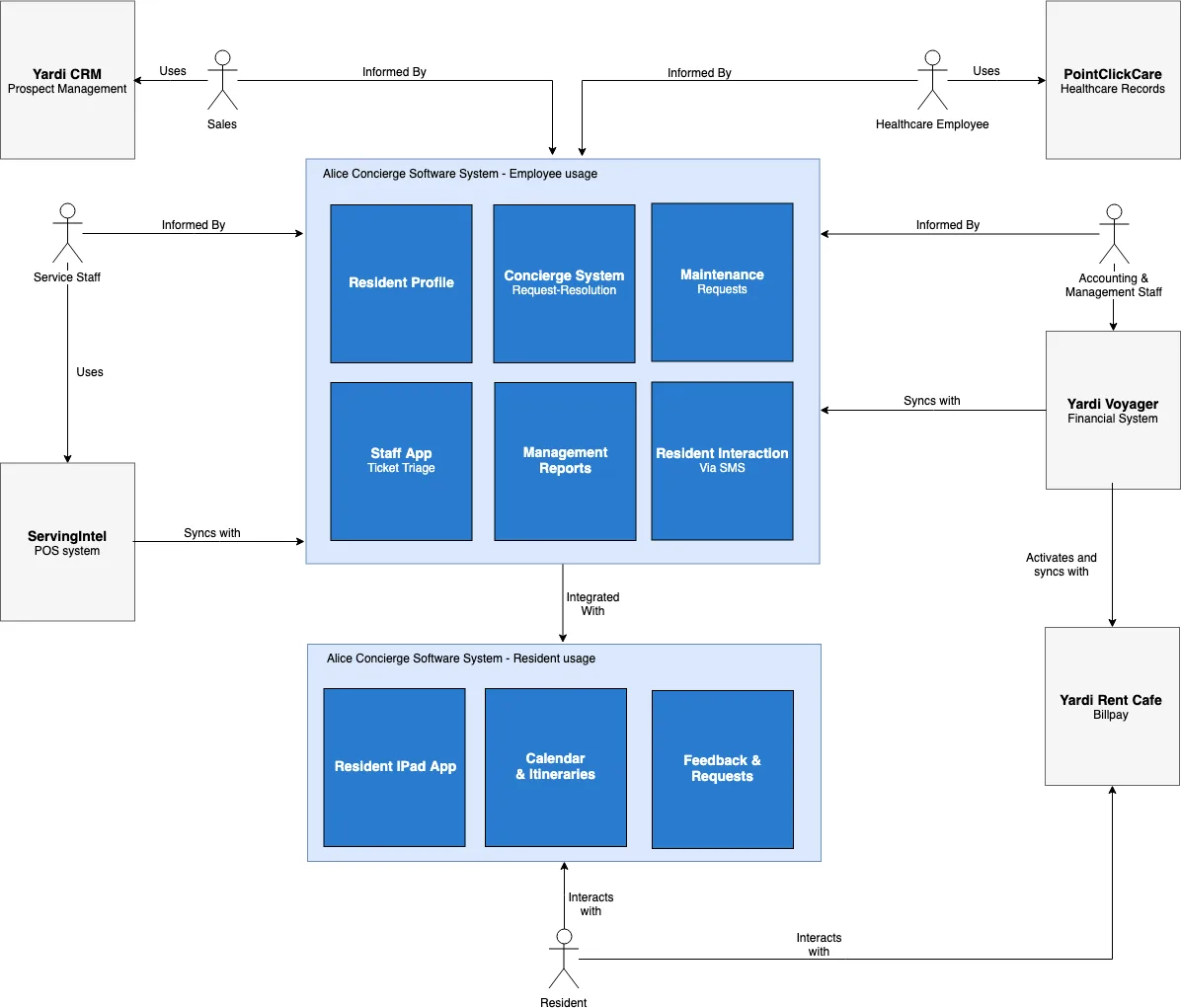
Named systems connected in shipped work
Patients on NeverAlone, with PointClickCare and Netsmart data
Tickets sold through the Stripe checkout we built for GoFan
RAF improvement from EHR and claims data
Which healthcare systems have you connected?
EHRs, claims feeds and the CRMs around them, in production. Nobody has worked with every healthcare system, so we list what we've shipped and say plainly what's still in test.
For CommuniCare we pull PointClickCare and Netsmart (GEHRIMED) data into the platforms we run, and we built the crosswalk that matches the same patient across both EHRs, including patients who showed up with more than one Medicare ID. The same PointClickCare data feeds the MDS work: $10M+ recovered to date and $24M+ in forecast PDPM revenue.
The EHR we built for Fathers' UpLift syncs with Tebra's SOAP API for demographics, claims and charge capture, so Tebra stays the billing system of record. For Congruity Health we take in TPA claims and eligibility files over FTPS and send intervention triggers into Salesforce, both ways.
Two edges, stated plainly. Epic so far is a test patient pulled from Epic's FHIR sandbox. Our FHIR R4 gateway on HAPI FHIR for Kipu is built and tested, and waiting on a partner's production credentials.
PointClickCare
SNF EHR data, in production
Netsmart (GEHRIMED)
Patients matched to PointClickCare
Acclivity
Data behind risk adjustment
Tebra
SOAP API: demographics, claims, charges
TPA claims and eligibility
Files over FTPS for Congruity Health
Salesforce
Intervention triggers, both ways
Epic
FHIR sandbox, test only
Kipu via HAPI FHIR R4
Built and tested, awaiting credentials
What does a hard healthcare integration look like in production?
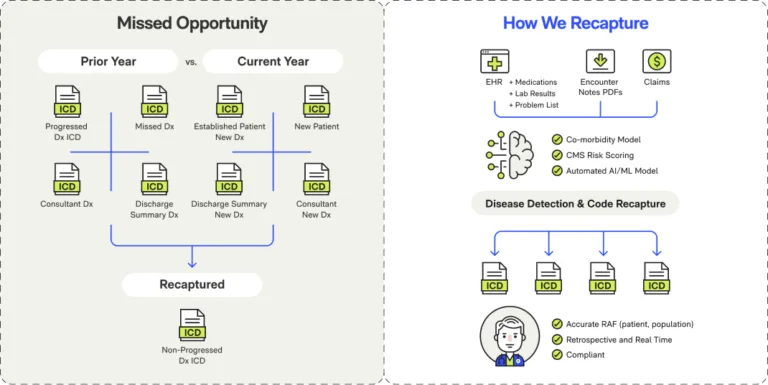
Risk adjustment for CommuniCare. The AI works because the data reaches it: diagnoses, assessments, medications, progress notes, lab results and claims for 20K+ patients.
We moved the source data from an on-premises database to AWS, matched patients across PointClickCare and Netsmart (GEHRIMED), and kept every suggested code linked to the record it came from. Coders accept or change each suggestion, and the model learns from physician feedback. The result is $10M+ in RAF improvement at 90%+ accuracy across 7 states and 245 providers.
The model was the easy part. Getting six data sources to agree on who each patient is took the real engineering. That's the work most integration projects underestimate.
RAF improvement
Accuracy
Providers in 7 states
What have you connected outside healthcare?
Payments, video, messaging, CRMs, cloud data services, hardware and the back-office systems companies already run. The same senior team does the healthcare work, so a Stripe checkout and an EHR sync get the same discipline.
Most of these systems were never meant to meet. Leica's Total Station had no iOS connection at all, so we rebuilt the link over Wi-Fi. As Leica Geosystems' product lead put it: “Our instruments natively do not talk to an iOS product, but we found a way through Wi-Fi.”
Every entry below links to the case study that proves it.
Payments and commerce
Stripe payments behind GoFan, the mobile ticketing MVP we built in 75 days that has since sold 20M+ tickets at 10,000+ schools. In-app purchases through IAPHUB across the Apple and Google stores for Kayo.
Communications
Twilio SMS, SendGrid email and native Zoom video inside the Fathers' UpLift EHR. AWS Chime video and Bandwidth E911 on NeverAlone. Twilio one-time codes for Kayo, and Slack digests from our AI agent platform.
CRM and marketing data
Salesforce, both ways, for Congruity Health. Clearbit contact and company enrichment for Mailchimp, released to production. CRM, property management and Vaultware data in one source of truth for Gables Residential.
Data, cloud and AI
AWS (EKS, S3, Aurora, IoT Greengrass), Google BigQuery, Cloud Spanner and Dataflow, Tableau, Segment, Amplitude, Auth0 and Firebase. OpenAI Whisper for HealthContext.AI, and Amazon Bedrock and Claude inside a client's own AWS account. See healthcare AI development.
Devices and hardware
Cox 2M's OBD-II tracker for Kayo. Wahoo's KICKR trainer over Bluetooth on 1,500+ in-store stations. Leica's Total Station over Wi-Fi for Safeload. A Bluetooth medication dispenser for Intent Solutions. OR monitors of any brand, read by an edge device, for Guardian.
Business systems and public data
Star Leasing's StarView over a secure VPN for roadside service. The MyUS.com JSON API through a gateway we co-built with their engineers. Medley's group-matching solver wrapped as a service. Shibboleth sign-on, the Scholars@Duke API and Mapbox for Duke's SDOH platform. SBIR.gov, SAM.gov and GitHub feeding our agent platform.
How do you build an integration that keeps working?
Five habits, from the first sprint, because we run what we build. Integrations rarely break on launch day. They break months later, when a vendor renames a field, a token expires or a file arrives empty.
- Mapping. Every field mapped from source to target against real sample data, not the spec, with an owner for each value. For CommuniCare that meant one crosswalk for patients carrying more than one Medicare ID.
- Permissions. Least-privilege credentials for each system, only the fields the workflow needs, and a BAA signed before we touch patient data. See security and PHI.
- Failure handling. Messages go through a queue. Failed calls retry with backoff, and anything that still fails lands where a person reviews it. On Star Leasing, photos upload separately from the service request, so a driver with weak signal still gets help.
- Monitoring. Alerts on errors, on volumes that fall to zero and on feeds that stop arriving. A missing file counts as a failure. Every read, write and change is logged with who, what and when.
- Ownership. The code runs in your cloud account and belongs to you. We provide L2 and L3 support on platforms we built and hand over with runbooks on a build-operate-transfer plan when you're ready.
Named systems connected in shipped work
OR monitor to phone on Guardian
NeverAlone live, and run by us since
Signed before we touch patient data
How do healthcare systems exchange data?
Through seven main channels. Each carries a different kind of data, and most organizations run several at once. Which ones a vendor actually supports is the first thing we check.
Healthcare interoperability is the ability of two systems to exchange data and use it without someone retyping it. Good healthcare interoperability solutions start from the channel each system really offers, not the one in the sales deck.
The table explains what each channel is for. It's a map of the methods, not a list of feeds we run; what we run is in the directory above. When a system offers more than one channel, we use the one its vendor documents and supports best. Many integrations end up mixing two: an API for live events and a nightly file for everything else.
The main ways healthcare systems exchange data
| Channel | What it is | What it carries | Where you meet it |
|---|---|---|---|
| HL7 v2 | Pipe-delimited messages, the oldest standard still in daily use | Admissions, discharges and transfers (ADT), orders, results, scheduling | Hospital and lab interfaces, usually through an interface engine |
| FHIR | An API standard built on web resources such as Patient, Encounter and Observation | Clinical records, payer data, and apps that launch inside the EHR (SMART on FHIR) | Certified EHR APIs, the payer APIs CMS requires, newer health tech |
| X12 | The HIPAA standard transactions for administrative data | Claims (837), remittance (835), eligibility (270/271), claim status (276/277), prior authorization (278) | Clearinghouses, payers and billing systems |
| NCPDP | The pharmacy industry's standards | Pharmacy claims (Telecommunication) and e-prescriptions (SCRIPT) | Pharmacies, PBMs and e-prescribing networks |
| Vendor APIs | A system's own REST or SOAP interface | Whatever the vendor exposes, often more than its FHIR endpoints | Most cloud EHRs, CRMs, telephony and practice management systems |
| Webhooks | The other system calls you when something changes | Events such as a new referral, a signed note or a finished call | Modern cloud platforms; near real-time workflows |
| SFTP and flat files | Scheduled files (CSV, fixed-width or X12) on a secure server | Bulk extracts, claims and eligibility files, reports | Payers, TPAs, older systems and anything without an API |
FHIR, HL7 and X12 are standards; each vendor implements a slice of them. See FHIR and HL7 integration and claims and X12 integration.
What happens in the week-one integration check?
Everyone thinks an integration is easy. We've seen simple ones take four months. So in week one we get access, pull real data and prove each connection before the build depends on it.
Access
Credentials, a sandbox, the vendor's partner or developer program, and who on your side signs off. Partner approvals often set the calendar, so we start them on day one.
Real data
A sample from your system, under a BAA. Field names in a spec and values in production are rarely the same thing, so we look at both.
The gaps
Which data the API exposes, what lives only in reports or exports, and where a person is the integration today, retyping between screens.
A plan
The channel for each system, the order to build them in, the risks we found and a written estimate. If a connection won't work, you hear it in week one.
Which healthcare system families do you integrate?
EHRs, behavioral health systems, pharmacy, labs, CRMs, payers and claims. Each family has its own standards and its own traps, so each has its own page.
EHR integration
EHR and EMR integration services for the record your clinicians live in. PointClickCare and Netsmart (GEHRIMED) are in production with us. See EHR integration.
FHIR and HL7
FHIR R4 resources, US Core profiles, SMART on FHIR apps and HL7 v2 messages, and when each is the right channel. See FHIR and HL7 integration.
Behavioral health EHR
Behavioral health and SUD records, where 42 CFR Part 2 consent rules sit on top of HIPAA. See behavioral health EHR integration.
Pharmacy
E-prescribing, NCPDP SCRIPT, dispensing and pharmacy management systems. What each vendor exposes varies a lot, so we confirm it in week one. See pharmacy integration.
Labs
Orders, results and LOINC codes. Lab results pulled through the EHR are one of six data sources behind our risk adjustment work. See lab integration.
CRM
Referral, intake and care coordination workflows. We replaced Salesforce with a custom care management platform for NeverAlone. See healthcare CRM integration.
Payer APIs and prior auth
Eligibility, the payer FHIR APIs CMS requires, and electronic prior authorization. See payer APIs and prior authorization.
Claims and X12
837 claims, 835 remittance and 270/271 eligibility. For Congruity Health we ingest claims and eligibility files from TPAs over managed FTPS. See claims and X12 integration.
Integrations we built, in production
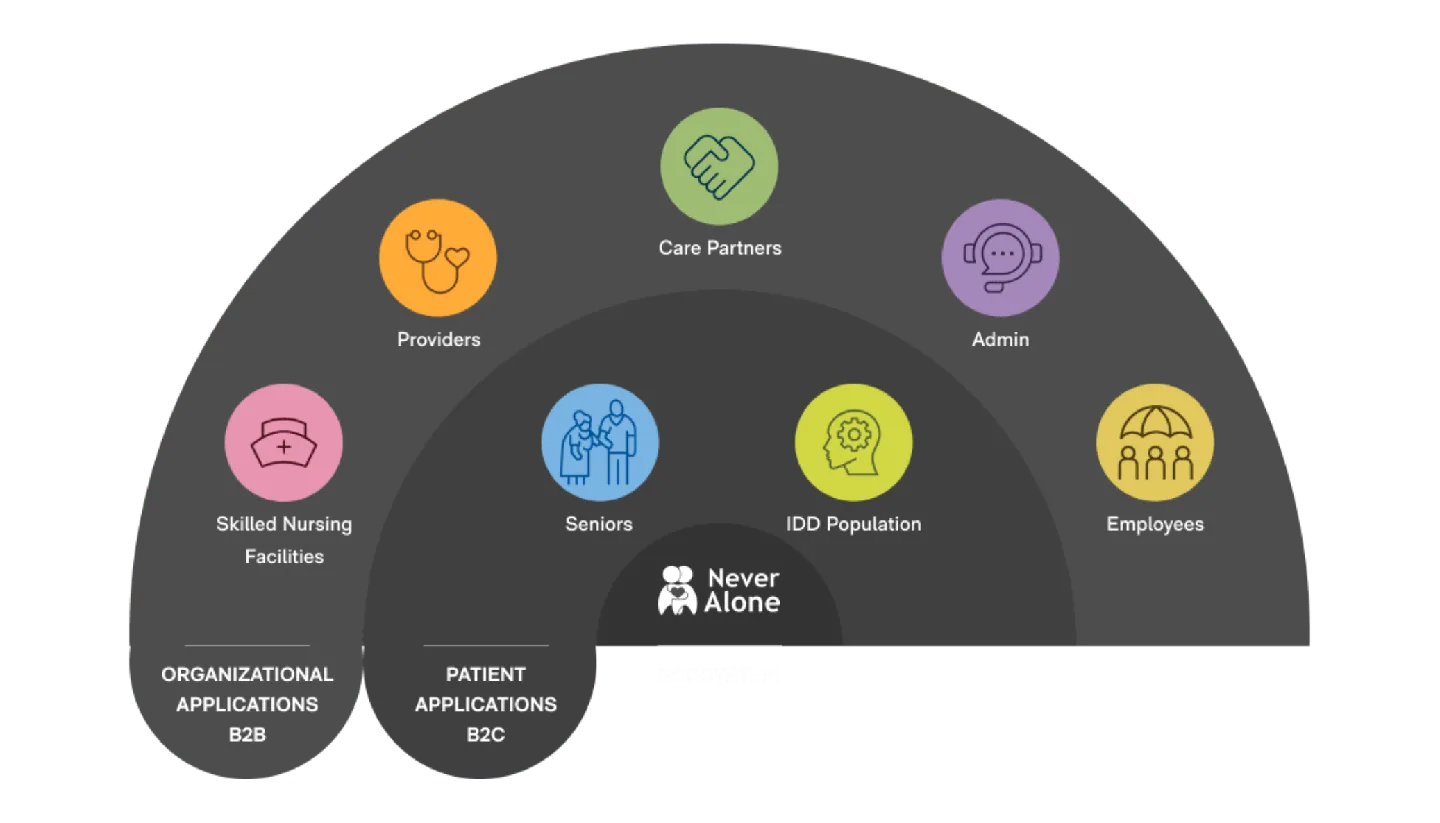
NeverAlone · CommuniCare
30,000 patients, six states
PointClickCare and Netsmart (GEHRIMED) data, AWS Chime video, Bandwidth E911 and a care management platform that replaced Salesforce. Live since March 2021; we still run it.
See the work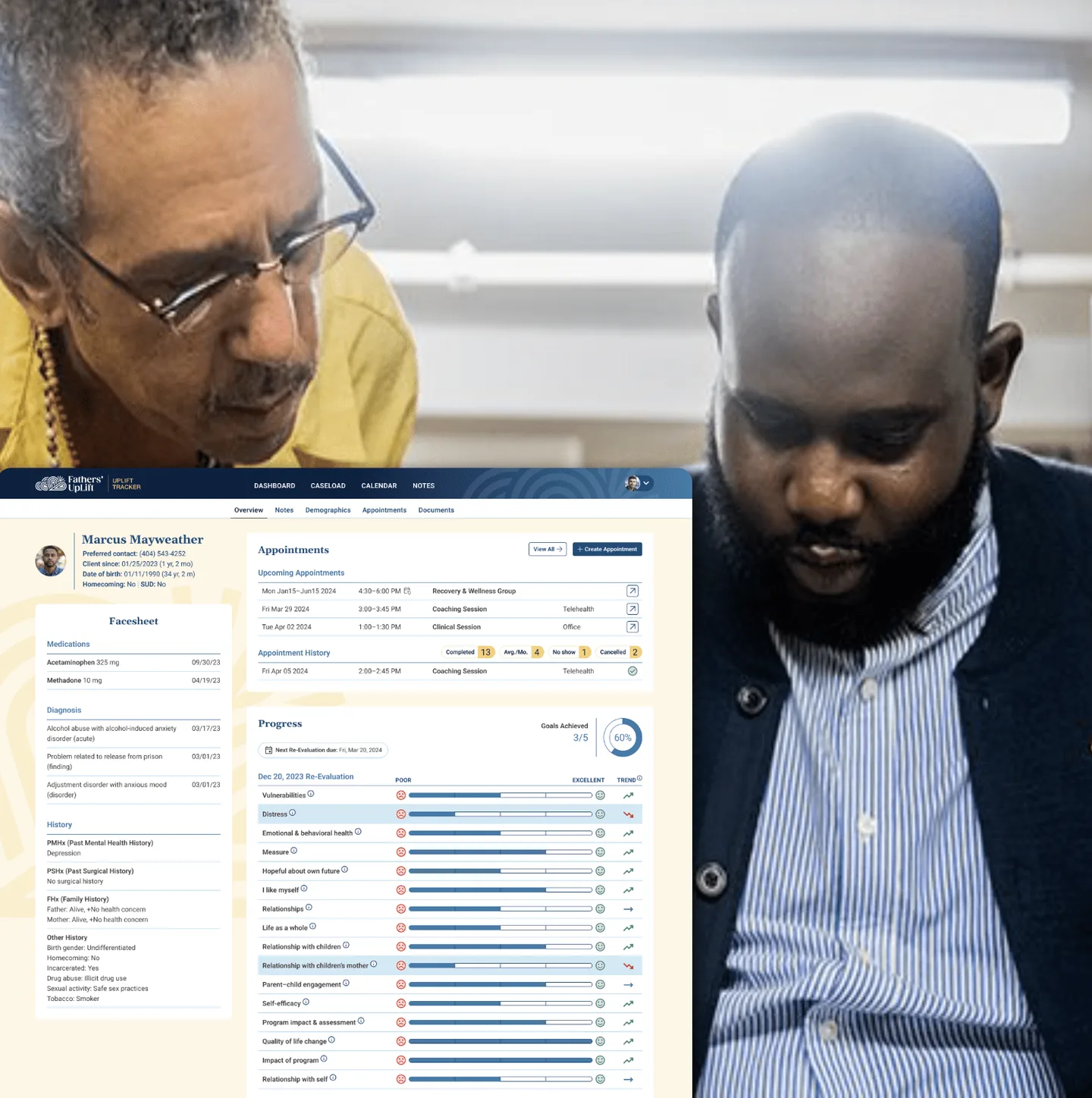
Fathers' UpLift
16,000+ fathers served
A purpose-built EHR synced with Tebra's SOAP API, with Zoom video, SendGrid email and Twilio SMS built in.
See the work
Congruity Health
7,020 patients tracked
TPA claims and eligibility over FTPS, AWS S3 to BigQuery, triggers into Salesforce both ways and Tableau dashboards.
See the work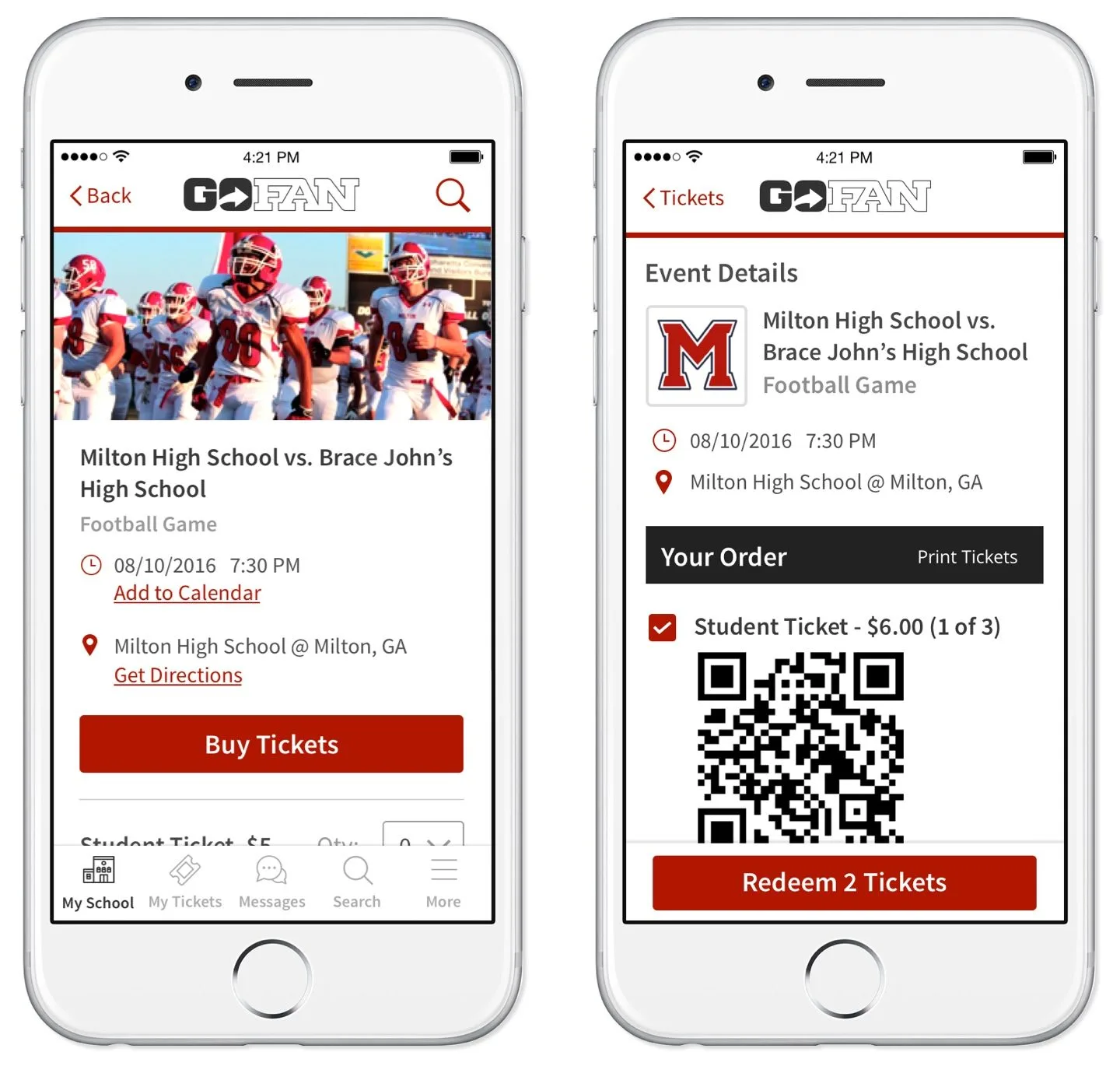
GoFan · Huddle
20M+ tickets sold
Stripe payments in a 75-day MVP that grew to 10,000+ schools, run with Huddle on a build-operate-transfer plan.
See the work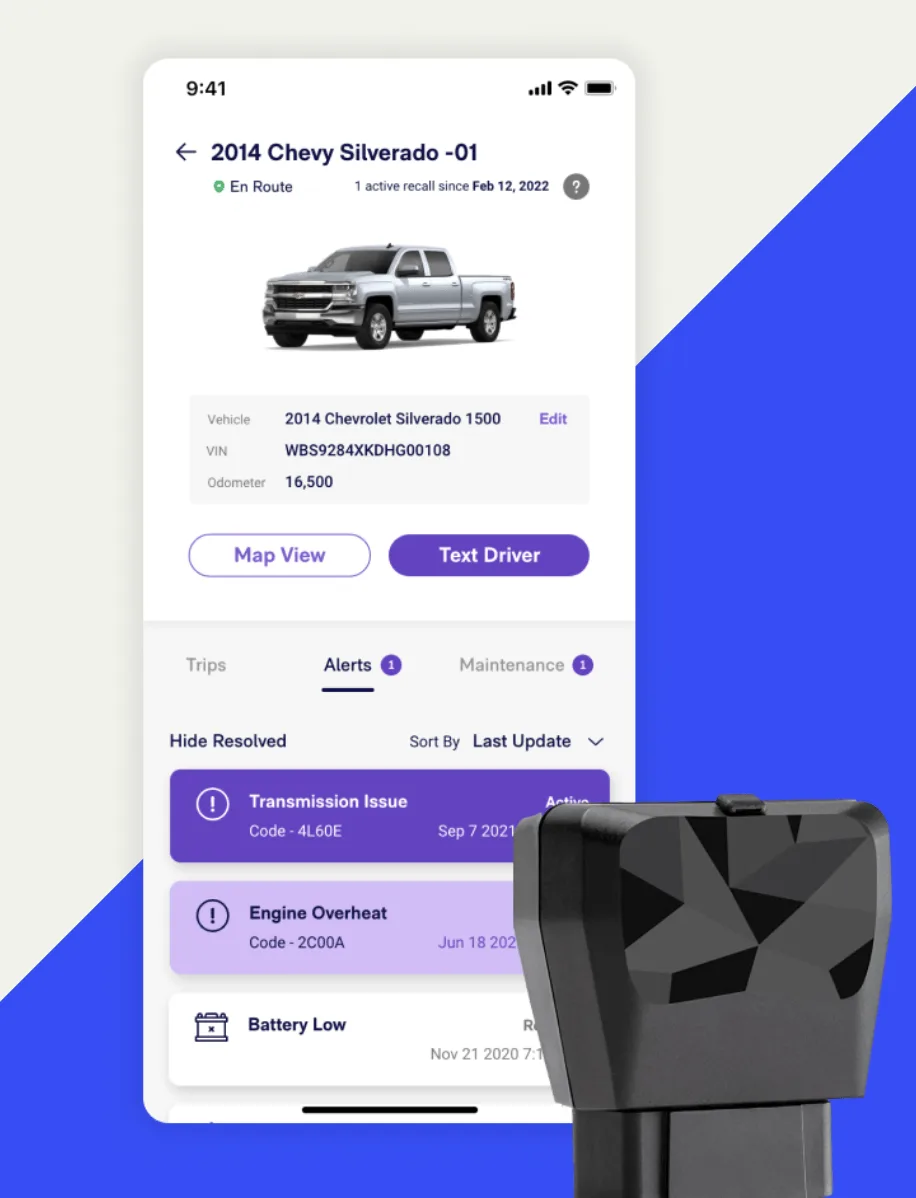
Kayo · Cox 2M
Live in 6 months
An OBD-II fleet tracker tied to iOS, Android and Amazon apps through Twilio, Auth0, Firebase and Mapbox.
See the work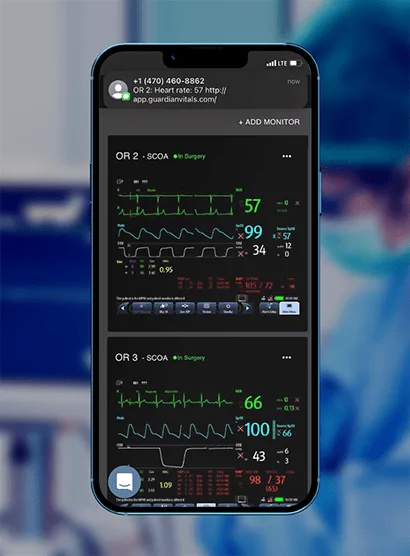
Guardian · Vigilant Medical
99.9% transcription accuracy
OR monitors of any brand read by an edge device on AWS IoT Greengrass and streamed to an anesthesiologist's phone in under two seconds.
See the workTrusted by healthcare leaders.
“Digital Scientists provided immense value to our plan administrators, providers, and patients. The team was able to come in and understand our core needs, while remaining product agnostic. They helped identify the technical debt and pitfalls, and to get us to a point of stabilization and growth.”

Robert Hager
CEO, CommuniCare Advantage
“The team at Digital Scientists was a huge help in not only developing our analytics platform, but understanding the competitive space and defining our true value proposition for our customers.”

Justin Davis
CEO, Congruity Health
Related services
Healthcare data engineering
Pipelines, warehouses and patient matching across sources.
Healthcare data engineering →Security and PHI
BAAs, NIST CSF 2.0 and how we handle patient data.
Security and PHI →Platform operations and build-operate-transfer
We run what we build, or hand it over.
Platform operations and build-operate-transfer →Healthcare IT consulting
Senior help for teams with one or two people in IT.
Healthcare IT consulting →API integration development
Our integration work across industries.
API integration development →Latest thinking on healthcare interoperability


Questions about healthcare integration
Have you worked with our EHR?
Maybe. Nobody has worked with every EHR. PointClickCare and Netsmart (GEHRIMED) integrations are in production on platforms we run, with patients matched across both. Our Epic work so far has been in Epic's sandbox. Beyond those, we can integrate with any system that has an API, a standard interface or a reliable export, and we prove the connection in the week-one check before the build depends on it.
Do you integrate systems outside healthcare, like Stripe?
Yes. We built the Stripe checkout behind GoFan, which has sold 20M+ tickets, and we've connected Twilio, SendGrid, Zoom, Salesforce, Clearbit, BigQuery, Segment and hardware from OBD-II trackers to Bluetooth trainers. Healthcare products need these too: the EHR we built for Fathers' UpLift runs Zoom, SendGrid and Twilio alongside its Tebra sync.
Do you use a healthcare integration engine?
When the job calls for one. If you already run an interface engine for HL7 v2 feeds, we connect to it and work with the people who run it. If you don't, we usually build connectors in code, on queues with retries and monitoring, inside your cloud account, so you own the code and skip a license. We have also built a FHIR R4 gateway on the open-source HAPI FHIR stack for Kipu, tested and waiting on a partner's production credentials.
How long does an integration take?
It depends more on the vendor than on the code. A system with a documented API and a sandbox moves fast. Partner programs, production credentials and the vendor's own paperwork set most of the calendar, and we've seen simple-looking integrations take four months. That's why we start access requests on day one and give you a dated plan after the week-one check.
What does an integration cost?
The vendor's API, your data and the workflow decide the work, so we scope it before we price it. We do that in a Blueprint or in a week-one integration check, and you get a written estimate before the build starts.
Who monitors the integration after launch?
We do, on platforms we built. We provide L2 and L3 support, with alerts on errors and missing feeds, while your team or your IT provider handles first-line questions. When you're ready, we hand it over on a build-operate-transfer plan. See platform operations and build-operate-transfer.
Will you sign a BAA?
Yes. We sign a BAA before we touch patient data. Our security plan is mapped to NIST CSF 2.0, and each client gets a security addendum. Where a third-party service in the integration handles PHI, we check it's covered by a BAA too.
Can you integrate a vendor with no API?
Usually. Most systems produce a report, a scheduled export or a database extract, and a reliable file on a secure SFTP server is a perfectly good integration. Where there's nothing, we look at the vendor's partner program or, with your permission, the database itself. Screen scraping is a last resort, and we'll tell you when a connection is too fragile to build a workflow on.
Talk it over
Tell us what you are trying to do. A senior person from our Atlanta team replies within one business day, and you can book a 30-minute call right after you send this.
- We tell you if we're the right fit, and if we're not, who is.
- Most work starts small, so you see how we work before you commit to more.
- We sign a BAA before we touch patient data.