An anesthesiologist’s thesis, engineered into a national OR monitoring platform.
Dr. Justin Scott had spent 18 years in the OR watching the same problem: one anesthesiologist, multiple patients, no continuous view. He founded Vigilant Medical Solutions and partnered with Digital Scientists to build the ML, the mobile app, and the platform that solved it.
Vital-sign transcription accuracy
Monitor images trained on
Refresh rate, OR to mobile
Monitor brand, zero-IT install
Remote, real-time anesthesia monitoring, built from a clinician’s insight.
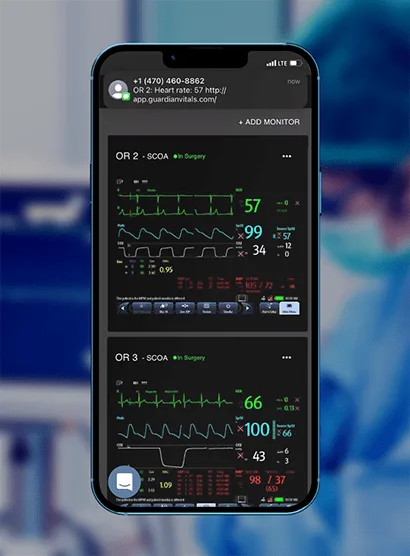
Guardian Vitals is a mobile platform that lets anesthesiologists monitor vital signs from every patient under their care, across multiple operating rooms, on a single screen. Dr. Justin Scott founded Vigilant Medical Solutions in 2014 after years of seeing the same problem in his own practice: anesthesia teams routinely manage several patients at once, and the legacy model of single-room monitoring leaves dangerous gaps.
Digital Scientists partnered with Vigilant as the technical team behind the product, the machine learning model that transcribes vital signs from any monitor brand, the mobile app that surfaces them with configurable alerts, and the cloud infrastructure that makes it work at scale. The model trained on more than a million monitor images and hit 99.9% transcription accuracy.
Today the platform is in use by anesthesia teams across the country and has been evaluated by the Geneva Foundation for deployment in forward military medical care.

Partner
Vigilant Medical Solutions
Founder
Dr. Justin Scott, M.D., FASA, practicing anesthesiologist, 18+ years
Industry
Clinical Monitoring, Digital Health
Services
ML / Computer Vision, Mobile Development, Cloud Infrastructure, UX, Product Strategy
Engagement
Long-term partnership, from prototype to national deployment
Method
One anesthesiologist. Multiple patients. No continuous view.
Anesthesia teams routinely care for several patients in parallel, often across different operating rooms, and the legacy monitoring model assumes the clinician is in the room. A critical change in one patient’s vitals can go unseen for minutes while the anesthesiologist is physically elsewhere.
Vigilant had a working prototype and a clear clinical vision. What they needed was a technical partner who could turn it into a production platform: an ML model accurate enough to be trusted in the OR, a mobile interface clean enough to be glanced at between cases, and cloud infrastructure that could scale into any hospital environment regardless of what monitor brand was installed.
The legacy model
Single-room monitoring
Vitals visible only inside the OR where the monitor lives
Gap between cases
Minutes of no visibility as the clinician moves between rooms
Brand lock-in
Each monitor vendor has its own proprietary data pipeline
IT-heavy integration
Traditional integrations require hospital IT projects to deploy
A clinician’s thesis, engineered.
Guardian is a working example of how we partner with healthcare ventures: the operator brings the domain expertise, the clinical insight, and the company. Digital Scientists brings the technical build, the ML, and the engineering depth to ship something real.
The Operator
Dr. Justin Scott
Practicing anesthesiologist, 18+ years in the OR. Founded Vigilant Medical Solutions to solve a problem he lived with daily. Owns the clinical thesis, the product vision, and the company.
The Technical Partner
Digital Scientists
Built the computer-vision model, the mobile app, the cloud infrastructure, and the universal-monitor data pipeline. Stayed through optimization, scaling, and regulatory-adjacent deployments.
The Outcome
A real product, in the market
Guardian Vitals is deployed in hospitals and anesthesia teams across the country, and has been evaluated by the Geneva Foundation for forward military medical care.
Every patient. Every monitor. One screen.
Guardian reads vitals off any OR monitor using a small edge device, runs the image through a trained computer-vision model, and surfaces the transcribed numbers, and configurable alerts, on the clinician’s phone. Sub-2-second refresh. Zero-IT install.
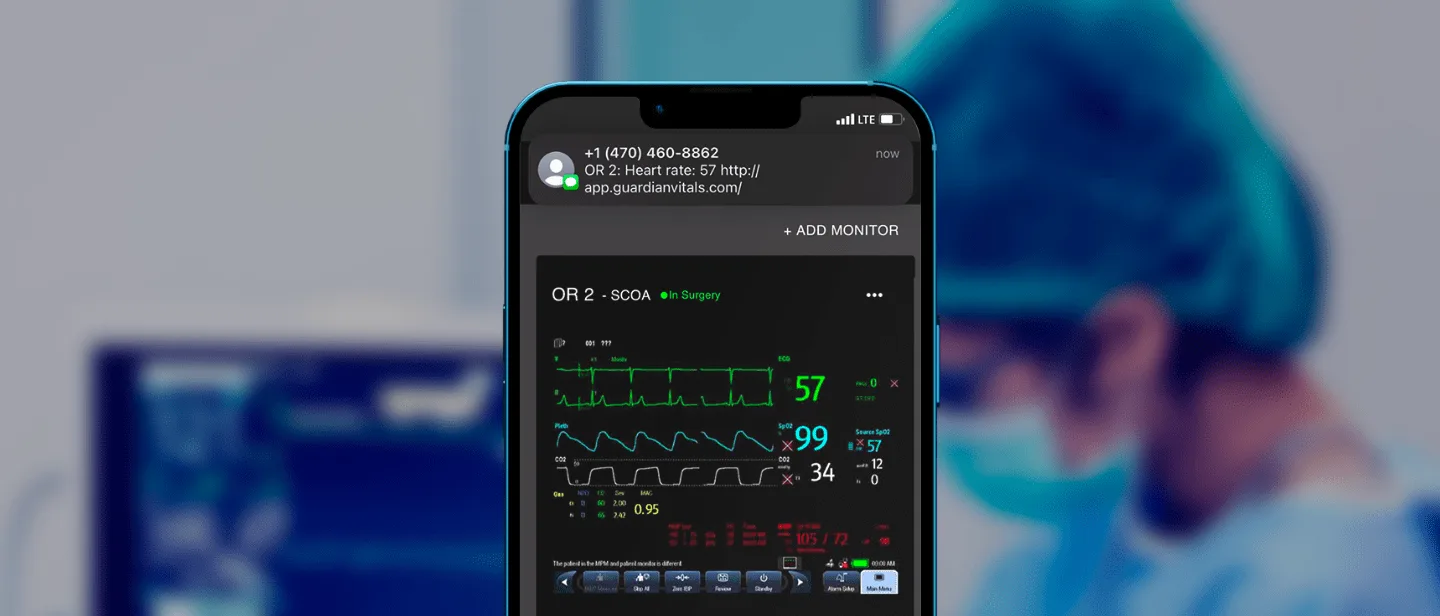
Simultaneous multi-case viewing
Add operating rooms and see vitals from every active case on a single screen. An anesthesiologist covering four rooms has continuous visibility across all of them, not just the one they’re standing in.
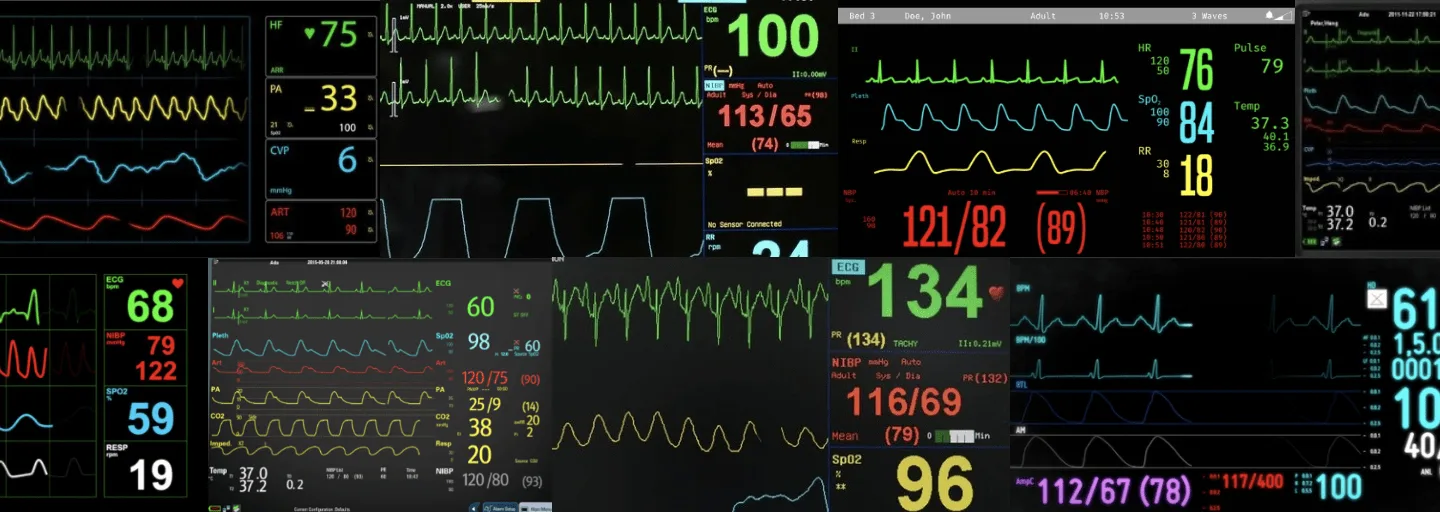
Intelligent alerts
Configure vital-sign ranges per case based on the patient’s specific medical context. When a value moves out of range, an SMS and email alert fires to the clinician’s device, proactively, before someone in the room has to call.
Universal monitor connectivity
Works with any OR monitor brand. The edge device captures the screen, computer vision transcribes it, and the cloud does the rest, no vendor SDK, no hospital IT project, no replacement hardware.
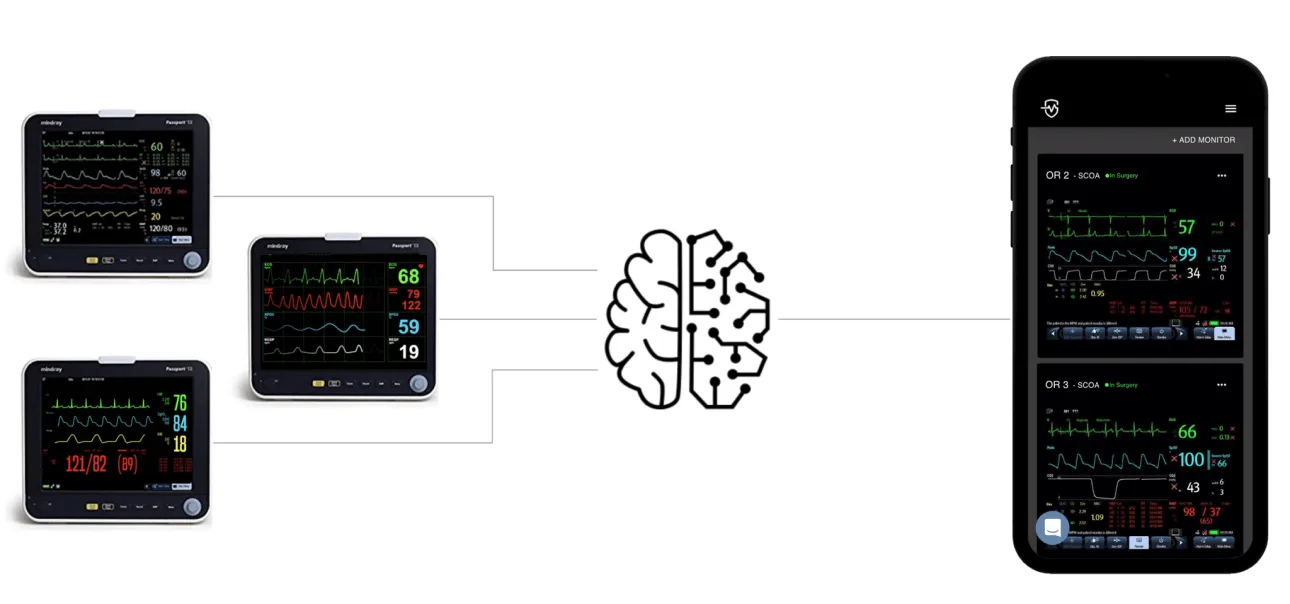
Computer vision trained on a million monitor images.
Monitor manufacturers don’t expose structured data over standardized APIs. So we built a vision model instead. Over a million images of patient monitors, across vendors, resolutions, and lighting conditions, trained the model to transcribe vital signs directly from the pixels, with 99.9% accuracy.
The model runs on a small edge device that sits next to the monitor, and each inference round-trips in under two seconds. That number matters: anything slower and the data is stale the moment it shows up on the clinician’s phone.
The same approach generalizes beyond the OR. The monitor-agnostic capture pipeline can be used anywhere vitals are displayed on a screen, ICUs, post-anesthesia care units, and remote patient monitoring contexts.
1M+
Images analyzed in training
99.9%
Transcription accuracy
<2s
End-to-end refresh
Evaluated by the Geneva Foundation for forward military medical care.
In January 2026, the Geneva Foundation, a nonprofit that advances U.S. military medicine and serves as a civilian research partner to the Department of Defense, conducted a product evaluation of the Guardian Vitals Monitoring Platform for use in Role-II austere forward-deployed environments.
The evaluation was conducted through the JBSA VAPOR (Validated Assessment Program for Operational Readiness) program, in partnership with TRC-4, during medical sustainment training. The team assessed low-light functionality, battery life, portability, ruggedness, and operability under unconventional-warfare and austere-care conditions.
Evaluation at a glance
25
Simulated patients monitored
10
Training iterations over 6 months
Role-II
Austere forward-deployed setting
NVG-ready
Screen readable under night-vision goggles
What was tested
Chief complaints included open chest wounds, compound wrist and ankle fractures, maxillary fractures, open leg wounds, and abdominal injuries, 25 simulated patients at the TORCH Site Training Complex during Prolonged Field Care (PFC) scenarios.
How it performed
“The screen was very easy to read in both low light and under night vision goggles. The user of the device was able to consistently obtain quality results in the Role-II austere condition.”
“The Guardian Vitals Monitoring Platform machine can serve as an effective tool to monitor both combat related and medical patients in an austere setting… should be given strong consideration to be added to current deployment medical equipment packages, across all DoW (Department of War) domains. The value this device can yield in terms of situational awareness is immeasurable, if properly utilized.”
, W. Douglas Gissendanner, Program Manager II, The Geneva Foundation · 2 January 2026
Security and HIPAA workflow, built in from the start.
Our developers are trained in HIPAA practice. Guardian is engineered with clinical-grade security throughout the stack, encrypted data in transit and at rest, secure cloud infrastructure, and an access model designed to keep PHI handling auditable and controlled.
Technology stack
Backend & Infrastructure
Cloud, Edge & Services
From clinical thesis to national deployment.
99.9%
Transcription accuracy
Monitor image to mobile-app reading
<2s
End-to-end refresh
OR monitor to clinician’s phone
Role-II
Geneva Foundation eval
Evaluated for forward military medical care
Guardian went from clinical prototype to a production platform with continuous remote monitoring across multiple OR cases. It is now available to hospitals and anesthesia teams across the country, and has been formally evaluated by the Geneva Foundation for use in Role-II austere forward-deployed medical care.
It’s a venture Dr. Scott owns, built on a technical platform Digital Scientists engineered, and a working template for how we partner with clinicians and operators who have a thesis worth shipping.
“By applying a robust machine learning model to our app, DS helped us create a scalable and accurate solution to improve the operating room experience for the anesthesia team and the patient. They are true collaborators.”
JUSTIN SCOTT, M.D., FASA
Founder & CEO, Vigilant Medical Solutions
Have a clinical thesis worth shipping?
We partner with clinicians, operators, and healthcare ventures who have the domain expertise and need a technical team that can build the platform around it.