
Healthcare App Development Company. We Build It. We Run It in Production.
Digital Scientists is a healthcare app development company in Atlanta. We design and build iOS, Android and web apps for patients, clinicians and care teams, then run them in production. We built NeverAlone, a 24/7 virtual care app that began as a 90-day MVP, and we still operate it for 30,000 patients across six states, including older adults and people with intellectual and developmental disabilities. Most clients start with a Blueprint that sets scope, architecture and budget, or go straight to an MVP.
Updated
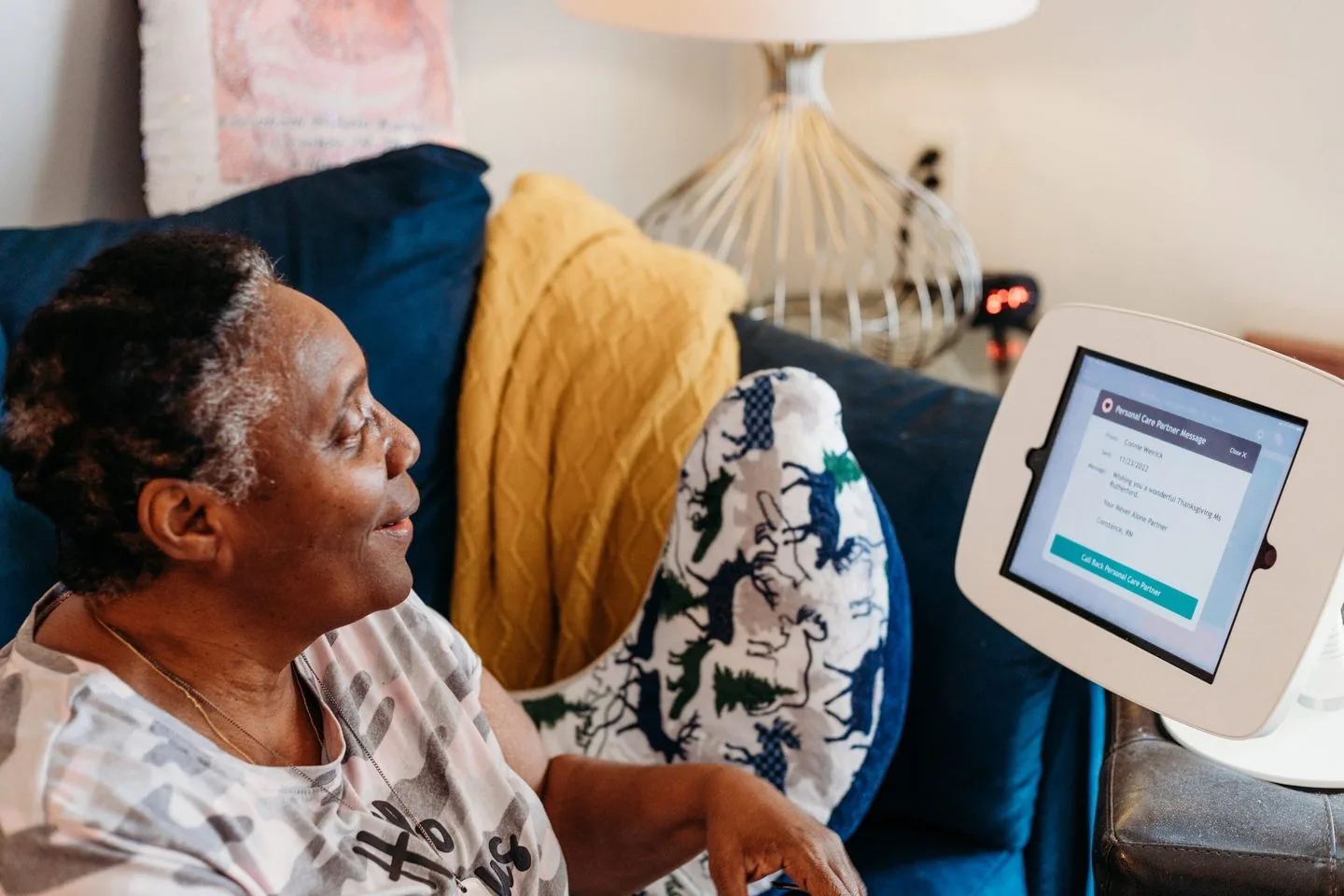
Patients on NeverAlone, across six states
Treat-in-place rate, post-acute care
Calls a year on the platform
NeverAlone devices in the field



NeverAlone: A Healthcare App We Built, Run, and Expand Every Day
NeverAlone is a 24/7 virtual care platform that connects seniors, IDD individuals, and post-acute care residents with clinical care partners via real-time video. We didn’t hand this off, we built it, we operate it in production, and we continue to expand its capabilities across new care settings.
The platform connects to EHRs and third-party provider networks to deliver mission-critical care for CommuniCare Health Services, one of the largest post-acute providers in the country.
Calls a Year
Treat-in-Place
Facilities
States Live
Who do we build healthcare apps for?
Health tech companies building a product to sell, and providers, payers and community programs building an app for their own patients, members or staff.
- Health tech founders and product teams. You bring the market and the idea; we bring the build, from Blueprint to MVP to production. See health tech companies.
- Post-acute and senior care operators. Tablets for residents, tools for night-shift nurses, and the platform behind them. See post-acute and senior care.
- IDD and behavioral health providers. Apps for people who need the simplest possible screen and a person on the other end. See behavioral health and SUD.
- Payers and community programs. Member apps and purpose-built tools, like the EHR we built for Fathers' UpLift in eight weeks. See health plans and payers.
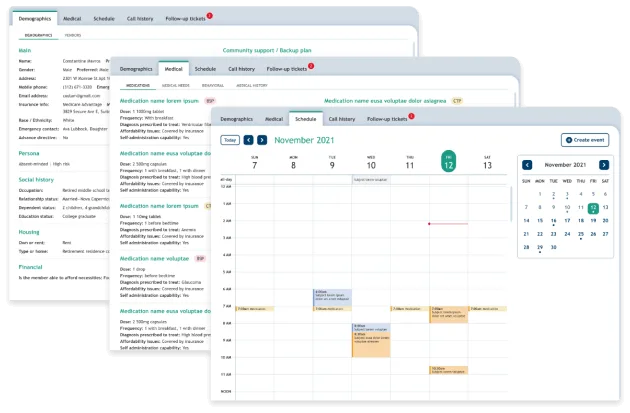
The care management platform we built for NeverAlone in 2022 to replace Salesforce: resident record, schedule and care plan.
Types of healthcare apps we build
Patient apps, clinician tools and the platforms behind them, for providers, post-acute operators and health IT companies. Each one HIPAA-compliant and connected to the systems care already runs on.
Remote Patient Monitoring
Continuous vital sign monitoring via connected devices. Proactive alerts reduce hospitalizations and enable treat-in-place care models.
RPM Solutions →Telehealth & Virtual Care
Video consultations, asynchronous messaging, and virtual rounding built for post-acute, home health, and primary care settings.
Telehealth Solutions →Clinical Decision Support
AI-powered tools that surface guidelines, flag risks, and recommend interventions at the point of care.
CDSS Solutions →Patient Portals & Digital Front Door
Self-service scheduling, health records access, secure messaging, and care plan tracking.
Digital Front Door →Revenue Cycle & Coding AI
Automated MDS coding, RAF/HCC score optimization, denial prediction, and claims workflow tools.
Revenue Cycle AI →EHR Integration & Interoperability
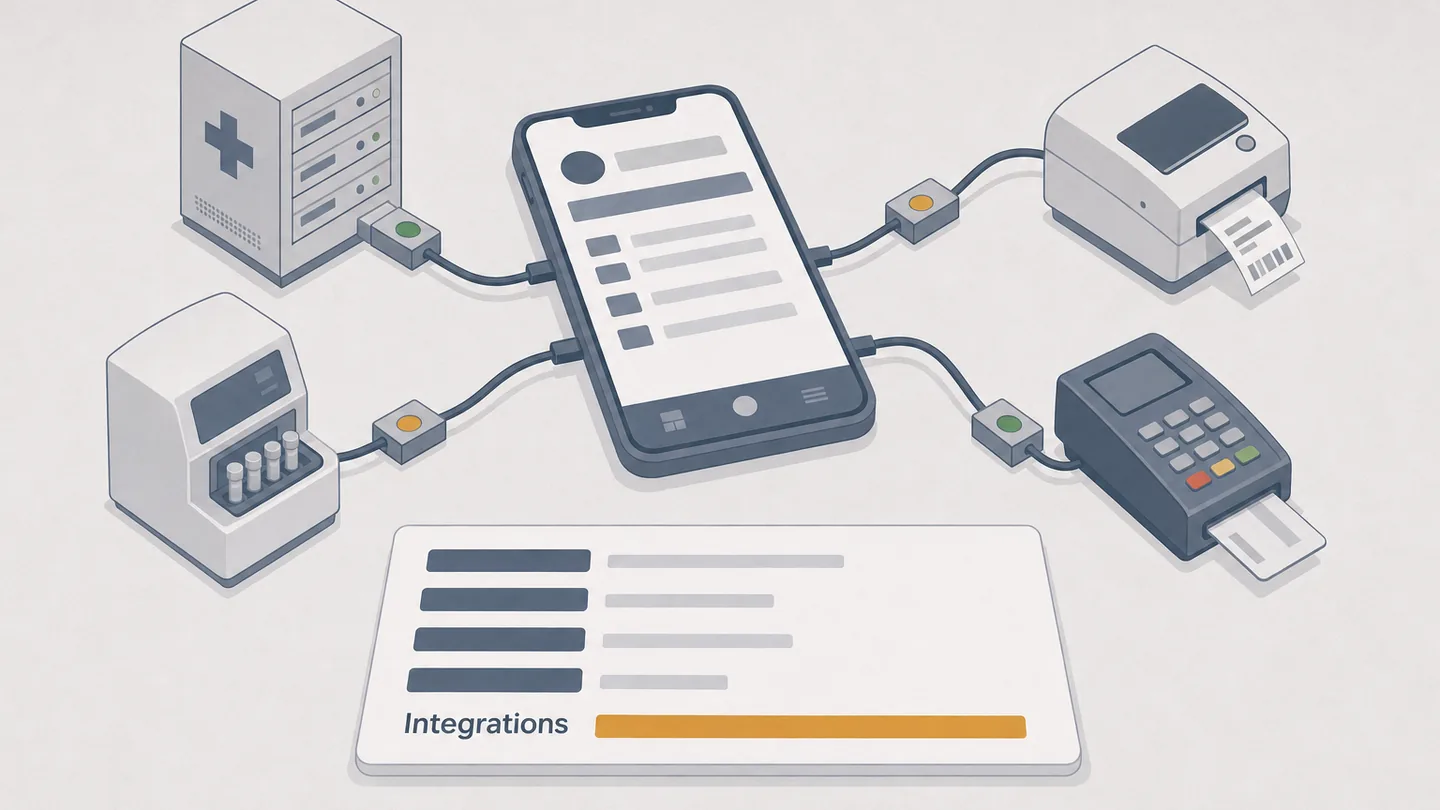
PointClickCare and Gehrimed in production. Epic tested in a sandbox. Anything else with an API, a standard interface or a reliable export, via HL7 FHIR, ADT feeds and custom APIs.
Interoperability →Can older adults and people with IDD actually use a healthcare app?
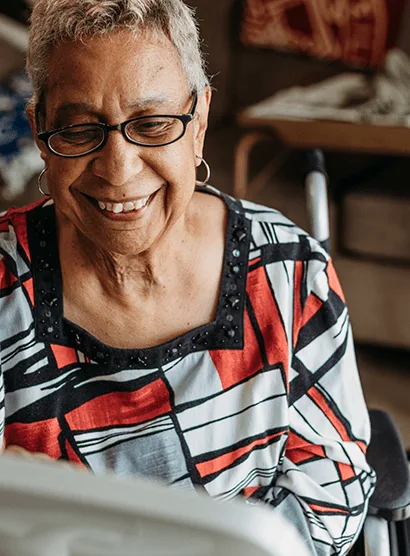
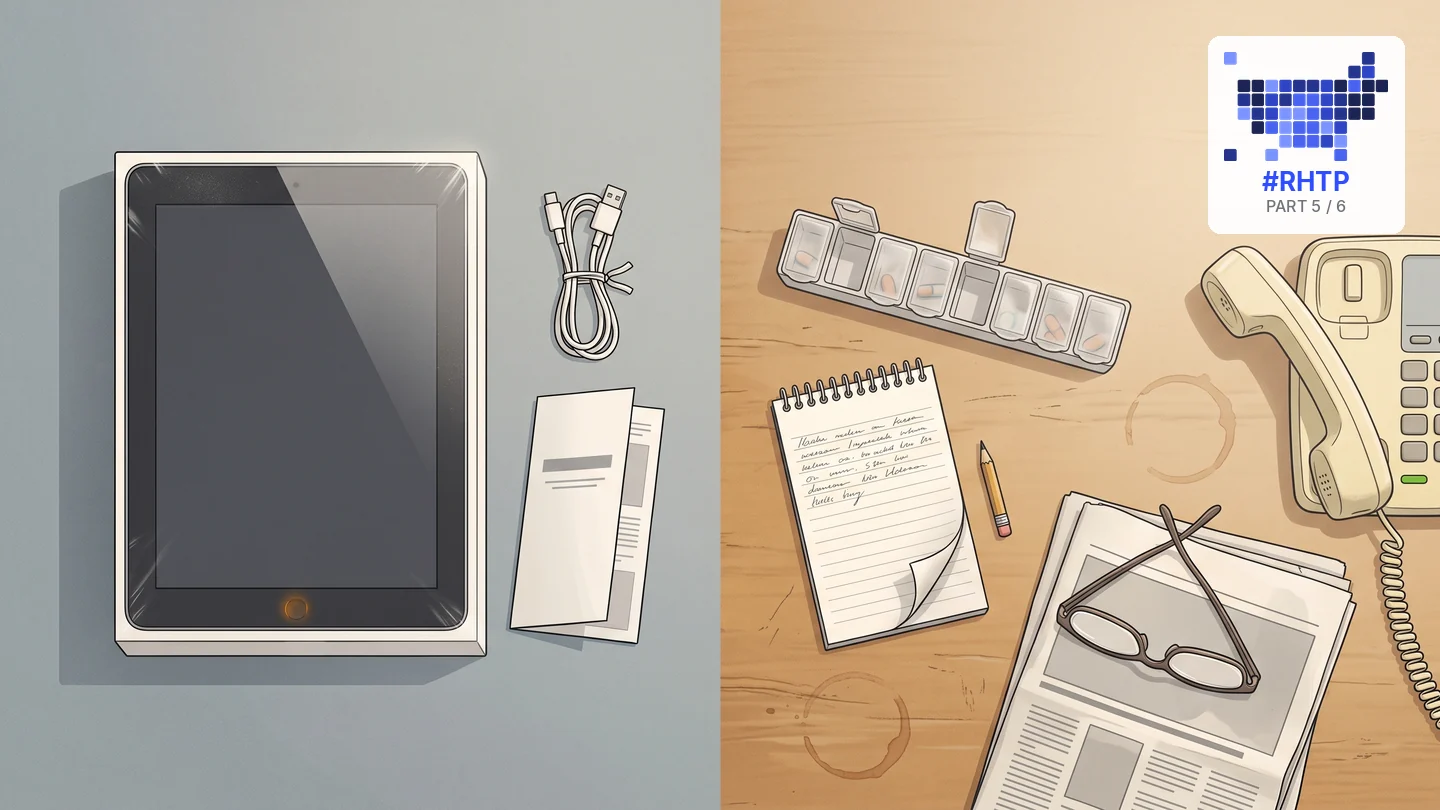
Yes, when the app is designed for them from the first sketch. NeverAlone serves residents in their 80s and 90s and adults with intellectual and developmental disabilities (IDD), on tablets with no login and one obvious way to reach a person.
We did UX research with older adults in an independent living community before the first pilot in June 2021. IDD support followed in 2022 through a partnership with Easterseals, and the same app now runs in skilled nursing, assisted living, home health and hospice. What works for an 85-year-old on a bad Wi-Fi night works for everyone else too.
- No login. The resident picks up the tablet and the care partner is one tap away. Accounts, updates and settings are handled remotely.
- Big targets, plain words. Large type, high contrast and few choices per screen, tested with the people who will use it.
- Accessibility standards. We design to WCAG 2.1 AA, and to AAA contrast where the audience needs it.
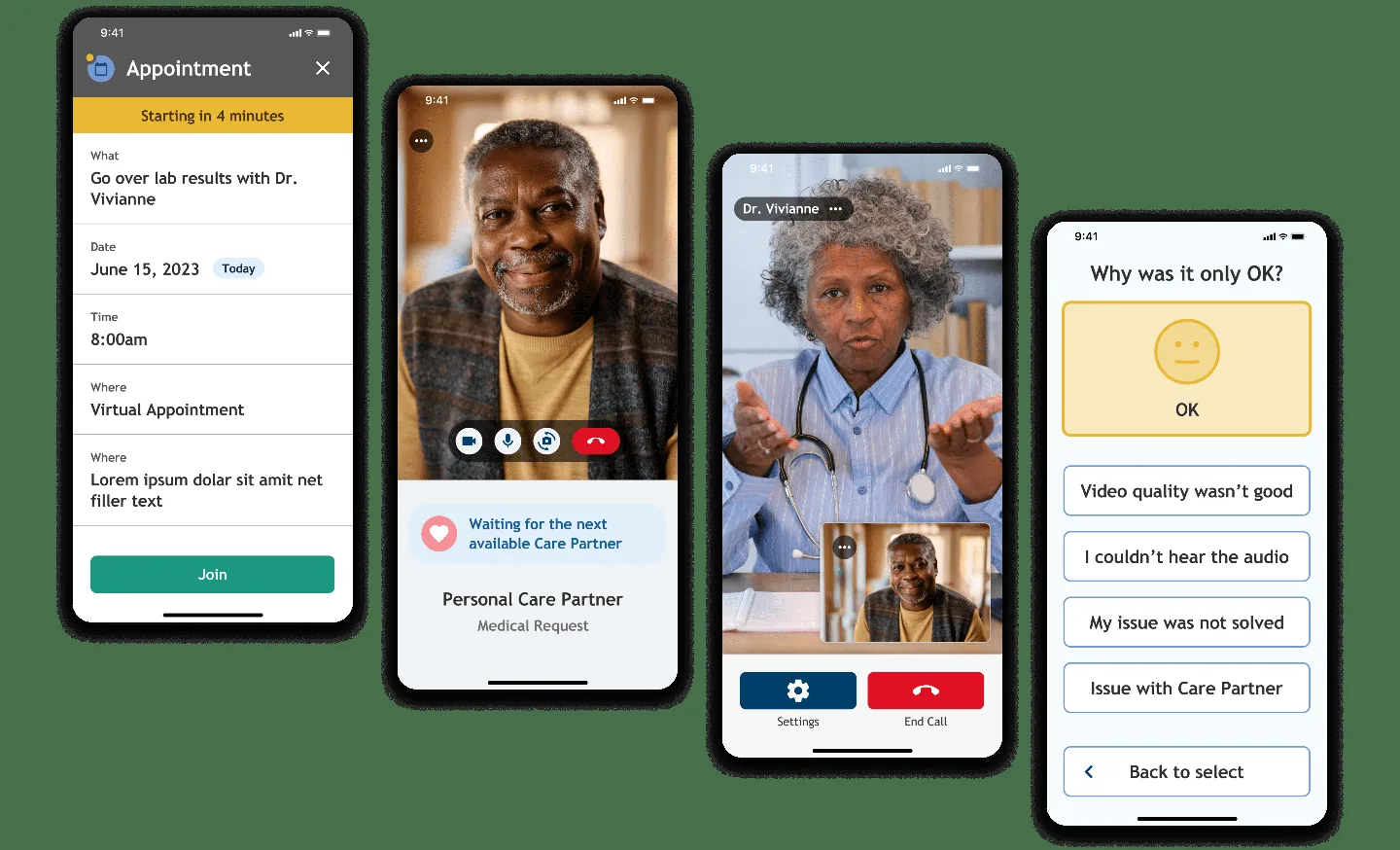
NeverAlone on a phone: the appointment, the video call with a care partner, and a one-tap check on how the call went.
What goes inside a healthcare app that has to work every time?
Video, phone access, an emergency path, device data, offline behavior and fleet management, each tested on the hardware patients actually hold. These are the parts that break in production, so we build and test them first.
Most of the building blocks below come from NeverAlone, which runs 24/7/365 on managed iPads, phones and the web. The rest come from device and monitoring products we built for Intent Solutions and Vigilant Medical. Where something is a pattern we design to rather than a system we run, we say so in the Blueprint.
Building blocks of a production healthcare app
| Building block | What it does | Where we've built it |
|---|---|---|
| Video visits | Two-way video between patient and care partner, tuned for weak connections | NeverAlone, on the Amazon Chime SDK |
| Phone access | Reach the same care team from a phone, not just the tablet | NeverAlone phone app |
| Emergency path | E911 with a validated address for each device, so an emergency call reaches the right place | NeverAlone, with Bandwidth E911 |
| Devices and wearables | Bluetooth devices, monitors and sensors feeding data into the app | Intent Solutions smart pill bottle; Guardian OR monitoring |
| Offline behavior | The app keeps its place and its data when Wi-Fi drops, then syncs | NeverAlone iPad client |
| Fleet management (MDM) | Lock-down, updates and remote reset for hundreds of shared devices | NeverAlone, 750+ devices |
| AI notes | Call summaries and an ambient scribe for the care team, reviewed by a person | HealthContext on NeverAlone: note time from 45 minutes to 5 |
MDM (mobile device management) is software that configures, updates and secures a fleet of devices remotely. E911 is enhanced 911, which passes a caller's registered address to emergency services.
HIPAA, HL7 FHIR and EHR integration, built in from day one
PointClickCare and Gehrimed integrations in production, Epic tested in a sandbox, and HL7 FHIR, ADT feeds and custom APIs for the rest. BAAs are signed before any PHI moves, and we support what we build in production.
24/7 Production Operations
We operate NeverAlone around the clock, 130+ facilities, six states, 100,000+ calls a year on the platform. When a fall alert fires at 2 AM, our infrastructure has to work. That operational discipline informs every product we build.
Hardware-Aware Development
Bedside tablets, OR monitors, Bluetooth pill bottles, wearable vitals sensors, healthcare doesn't live on a laptop. We design for intermittent connectivity, device provisioning at scale, and the physical reality of clinical environments.
HIPAA From Day One
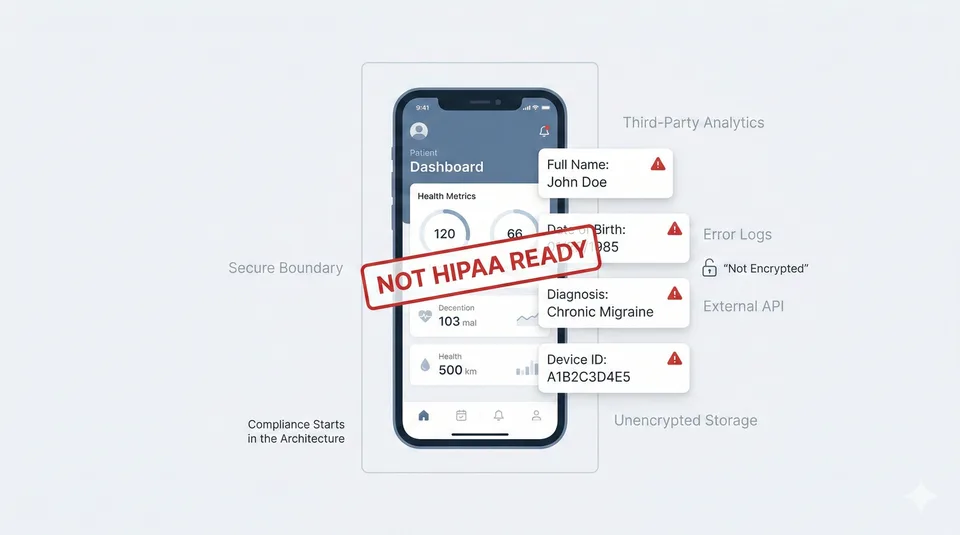
PHI encryption, audit logging, role-based access mapped to clinical hierarchies, BAA-ready infrastructure. We don't bolt security on after the fact, it's in the architecture from sprint zero. We've passed audits. We know what surveyors look for.
How healthcare app development works, step by step
One integrated team handles product strategy, UX research with clinicians and patients, engineering and production operations. The people who observe your workflows write the code that ships.
Strategy call
Thirty minutes on the clinical problem, the users, and who owns the outcome.
A recommended starting point
Blueprint
Four to six weeks of research with clinicians and patients, workflow design, architecture, a compliance plan and a budget you can fund.
Plan, architecture and budget
Step 3Build
MVP or full build in two-week sprints on iOS, Android and web, with EHR integration and testing built in. You see working software early.
Production app and launch
Step 4Run in production
Monitoring, support and the next release. Healthcare apps change with regulations, care settings and clinical feedback.
Ongoing support
How much does healthcare app development cost?
It depends on how much the app has to prove and how much it has to connect to. These are the ranges we see with our clients.
- MVP, $75K to $250K, 8 to 16 weeks. Two or three workflows on iOS, Android or web, ready for real users at your first site.
- Enterprise MVP, $150K to $250K, 12 to 16 weeks. Several user types, EHR integration and AI.
- Full platform, typically $250K to $1.5M, phased. Multiple care settings, integrations and 24/7 production support.
The Blueprint sets the number before the build starts. See how the stages work on our healthcare MVP page.
What drives the cost
User types
A patient app alone costs less than one that also serves nurses, physicians and administrators.
Integrations
EHRs (PointClickCare, Epic, Cerner), pharmacy systems, devices and payers. Each one adds scope and testing.
Compliance
HIPAA is the baseline. SOC 2, HITRUST or FDA software as a medical device add documentation and review.
Platforms
Native iOS and Android, one React Native codebase, or a web app. Bedside tablets and connected devices add hardware testing.
AI
Ambient documentation, risk prediction or agents add data work, validation and monitoring.
How to vet a healthcare app development partner.
If you are evaluating us against MindSea, Topflight, ScienceSoft, Arkenea, Vention, or Folio3, ask every firm the same seven questions. The right partner answers all of them in production terms, not slideware.
Have you operated a healthcare app you built in production?
Most firms ship and walk. The ones that operate the platform answer 2 AM pages know what production failure modes actually look like. DS operates NeverAlone 24/7 across 130+ facilities.
Name the EHRs you have integrated with by vendor.
Generic “FHIR / HL7 capability” is not the same as a production integration. Ask each firm to name vendors. DS has PointClickCare and Gehrimed in production and Epic tested in a sandbox, with FHIR, HL7, and ADT capability for the rest. No other firm in the comparison set publishes PointClickCare on its service page.
Show dollar-denominated outcomes from a single named program.
Project-level metrics are table stakes. Platform-level dollar outcomes are not. DS: $10M+ recovered and $24M+ forecast PDPM revenue from MDS AI, $10M+ RAF improvement, 96% treat-in-place across 30,000 patients.
Where is the team that writes the code? Same time zone as you?
Offshore staff augmentation is the cheap quote. It also produces the most rework. DS engineers are in Atlanta. The ones in your discovery sessions are the ones shipping the code.
Can you take equity instead of fees, if the model fits?
Pure services firms cannot. Equity-aligned partnership shifts the incentive from billable hours to outcomes. DS holds equity in NeverAlone and operates the platform we built. Our Venture Studio offers equity-aligned and operator-founder programs.
Have you built for high-risk elderly / post-acute / home health populations?
Acute clinical-trial design is not the same as a tablet for an 85-year-old. DS lives in post-acute, SNF, senior living, home health, hospice, and IDD. CommuniCare, Easterseals, Guardian.
How do you de-risk the build before a big commitment?
A real partner will de-risk before billing six figures. DS: a Blueprint from $25K to plan it, or Build with Us, two weeks for $10K, building on your real systems. If the riskiest assumption fails, you find out early.
Plan first, or start building.
Either way, you work with senior people who build with AI, BAAs are signed before any PHI moves, and you own everything we make.
Plan first
Blueprint
Research with clinicians, patients and the people who decide, the architecture, and a development plan with milestones and a budget you can fund. For when the big questions come first.
4 to 6 weeks · from $25K
How the Blueprint works →Start building
Build with Us
A senior solution architect who builds your first piece of work, a workflow, an integration or an AI feature, alongside the person who owns the problem. For when you’d rather start than plan.
2 weeks · $10K to start · engineering and AI compute included
How Build with Us works →Already know what you need? Go straight to a team: MVP or Full Build. Prefer an equity-aligned model? See our Venture Studio. Not sure? Talk it over.
More healthcare apps we built
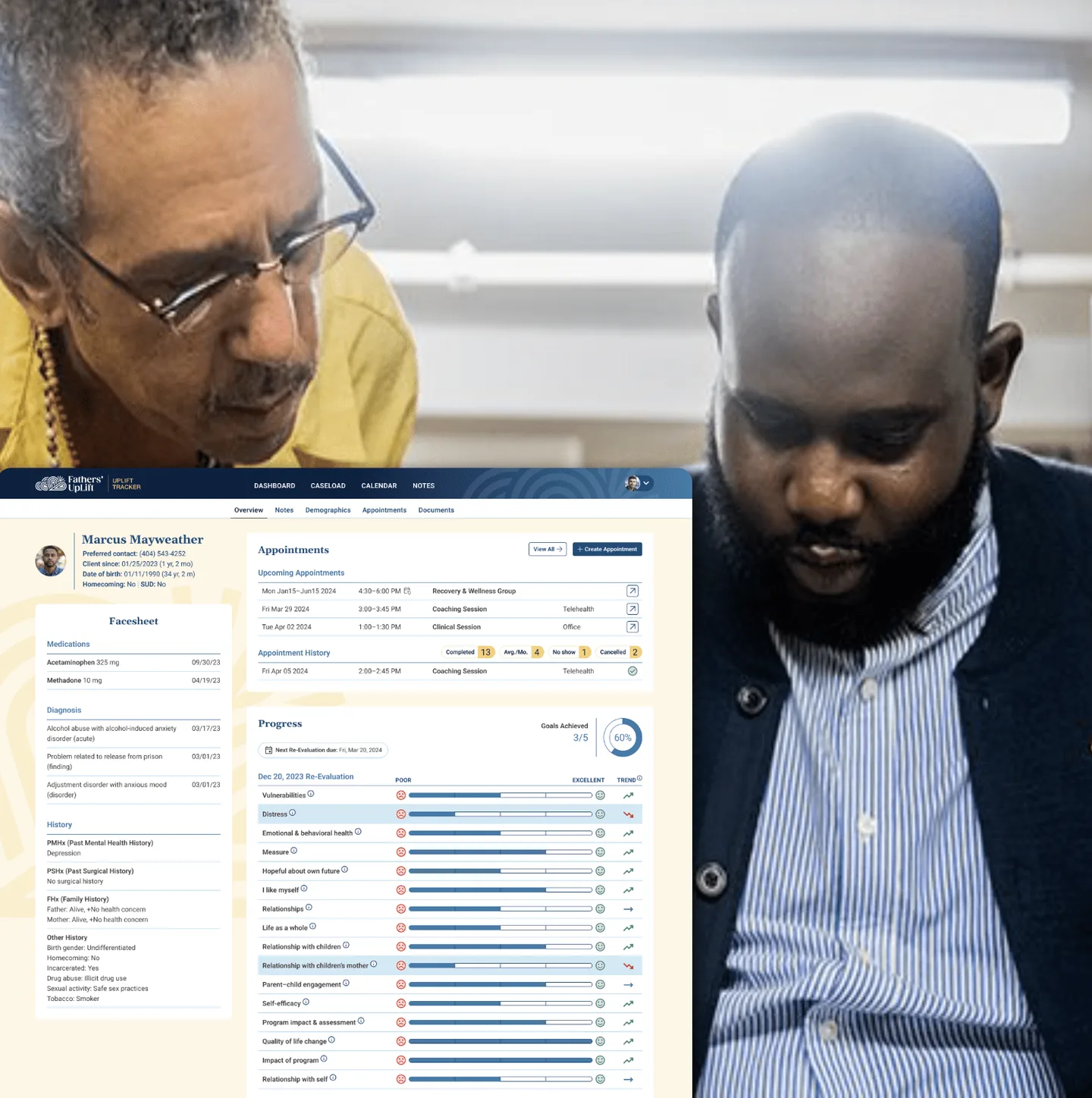
Fathers' UpLift
Custom EHR in 8 weeks
A purpose-built EHR for a community program serving fathers, from Blueprint to MVP in eight weeks.
See the work
Congruity Health
7,020 patients tracked
An analytics MVP that turns claims and eligibility data into telehealth interventions for chronic disease.
See the workTrusted by healthcare leaders.
“NeverAlone has made our processes more efficient, reducing onsite visits and helping our members gain a greater sense of independence. What truly sets the team apart is their commitment to understanding the specific needs of our community. They took the time to learn about our challenges and tailored their solution to fit our goals. The partnership has been invaluable in empowering both our members and our staff.”

Donna K. Elbrecht
CEO, Easterseals Arc of Northeast Indiana
“Thank you to the Digital Scientists team, this has been a long time coming! We finally have something that will be useful for our team so I want to take this opportunity to thank you for your hard work and your diligence. You took an idea and made it come to life!”
Dr. Charles Clayton Daniels Jr.
CEO & Founder, Fathers' UpLift
Related services
Telemedicine and virtual care
Video, phone and 24/7 care partner platforms.
Telemedicine and virtual care →Patient portals and apps
Scheduling, records, messaging and the digital front door.
Patient portals and apps →Healthcare software development
Custom platforms for providers, payers and health tech.
Healthcare software development →Healthcare product development
Blueprint, MVP and full build for digital health.
Healthcare product development →Platform operations and build-operate-transfer
We run what we build, or hand it over.
Platform operations and build-operate-transfer →Mobile app development
How we build iOS and Android apps outside healthcare.
Mobile app development →Healthcare app development guides
Frequently asked questions about healthcare app development
How much does it cost to build a healthcare app?
With Digital Scientists, a healthcare app costs $75K to $250K for an MVP, depending on how much it has to prove: an MVP with two or three workflows runs $75K to $150K over 8 to 12 weeks, and an enterprise MVP with several user types, EHR integration and AI runs $150K to $250K over 12 to 16 weeks. A full platform across multiple care settings typically runs $250K to $1.5M, phased. User types, integrations, compliance scope, platforms and AI drive the estimate, and the Blueprint sets the final number before the build starts.
How do you handle HIPAA compliance?
HIPAA compliance is built into our architecture from sprint zero, not bolted on at the end. That means PHI encryption at rest and in transit, audit logging for every data access event, role-based access controls mapped to clinical hierarchies, and BAA-ready infrastructure. We've been through compliance audits and know what surveyors look for. Every member of our team is HIPAA-trained, and we execute BAAs before any PHI touches our systems. See our security approach.
Can you integrate with our EHR system?
Yes, we can integrate with your EHR. PointClickCare and Gehrimed are in production on platforms we operate today. Epic is tested in a sandbox environment and ready to harden for production scope. For Cerner and other systems we integrate via HL7 FHIR APIs, ADT feeds and custom data exchange protocols. See our interoperability approach.
How long does it take to build a healthcare app?
A focused MVP typically takes 8 to 12 weeks. A full-featured clinical platform with EHR integrations and multiple user types usually takes 16 to 24 weeks. We ship in two-week sprints, so you see working software from week two, not at the end. Most projects start with a four to six week Blueprint that sets scope and budget.
Do you support apps after launch?
Yes, and for healthcare, post-launch is where the real work happens. We operate NeverAlone 24/7 across 130+ facilities in six states, managing uptime, deploying updates, and responding to incidents in real time. Healthcare apps are never "done"; they evolve with regulatory changes, new care settings, and clinical feedback. Our Production Support model provides ongoing development, monitoring, and scaling after launch.
What does a custom post-discharge mobile app cost?
Most healthcare app projects with us start with a Blueprint (from $25K, 4 to 6 weeks): user research, workflow design, technical architecture, and a calibrated build proposal. From the Blueprint, a typical custom build runs $250K to $1.5M with ROI in 12 to 36 months, phased and tied to clinical and financial KPIs. We also offer a Venture Studio path when an equity-aligned model fits, including operator-founder partnerships, co-build arrangements, and licensing a proven scaffold like NeverAlone for virtual care. If you would rather start building, Build with Us is two weeks for $10K.
How does a custom app reduce 30-day readmissions for high-risk elderly?
Three mechanisms, all running in production today on NeverAlone. First, the app pulls discharge data from PointClickCare so the patient is not re-explaining their care plan; Epic is tested in a sandbox environment, and other systems integrate via FHIR, HL7, and ADT. Second, two-way video to a 24/7 clinical care partner intercepts a clinical event before a hospital trip becomes the only answer. 96% of NeverAlone events resolve in place. Third, RPM devices and patient-reported symptoms surface deterioration earlier than scheduled follow-ups would. The combination is what produces measurable readmission avoidance.
Can a custom healthcare app integrate with PointClickCare to pull discharge data?
Yes. We have PointClickCare integration in production on platforms we operate. Discharge data, ADT feeds, medication reconciliation, and patient demographics all flow into the apps we build. Of the seven firms most commonly compared in healthcare app development, DS is the only one that publishes PointClickCare on its service page.
Should we build the app in-house, hire a partner, or use a venture studio?
Three honest paths. In-house works if healthcare software is your business and you can hire and retain a senior product, mobile, and DevOps team for 12+ months. Hire a partner works if you have a clear scope, a healthcare operations team, and you want a defined first scope with you owning the IP. Venture studio works if the product is adjacent to your operating model, you want equity alignment, and you want a team that has run a comparable platform in production. DS offers all three engagement models, including equity-aligned partnerships and operator-founder programs.
How are you different from other healthcare app development firms?
Five things stand out. (1) We operate a healthcare platform we built. NeverAlone, one of our production proof points, runs on 30,000 patients across six states. (2) We have PointClickCare and Gehrimed in production, not just FHIR/HL7 capability, and Epic tested in a sandbox environment. (3) We publish dollar outcomes at platform scale: $10M+ recovered and $24M+ in forecast PDPM revenue from our MDS platform, and a $10M+ RAF improvement from risk adjustment AI. (4) US-based Atlanta team. Same engineers in your discovery sessions write the code that ships. (5) Two engagement models. Professional Services, where you own the IP, or a Venture Studio path with equity-aligned, scaffold-license, and operator-founder programs. See the full healthcare hub.
Should we build native or cross-platform?
Usually one React Native codebase for iOS and Android, plus a web app for staff and admins. We go native in Swift or Kotlin when the app needs deep device, Bluetooth or media access that a shared codebase handles poorly. NeverAlone's iPad client is React Native with a native video framework underneath, which gives one codebase without giving up call quality.
How do you handle HIPAA in a mobile app?
The phone is the riskiest place PHI lives, so we keep as little there as possible. Data is encrypted on the device and in transit, sessions time out, and shared devices are managed through MDM so a lost tablet can be locked or reset remotely. We sign a BAA before we touch patient data, and our security plan is mapped to NIST CSF 2.0.
Can older adults actually use it?
Yes. NeverAlone serves residents in their 80s and 90s and adults with intellectual and developmental disabilities. The tablets have no login, large targets and one obvious way to reach a person, and we test with real residents and staff before anything ships.
Do you publish to the App Store for us?
Yes. We set up the developer accounts in your name, run beta testing through TestFlight, and automate release pipelines so updates are routine rather than events. For managed devices such as resident tablets, we push the app through MDM instead of the public stores. You own the accounts and the listings.
Talk it over
Tell us what you are trying to do. A senior person from our Atlanta team replies within one business day, and you can book a 30-minute call right after you send this.
- We tell you if we're the right fit, and if we're not, who is.
- Most work starts small, so you see how we work before you commit to more.
- We sign a BAA before we touch patient data.