
EHR Integrations
Digital Scientists builds and runs EHR integrations for healthcare products and providers. PointClickCare and Netsmart (GEHRIMED) run in production on platforms we operate, with patients matched across both EHRs. That data feeds CommuniCare's MDS platform, which has recovered $10M+ to date. We've tested Epic in a sandbox. For other EHRs we connect through FHIR, HL7, vendor APIs or file feeds where the EHR supports them. Most integrations start with a Blueprint that maps the data, the access and the risk before the build.
Updated
Recovered to date on CommuniCare's MDS platform, built on PointClickCare
Forecast PDPM revenue from the same MDS platform
Patients across six states on NeverAlone
Patients in risk adjustment, 7 states, 245 providers





What does EHR integration with Digital Scientists involve?
It means getting the right data out of the EHR, into your product, and back to where the clinician works, then keeping it running. We build the integration and we operate it.
An EHR integration is the connection between an electronic health record and another system: your product, an AI model, a billing tool or a care team console. The hard part is rarely the first data pull. It's access approvals, mismatched patient IDs, slow vendor APIs and a feed that stops at 2 a.m.
We've done this in production for CommuniCare's skilled nursing facilities, physician practice and health plan for years. We can integrate with any system that has an API, a standard interface or a reliable export. EHR work is one part of our healthcare integrations practice, alongside FHIR and HL7, labs, payers and claims.

What does a production EHR integration look like?
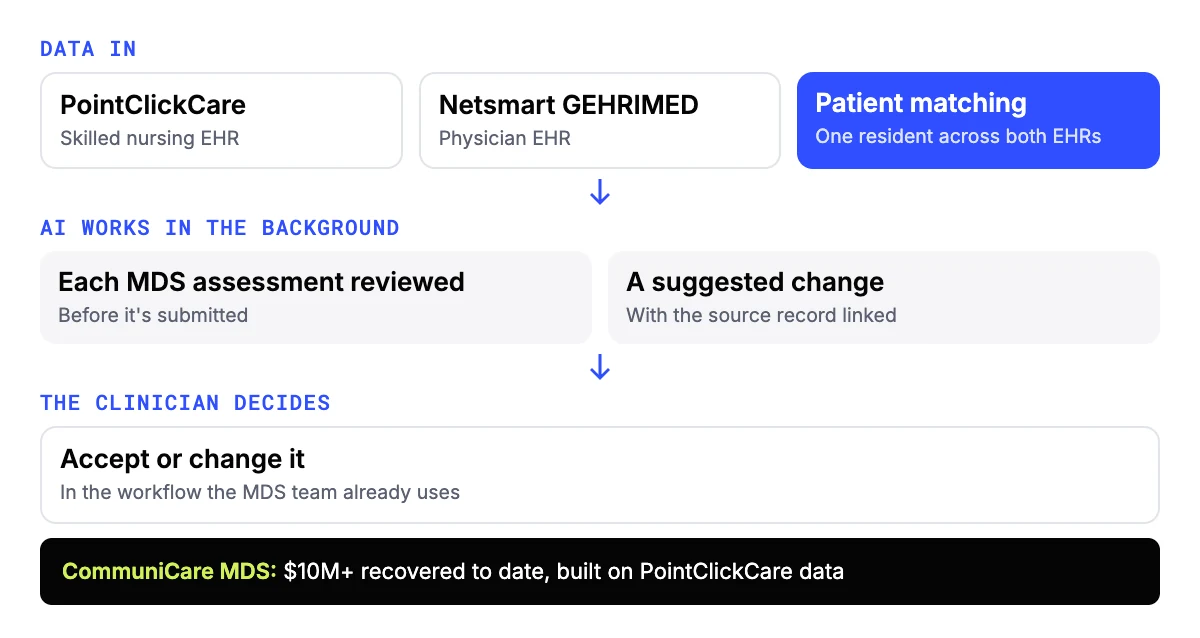
It looks like CommuniCare's MDS platform: AI recommendations for MDS coordinators, built on PointClickCare data and used across CommuniCare's skilled nursing facilities since April 2024.
PointClickCare is the system of record. We read assessment data, clinical notes, medications and lab results, scan for 200+ clinical events that change an MDS assessment, and surface recommendations inside the PointClickCare workflow. No separate login and no duplicate data entry. Every recommendation links to its source documentation, and the coordinator validates it before acting.
The result: $10M+ recovered to date, and $24M+ in forecast PDPM revenue. The same data foundation runs NeverAlone and CommuniCare's risk adjustment work, where we matched patients across GEHRIMED and PointClickCare and cleaned up patients carrying more than one Medicare ID. See the CommuniCare MDS case study.
Recovered to date (MDS)
Forecast PDPM revenue (MDS)
Clinical events scanned in PointClickCare data
EHR integration is the hardest part of healthcare technology
Healthcare AI pilots often stall at integration. The AI works in demos. The models are accurate. But when it's time to connect to the EHR, everything breaks down. API limitations, data format mismatches, authentication complexity, workflow timing. The challenges compound.
Generic technology vendors underestimate this. They build tools that require manual data entry or copy-paste workflows. Staff don't adopt them. The ROI never materializes. The pilot fails.
Our solutions are designed for integration from day one, not bolted on as an afterthought.
Why EHR Integration Fails
API Limitations
EHR APIs often don't expose the data or functionality needed. Workarounds require deep platform knowledge.
Authentication Complexity
OAuth flows, session management, token refresh. Healthcare authentication is more complex than standard integrations.
Data Format Mismatches
HL7, FHIR, proprietary formats: translating between systems requires careful mapping and validation.
Workflow Timing
Healthcare workflows have specific timing requirements. Async processes must fit clinical flow.
Which EHRs do you connect to, and how?
PointClickCare and Netsmart (GEHRIMED) run in production, Acclivity fed our risk adjustment work, and we've tested Epic in a sandbox. Anything else we connect through FHIR, HL7, vendor APIs or file feeds where the EHR supports them.
The status column is the honest part. Production means a live integration on a platform we run today. Sandbox means we've built against the vendor's test environment, not a live health system. Capability means the EHR publishes a way in and we'd build against it, with a sandbox test planned in the Blueprint.
Most of our production work sits in post-acute care, where PointClickCare is the system of record for skilled nursing and GEHRIMED serves the physicians who round there. We'd rather tell you where we stand up front than have you discover it in month three.
EHRs, how we connect and where each stands
| EHR | How we connect | Status | Where it runs |
|---|---|---|---|
| PointClickCare | Data access granted by the provider; recommendations surfaced in the PointClickCare workflow | Production | NeverAlone; CommuniCare MDS, now run by CommuniCare; risk adjustment, 2023 to 2024 |
| Netsmart (GEHRIMED) | Data integration with patients matched across EHRs to PointClickCare | Production | NeverAlone, risk adjustment |
| Acclivity Health | Data integration for diagnosis and risk data | Delivered 2023 to 2024 | Risk adjustment: 7 states, 245 providers, 20K+ patients |
| Epic | FHIR R4 APIs | Sandbox | Tested against Epic's FHIR sandbox |
| Elation Health | Elation's API | Capability | Scoped in the Blueprint |
| athenahealth | athenahealth's developer APIs | Capability | Scoped in the Blueprint |
| eClinicalWorks | eClinicalWorks FHIR APIs | Capability | Scoped in the Blueprint |
| Oracle Health (Cerner) | FHIR R4 APIs | Capability | Scoped in the Blueprint |
| MatrixCare | Vendor APIs or file feeds | Capability | Scoped in the Blueprint |
| Any other EHR | An API, a standard interface or a reliable export | Capability | Scoped in the Blueprint |
Production: live on a platform we run today. Sandbox: built against the vendor's test environment. Capability: the EHR publishes a way in, and we prove it in a sandbox before the build.
Our integrations with major EHR platforms
PointClickCare and Netsmart (GEHRIMED) run in production on platforms we operate, with patients matched across both. We've tested Epic in a sandbox. Elation and other EHRs we connect through FHIR, HL7, vendor APIs or file feeds where the EHR supports them.
PointClickCare
In productionIn production across CommuniCare's skilled nursing facilities on NeverAlone, and on the MDS platform we built and handed to CommuniCare's own team. Assessment data, clinical documentation and resident records, with recommendations surfaced inside the PointClickCare workflow.
- *MDS assessment data extraction
- *Clinical documentation integration
- *Resident demographics and census
- *Medication records and lab results
- *Real-time event triggers
Epic
Sandbox testedTested against Epic's FHIR sandbox; no Epic production interface on record. For a health system on Epic, we plan the route in the Blueprint: FHIR APIs, CDS Hooks or an interface the health system's Epic team supports.
- *FHIR R4 APIs, sandbox tested
- *CDS Hooks for clinical decision support
- *Patient record access
- *Order entry and results
- *Patient-facing apps through SMART on FHIR
Netsmart (GEHRIMED)
In productionIn production with Netsmart's GEHRIMED for post-acute and long-term care physician practices on NeverAlone, and used in our risk adjustment work. Patients are matched across GEHRIMED and PointClickCare.
- *Patient demographic synchronization
- *Encounter and progress note data
- *Diagnosis and problem list access
- *Medicare ID cleanup and deduplication
- *Patient matching with PointClickCare
Elation Health
CapabilityElation Health publishes a modern API for primary care and direct primary care practices. We build against it where a client runs Elation; no production Elation integration is on record.
- *Patient chart access and updates
- *Visit documentation
- *Orders and results integration
- *Billing and claims data
- *Patient portal connectivity
Can you read from the EHR, write back to it and react to events?
Yes, where the EHR allows each one. Reading is the common case. Writing back and event triggers depend on what the vendor exposes and what the provider approves.
Writing back is where integration projects slip. It needs the vendor's write permission, usually a separate sign-off from the provider's IT and compliance teams, validation on every field so bad data never lands in the chart, and a clinician who reviews clinical changes first. On CommuniCare's MDS platform, coordinators review every recommendation in PointClickCare before anything changes in the record.
Some EHRs only allow reads. Then we design the workflow around that instead of pretending otherwise.
Read
Demographics, diagnoses, assessments, notes, medications and labs, pulled through an API, a FHIR endpoint or a reliable export.
Write back
Notes, codes or billing data written to the EHR where the vendor permits it, validated field by field, with a person approving clinical changes.
Event triggers
ADT feeds (admit, discharge and transfer messages) and vendor webhooks start work the moment something happens, not at the next nightly batch.
Batch and files
When real time isn't offered, scheduled extracts or secure file feeds on a cadence the workflow can live with.
How we approach EHR integration
Read and Write Data Flows
Read from the EHR to inform the work. Write back where the vendor allows it, with a clinician approving. No copy-paste.
Real-Time Event Triggers
ADT notifications, order events, documentation saves trigger AI actions at the right moment in clinical workflow.
Batch Synchronization
When real-time isn't needed or available, batch processes keep data synchronized on appropriate schedules.
Workflow Embedding
AI tools appear within existing EHR workflows, not as separate applications requiring context switching.
Error Handling & Recovery
Healthcare integrations must be reliable. Error handling, retry logic and failure notifications.
Audit Trails
Every data access, every write, every modification logged. Compliance-ready audit documentation.
How do you keep an EHR integration reliable once it's live?
We assume it will break and build for that: retries, monitoring, audit logs and PHI controls from the first release, not after the first outage.
EHR integrations fail quietly. A token expires, a vendor renames a field, a feed stops overnight and nobody notices until a clinician opens an empty chart. PointClickCare's APIs are locked down and slow, so on CommuniCare's platforms we built the data engineering around them instead of waiting for them to change. Each integration ships with a runbook, so whoever is on call knows what normal looks like and what to do when it isn't.
Our security plan is mapped to NIST CSF 2.0, and we sign a BAA with every covered entity. More on security and PHI.
What breaks in a live EHR integration, and what we do about it
| What breaks | What we do |
|---|---|
| The vendor API is slow or down | Retries with backoff and queues that hold work until the EHR is back, so no record is lost |
| A token or credential expires | Automatic refresh, with an alert before expiry |
| A field changes or arrives empty | Validation on every record; bad data is set aside for review, not written |
| One patient, two IDs | Patient matching across EHRs. On CommuniCare we found and cleaned up multiple Medicare IDs per patient across GEHRIMED and PointClickCare |
| A feed stops | Monitoring on volume and freshness, with alerts to the team that runs it |
| Who saw or changed what | An audit log of every read and write, PHI encrypted in transit and at rest, and access limited by role |
Healthcare compliance built in
EHR integrations involve PHI. Compliance isn't optional. It's foundational to everything we build.
Compliant by Design
PHI handling, encryption, access controls: HIPAA requirements embedded in architecture.
Business Associates
BAAs in place for PHI handling responsibilities.
Who runs the integration after launch?
We do, for platforms we build. We watch the feeds, absorb vendor changes, ship fixes and take L2 and L3 support, while your team or IT provider takes first-line questions.
An EHR integration is never finished. Vendors release new versions, providers change workflows, and CMS updates the RAI manual every October, so the MDS logic has to follow. On CommuniCare's platforms we review each year's changes before they reach production.
We don't run desktop support or a help desk; we work alongside your IT provider or MSP. When you're ready to own it, we hand over the code, the cloud accounts and the runbooks on a build-operate-transfer plan. See platform operations.
NeverAlone in production since March 2021
Calls a year on NeverAlone
Support for platforms we built
Integration expertise you can't get from generic vendors
We're not a generic software shop that did a healthcare project once. We've built production integrations serving 30,000 patients across six states. We operate NeverAlone daily, which means we deal with EHR integration challenges in production, not just development.
This matters because integration problems often don't surface until production. Edge cases, data quality issues, performance under load. These challenges require experience to navigate quickly.
When you work with us, you get a team that has seen the patterns, knows the workarounds, and can solve integration problems without weeks of research and experimentation.
What We Bring
- Y Production experience with PointClickCare and Netsmart (GEHRIMED), plus Acclivity for risk adjustment. Epic tested in a sandbox. Other EHRs through FHIR, HL7, vendor APIs or file feeds where the EHR supports them.
- Y 30,000 patients served through our integrations
- Y HIPAA compliance built into every integration
- Y Read and write, where the EHR allows it
- Y Real-time event triggers for workflow integration
- Y Production support and troubleshooting
Every solution we build integrates with your EHR
Documentation Automation
AI-drafted documentation that clinicians review before it reaches the EHR.
MDS / PDPM
MDS data extraction and recommendation integration with PointClickCare.
Virtual Care
Virtual care visits with the resident's chart on screen, pulled from the EHR.
Back-Office AI
Revenue cycle AI connected to billing and clinical systems.
Ambient AI Scribes
AI-drafted clinical notes for clinician review, ready for the EHR encounter.
RAF / HCC Coding
Risk adjustment coding pulls diagnosis data from clinical records.
Revenue Cycle AI
Claims, denials, and prior auth automation connected to your billing systems.
EHR integrations in production
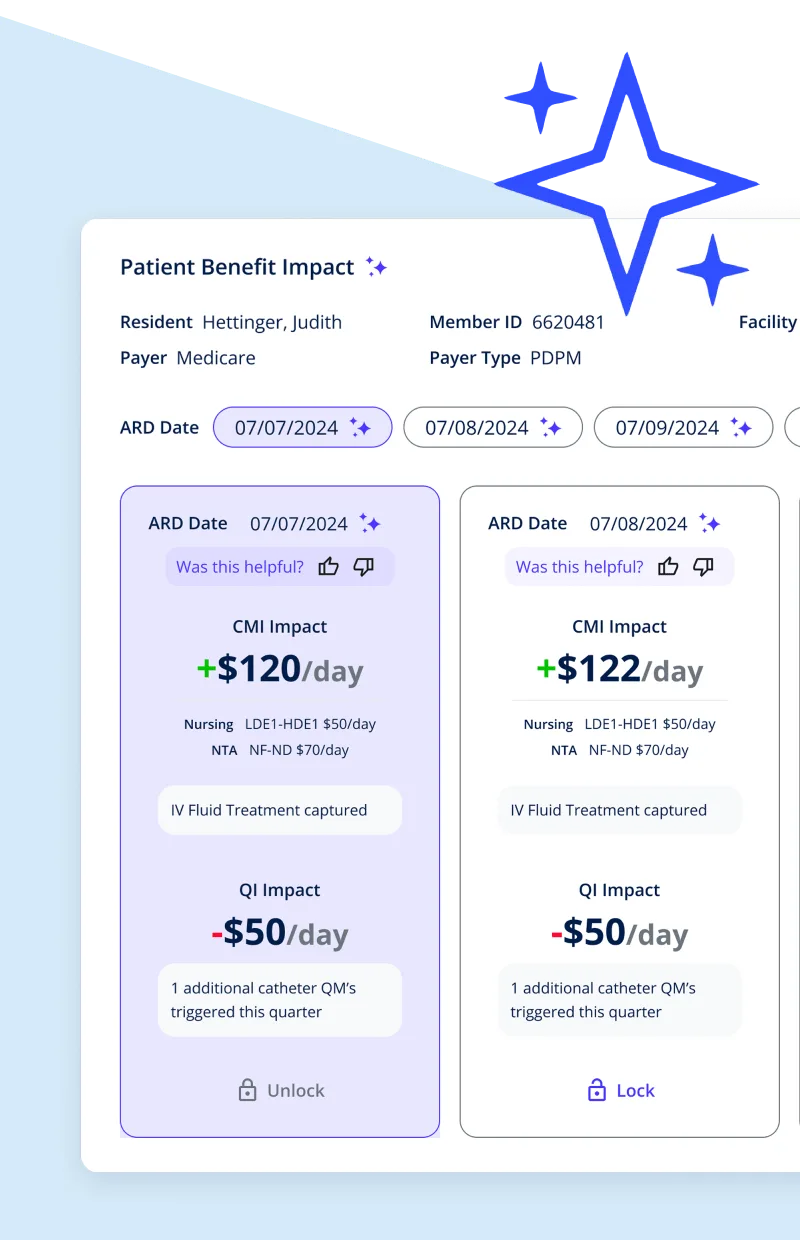
CommuniCare MDS · PointClickCare
$10M+ recovered to date; $24M+ forecast PDPM revenue
AI recommendations for MDS coordinators inside the PointClickCare workflow, with no separate login.
See the work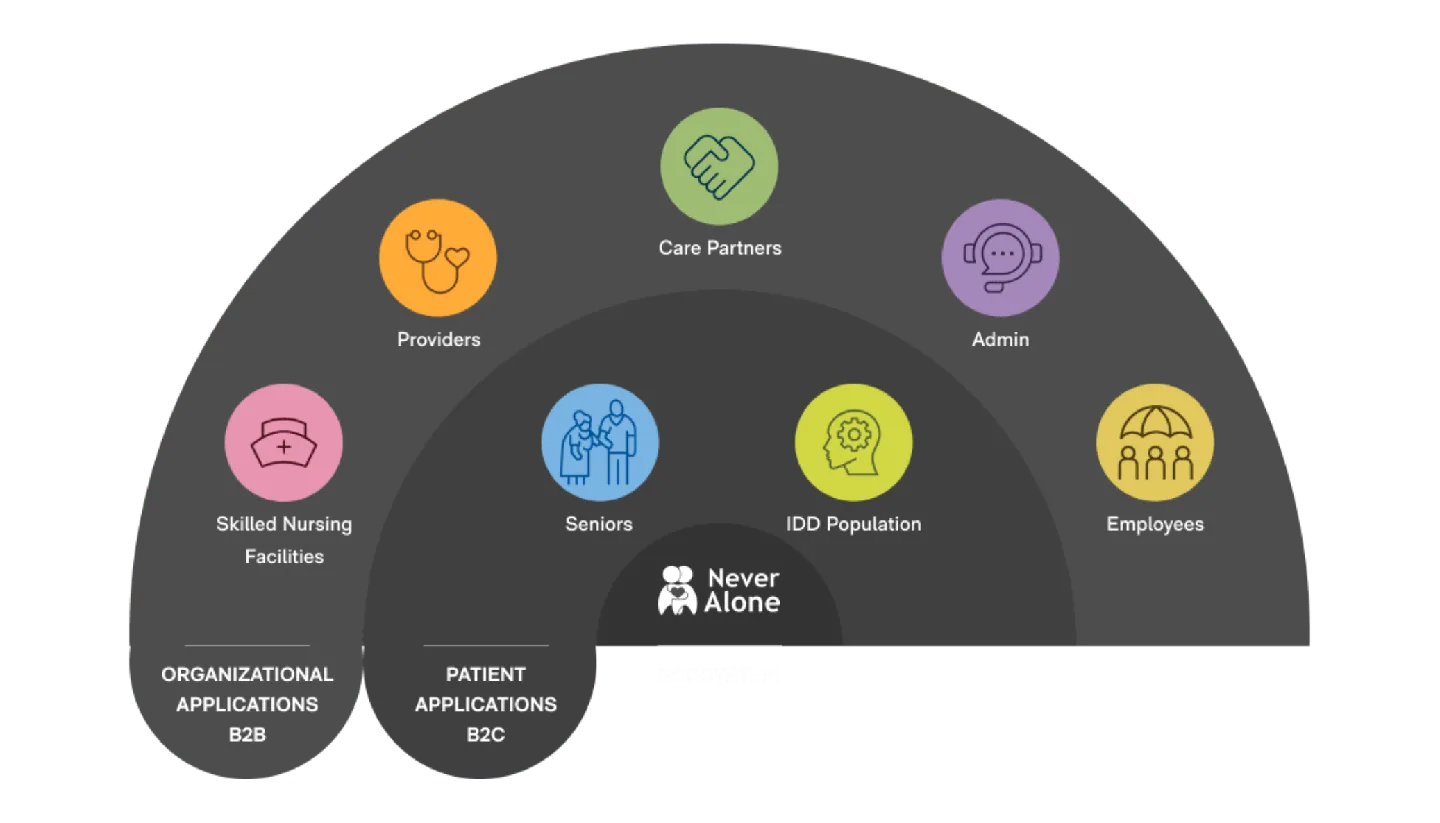
NeverAlone · CommuniCare
30,000 patients across six states
A 24/7 virtual care platform with PointClickCare and GEHRIMED data and patients matched across both EHRs.
See the work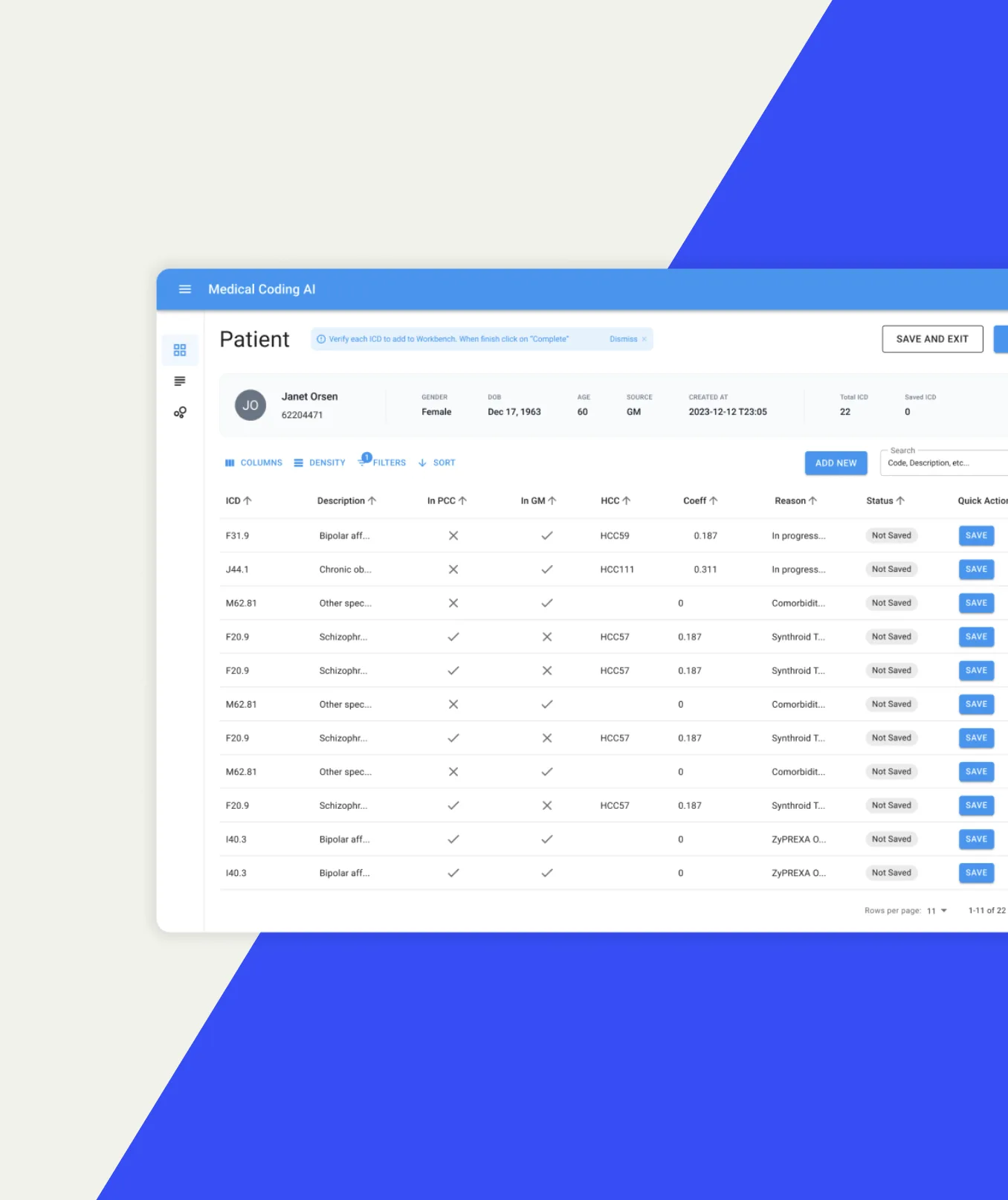
CommuniCare risk adjustment
$10M+ at 90%+ accuracy
GEHRIMED, PointClickCare and Acclivity data behind AI coding support across 7 states, 245 providers and 20K+ patients.
See the workTrusted by healthcare leaders.
“Digital Scientists provided immense value to our plan administrators, providers, and patients. The team was able to come in and understand our core needs, while remaining product agnostic. They helped identify the technical debt and pitfalls, and to get us to a point of stabilization and growth.”

Robert Hager
CEO, CommuniCare Advantage
“Thank you to the Digital Scientists team, this has been a long time coming! We finally have something that will be useful for our team so I want to take this opportunity to thank you for your hard work and your diligence. You took an idea and made it come to life!”

Dr. Charles Clayton Daniels Jr.
CEO & Founder, Fathers' UpLift
Related healthcare work
Healthcare integrations
EHR, FHIR, labs, payers, claims and HIPAA cloud.
Healthcare integrations →FHIR and HL7
Standards-based data exchange, planned before the build.
FHIR and HL7 →Behavioral health EHR integration
Integrations for behavioral health and SUD providers.
Behavioral health EHR integration →MDS and PDPM
AI for MDS coordinators, built on PointClickCare.
MDS and PDPM →RAF and HCC coding
Risk adjustment on data from three EHRs.
RAF and HCC coding →API and integration development
Our integration practice across industries.
API and integration development →Latest thinking on EHR data and integration
Questions about EHR integration
Can you write back to the EHR?
Yes, where the EHR allows it. Writing back needs the vendor's write permission, the provider's approval, validation on every field and, for clinical data, a person who reviews the change first. On CommuniCare's MDS platform, recommendations surface inside PointClickCare and coordinators validate each one against its source documentation before acting. Some EHRs only allow reads, and then we design the workflow around that.
Do you have PointClickCare Marketplace access?
Our PointClickCare work runs on data access the operator grants, which is how most provider-built tools connect. If your product needs a PointClickCare Marketplace listing to sell to many facilities, the partner application, review and timelines are part of the plan, and we scope them in the Blueprint so they don't surprise your launch date.
Epic: App Orchard, Showroom or an interface?
Our Epic work so far is in a sandbox: we've pulled patient data from Epic's FHIR sandbox. We don't have an Epic production interface or a Showroom listing on record. For a product many Epic health systems will buy, the usual route is a SMART on FHIR app through Epic's developer program; Showroom replaced App Orchard. For one health system, it's often faster to build to the interface that system's Epic team already supports. We pick the route in the Blueprint.
What about athenahealth and eClinicalWorks?
Both publish APIs: athenahealth through its developer platform and eClinicalWorks through FHIR APIs. We haven't run either in production. We'd build against their sandbox first, confirm what the API exposes for your workflow, and plan access approvals in the Blueprint. We can integrate with any system that has an API, a standard interface or a reliable export.
How do you handle PHI in an EHR integration?
We sign a BAA with every covered entity, encrypt PHI in transit and at rest, limit access by role and log every read and write. Our security plan is mapped to NIST CSF 2.0, and each client gets a security addendum. Integrations run in a HIPAA-eligible cloud account, which can be your own AWS account.
Where does an EHR integration project start?
Most start with a Blueprint that maps the data you need, what each EHR exposes, who has to approve access and where the risk sits. If the integration is the risky part, we pull it forward and prove it against the vendor's sandbox before the full build. These are common starting points, not rules.
Tell us what needs to connect
No commitment. No sales deck. We respond the same day, and you talk to senior leadership.
We run integrations in production with PointClickCare, MatrixCare and Netsmart over FHIR, HL7 and ADT.