
Healthcare IT consulting that ends in working systems
Digital Scientists is a healthcare technology consulting team for providers, health plans and community organizations without an in-house digital team. We audit the systems you run, run vendor-neutral EHR and vendor selection, write the roadmap, then build and run what it calls for. For CommuniCare Advantage, a Medicare Advantage special needs plan, we audited 60+ systems, ran an 11-vendor EHR selection and cut the technology footprint by 25%. Most clients start with a 4-week Blueprint.
Updated

Systems audited for CommuniCare Advantage
EHR vendors in one selection
Requirements scored across 15 categories
Smaller technology footprint






What does healthcare IT consulting look like when it ends in a working system?
It ends with fewer systems, one source of truth and reports the regulator accepts. That's what it looked like for CommuniCare Advantage, a Medicare Advantage special needs plan that was growing into an accountable care organization.
Years of growth had left the plan with more than 60 digital products, several EHRs that didn't meet its needs, and data split across clinical and operational systems. CMS reporting was at risk, and missed billing was costing money.
We started with interviews and an audit of every system, then mapped how data moved between patients, providers, the EHR, care management and CMS. That map, shown here, became the basis for every decision after it.
Next came an 11-vendor EHR selection and a formal RFP. Then we built a SQL data mart and a Power BI reporting suite, including the Universe Report for CMS audits, HRA and care plan completion, risk levels and scheduling. The plan was back in CMS compliance in under six months, with a technology footprint 25% smaller. Read the CommuniCare Advantage case study.
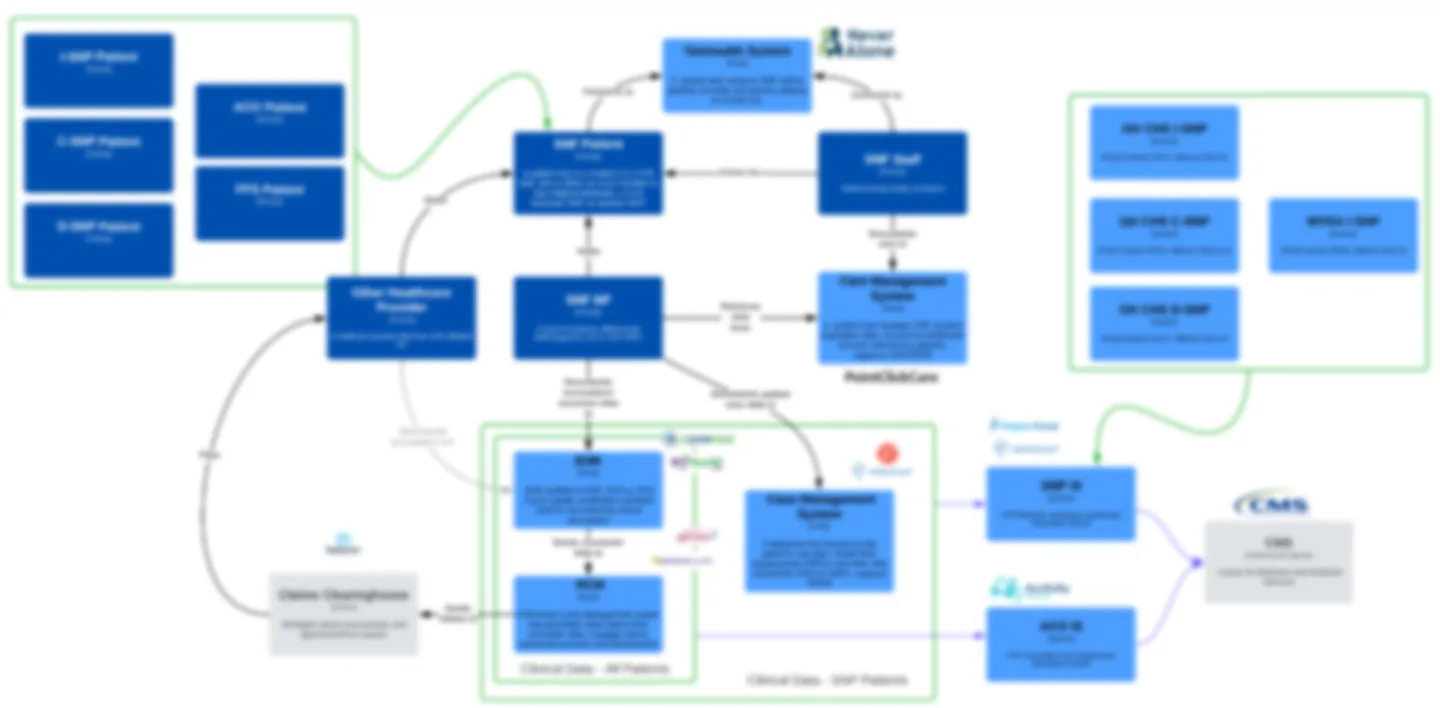
From our CommuniCare Advantage audit: a map of 60+ systems and how patients, providers and the plan connect.
Who is healthcare IT consulting for?
Healthcare organizations that run a lot of software but don't have a digital team to own it. Someone keeps the laptops and network running. Nobody owns how the systems fit together, which ones to keep, or what to build next.
Providers
Post-acute, behavioral health, physician groups and senior care operators with an EHR, a billing system and a dozen tools added one at a time. See post-acute and senior care.
Health plans
Medicare Advantage, special needs and risk-bearing plans whose CMS reporting depends on data spread across vendors. See health plans and payers.
Community organizations
Rural health, community programs and grant-funded organizations that need a plan a funder will accept, and someone to deliver it. See rural and community health.
Leaders between decisions
A CEO, COO or CFO facing an EHR renewal, a compliance finding or an acquisition, who wants an independent read before signing anything.
What does a healthcare technology ecosystem audit find?
It finds what you actually run, what each system costs, where the data goes and which systems you can retire. An ecosystem audit is an inventory of every system, integration and data flow, mapped against how your teams work today.
We interview executives and the people who do the work, then document every product, who owns it, what it connects to and what it costs. The output is a current-state map, a target-state map and a ranked list of what to keep, replace, connect or retire.
We also document the compliance requirements the systems have to meet. For a health plan, that's CMS reporting. For a provider, it's often billing, quality measures and HIPAA.
At CommuniCare Advantage the audit covered 60+ digital products. It showed overlapping tools, siloed clinical and operational data, and no proactive view of the numbers CMS audits. The fixes it pointed to cut the footprint by 25%.
Digital products audited and mapped
Back to CMS compliance
Smaller technology footprint
How do you choose an EHR or vendor without being sold to?
You write down what you need before any vendor demos, then score every vendor against the same list. We run that process for you, product agnostic, and the scoring is yours to keep.
For CommuniCare Advantage we looked at 11 EHR and care management platforms. We scored them on 434 requirements across 15 categories, including post-acute experience, compliance and how well each would integrate with the rest of the plan's systems.
Then we ran the RFP: the requirements document, vendor questions, onsite presentations and a grading matrix the leadership team used to decide. We also used a buy, build or partner framework, because sometimes the right answer is to buy most of it and build one piece.
After the decision, we consulted on the migration to the new EHR so the choice held up in practice. Robert Hager, the plan's CEO, put it this way: we understood their core needs "while remaining product agnostic."
EHR and care management vendors compared
Requirements scored, across 15 categories
Decision the leadership team could defend
What goes into a healthcare IT roadmap?
Four kinds of work, in order: connect the systems you keep, modernize the ones holding you back, automate the manual work, and build only what you can't buy. Each item gets a reason, a cost range and an owner.
Most roadmaps fail because they list projects without saying which to do first. Ours rank the work by what it's worth and what it depends on. A report can't be right until the data behind it is connected, so connecting usually comes first. Nobody likes a big-bang replacement, so we plan to take over from a legacy system in stages.
The four kinds of work in a healthcare IT roadmap
| Step | What it means | Example from our work |
|---|---|---|
| Connect | Integrate the systems you keep, so data moves once and lands in one place. | A SQL data mart for CommuniCare Advantage as the single source of truth. See healthcare integrations. |
| Modernize | Replace or retire systems that cost more than they return, in stages. | An 11-vendor EHR selection and migration consultation; a 25% smaller footprint. |
| Automate | Take repeat manual work off staff: reports, checks, coding review. | Power BI reports for CMS audits, HRA and care plan completion, risk and scheduling. |
| Build | Build only what no vendor sells, where it moves a number you care about. | A custom care management platform for NeverAlone that replaced Salesforce. |
The order changes by organization. Some roadmaps are mostly connect; others start with a build because nothing on the market fits.
What happens after the plan?
We build it. The same senior team that wrote the roadmap does the integration and software work, so nothing gets lost in a handoff between a consultant and a builder.
At CommuniCare Advantage the roadmap turned into a data mart and a Power BI reporting suite. For Duke, a landscape analysis and buy-or-build recommendation turned into an interactive social determinants of health map and a custom CRM. For Congruity Health, work on positioning turned into an analytics platform that tracks 7,020 enrolled patients.
Once it's live, we run it if you want us to. We support platforms we built, with your team or ours taking first-line questions and Digital Scientists handling L2 and L3. We also offer build-operate-transfer: we build it, run it until it's stable, then hand over the code, accounts and know-how. We've run NeverAlone, a virtual care platform for 30,000 patients across six states, since March 2021. See platform operations.
Patients on NeverAlone, a platform we run
NeverAlone live, and still running
Support for platforms we built, or a planned handover
Consulting that turned into working systems

CommuniCare Advantage
60+ systems audited, 25% smaller footprint
Ecosystem audit, 11-vendor EHR selection and RFP, then a data mart and Power BI reporting that brought the plan back to CMS compliance in under six months.
See the work
Duke
Buy-or-build call, then the build
A landscape analysis and buy-or-build recommendation that became an interactive social determinants of health map and a custom CRM for community partnerships.
See the work
Congruity Health
7,020 patients tracked
Positioning and competitive work that became an analytics platform turning claims and eligibility data into interventions for chronic disease.
See the workTrusted by healthcare leaders.
“Digital Scientists provided immense value to our plan administrators, providers, and patients. The team was able to come in and understand our core needs, while remaining product agnostic. They helped identify the technical debt and pitfalls, and to get us to a point of stabilization and growth.”

Robert Hager
CEO, CommuniCare Advantage
“The team at Digital Scientists was a huge help in not only developing our analytics platform, but understanding the competitive space and defining our true value proposition for our customers.”

Justin Davis
CEO, Congruity Health
How do you start a healthcare IT consulting engagement?
Most clients start with one paid, time-boxed step that ends in a decision. These are common starting points, not rules, and the first 30-minute conversation is free.
Common ways to start healthcare IT consulting
| Start | What you get | Time | Investment | Best when |
|---|---|---|---|---|
| Blueprint | Scope, architecture, compliance requirements, user stories and a milestone budget for something new. | 4 or 6 weeks | $25K, or from $50K with a prototype | The roadmap calls for a build and your board needs a number. |
| Build with Us | A senior solution architect working in your systems on one real piece of work. | Two weeks, then month to month | $10K, then $20K a month | You already know the first integration or fix. |
Prices from our published Blueprint and Build with Us pages. See all ways to start.
Related services
Healthcare integrations
Connect the systems the roadmap says to keep.
Healthcare integrations →EHR integration
PointClickCare, Netsmart and the systems around your EHR.
EHR integration →Healthcare data engineering and analytics
Data marts, pipelines and reporting your regulators accept.
Healthcare data engineering and analytics →Platform operations and build-operate-transfer
We run what we build, or hand it over.
Platform operations and build-operate-transfer →Ways to start
Blueprints, MVPs and Build with Us, with prices.
Ways to start →Technical advisory
Senior technical advice outside healthcare.
Technical advisory →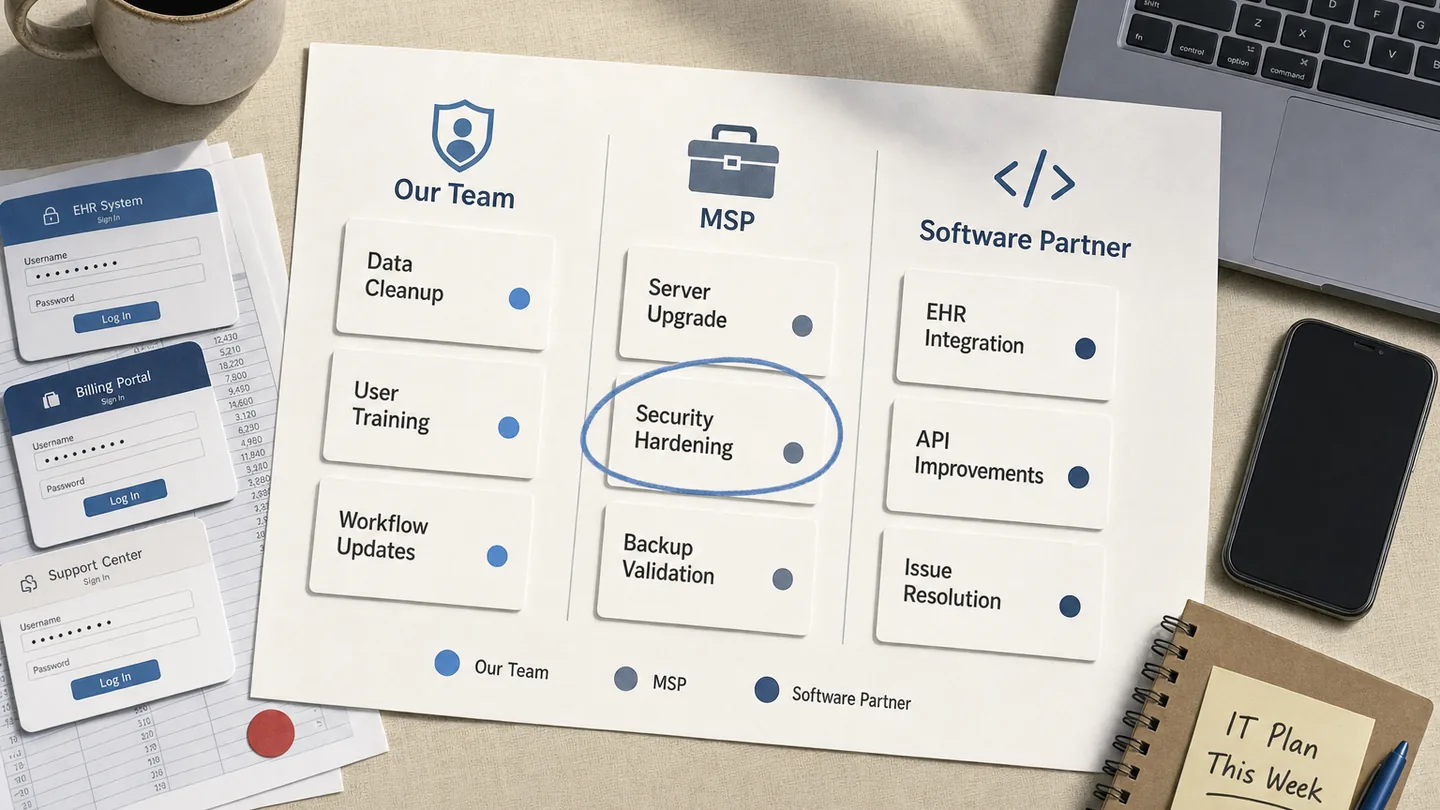
Questions about healthcare IT consulting
Do you also do desktop and network support?
No. We don't do desktop, network or helpdesk support. We work alongside your IT provider or MSP, who keeps devices and networks running, while we handle the systems, integrations, data and software.
Can you help us choose an EHR?
Yes. We document your requirements, compare the vendors that fit, run demos against the same scoring matrix and help you plan the migration. For CommuniCare Advantage we evaluated 11 EHR and care management platforms against 434 requirements.
How long does an audit take?
A Blueprint on an existing platform takes 4 to 6 weeks. A full ecosystem audit of a larger organization takes longer, set by the number of systems and interviews. CommuniCare Advantage's covered more than 60 systems.
Are you vendor-neutral?
Yes. We recommend what fits your requirements, and the scoring matrix is yours to see. Sometimes our recommendation is to buy, sometimes to build one piece, and sometimes to keep what you have and connect it.
Can you run our RFP?
Yes. We write the requirements and the RFP, manage vendor questions and presentations, score responses on a grading matrix and give your leadership team a recommendation. You make the decision.
Do you build what the roadmap recommends?
Yes, if you want us to. The same senior team does the integration and software work, and we support the platforms we build with L2 and L3 support or a planned handover to your team.
Talk it over
Tell us what you are trying to do. A senior person from our Atlanta team replies within one business day, and you can book a 30-minute call right after you send this.
- We tell you if we're the right fit, and if we're not, who is.
- Most work starts small, so you see how we work before you commit to more.
- We sign a BAA before we touch patient data.