A healthcare IT strategy for a two-person IT team is a short, ranked list of which systems to keep, connect, replace or build, and a named owner for each decision. Your IT staff or MSP keep devices and the network running. Someone still has to own how the systems fit together. Digital Scientists fills that seat, then builds what the plan calls for. For CommuniCare Advantage we audited 60+ systems, ran an 11-vendor EHR selection and cut the technology footprint by 25%. Most organizations start with a 4-week Blueprint.
What does a two-person IT team actually own?
A two-person IT team owns uptime: laptops, accounts, the network, the phones, and the ticket queue that never empties. That's a full-time job, and it's the right job for them. What nobody owns is the system map: which applications you run, what each one costs, where patient data moves between them, and which ones you should stop paying for.
In a post-acute operator, a behavioral health practice or a community program, that gap shows up the same way. The EHR was chosen years ago. Billing runs in a second system. Intake, scheduling and reporting grew up around them in spreadsheets and form tools. Every new program added a vendor. When the COO asks why a report takes three days, the honest answer is that nobody was ever assigned the question.
That's the job of healthcare IT consulting done right: an independent owner for the system map, the vendor decisions and the roadmap, working alongside the people who keep the lights on.
Isn't that what our MSP is for?
No. A managed service provider, or MSP, is an outside firm that runs your devices, network, security tooling and helpdesk under a service agreement. A good MSP is worth every dollar. Its job is keeping the infrastructure healthy, not deciding whether your EHR still fits, how your care management data should reach your billing system, or what to build next.
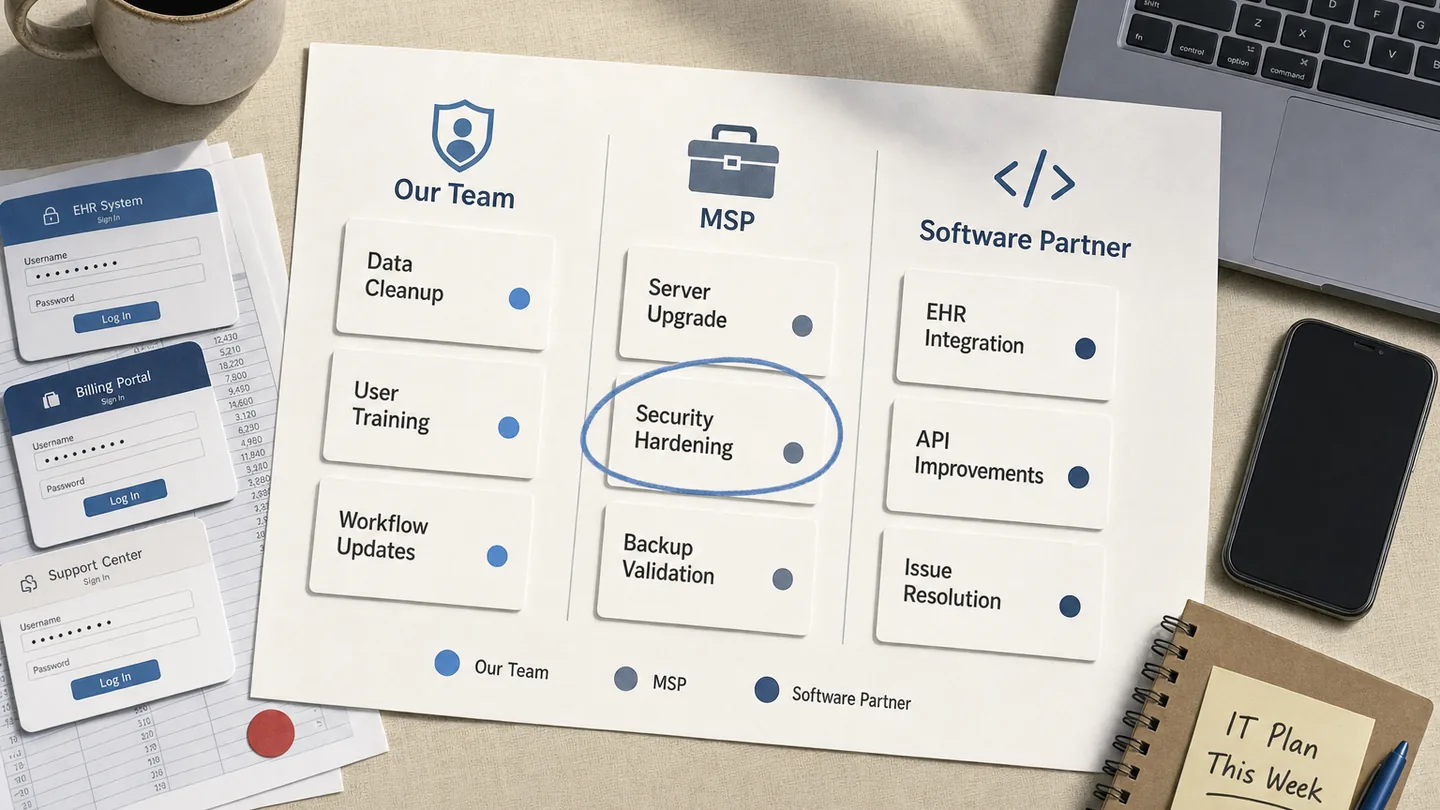
Digital Scientists is not an MSP and doesn't do desktop, network or helpdesk support. We work next to your IT staff and your MSP, never in place of them. They keep devices and networks running. We handle the systems, integrations, data and software. The split is clean, and it keeps everyone doing what they're good at.
| Your IT staff | Your MSP | Digital Scientists | |
|---|---|---|---|
| Owns | Day-to-day users, accounts and on-site issues | Devices, network, security tooling and helpdesk | The system map, vendor decisions, integrations, data and custom software |
| Typical work | Onboarding staff, fixing access, first-line questions | Patching, backups, monitoring, endpoint security | Ecosystem audits, EHR selection and RFPs, roadmaps, builds |
| Answers the question | Is it working today? | Is the infrastructure healthy and secure? | Are these the right systems, connected the right way? |
| After launch | Takes first-line questions | Keeps the infrastructure running | L2 and L3 support on platforms we built, or a planned handover |
Where does tool sprawl come from?
Tool sprawl comes from solving each problem with the nearest tool. Nobody plans it. A program launches and needs intake, so someone builds a form. Tracking goes into a shared spreadsheet. The EHR covers billing but not the way your staff actually work, so the workflow lives everywhere else.
Fathers' UpLift, a Boston mental health program for fathers, ran exactly that way. Providers juggled Tebra, an EHR designed for medical offices, plus Google Sheets for tracking and JotForm for intake. None of it fit a coaching-centered model, and there was no single source of truth. We built a purpose-built EHR that replaced the juggling with one hub and kept Tebra as the billing system of record, synced for demographics, claims and charge capture. They went from Blueprint to a working MVP in 8 weeks. Read the Fathers' UpLift case study.
The lesson for a small team: sprawl isn't a discipline problem. It's a sign that the core system doesn't fit the work, and adding tools around it won't fix that.
What should a healthcare IT strategy cover?
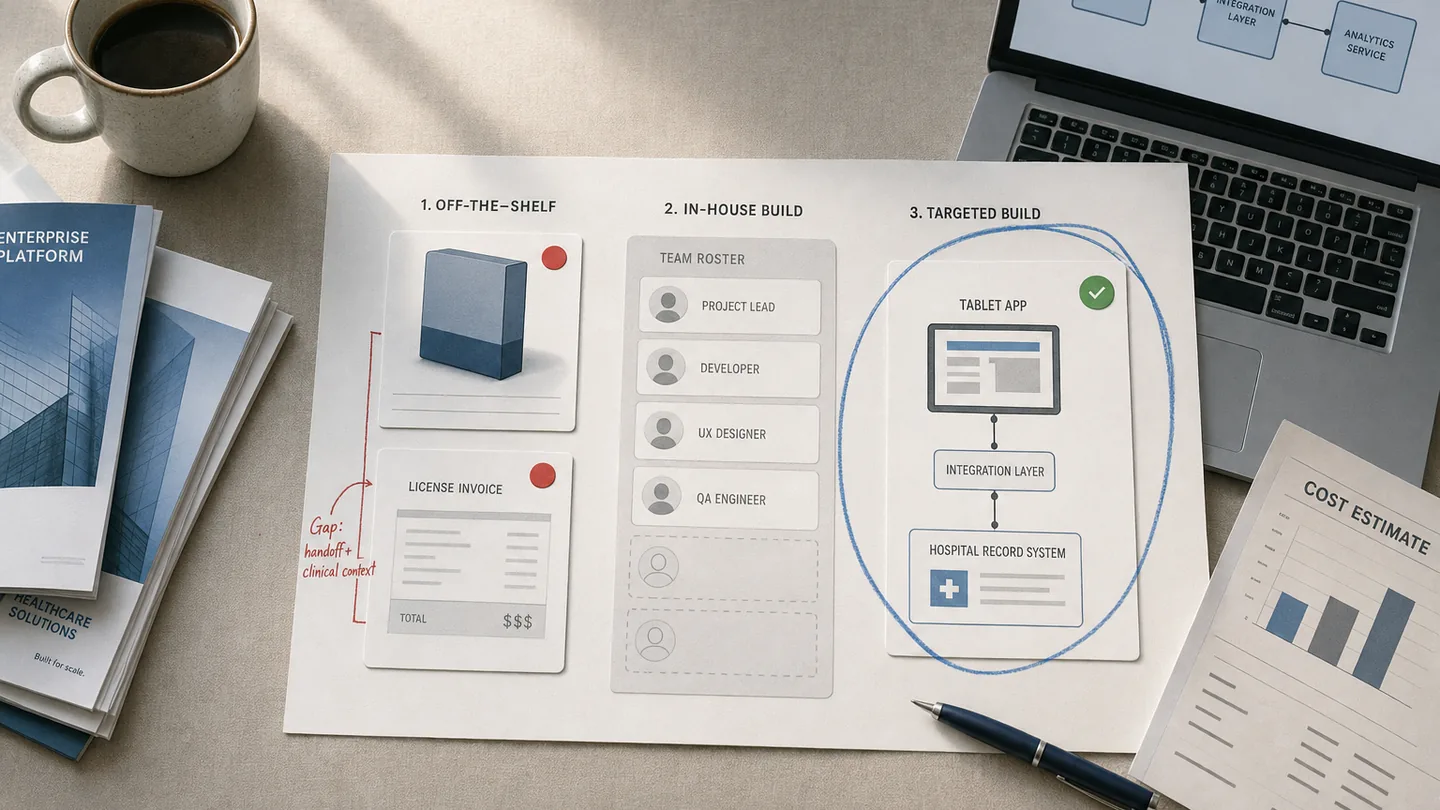
It should cover four kinds of work, in order: connect the systems you keep, modernize the ones holding you back, automate the manual work, and build only what you can't buy. Each item gets a reason, a cost range and an owner.
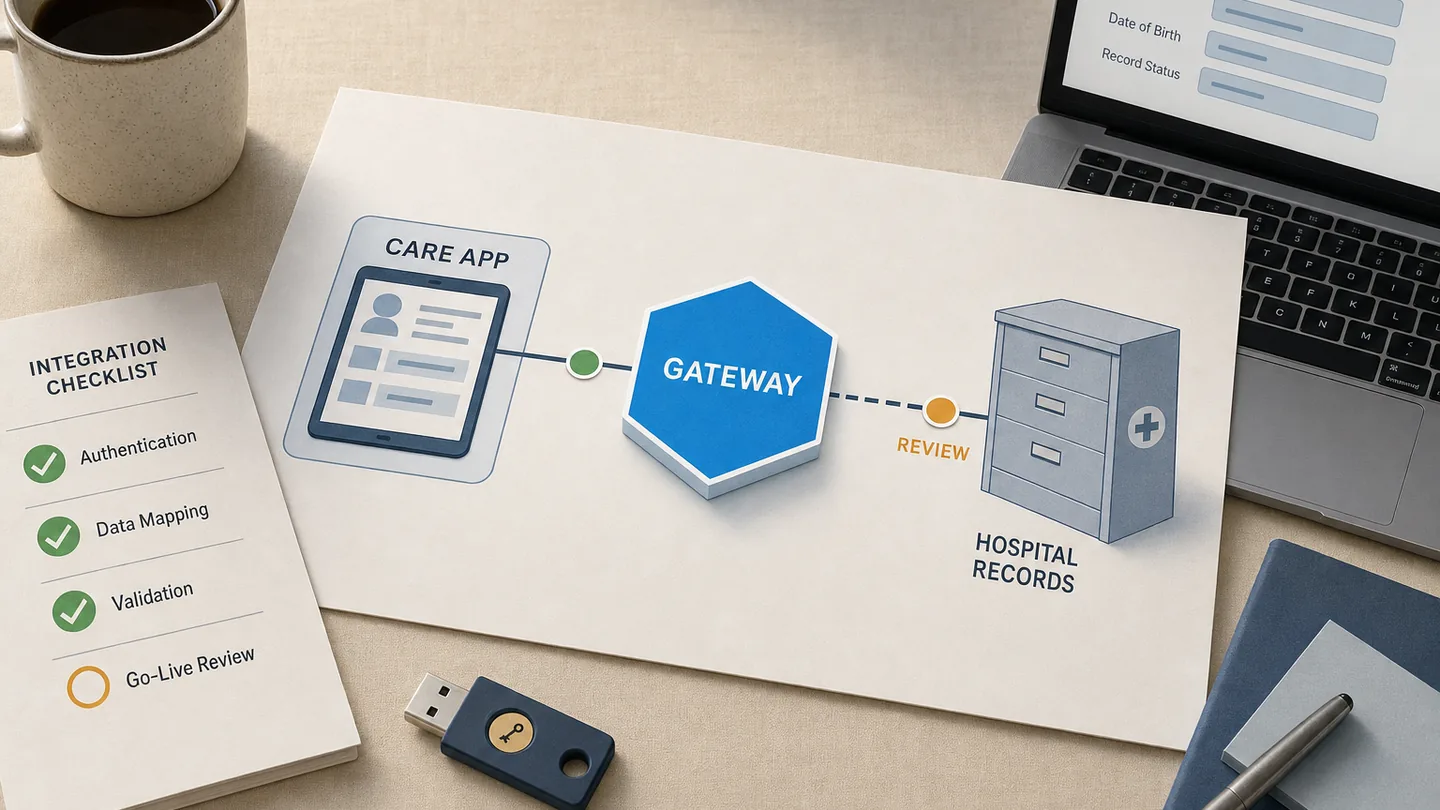
- Connect. Integrate the systems you keep so data moves once and lands in one place. A report can't be right until the data behind it is connected, so this usually comes first. See healthcare integrations.
- Modernize. Replace or retire systems that cost more than they return, in stages. Nobody likes a big-bang replacement while clinical staff keep working.
- Automate. Take repeat manual work off staff: reports, checks, reconciliations.
- Build. Build only what no vendor sells, where it moves a number you care about.
Most roadmaps fail because they list projects without saying which to do first. Rank the work by what it's worth and what it depends on, and the order mostly writes itself.
How do you find out what you actually run?
You run an ecosystem audit: an inventory of every system, integration and data flow, mapped against how your teams work today. We interview executives and the people who do the work, then document every product, who owns it, what it connects to and what it costs. The output is a current-state map, a target-state map and a ranked list of what to keep, replace, connect or retire.
At CommuniCare Advantage, a Medicare Advantage special needs plan, the audit covered 60+ digital products. It showed overlapping tools, siloed clinical and operational data, and no proactive view of the numbers CMS audits. We then built a SQL data mart and a Power BI reporting suite. The plan was back in CMS compliance in under six months, with a technology footprint 25% smaller.
How do you choose an EHR without being sold to?
Write down what you need before any vendor demos, then score every vendor against the same list. A small IT team rarely has the hours to run that process, and vendors know it. The demo becomes the requirements document, and the best presenter wins.
For CommuniCare Advantage we compared 11 EHR and care management platforms against 434 requirements across 15 categories, including post-acute experience, compliance and how well each would integrate with the rest of the plan's systems. We ran the RFP, managed vendor questions and presentations, and gave leadership a grading matrix they could defend. They made the decision. Sometimes the right answer is to buy most of it and build one piece; sometimes it's to keep what you have and connect it.
Who runs what gets built?
Whoever builds it should be ready to run it, or hand it over on a date you agree. A two-person IT team can't absorb a new platform on top of everything else, and it shouldn't have to.
We support the platforms we build, with your team taking first-line questions and Digital Scientists handling L2 and L3. We also offer build-operate-transfer: we build it, run it until it's stable, then hand over the code, accounts and know-how to your team. We've run NeverAlone, a virtual care platform for 30,000 patients across six states, since March 2021. See platform operations.
How do you start with a small team?
Start with one paid, time-boxed step that ends in a decision. These are common starting points, not rules:
- Blueprint. 4 weeks at $25K, or 6 weeks from $50K with a working prototype, when the roadmap calls for a build and your board needs a number.
- Build with Us. $10K for two weeks, then $20K a month, when you already know the first integration or fix.
The first 30-minute conversation is free. Bring your system list, even if it's a spreadsheet, and your IT lead or MSP contact. See all ways to start.
Frequently asked questions
What is a healthcare IT strategy?
A healthcare IT strategy is a ranked plan for which systems to keep, connect, replace or build, with a reason, a cost range and an owner for each item. For a small organization it fits on a few pages and starts with an inventory of what you run today.
Does Digital Scientists replace our MSP?
No. We don't do desktop, network or helpdesk support. We work alongside your IT staff and MSP, who keep devices and networks running, while we handle the systems, integrations, data and software.
Do we need a CIO to have an IT strategy?
You need someone who owns the system map and the vendor decisions. In a small organization that's usually the COO or CEO, working with an outside team that does the audit, the vendor selection and the roadmap, and then builds what it calls for.
How long does an IT audit take?
A Blueprint on an existing platform takes 4 to 6 weeks. A full ecosystem audit of a larger organization takes longer, set by the number of systems and interviews. CommuniCare Advantage's covered more than 60 systems.
Are you vendor-neutral?
Yes. We recommend what fits your requirements, and the scoring matrix is yours to see. Sometimes the recommendation is to buy, sometimes to build one piece, and sometimes to keep what you have and connect it.