Buy healthcare software when the workflow is standard and the product isn't what sets you apart. Build when the software is your product, your workflow is your advantage, or the integrations you need don't exist off the shelf. Partner when you need to build but don't have a product team yet. At Digital Scientists, a 4-week Blueprint ($25K) settles the question before you commit to a license or a build. NeverAlone started that way, as a 90-day MVP, and now serves 30,000 patients across six states.
When should you buy healthcare software?
Buy when the workflow looks the same at every organization like yours and a vendor already covers most of it. Billing, scheduling, payroll and the core EHR for most practices are solved problems, and paying someone else to keep them current is the cheap option.
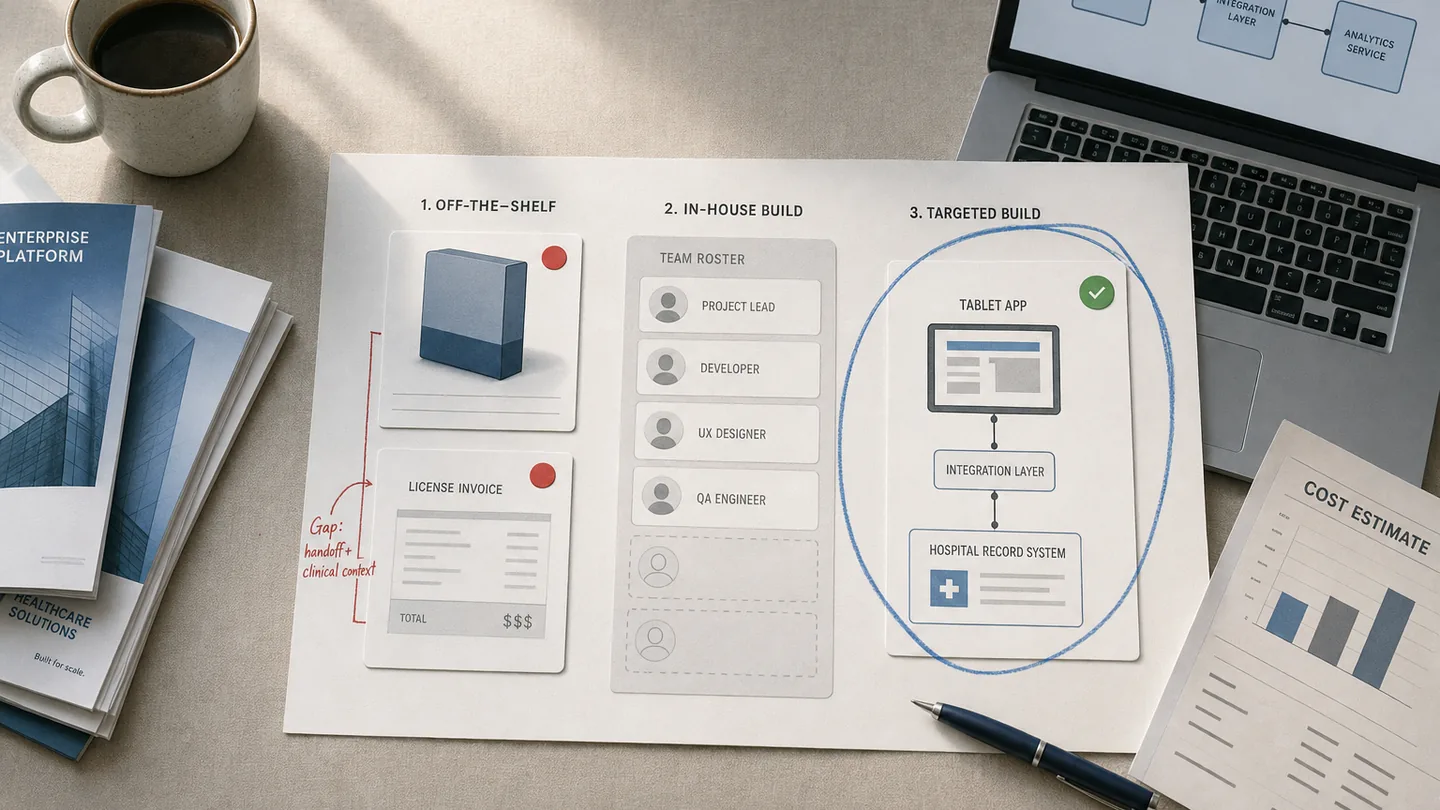
The license is rarely the full cost. You also pay for implementation, configuration, training, the integrations the vendor doesn't include, and the workarounds your staff build when the product doesn't fit. Total cost of ownership is the license plus everything it takes to make the product work in your operation, for as long as you run it. Price that before you sign.
A good test: if three competitors could run the same product the same way and no patient would notice, buy it.
When does building make sense?
Build when the software is the product you sell, when your clinical or operational workflow is what makes you better, or when the integrations you need aren't on any vendor's roadmap. People don't invest in custom development if it doesn't move the needle, so the first question is which needle, and by how much.
You're in build territory when most of these are true:
- The platform is what your customers pay for, or what an investor or acquirer will diligence.
- Your workflow is non-standard, and staff already run it on spreadsheets and side tools.
- Your data is an asset you want to own, including for AI later.
- You want to own the patient experience end to end and make it easy for them.
Building also means owning: the code, the roadmap, and the job of keeping it running under HIPAA. If nobody on your side will own the product after launch, decide who will before you start.
What does custom healthcare software cost?
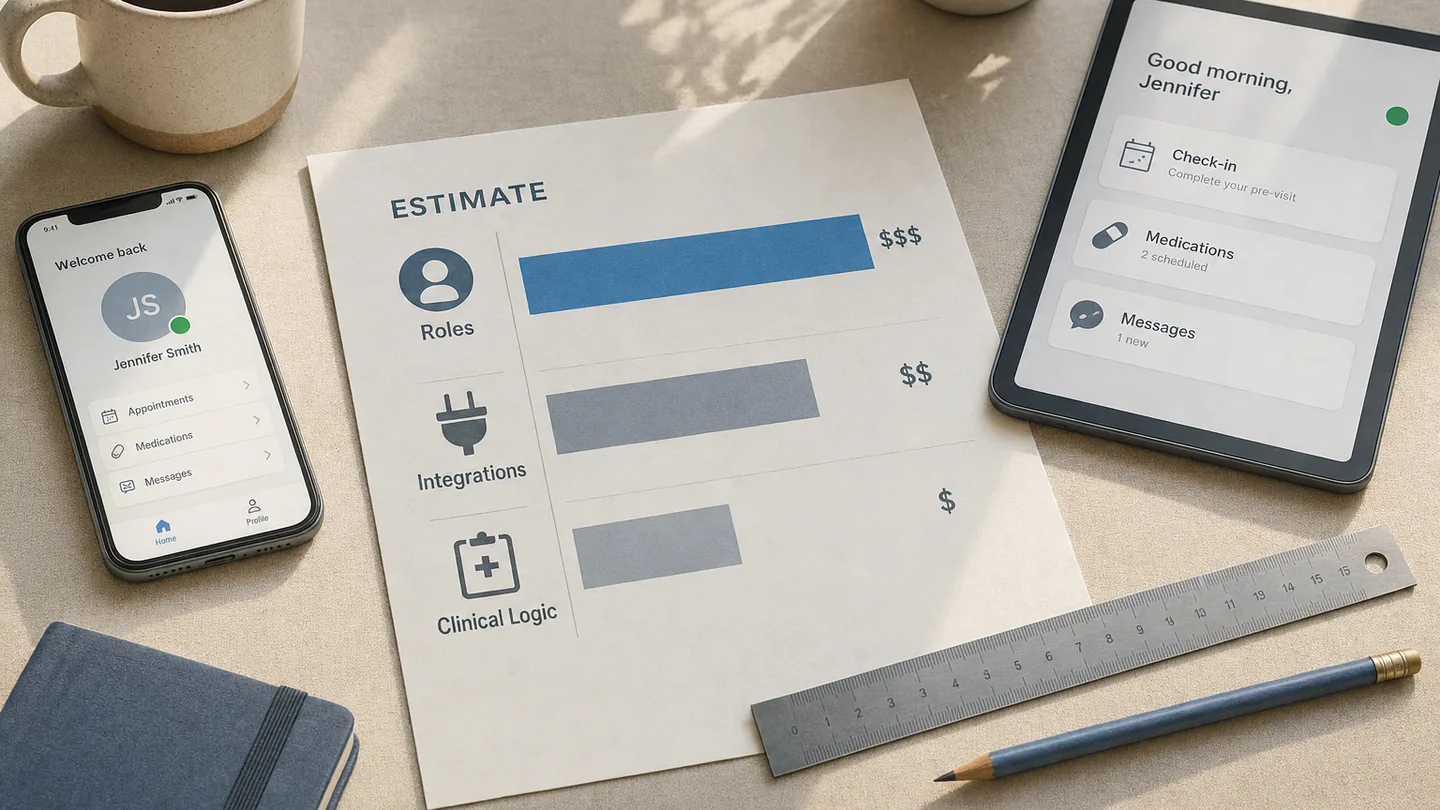
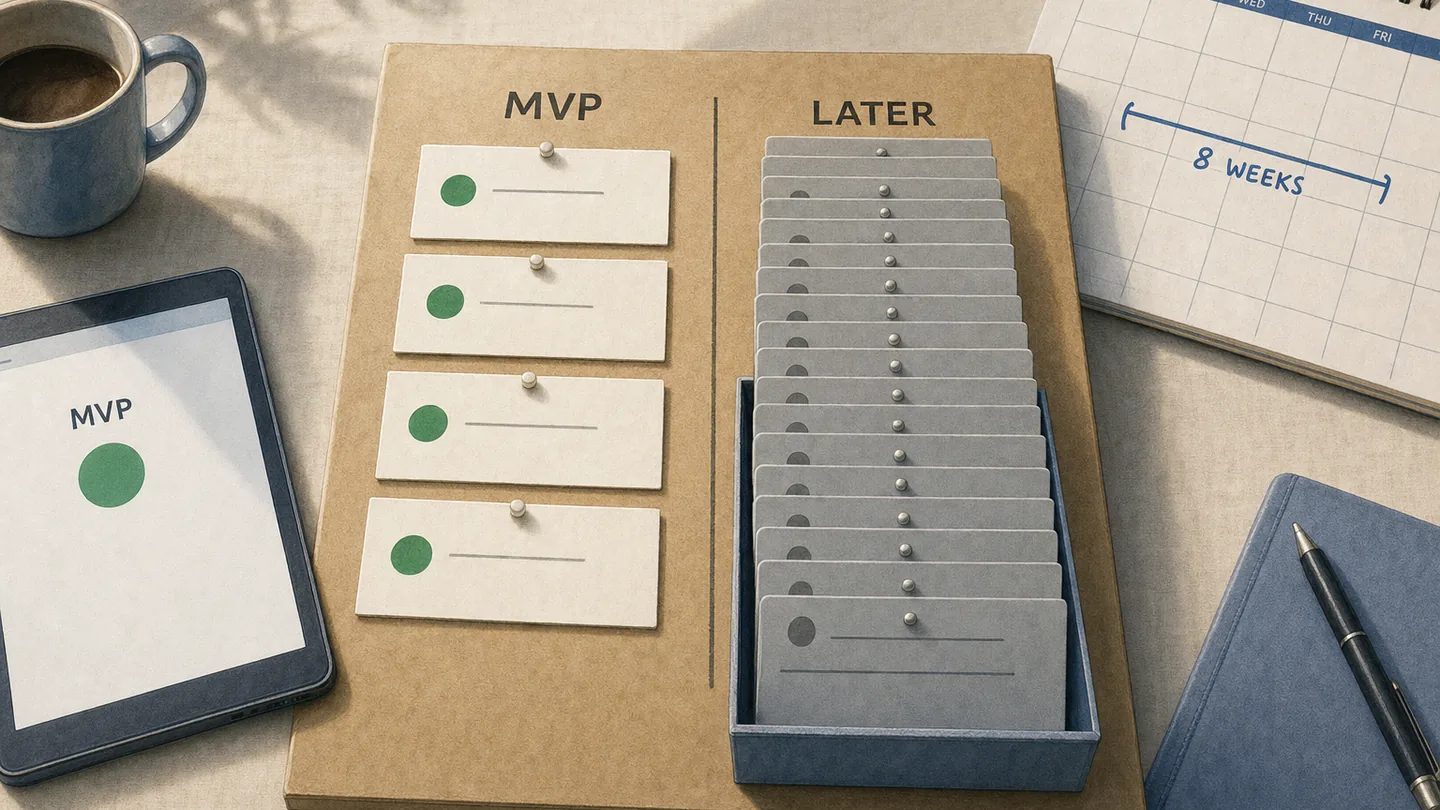
Custom healthcare software with Digital Scientists starts with a Blueprint at $25K for 4 weeks, or from $50K for 6 weeks with a working prototype, followed by an MVP at $75K to $250K over 8 to 16 weeks. The full build is scoped from what the MVP teaches you.
A Blueprint is a short engagement that produces the scope, architecture, user stories and screens for what gets built, plus the investment it takes. An MVP, or minimum viable product, is the smallest version real users can run in a real workflow.
Where you land in the MVP range comes down to three things: how many user roles you serve, how many systems you connect to, and how much of the clinical logic is new. A single-role tool on one data source sits near the bottom. A multi-role platform with EHR data, video and mobile sits near the top. Fathers' UpLift went from Blueprint to a working, purpose-built EHR MVP in 8 weeks.
For how we scope, build and run the full product, see our healthcare software development services.
How do buy, build, partner and hybrid compare?
Each path trades cost against control.
| Buy | Build in-house | Partner | Hybrid | |
|---|---|---|---|---|
| Cost | License per user or location, plus implementation and integration fees | Salaries for a full product team, plus the months it takes to hire one | Blueprint $25K (4 weeks) or from $50K (6 weeks); MVP $75K to $250K; Build with Us $10K for two weeks, then $20K a month | Licenses for the standard systems, plus a custom build for the layer that sets you apart |
| Time to value | Weeks to months of setup and configuration | Hiring time, then the build | Blueprint in 4 to 6 weeks, MVP in 8 to 16 weeks | Fast on the bought parts; MVP timeline on the custom layer |
| Ownership | Vendor owns the product and roadmap; you own your data under contract | You own the code, IP and roadmap | You own the code, IP and roadmap, and can move it in-house when ready | Vendor owns the core systems; you own the custom layer |
| Integration burden | Vendor's standard connectors; you pay for the rest | All of it is yours to build and maintain | Partner builds and runs them; the Blueprint names each one up front | Highest: the custom layer connects to every bought system |
| Best when | The workflow is standard and not a differentiator | The software is your product and you already have a product team | You need to build but don't have a product team yet | Core records are standard but your workflow or patient experience is not |
What about partnering?
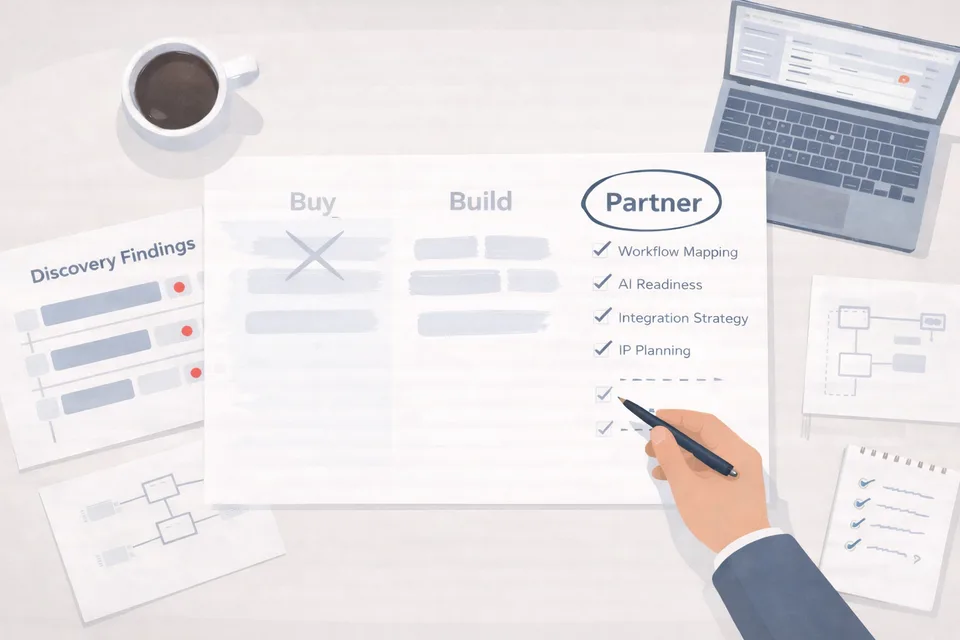
Partnering means an outside team acts as your product and engineering group, and you decide later whether to bring the work in-house. It fits when you've decided to build but don't have a product team, or don't want to hire one before the product proves itself. People have to make this decision of buy, build, or partner, and we're the partner.
That's how NeverAlone happened. CommuniCare had the clinical model and the facilities. We were the product team: a 90-day MVP, then iteration on what nurses and providers used. It now serves 30,000 patients across six states, and we still run it.
After an MVP, Build with Us keeps a senior team shipping: $10K for the first two weeks, then $20K a month. You can also plan for build-operate-transfer, an arrangement where the partner builds and runs the platform, then hands the code, operations and knowledge to your team on a planned date.
For gaps that surface mid-discovery, see buy, build, or partner when discovery turns up gaps.
How do integrations change the math?
Integrations are usually the biggest swing in cost and timeline. When you buy, the vendor covers its standard connectors and you pay for everything else. When you build, every connection is on your plan.
Interoperability is the ability of separate systems to exchange data and use it without anyone re-keying it. EHR data arrives in different shapes from different vendors. The same patient shows up under slightly different names and IDs in each system, so matching them is its own piece of work. Interfaces change when the vendor decides to change them.
On NeverAlone, that meant pulling data from PointClickCare and from Netsmart's GEHRIMED, and matching patients across both EHRs, so the clinician on a video call sees the patient's history, medications and diagnoses.
The practical rule: list every system the software reads from or writes to before you compare options. If an off-the-shelf product covers your list with standard connectors, buying gets cheaper. If half the list is custom work either way, building looks different. I'm usually trying to pull risk forward here. If one integration is uncertain, test it in the first weeks, before the rest of the plan depends on it.
What does a hybrid look like?
A hybrid buys the standard systems and builds the layer that makes you different on top of them. Many healthcare organizations end up here.
The usual shape: keep the EHR and billing system you bought, and build the workflow, patient experience or data product that runs across them. The bought systems stay the system of record. The custom layer is where your advantage lives.
Hybrids shift over time. NeverAlone's care management first ran on Salesforce. In January 2022 we replaced it with a custom care management platform built for the NeverAlone care workflow. Nobody likes a Big Bang, and you have to be thoughtful about how you slowly take over from a legacy application while clinical staff keep working.
How do you decide in four weeks?
Run a 4-week Blueprint before you sign a license or a build contract. At the end you have a decision, a scope and a number.
The four weeks should answer five questions:
- How does the workflow run today, and which systems does it touch?
- Which off-the-shelf products cover it, and what do they leave out?
- Which pieces are worth building because they move the needle?
- Which integration or assumption carries the most risk, and does it hold up?
- What does each path cost to reach production and to run?
If users need to touch something before you commit, the 6-week Blueprint (from $50K) adds a working prototype. When the answer is buy, that's a good result for a $25K spend. If the answer is build, our healthcare product development path takes it from Blueprint to MVP to production.
Frequently asked questions
How much does custom healthcare software cost?
With Digital Scientists, an MVP costs $75K to $250K over 8 to 16 weeks, after a Blueprint at $25K for 4 weeks or from $50K for 6 weeks with a working prototype. The number of user roles, integrations and new clinical logic sets where you land.
Is it cheaper to buy or build healthcare software?
Buying is cheaper up front when a product fits a standard workflow. Building wins when the workflow is your advantage and a bought product would leave you paying for licenses plus workarounds that never fit. Compare total cost of ownership over the years you'll run it.
How long does it take to build healthcare software?
An MVP takes 8 to 16 weeks after a 4- or 6-week Blueprint. NeverAlone launched as a 90-day MVP, and a fatherhood program went from Blueprint to a purpose-built EHR MVP in 8 weeks.
Who owns the code if we partner with Digital Scientists?
You do. Clients keep the code, IP and roadmap, and can move the platform to their own team through build-operate-transfer when they're ready to staff it.
Do you build HIPAA-compliant healthcare software?
Yes. We work under a business associate agreement (BAA), the contract HIPAA requires when a vendor handles protected health information, and we run NeverAlone, a platform serving 30,000 patients across six states, in production today.