A healthcare app MVP costs $75K to $250K with Digital Scientists, built over 8 to 16 weeks, after a Blueprint at $25K for 4 weeks or from $50K for 6 weeks with a working prototype. Five things set where you land: how many user types you serve, how many systems the app connects to, how much compliance scope it carries, which platforms it ships on, and whether it uses AI. NeverAlone started as a 90-day MVP with us and now serves 30,000 patients across six states.
What does a healthcare app cost at each stage?
Each stage has its own price, and each one ends with a decision about the next. A focused MVP with two or three workflows runs $75K to $150K over 8 to 12 weeks. An enterprise MVP with several user types, EHR integration and AI runs $150K to $250K over 12 to 16 weeks. A full platform across multiple care settings typically runs $250K to $1.5M, phased, and it's scoped from what the MVP teaches you.
An MVP, or minimum viable product, is the smallest version of the app that real patients, clinicians or staff use in a real workflow. A Blueprint comes before it: user research, scope, architecture, user stories and a build plan with a budget your board or investors can approve. The 6-week version adds a working prototype users can try.
I'd rather give you ranges than a quote nobody has earned yet. A number set before the workflow is mapped is a guess with a dollar sign on it. For what we build and run in production, see our healthcare app development services.
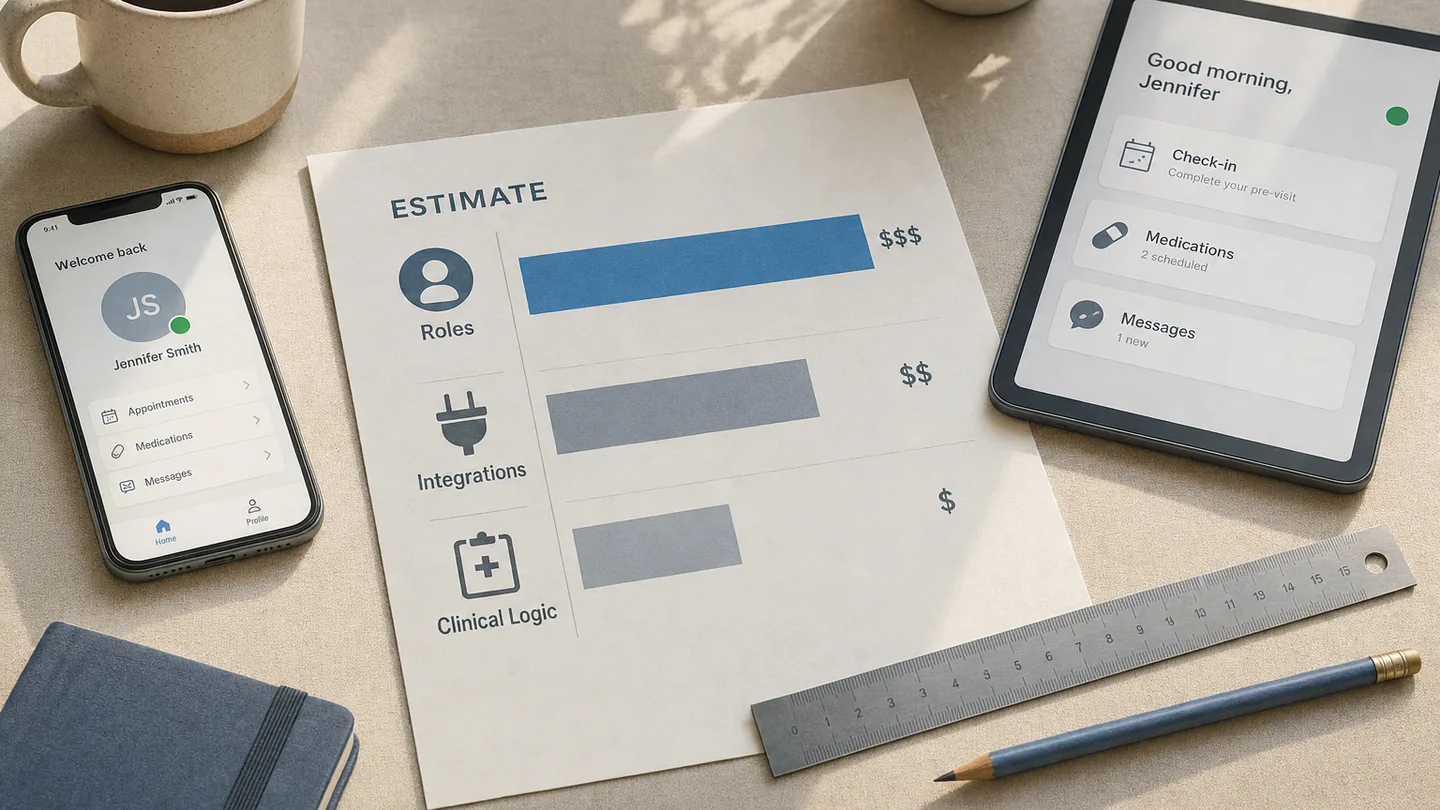
What drives the cost of a healthcare app?
User types, integrations, compliance scope, platforms and AI drive the estimate. Screen count matters far less than most budgets assume. Here's how each one moves the number, and where we've built it.
| Driver | Near the bottom of the range | Near the top of the range | Where we've built it |
|---|---|---|---|
| User types | One role, such as patients or front-desk staff | Patients, clinicians, care partners and admins, each with their own screens and permissions | NeverAlone serves residents, care partners and the nurses and providers behind them |
| Integrations | One data source, or none in the first release | EHR data from more than one vendor, with patients matched across systems | PointClickCare and Netsmart (GEHRIMED) data on NeverAlone, with cross-EHR patient matching |
| Compliance scope | Little or no PHI stored on the device | PHI on shared devices, audit logging on every access, buyer security reviews | BAA before we touch patient data; security plan mapped to NIST CSF 2.0 |
| Platforms | One React Native codebase, or a web app alone | iOS, Android and web, plus native code for Bluetooth devices or media | NeverAlone's iPad client: React Native with a native video framework underneath |
| AI | None in the first release | Call summaries or an ambient scribe, reviewed by a person | HealthContext on NeverAlone: note time from 45 minutes to 5 |
| Devices | Patients use their own phones | Hundreds of shared devices locked down and updated remotely | 750+ NeverAlone devices under mobile device management |
Two drivers near the top usually put you in the enterprise MVP range. Four or more and you're planning a phased platform, not a single release.
Why do integrations swing the budget most?
Integrations swing the budget most because the other side sets the terms. Your team controls its own screens. It doesn't control how an EHR vendor shapes its data, how fast a partner issues credentials, or when an interface changes.
Interoperability is the ability of separate systems to exchange data and use it without anyone re-keying it. In practice the same patient shows up under slightly different names and IDs in each system, so matching them is its own piece of work. On NeverAlone we pull data from PointClickCare and from Netsmart's GEHRIMED and match patients across both, so the care partner on a video call sees the history, medications and diagnoses.
Be precise about what's proven. Our Epic work to date is in a sandbox. For Epic, Cerner and the rest we use FHIR where the other side supports it and custom data exchange where it doesn't. We connect to any system that has an API, a standard interface or a reliable export. The question for your budget is how much of that work is new.
The practical rule: list every system the app reads from or writes to before anyone prices it. If one integration is uncertain, test it in the first weeks, before the rest of the plan depends on it.
How much does HIPAA add to the cost?
HIPAA isn't a line item you bolt on at the end. It's a set of architecture decisions, and it costs the least when it's designed in from the first sprint. Retrofitting it after launch is where the money goes.
The decisions that carry cost:
- Where PHI lives. The phone is the riskiest place patient data sits, so we keep as little there as possible, encrypted on the device and in transit, with sessions that time out.
- Who sees what. Role-based access mapped to how the care team actually works, with audit logging on every access.
- Shared devices. Tablets in a facility are managed through MDM, so a lost device is locked or reset remotely.
- Paperwork buyers ask for. A business associate agreement (BAA) is the contract HIPAA requires when a vendor handles protected health information. We sign one before we touch patient data.
If you sell to health systems or payers, budget time for their security questionnaires. We build so each answer is a document you hand over, not a promise.
Native or cross-platform: which costs less?
Cross-platform costs less for most healthcare apps. We usually build one React Native codebase for iOS and Android, plus a web app for staff and admins. That's one codebase to build, test and keep current instead of two.
We go native in Swift or Kotlin when the app needs deep device, Bluetooth or media access that a shared codebase handles poorly. That's a real cost, so it should be a real requirement. NeverAlone's iPad client splits the difference: React Native for the app, with a native video framework underneath for call quality.
Accessibility belongs in the same conversation. NeverAlone serves residents in their 80s and 90s and adults with intellectual and developmental disabilities, on tablets with no login and one obvious way to reach a person. Designing for that audience from the first sketch costs less than redesigning for it after a failed pilot.
What does a healthcare app cost after launch?
A healthcare app is never done. It changes with regulation, new care settings and what clinicians tell you after the first month. Plan for running it from the start.
You have two options. We run it, with your team or ours taking first-line questions and Digital Scientists handling L2 and L3 support, billed monthly. Or we hand it over on a build-operate-transfer plan: we build the app, run it until it's stable and your team is hired and trained, then transfer the code, the accounts and the know-how. Either way, you own the code, the IP and the roadmap.
NeverAlone has run 24/7 since March 2021. We still operate it, and that keeps our estimates honest: we price builds knowing what it takes to keep one running.
How do you get a real number before you commit?
Run a Blueprint. At the end you have a scope, an architecture, a build plan and a budget, and you decide on evidence whether to build. Fathers' UpLift, a community program serving fathers, went from Blueprint to a working, purpose-built EHR MVP in 8 weeks; see the custom EHR case study.
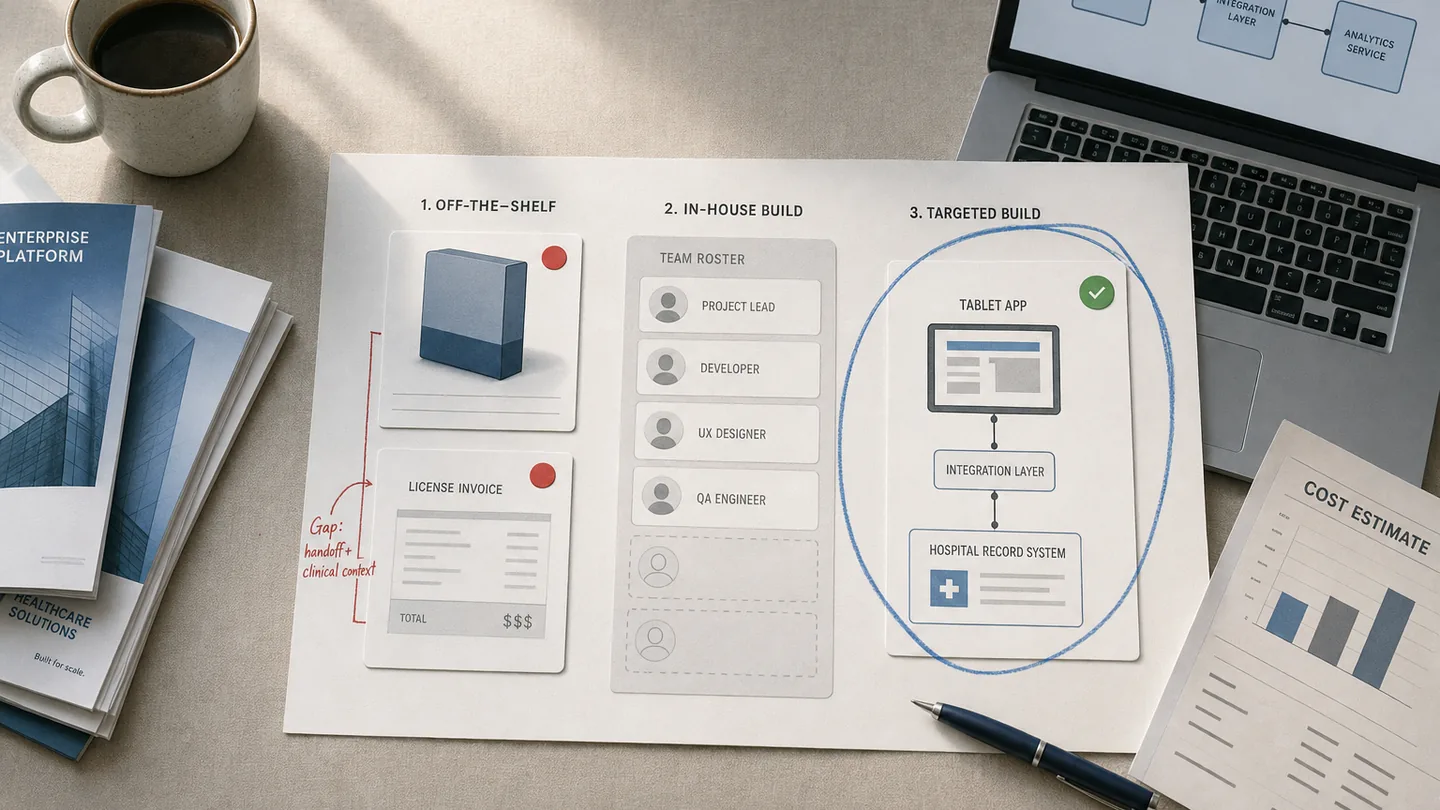
If you're still choosing between a product off the shelf and a custom app, start with build vs buy healthcare software. For what good looks like in production, see these examples of successful healthcare apps, and for the wider planning picture, our guide to healthcare app development in 2026.
Bring your workflow, your systems list and the result the app has to prove. We'll tell you which range you're in. Talk it over.
Frequently asked questions
How much does it cost to build a healthcare app?
With Digital Scientists, a healthcare app MVP costs $75K to $250K over 8 to 16 weeks. A focused MVP with two or three workflows runs $75K to $150K; an enterprise MVP with several user types, EHR integration and AI runs $150K to $250K. A Blueprint at $25K for 4 weeks, or from $50K for 6 weeks with a working prototype, sets the number before the build.
What makes a healthcare app expensive?
Five drivers: the number of user types, the integrations, the compliance scope, the platforms it ships on and any AI features. Integrations swing the budget most, because the EHR or partner on the other side sets the terms.
How long does it take to build a healthcare app?
An MVP takes 8 to 16 weeks after a 4- or 6-week Blueprint. NeverAlone launched as a 90-day MVP, and Fathers' UpLift went from Blueprint to a working, purpose-built EHR MVP in 8 weeks.
Is a cross-platform app cheaper than native?
Usually. One React Native codebase covers iOS and Android, plus a web app for staff. We go native in Swift or Kotlin only when the app needs deep device, Bluetooth or media access.
What does a healthcare app cost to run after launch?
Running it is a monthly cost, scoped to the platform. We support apps we built with L2 and L3 support, or hand everything to your team on a build-operate-transfer plan. You own the code and the IP either way.