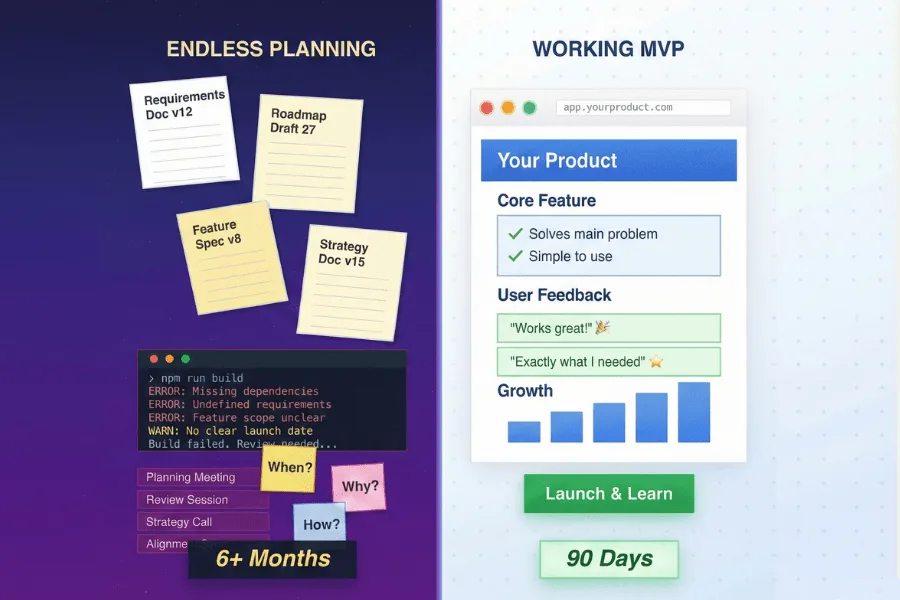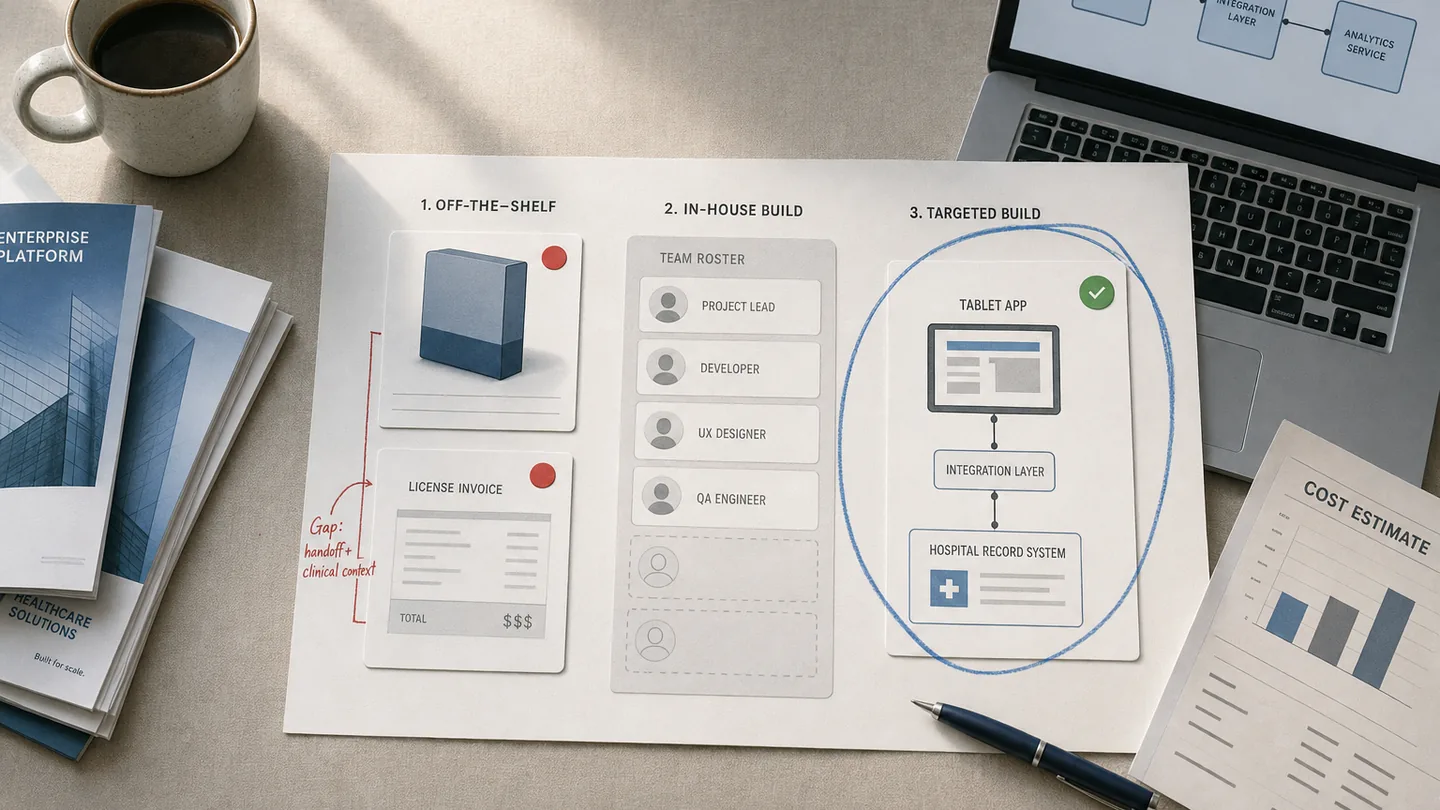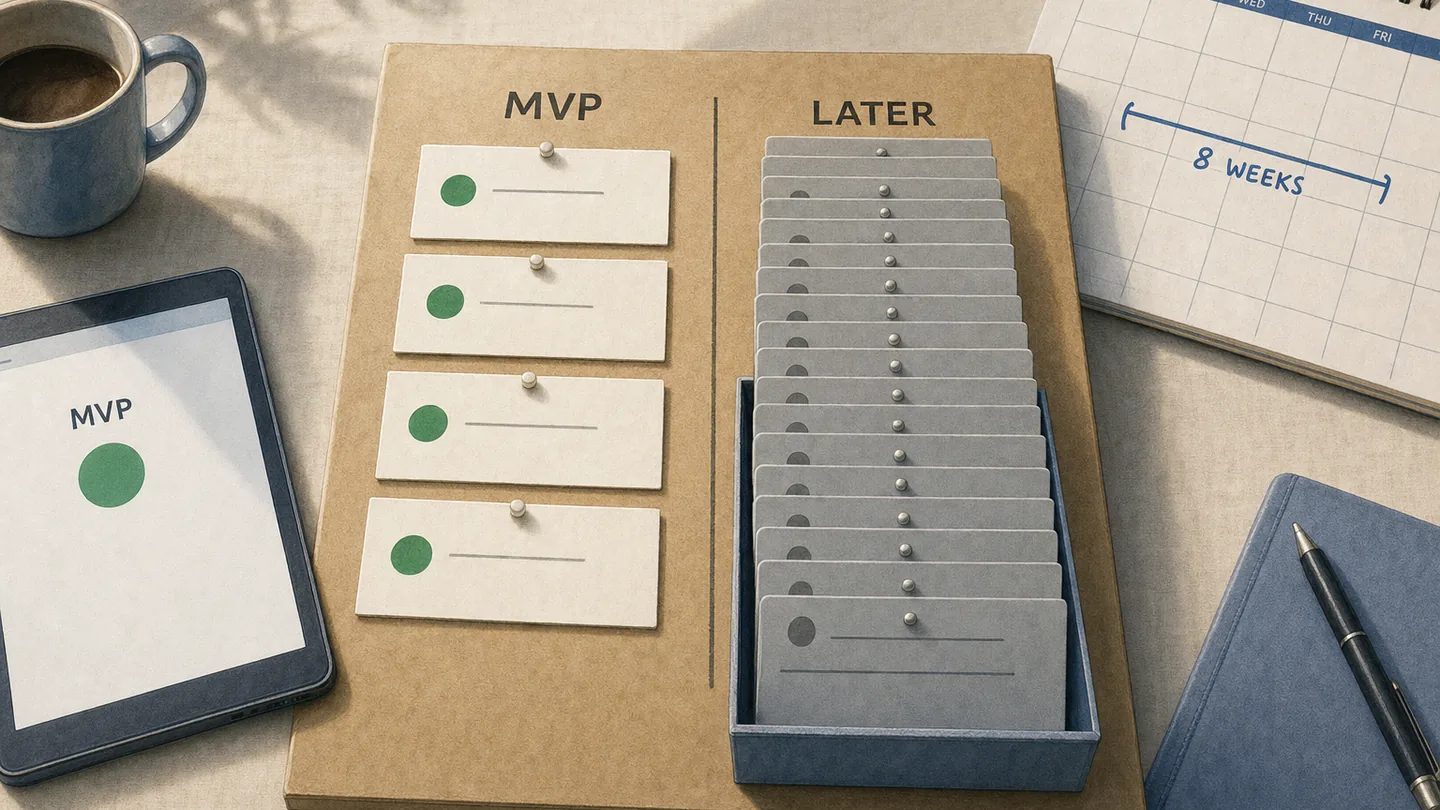
A digital health MVP should prove one result with real patients, clinicians or payers, and nothing else. Build the workflow that proves it, the HIPAA foundations under it, and the one integration it can't work without. Leave out the second user type, the admin console, the analytics suite and most AI. With Digital Scientists, an MVP takes 8 to 16 weeks and $75K to $250K. NeverAlone began as a 90-day MVP, a tablet that let seniors reach a care partner by video, and now serves 30,000 patients across six states.
What is a digital health MVP?
A digital health MVP, or minimum viable product, is the smallest version of a health product that real users run in a real care workflow, built on production foundations. It's not a demo and it's not a prototype. A prototype shows what the product will do. An MVP does it, with real patient data, under a BAA.
That distinction matters more in healthcare than anywhere else. A consumer app can ship rough and patch later. A product that touches protected health information or sits inside a clinical workflow has to be secure, auditable and reliable from the first user. So the MVP is small in scope, never small in quality.
The MVP is one step in healthcare product development: a Blueprint to agree what gets built, the MVP to put it in front of real users, a full build to make it production grade, then either we run it or your team does. Our minimum viable product page covers how we run MVPs outside healthcare.
What should you build first?
Build the one workflow that proves the result the product exists for. Start from that result, then cut everything that doesn't help prove it. Custom development is only worth it if it moves a number you care about, so agree on that number before anyone writes a user story.
For NeverAlone, the first version was a simple tablet that let independent-living seniors reach a care partner by video. It ran as a pilot within three months. Everything after that, the care management platform that replaced Salesforce, the employee health app, the move into skilled nursing, IDD, home health, hospice and behavioral health, was added because the pilot earned it.
For Fathers' UpLift, a community program serving fathers, the job was a purpose-built EHR. Blueprint and MVP took eight weeks together. See the custom EHR case study.
Both started narrow. Neither tried to be the whole platform on day one.
What should a digital health MVP leave out?
Leave out anything the first users don't need to prove the result. Most first feature lists are about 60% wrong, and the MVP exists to find out which 60% before you spend on it.
The usual cuts:
- The second and third user type. Serve one role well. If the product is for patients, the clinician side starts as the smallest view that lets the care team respond.
- Admin consoles. Your team handles accounts and settings by hand, or we do, until volume makes a console worth building.
- Analytics dashboards. Log the events you need to measure the result. Build the dashboards once you know which numbers matter.
- Most AI. Add a model when the workflow is proven and you have the data to judge it, not to make the pitch deck shine.
- Every integration on the wish list. Pick the one the workflow can't run without. The rest go in the full build.
| Area | Build in the MVP | Leave for the full build |
|---|---|---|
| Users | One primary role, plus the smallest view the care team needs to respond | Additional roles, organizations and permission tiers |
| Workflow | The one workflow that proves the result | Edge cases, secondary flows, settings screens |
| Integrations | The one system the workflow can't run without | The rest of the systems list, planned in the Blueprint |
| HIPAA and security | All of it: BAA, encryption, access controls, audit logging | Nothing. This is never deferred |
| Admin and reporting | Event logging to measure the result | Admin consoles and analytics dashboards |
| AI | Only if AI is the result being proven | Summaries, scribes and models once the workflow holds |
| Platforms | One platform, or one React Native codebase | Additional native apps and device support |
What can't you cut, even in an MVP?
You can't cut HIPAA, the riskiest integration or accessibility for the people who will actually use it. Those are cheaper to design for in week one than to fix after launch.
- HIPAA and patient data. BAAs, access controls, audit trails and where PHI lives are architecture decisions. We sign a BAA before we touch patient data.
- The integration risk. Products don't fail on code. They fail on an integration that took four months instead of two weeks. If a piece is risky, we spend a week of engineering on it before anyone commits to the full build.
- Security diligence. Health systems, payers and investors send long security questionnaires. Build so you can answer them, or the first enterprise sale stalls.
- Usability for your real users. NeverAlone's tablets have no login, large targets and one obvious way to reach a person, because the users are residents in their 80s and 90s and adults with intellectual and developmental disabilities.
Ownership belongs here too. You own the code, the IP and the roadmap, with repositories and cloud accounts set up in your name or ready to transfer. Investors and acquirers will check.
How much does a digital health MVP cost, and how long does it take?
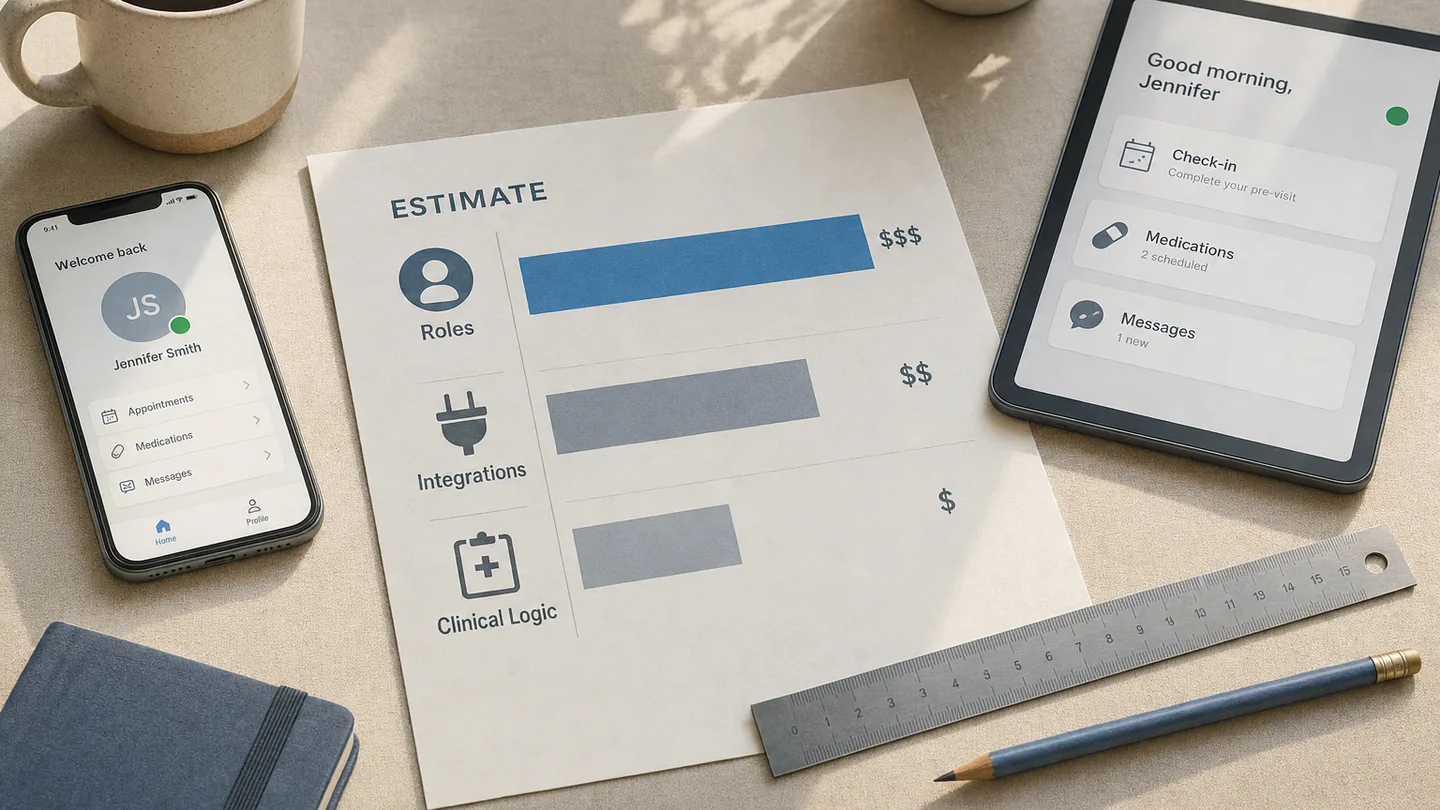
Most healthcare MVPs we build land between $75K and $250K over 8 to 16 weeks. A focused MVP with two or three workflows runs $75K to $150K over 8 to 12 weeks. An enterprise MVP with several user types, EHR integration and AI runs $150K to $250K over 12 to 16 weeks.
Before the MVP comes a Blueprint: $25K for 4 weeks, or from $50K for 6 weeks with a working prototype users can try. It produces the scope, architecture, user stories and a build plan with a budget your board or investors can approve. These are common starting points, not rules. Some clients go straight to an MVP.
Every feature you cut moves you toward the bottom of that range and the front of the calendar. That's the business case for a disciplined MVP.
What happens after the MVP?
The MVP ends with a decision: build, pivot or stop. If the evidence says build, the full build takes 3 to 12 months and is scoped from what the MVP taught you, adding the integrations, security controls, admin tools and analytics you deferred.
Then someone runs it. We support platforms we built, with L2 and L3 support, or hand them to your team on a build-operate-transfer plan: we build the product, operate it until it's stable and your team is hired and trained, then transfer the code, the accounts and the know-how.
NeverAlone has been live since March 2021 and handles more than 100,000 calls a year. The 90-day MVP decided what got built next. For what separates MVPs that work from the ones that don't, read MVP development: what actually works.
Bring the result your product has to prove and your first feature list. We'll show you what to cut. Talk it over.
Frequently asked questions
How much does a digital health MVP cost?
Most healthcare MVPs we build land between $75K and $250K over 8 to 16 weeks, depending on the number of integrations, apps and AI features. A Blueprint at $25K for 4 weeks, or from $50K for 6 weeks with a working prototype, gives you a scope and a budget before you commit.
What is the difference between a prototype and an MVP?
A prototype shows what the product will do. An MVP does it, with real users in a real workflow, built on production foundations with HIPAA controls in place.
Does a digital health MVP need to be HIPAA compliant?
Yes, if it touches protected health information. BAAs, encryption, access controls and audit logging are architecture decisions, so they go in the MVP, not the full build. We sign a BAA before we touch patient data.
How long does it take to build a digital health MVP?
8 to 16 weeks, after a 4- or 6-week Blueprint. NeverAlone ran as a pilot within three months, and Fathers' UpLift went from Blueprint to a working, purpose-built EHR MVP in 8 weeks.
Who owns the code from the MVP?
You do. You own the code, the IP and the roadmap, and we set up repositories and cloud accounts so they transfer whenever you want.