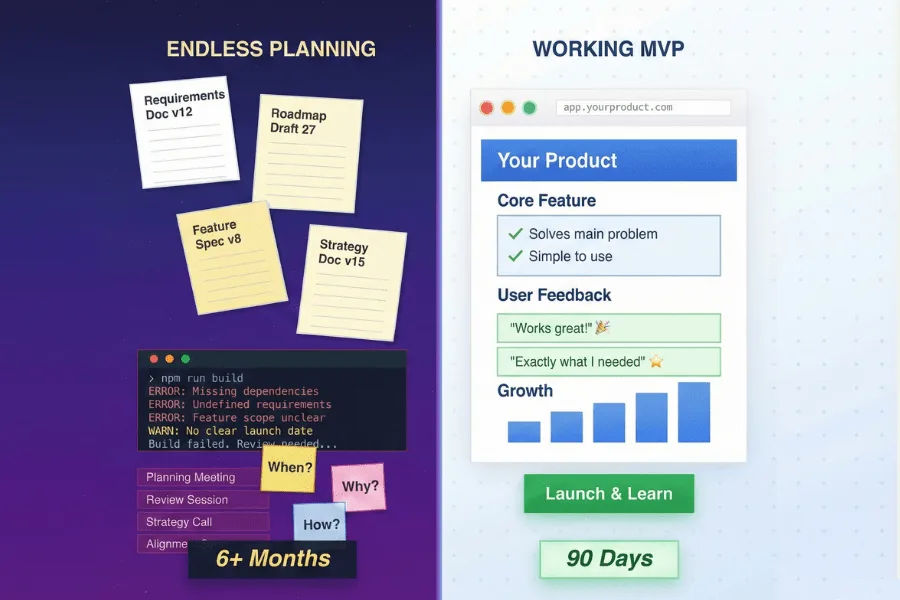
Successful MVP development isn’t about building everything. It’s about building the right things first.
The most competitive companies today aren’t chasing perfection. They’re moving fast, validating early, and letting real users, not internal opinions, guide their strategy. That mindset separates MVPs that gain traction from those that silently drain budgets.
After helping hundreds of startups and enterprises, we’ve seen clear patterns emerge. These are proven MVP development practices that consistently turn ideas into market-ready products quickly. In this article, we’ll explore why MVP development efforts often fail, what a successful process looks like, and how to turn early feedback into scalable growth. If you need a focused build-measure-learn sprint, see our MVP development services for a 4-16 week path from concept to tested product.
Why Most MVP Development Efforts Fail
A Minimum Viable Product should do one thing exceptionally well:
Prove your idea delivers real value to real users.
Most MVP initiatives fail because teams lose focus. They overbuild. They chase edge cases. They polish features no one asked for. Feature bloat is the silent killer of early-stage product efforts.
Instead, successful MVP development is anchored in three core principles:
- Rapid validation of key assumptions
- Lean architecture to reduce complexity
- Data-driven iteration based on actual usage
These principles guide every decision, from design to deployment. Without them, teams risk building a technically sound product that solves the wrong problem.
Today’s users also expect more, even in an MVP:
- Seamless cross-platform experiences
- AI-enhanced functionality
- Enterprise-grade security
Meeting these expectations without derailing timelines is a delicate balance that requires discipline, clarity, and strategic trade-offs. Many organizations fail not because of lack of effort, but because they try to satisfy every potential need too early in the process.
Real Results From Strategic MVP Development
One of the best ways to understand what works is to look at real-world MVP development outcomes. Here are two examples:
NeverAlone: Remote Patient Monitoring Platform
NeverAlone aimed to validate a new model for remote care through a focused MVP approach. The goal was to test whether patients and providers could interact effectively within a lightweight care ecosystem before investing in a full solution.
We delivered a 90-day proof of concept centered on core functionality. This allowed real patients and providers to test the system, provide feedback, and validate the care model in a live environment.
Outcome: Funding secured and a full-scale development roadmap within three months. The team was able to move forward with confidence, knowing they had a validated concept and real user insights.
GoFan Ticketing Platform
GoFan partnered with Digital Scientists to replace outdated paper-based ticketing systems with a more modern, scalable solution.
We focused on essential features that proved market demand quickly. By launching with only the necessary functionality, the team could gather feedback, validate demand, and iterate effectively.
Today: The platform supports thousands of schools nationwide. The MVP helped GoFan establish market traction and positioned the company for long-term success.
The MVP Development Framework That Actually Works
Many MVPs don’t fail because of poor execution. They fail because teams build the wrong thing very efficiently. A great MVP development strategy starts with knowing what not to build.
Here’s a proven framework that works across industries:
1. Start MVP Development With Discovery
Every successful MVP starts before the first line of code. The discovery phase sets the foundation by answering one core question:
What is the smallest product that proves real value?
Discovery sprints answer this through:
- User interviews to validate real problems
- Competitive analysis to avoid duplication
- Competitive analysis to avoid duplication
During discovery, teams can test different approaches, challenge assumptions, and clarify who the product is for and why it matters. Time spent here often saves months of wasted development later.
2. Prioritize MVP Features Ruthlessly
Effective MVP development means identifying what’s essential and cutting the rest. We use three categories to prioritize:
- Must-Have: Solve the core problem. Without these, the product has no purpose.
- Nice-to-Have: Improve usability, but aren’t required for validation.
- Future Features: Important enhancements to develop after proving market fit.
For B2B SaaS, that often means a single core workflow and basic authentication. Reporting, integrations, and automation can follow after initial user feedback confirms demand.
This approach prevents scope creep and ensures development efforts are focused on what matters most to early adopters.
3. Build for Feedback, Not Perfection
An MVP should balance production readiness with flexibility. The goal is not to launch a flawless product but to get actionable data from real users as early as possible.
Modern tools like React Native and lightweight web stacks enable rapid development across platforms without creating long-term technical debt. A single codebase can support iOS, Android, and web platforms efficiently.
The most important milestone in MVP development? Launching early.
The first 50-100 users often reshape your roadmap. Many high-growth products pivoted at this stage because teams listened closely to real feedback. Success depends less on building everything perfectly and more on learning and iterating quickly.
Choosing the Right MVP Development Partner
Teams typically approach MVP development in one of three ways:
- In-house: Offers control, but requires time and resources to staff
- Freelancers: Provide flexibility, but limited accountability
- Agencies: Bring speed and process through cross-functional teams
The best MVP development partners bring both technical skill and product strategy. They challenge your assumptions, suggest smarter alternatives, and help avoid common traps like overengineering or premature scaling.
At Digital Scientists, our interdisciplinary teams align from day one. Designers, developers, and product strategists work side by side to keep MVP development focused on solving real business problems. This alignment reduces friction and accelerates time to market.
Technology Decisions That Support Scalable MVP Development
Technology choices made during MVP development impact scalability, maintainability, and long-term cost.
We prioritize:
- Cloud infrastructure for flexible scaling
- Security and compliance from the start
- AI and automation as standard expectations, not add-ons
By making scalable choices early, teams avoid costly rework. MVPs that are well-architected from day one can evolve naturally into full-featured products without requiring a total rebuild.
Choosing the right tech stack also helps attract talent and align with enterprise IT standards. Smart MVP development means thinking ahead, even when you’re starting small.
After MVP Launch: Turning Feedback Into Growth
Launching is only the beginning.
The first 90 days after MVP development are critical. This is when products either stall or accelerate. The difference often comes down to how teams handle feedback and prioritize next steps.
High-performing teams:
- Systematically collect user feedback
- Use interviews, analytics, and support data to identify patterns
- Prioritize improvements based on evidence, not gut instinct
They also invest in quality code, clear documentation, and modular architecture early. This groundwork enables faster iteration and prepares the product for scale.
A strong MVP development process doesn’t end with launch. It evolves into a growth engine, fueled by insights from real users and guided by a shared understanding of the product’s value.
Why MVP Development Matters for Business Leaders
Strong MVP development:
- Reduces risk by validating assumptions before full investment
- Accelerates time to market through faster feedback cycles
- Informs strategy using real customer data, not guesswork
For business leaders, MVP development is not just a technical exercise. It’s a strategic advantage. It enables faster decision-making, clearer product direction, and smarter use of resources.
While competitors hesitate or overbuild, teams with a solid MVP process learn faster, iterate smarter, and deliver value sooner. The result? A continuous cycle of validation and growth that compounds over time.
Ready to Launch MVP Development That Works?
At Digital Scientists, we’ve helped startups and Fortune 500 companies validate ideas, enter markets quickly, and scale with confidence.
We don’t just build software. We build products that succeed in real markets.
Your competitors aren’t waiting.
Every week you delay MVP development is a week of feedback, learning, and growth you’re giving away.
Let’s build something that works. Contact us today.