
We operate the virtual care platform we build.
Most agencies pitch virtual care from a slide deck. We pitch it from production. NeverAlone, the platform we built and hold equity in, serves 26,000+ patients across 7 states at a 96% treat-in-place rate. The lessons of running it at scale go directly into every custom virtual care engagement we take on.
Patients in Production
Multi-State Network
Treat-in-Place Rate
Nurse Capacity
Telehealth is one component. A virtual care platform is the connected system.
A virtual care platform is the technology that delivers care wherever the patient is. Acute and ambulatory settings, post-acute and skilled nursing, home health and hospice, behavioral health, and rural populations who cannot reach specialty care without a 90-minute drive. It connects four moving parts: synchronous telehealth (video and messaging visits), remote patient monitoring (continuous device data from blood pressure cuffs, glucometers, pulse oximeters, and continuous monitors), AI-powered virtual care assistants (routine monitoring, medication management, escalation triage), and bidirectional EHR and payer integration so the data flows where care decisions get made.
Buying a video tool is not the same as building a virtual care platform. Video is the easy part. The hard parts are the workflow integration, multi-state licensing logic, payer billing alignment, RPM data routing, and the operational discipline to run all of it in production at scale. We have been doing exactly that for 26,000+ patients across 7 states since the platform first went live.
The workforce will not catch up. The reimbursement model already changed.
Healthcare is short roughly 100,000 nurses today and projected to be short 1.1 million by 2030. At the same time, payers and CMS are paying for outcomes, not visits. Organizations that wait for the workforce to recover are running a strategy that cannot win.
Per Avoidable Readmission
National average cost of a 30-day readmission. Most are preventable with continuous monitoring and earlier intervention.
ER vs. $50 Telehealth Visit
An ER visit averages $1,500. A telehealth consult that prevents it averages $50 to $100. The math on after-hours triage is not subtle.
After-Hours Care Gap
Two-thirds of after-hours decisions are made without specialist access. Generic telehealth tools do not solve this. Workflow-integrated virtual care does.
Virtual care wherever care happens.
Different settings, different workflows, different reimbursement models. NeverAlone, the platform we built and operate, serves eight of these segments in production. We engineer virtual care for the rest in custom engagements.
Skilled Nursing
24/7 clinical coverage, treat-in-place, PDPM-aligned documentation, night-shift backup.
Assisted & Independent Living
Resident monitoring, family communication, on-call clinical authority for non-medical staff.
Home Health
Clinical backup between scheduled visits, RPM-driven escalation, OASIS workflow integration.
Hospice
Symptom management, family communication, comfort-care decision support, transfer reduction.
Health Systems & Acute Care
Hospital-at-home, post-discharge follow-up, ED diversion, specialist consult routing.
ACOs & Health Plans
Risk stratification, attributable outcomes, treat-in-place economics, MA and ACO REACH alignment.
IDD Services
Direct support professional escalation, behavior monitoring, multi-residence coordination.
Behavioral Health & Rural Access
Asynchronous messaging, crisis triage, multi-state licensing for specialty care reach into rural and underserved populations.
Buy. Build. Partner.
Most organizations evaluating virtual care think there are two options. There are three. Partner is the lane DS was built for: you drive the care model and the IP, we bring the platform engineering and the operational discipline of running NeverAlone in production.
| Decision Lever | Buy (Doximity, Teladoc, Amwell) | Build (Ground Up) | Partner with DS |
|---|---|---|---|
| Time to deploy | Weeks | 12 to 18 months | 8 to 12 weeks on the NeverAlone scaffold |
| Workflow fit | You adapt to the product | Exact fit, you carry all the risk | Exact fit on a production-proven foundation |
| IP ownership | Vendor owns it | You own it | You own it |
| Cost economics at scale | Per-seat SaaS gets punishing | Capex heavy, opex light | Predictable, milestone-funded |
| Operational learning | Vendor sees your usage data | You start from zero | 26K-patient operational track record |
| Best fit for | Standard outpatient telehealth | Ventures with deep tech teams | Health systems, post-acute, home health, hospice, rural networks, VBC organizations, behavioral health, IDD |
Three layers, one platform.
A virtual care platform that works in production has three layers. We have built and operated all three. Skipping any of them is the most common reason custom virtual care builds stall in pilot and never reach production scale.
Care Delivery Model
Synchronous telehealth, asynchronous messaging, after-hours triage, family communication, and care plan adherence. Multi-state licensing logic, payer billing rules, and the workflow that connects clinicians to patients across modalities.
Connected Devices & RPM
Continuous data from blood pressure cuffs, glucometers, pulse oximeters, weight scales, and wearables. Routing rules, alert thresholds, escalation paths, and the data engineering that turns device noise into clinical signal.
AI Virtual Care Assistants
Routine monitoring, medication management, after-hours triage, and intelligent escalation. Extends nursing capacity 3x without sacrificing clinical judgment. Provider-driven, not vendor-driven.
Professional Services or Venture Studio.
DS operates two business models. Most virtual care engagements fit one cleanly. Some span both. The model is named explicitly because the funding mechanics, IP arrangement, and timeline are materially different.
Build a custom virtual care platform for your network.
You operate the care model. You own the IP. We engineer the platform: telehealth, RPM, virtual care assistants, EHR integration, payer billing. Milestone-funded engagements that survive CFO scrutiny because every phase produces a measurable outcome, not a deliverable.
Typical engagement: $250K to $1.5M. ROI in 12 to 36 months. Discovery first, then phased build tied to clinical and financial KPIs.
License the NeverAlone scaffold or co-build with equity alignment.
For organizations launching a new virtual care line of business, we license the NeverAlone scaffold as the foundation, customize for your network, and align incentives with equity or revenue share. You get production-proven architecture instead of starting from zero.
Typical engagement: Faster deployment via the scaffold (8 to 12 weeks vs. 12 to 18 months). Equity or revenue-share aligned. We have skin in the game.
Production deployments. Verified outcomes. Not vendor estimates.
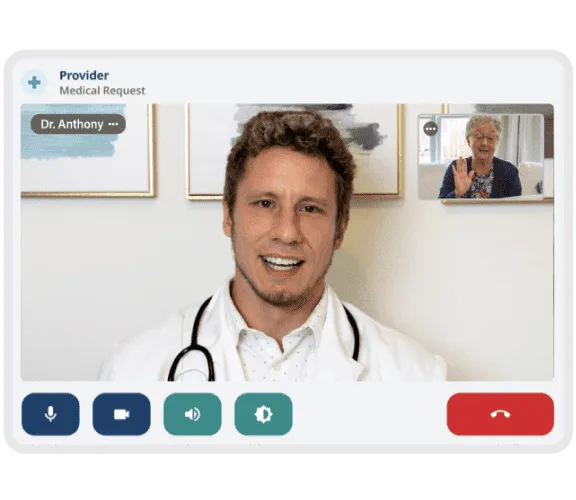
26,000 patients. 7 states. 24/7 in production.
We built it. We hold equity in it. We operate it. NeverAlone is the platform our virtual care methodology is grounded in. Every lesson from running it at scale flows back into custom engagements.
Patients
Treat-in-Place
Quality Incentives
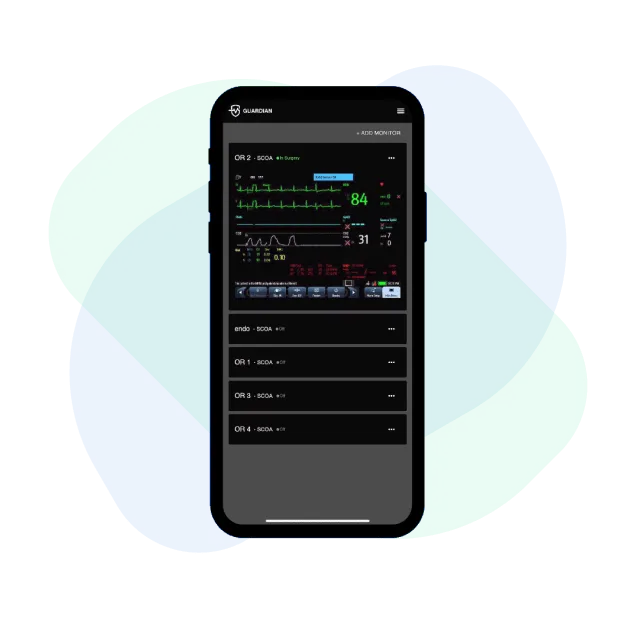
AI-powered remote monitoring for the operating room.
Specialist RPM for surgical environments. Continuous monitoring, intelligent alerting, integration with hospital EHR systems. 32% reduction in monitoring cost across deployed sites.
Cost Reduction
Alert Routing
Integration
Virtual Care Diagnostic
Before we build anything, we map your current care model, stratify your patient population by virtual-care suitability, and quantify what you can recover.
What You Get
Care Delivery Model Map
Current state vs. target state across telehealth, RPM, and AI assistants
Patient Population Stratification
Risk tiers, suitability for virtual care, expected utilization shift
Technology Stack Audit
EHR, billing, device, and licensing gaps with named integration paths
Buy / Build / Partner Recommendation
With ROI projections, capital phasing, and CFO-grade business case
60 to 90 Day Pilot Plan
Tied to the highest-ROI patient population and a measurable outcome
Network & Payer Alignment Brief
Multi-state licensing, billing readiness, and value-based contract fit
Works with your existing EHR, devices, and billing systems
Virtual care that does not integrate is virtual care that does not get used. We have production experience with the platforms your team is already running.
EHR Systems
PointClickCare and Gehrimed in production. Epic integrated in an R&D environment. Cerner, MatrixCare, Netsmart, and Elation via FHIR R4, HL7v2, and ADT.
RPM Devices
Blood pressure, glucose, pulse ox, weight, continuous cardiac, consumer wearables. Routing rules and alert thresholds configurable per population.
Telehealth Stack
HIPAA-compliant video, asynchronous messaging, family communication, multi-state licensing logic, on-call rotation.
Payer & Billing
Telehealth reimbursement codes, RPM CPT alignment, value-based contract billing, prior auth status feeds.
EHR Integrations is the supporting capability that runs underneath every healthcare domain at DS. See the production EHR integration backbone →
We do not just build and hand off. We operate, support, and stand behind our work.
Discover
Care Model Mapping. Current state vs. target state across telehealth, RPM, AI assistants.
Patient Population Stratification. Virtual care suitability by risk tier and condition.
Experiment
Hypothesis & Scope. Highest-ROI population gets a working virtual care pilot.
Build & Validate. Real patients, real devices, real EHR data, real outcomes.
Engineer
Iterative Sprints. Clinical and operational feedback loops every 2 weeks.
Systems Integration. EHR, devices, billing, payer portals.
Multi-State Licensing. Provider credentialing, scheduling rules, compliance.
Production Deploy. Phased rollout with monitoring and on-call.
Optimize
KPI Accountability. Treat-in-place rate, readmissions, capacity, validated by analyst.
Continuous Improvement. Model retraining, payer policy updates, operations support.
Often combined with
Patient Engagement Platforms
The patient-facing layer. Family communication, portals, activation. The companion category to virtual care.
Learn more →Value-Based Care
Virtual care infrastructure is how VBC contracts get hit. Risk stratification, treat-in-place, attributable outcomes.
Learn more →Ambient AI Scribes
Documentation at the point of virtual encounter. Cleaner billing, less clinician burden.
Learn more →Revenue Cycle AI
Telehealth reimbursement, RPM CPT codes, prior auth automation. Virtual care has its own RCM nuances.
Learn more →EHR Integrations
The supporting capability that runs underneath every domain. Bidirectional FHIR/HL7 in production.
Learn more →Frequently Asked Questions
Common questions about custom virtual care platform development for healthcare organizations.
DS works as a Professional Services build partner or as a Venture Studio with equity-aligned partnerships, accelerators, and operator-founder programs. The right model depends on whether you own the IP, share it, or license ours.
See all engagement models →Funding note
Remote care services is one of the highest weighted factors CMS scores under the $50 billion Rural Health Transformation Program, and all fifty states hold an award.
See what we build against the scored factors → What would we build if we started with rural healthcare? →Ready to map your virtual care opportunity?
Start with a Virtual Care Diagnostic. 2 to 3 weeks. We will map your care model, stratify your population, and recommend buy, build, or partner with hard ROI numbers.
Or call: 404.654.3855