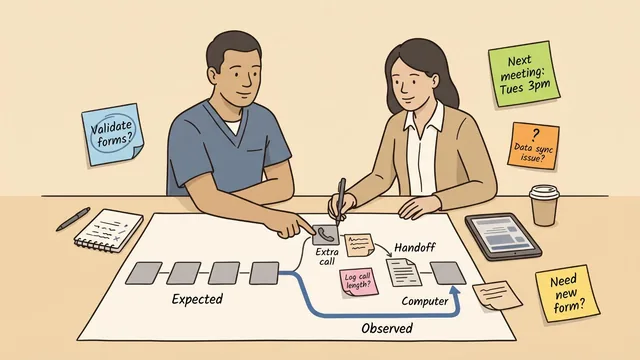
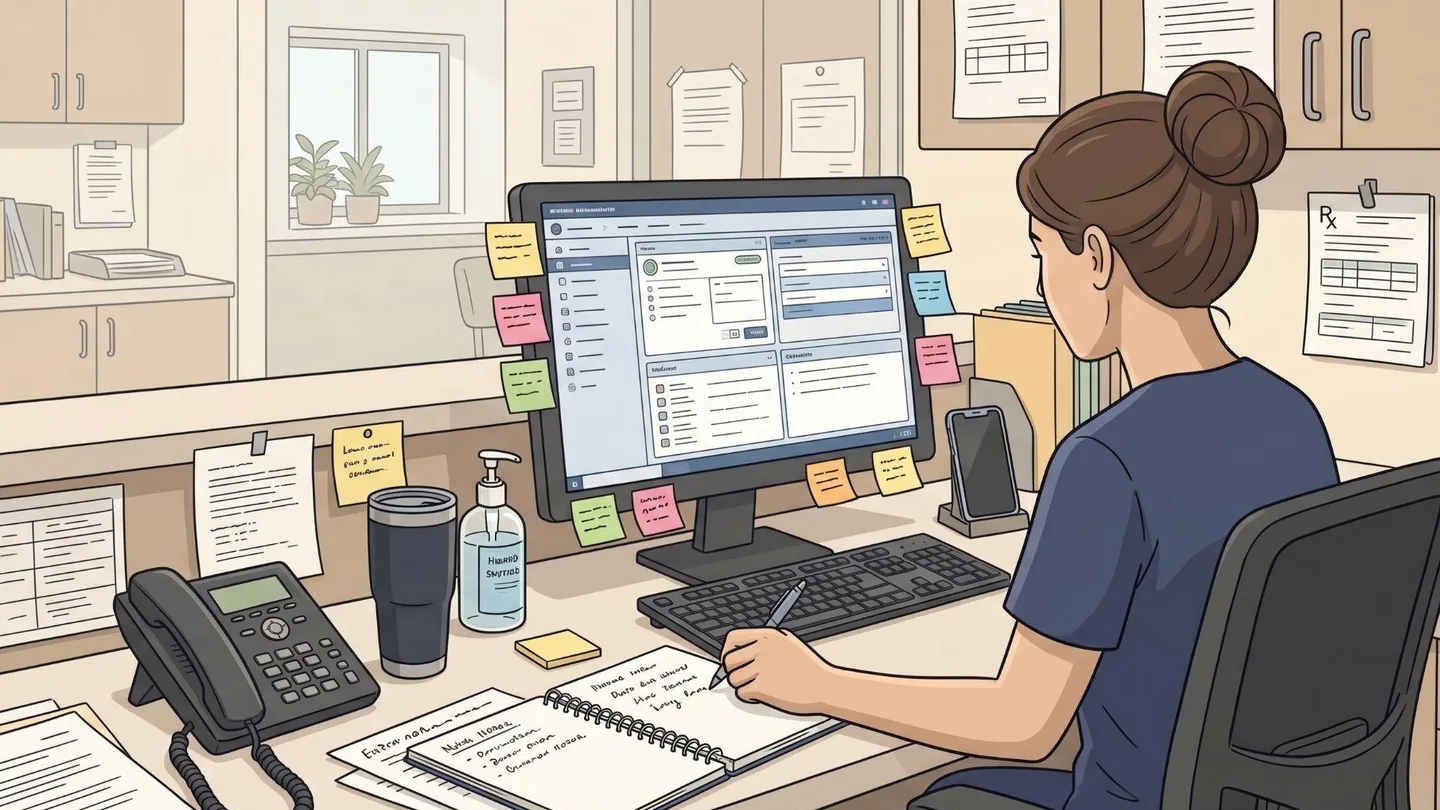
A clinic manager walked us through her workflow. Somewhere around the third sticky note on her monitor, she said something we have heard in one form or another across our work with healthcare teams:
“The system works fine. We just have a lot of workarounds.”
That sentence is the whole problem in eight words.
The workarounds are the system.
The sticky notes around the monitor. The shared login. The binder in the passenger seat of the home health nurse’s truck. The CNA who texts a photo of a wound to a provider because uploading it takes eleven clicks and the Wi-Fi drops in the east hallway.
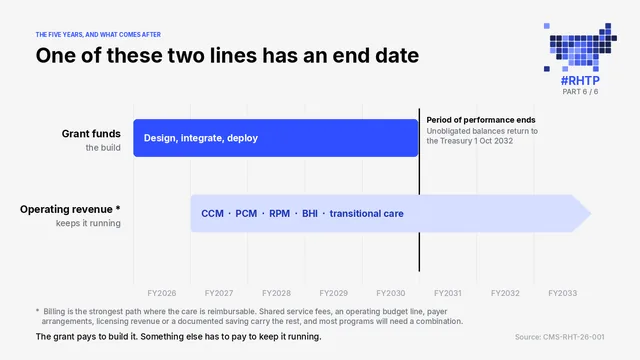
With $50 billion moving through the Rural Health Transformation Program (RHTP) between now and 2030, rural healthcare organizations have a rare opportunity to rethink how technology supports care. They also face a clock. Year 1 funds must be obligated by 30 October 2026, and CMS draws a hard line on what that means: money earmarked for future spending is not money spent. It has to be paid out.
A lot of technology is going to get purchased along the way.
Some of it will improve how care happens. Some of it will technically launch, then accumulate its own collection of workarounds as clinicians and staff adapt it to the realities of their day. The difference between those outcomes is rarely the quality of the code.
It is whether anyone took the time, before building, to understand the people doing the work, the caregivers and patients they serve, the environments they work in, and what needs to change.
The opportunity is bigger than technology
RHTP creates an opportunity to invest in things rural health organizations have needed for a long time: better access to care, stronger and more sustainable workforces, new models of care delivery, and the technology that makes those things possible.
There is a difference between deploying technology and creating change with technology.
Your award describes outcomes. It does not describe software. Someone still has to decide what gets built, and that decision carries more weight than the code that follows it.
We have seen this distinction play out repeatedly in healthcare.
A telehealth platform can be implemented successfully and still go unused because it does not fit the way appointments are scheduled.
A well-designed dashboard can put more information in front of a nurse while adding fifteen minutes of documentation to the end of every shift.
Neither is a technology failure. Both are discovery failures.
Under RHTP, both also cost points. CMS scores execution, not purchase. Adoption is a scoring factor, the technical score is recalculated every year, and several factors are initiative-based, which means a state has to show follow-through to keep them. A device sitting unused in a supply closet earns nothing, and the gap shows up at the next recalculation.
That is why programs like RHTP have to demonstrate more than implementation. States and their partners will need to show what changed:
- Did access improve?
- Did a new model of care work?
- Did technology reduce burden or add to it?
- Did patients use it?
That is not a reporting exercise that begins at the end of a project. It is a design question that belongs at the beginning.
The last question is the one most plans skip
RHTP funds five federal fiscal years and then stops. RHTP dollars also cannot duplicate or supplant existing federal, state or local funding, which means the program will not pay for a service Medicare already reimburses. Read that rule the other way round and it points at how these programs survive the boundary: the grant pays to build it, and care coordination billing pays to run it. Chronic care management, principal care management, remote physiologic monitoring and behavioral health integration are existing mechanisms. That revenue does not stop in 2030.
Which billing pathway a program will eventually run on is a discovery question, not a finance question to answer later. It changes what has to be documented, who has to be enrolled, what consent looks like, and what the software has to capture on the first day it goes live. A virtual care program that cannot produce billable, defensible documentation has an expiry date on it.
Discovery is fundable
The most common objection to discovery is that it comes out of a budget already committed to something else. Under RHTP, largely it does not.
Training and technical assistance is an approved use of funds. The planning, the architecture and the business case can be paid for by the award rather than out of an operating margin that is already thin. Each of those is a contracted, payable engagement rather than an earmark, which matters when the obligation deadline is measured in weeks rather than quarters. A readiness review, a working session and a blueprint can all be complete inside eight to twelve weeks.
What to ask a partner
For organizations evaluating technology and innovation partners, it is worth asking not only “Can they build this?” but also:
“How will they help us figure out what is worth building?”
We hold ourselves to the same question. We built NeverAlone and we still operate it: 26,000+ patients across 130+ facilities in 7 states, a licensed provider reached in under three minutes, 96% treated in place. Five years of running it is where most of what we know about discovery came from: provider licensure state by state, escalation and hand-off, documentation that survives an audit, and rollout across facilities with uneven connectivity.
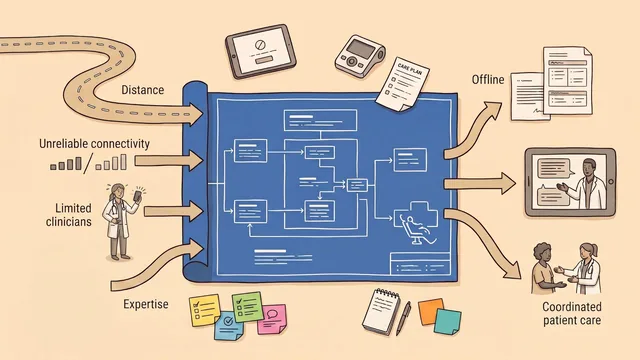
That is the role we have learned to play best: helping healthcare organizations reduce uncertainty before they make expensive decisions. We bring design, technology and healthcare expertise together early, getting close to the people doing the work, testing assumptions, and turning what we learn into a clearer path forward.
Want to know what good discovery looks like in rural healthcare? That is where we go next: into the field, where workflows meet the realities of care. Read part two: discovery in rural healthcare, user research before you build →