There is a version of rural healthcare that most health technology seems to have in mind. A small hospital. A specialist forty minutes away. Broadband that works most of the time. Roads that remain roads year-round.
Then there are the conditions we have witnessed firsthand.
We have driven three to four hours between patient interviews, sometimes with no other buildings in sight for miles. We have talked with patients about the distances they travel to receive care, and watched clinical teams work with limited staff, limited access to specialists, and technology that does not fit the environment they are working in.
Connectivity cannot be taken for granted. One person being out changes how the entire day works. Transportation determines whether care happens at all.
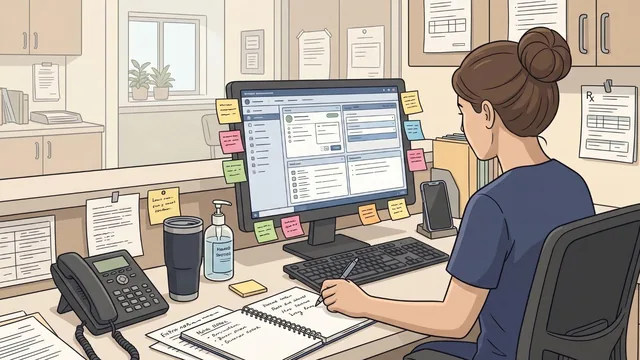
When the official workflow does not fit the reality of the day, people find another way.
Those workarounds are not edge cases. They are part of the operating environment.
The more time we spend alongside rural healthcare organizations, clinicians, operational teams and patients, the more we question the assumptions built into healthcare technology.
Not just: what technology can we bring to rural healthcare?
But: what would we build differently if rural healthcare were the starting point?
We do not have one answer. Different communities have different needs, resources and realities. But our work has left us with five questions worth exploring together.
1. How might we recognize a problem before it becomes an emergency?
Distance changes what deterioration means.
When a patient lives minutes from a hospital, worsening symptoms may mean a trip to the emergency department. When care is hours away, that same change sets off a more complicated chain of decisions around transportation, staffing, specialist access, and sometimes emergency evacuation.
So what could happen earlier? What if we could recognize meaningful changes while there were still more options?
Remote monitoring is part of that. So is medication adherence, recent utilization, symptoms, and environmental conditions.
So is something less sophisticated: the local clinician or caregiver saying, this patient isn’t acting like themselves today.
What becomes possible if we find better ways to bring those signals together?
2. How might we design clinical technology if we assumed the internet would disappear?
Most healthcare software works best when connectivity does too. In many rural environments, that cannot be assumed.
The people delivering care do not stop working when the software does. They write things down. They remember what needs to be entered later. They create temporary workflows. They find another way.
So what if offline were not a failure state at all?
What would we design differently if documentation, medication information, care plans and critical workflows had to keep functioning without a connection?
It is not the kind of capability that shines in a sales demo. But it raises the question of where we are designing from: the environment where technology is purchased, or the environment where people have to use it.
3. How might we design around the clinician who is actually there?
Healthcare technology assumes a particular care team. Then you spend time in a smaller facility.
One person wears multiple hats. A clinician makes decisions that would be distributed across several roles in a larger system. The specialist is somewhere else entirely.
So what does technology look like if we start with the person standing in front of the patient? What does that person need to make the decisions they are responsible for making? Where do they need guidance? When do they need another set of eyes? What information matters most in that moment?
There is a wide space between fully manual work and fully automated decision-making. What can thoughtful design make possible inside it?
4. How might care planning account for the realities of place?
Scheduling systems understand time. They understand geography much less well.
A system knows a patient needs another visit in twelve weeks. It does not know what those twelve weeks mean for someone who has to make a three-hour trip, coordinate several appointments into one day, depend on someone else for transportation, or navigate seasonal conditions.
What if access itself were part of the care plan?
Could visits be coordinated differently? Could transportation constraints influence when follow-ups happen? Could a difficult travel period change when a prescription gets refilled or a diagnostic test gets scheduled?
In rural healthcare, place is not an address. It is part of the care experience. What changes when we design for it that way?
5. What if the scarce resource is not technology but access to expertise?
A rural facility may have equipment. It may have data. It may have a clinician standing next to the patient. What it may not have at that moment is the expertise needed for the next decision.
Telehealth is one answer. Traveling specialists are another. But what else becomes possible if we ask: how might expertise move more freely than people can?
A specialist could review a well-structured case asynchronously. A clinician using a portable diagnostic tool could get support capturing the right information and a clear path to someone who can interpret it. Several facilities could share access to scarce expertise.
The answer may involve technology. It may also involve new workflows, services, partnerships or reimbursement models. That is what makes the question interesting.
What might these questions uncover?
We could turn each of these into a product concept. Draw the screens. Map the architecture. Estimate a build.
Our experience has made us more interested in what happens before that.
Sometimes the workaround someone shows you twenty minutes into an interview changes your understanding of the problem entirely.
Maybe specialty access is not a telehealth problem. Maybe it is transportation.
Maybe remote monitoring does not help if the clinical team already has more alerts than it can manage.
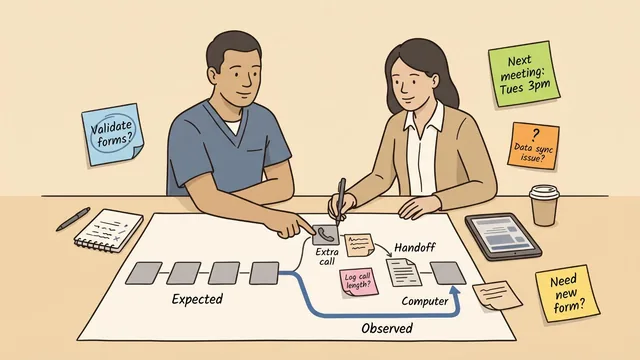
Maybe connectivity is not where information breaks down. Maybe it is the handoff between organizations.
Getting closer to the work creates better questions, and better questions create more possibilities.
That is what makes current rural health funding interesting to us. It creates an opportunity not only to implement technology, but to find where changes in services, workflows, experiences, partnerships and technology would improve how care is delivered.
Spend time with patients. Shadow clinicians. Follow the referral. Watch the handoff. Find the spreadsheet sitting beside the official system. Understand why the workaround exists.
Then prototype something small. Put it into the environment where it would have to work. See what changes.
Sometimes that exploration leads to software. Sometimes it leads somewhere cheaper: a workflow change, a partnership, a billing pathway nobody was using.
What could we rethink together?
What interests us about rural healthcare is not how to bring more technology into rural communities. It is what we find when we start with the conditions themselves.
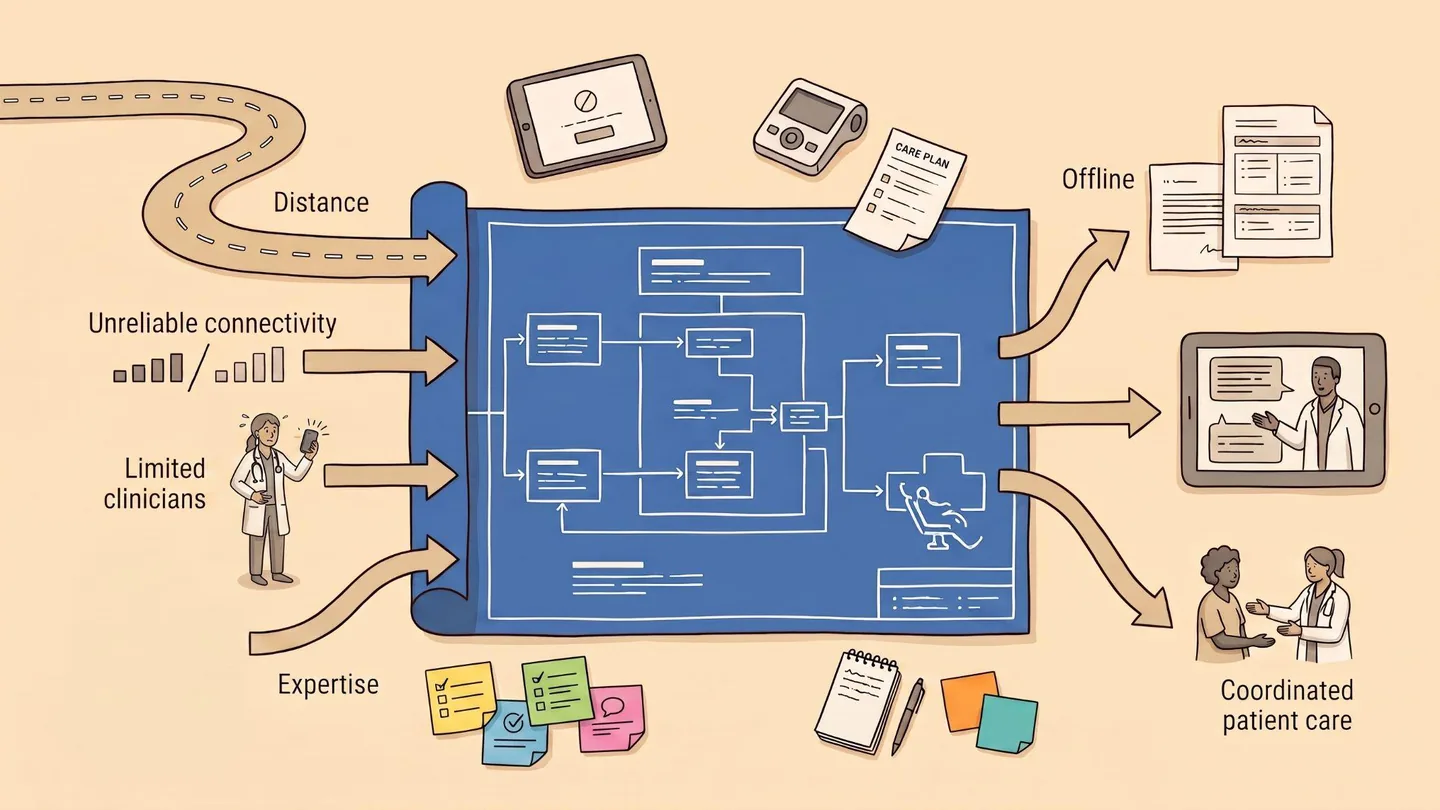
The distance. The staffing realities. The unreliable connection. The specialist who is not there. The three-hour drive. The handoff that depends on a phone call. The workaround everyone knows but nobody documented.
Then ask: what could the experience of rural healthcare become if we designed from those realities outward?
These are questions we want to keep exploring with rural healthcare organizations, clinicians, patients, community partners and funders.
At Digital Scientists we bring research, service design, healthcare and technology together to help organizations explore questions like these, turn promising opportunities into fundable and testable ideas, and learn what is worth pursuing.
We do not expect the answers to look the same everywhere. That is what makes this work interesting, and we are curious what questions we have not asked yet.