
Technology for post-acute, senior care and IDD providers
Digital Scientists designs, builds, integrates and runs post-acute care technology solutions for skilled nursing, home health, hospice, senior living and IDD providers. We built NeverAlone, a 24/7 virtual care platform that began as a 90-day MVP and now supports 30,000 patients across six states with a 96% treat-in-place rate. We still run it. We work alongside your EHR: PointClickCare and Netsmart (GEHRIMED) in production, and any system with an API, a standard interface or a reliable export. Most providers start with a Blueprint or one focused pilot.
Updated
Patients on NeverAlone across six states
Treat-in-place rate on NeverAlone
Virtual care calls a year
Recovered to date on CommuniCare's MDS platform




What does post-acute care technology look like after five years in production?
It looks like NeverAlone: a 24/7 virtual care platform that puts a provider on video with the nurse at the bedside, so the resident is treated in place instead of sent to the ER.
It began in March 2021 as a 90-day MVP with CommuniCare Health Services: a tablet for independent-living seniors with no username and no password, so they could reach a care partner by video. From there it grew into CommuniCare's skilled nursing facilities for nights, weekends and holidays, when no provider is on site. We built a care management platform that replaced Salesforce, extended the platform to adults with IDD with Easterseals Arc of Northeast Indiana, added employee health, and added behavioral health by August 2023, then home health and hospice.
During a call the provider sees the resident's history, medications and diagnoses, pulled from PointClickCare and Netsmart (GEHRIMED) with the same patient matched across both EHRs. Video runs on AWS Chime, E911 on Bandwidth, and every tablet is a managed iPad. The platform went multi-tenant and is licensed to facilities outside CommuniCare's own network. We still run it, and running platforms keeps us grounded in the challenges of everyday care delivery. Read the NeverAlone case study.
Patients across six states
Treat-in-place rate
Calls a year
Managed devices in the field
Post-acute care operators are fighting on three fronts simultaneously.
Post-acute care isn't a single setting. It's a continuum spanning skilled nursing, home health, hospice, assisted living, memory care, rehabilitation, and more. Each has different regulatory frameworks, payment models, and technology needs. The common thread: staffing shortages, reimbursement pressure, and technology that wasn't built for how these environments actually work.
One RN covering 100+ residents. When something goes wrong, the options are manage alone, call 911, or send to the ER. Each avoidable transfer costs $10K+ and counts against readmission measures.
Annual reimbursement leakage at a typical 100-facility operator from missed MDS diagnoses, undercoded assessments, and inconsistent PDPM capture across sites.
Per-visit documentation burden. Nurses spend more time charting than caring for residents. Documentation drives burnout, and burnout drives the staffing crisis.
What problems are post-acute and senior care providers trying to solve?
Six come up in almost every conversation we have with operators. Each one is a care delivery or reimbursement problem first and a software problem second.
Nobody to call at 2 AM
One nurse, a building full of residents and no provider on site. Without fast access to a clinician, the safe choice is the ER, and every avoidable transfer costs money and disrupts the resident.
Revenue documented but not captured
Diagnoses and comorbidities sit in the chart but never reach the MDS or the claim. Under PDPM and Medicare Advantage risk adjustment, that gap is real money across every facility.
Charting that eats the shift
Clinicians spend up to 45 minutes on a note. That time comes out of resident care and feeds burnout in a workforce that's already short.
Data stuck in the EHR
PointClickCare, MatrixCare or a physician EHR holds the record, and staff retype it into other systems by hand.
People who won't use a login
Seniors with low vision or a tremor, adults with IDD, and staff with no time all have one thing in common: if it needs a password, it doesn't get used.
Too many systems and no one owns the whole
Years of point solutions pile up. When we audited CommuniCare Advantage's stack we reviewed 60+ systems, ran an 11-vendor EHR selection and left a 25% smaller footprint.
Where do post-acute providers usually start with us?
With the problem that costs the most today, scoped small enough to prove in weeks before anything rolls out across your facilities.
Start small, prove value, then scale. NeverAlone began in one independent living community before it reached CommuniCare's skilled nursing network. CommuniCare's MDS work started as a focused build on PointClickCare data in April 2024 and grew as the results came in.
Each first step ends with a decision you make on evidence: carry on, change course or stop. The table shows where operators like you often begin.
Common starting points for post-acute and senior care providers
| If this is you | Common first step | What you get | Where it often goes next |
|---|---|---|---|
| After-hours coverage gaps across facilities | A Blueprint for virtual care: call flow, EHR data, devices and staffing | A plan, a working prototype and a budget for a pilot | A pilot in a few facilities, then a rollout, the path NeverAlone took |
| MDS or coding accuracy worries you | A data review on your PointClickCare and claims data | Where revenue is missed, facility by facility | AI recommendations for MDS coordinators or coders, like MDS and PDPM |
| Notes take too long | An ambient scribe pilot with one care team | Measured note time before and after | A scribe built into your workflow; HealthContext cut note time from 45 minutes to 5 |
| A new service line or product: IDD, home care, employee health | A Blueprint, 4 to 6 weeks | Scope, architecture, user stories and a prototype | An MVP on production foundations |
| Too many systems, or an EHR decision coming | IT consulting: a systems audit and vendor selection | An ecosystem map, requirements and a scored shortlist | Selection, migration and the integrations around it |
These are common starting points, not rules. Many providers combine them or change course, and the first conversation is where we work out the right one.
What do we build, connect and run for post-acute providers?
Software that works alongside your EHR, not instead of it. We build it, connect it to the systems you already run, and operate it, or hand it to your team.
We support platforms we built, with L2 and L3 support from our team, and we work alongside your IT provider or MSP rather than running a help desk. When you're ready to own it, we hand over the code, cloud accounts and runbooks on a build-operate-transfer plan. CommuniCare's MDS platform is the example: we built it from April 2024 and handed it to CommuniCare's own team. See platform operations.
Virtual care
24/7 coverage for nights and weekends: video on AWS Chime, E911 through Bandwidth, managed iPads. See telemedicine and virtual care.
MDS and PDPM AI
Recommendations for MDS coordinators inside the PointClickCare workflow: $10M+ recovered to date and $24M+ in forecast PDPM revenue. See MDS and PDPM.
Coding and risk adjustment
We built CommuniCare's risk adjustment engine in 2023 and 2024: $10M+ at 90%+ accuracy across 20K+ patients, 7 states and 245 providers. See coding and risk adjustment.
Ambient scribes
HealthContext, built into NeverAlone, cut clinical note time from 45 minutes to 5. See ambient scribes.
EHR integration
PointClickCare and Netsmart (GEHRIMED) in production, with patients matched across both. See EHR integration.
Care management
A custom care management platform that replaced Salesforce for NeverAlone's care teams. See care management software.
Built for the complexity of post-acute care.
Skilled Nursing Facilities
MDS optimization, PDPM revenue capture, quality measures.
$24M+ PDPM revenue forecast →
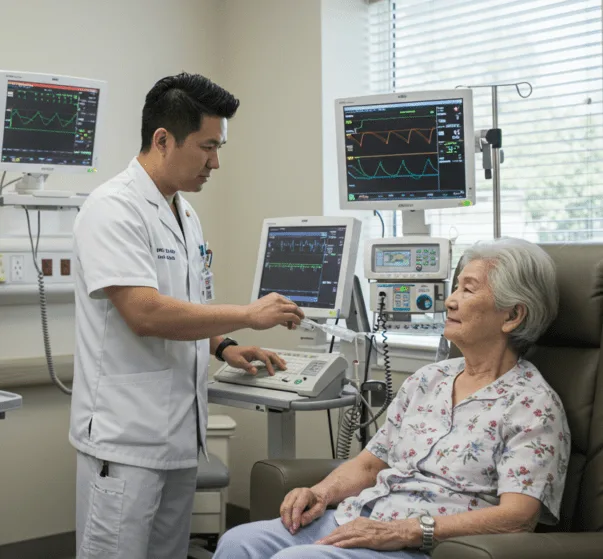
Home Health & Hospice
Documentation automation, scheduling, OASIS assessments.
documentation cut from 45 to 5 min →
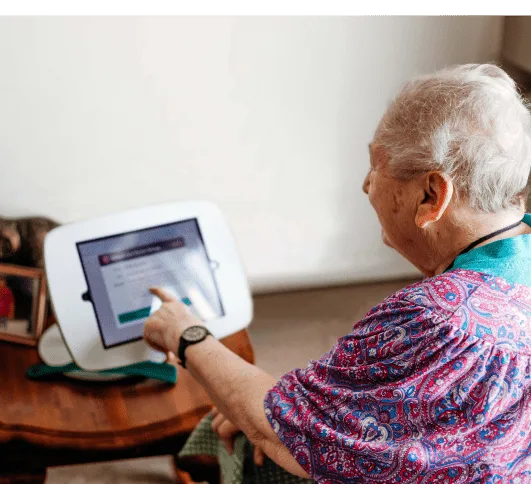
Senior Living / CCRCs
Resident engagement, family communication, operations.
Senior living software →
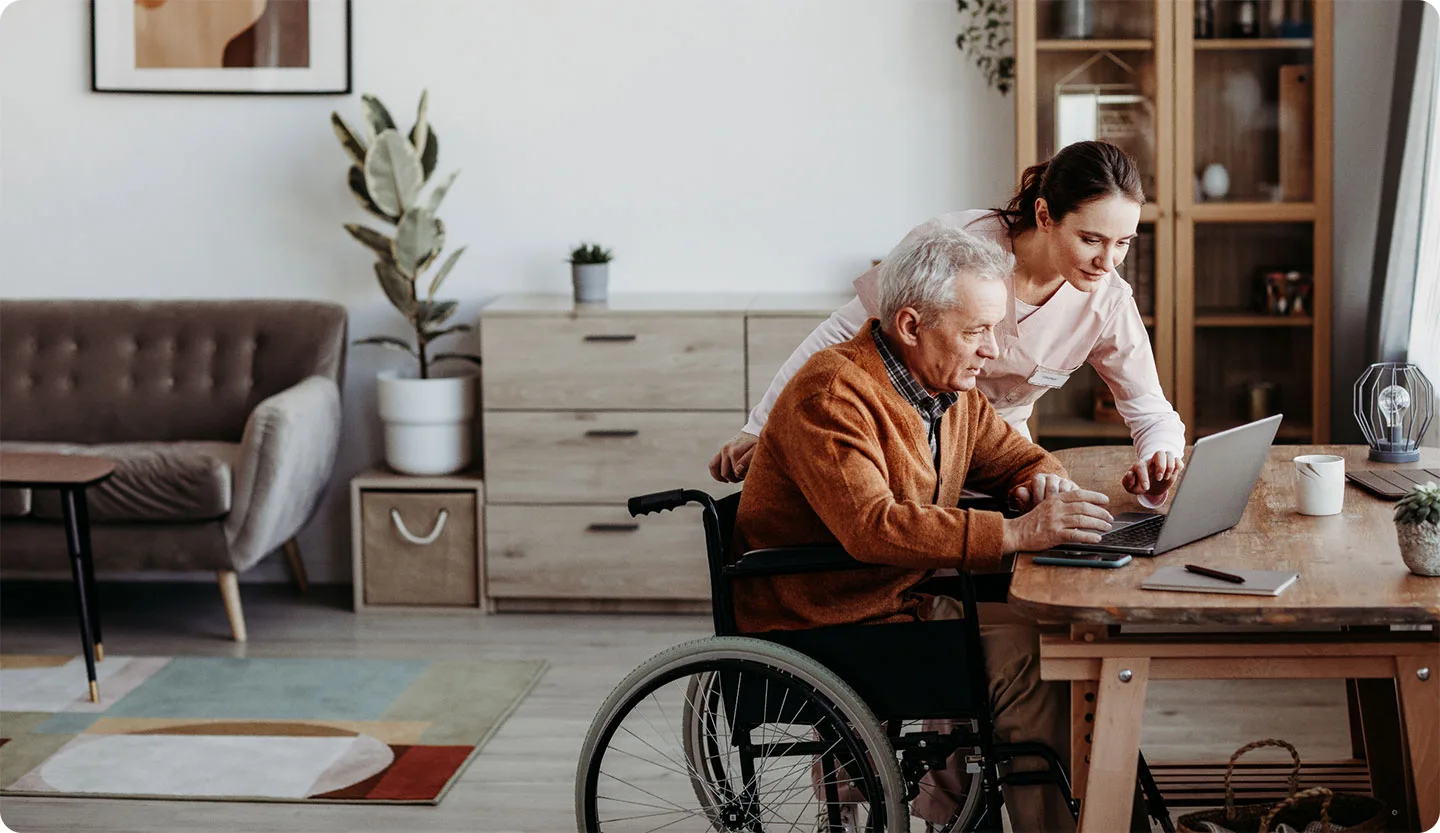
Health Systems & HealthIT
R&D partnership, platform development, EHR integration.
Your R&D partner →
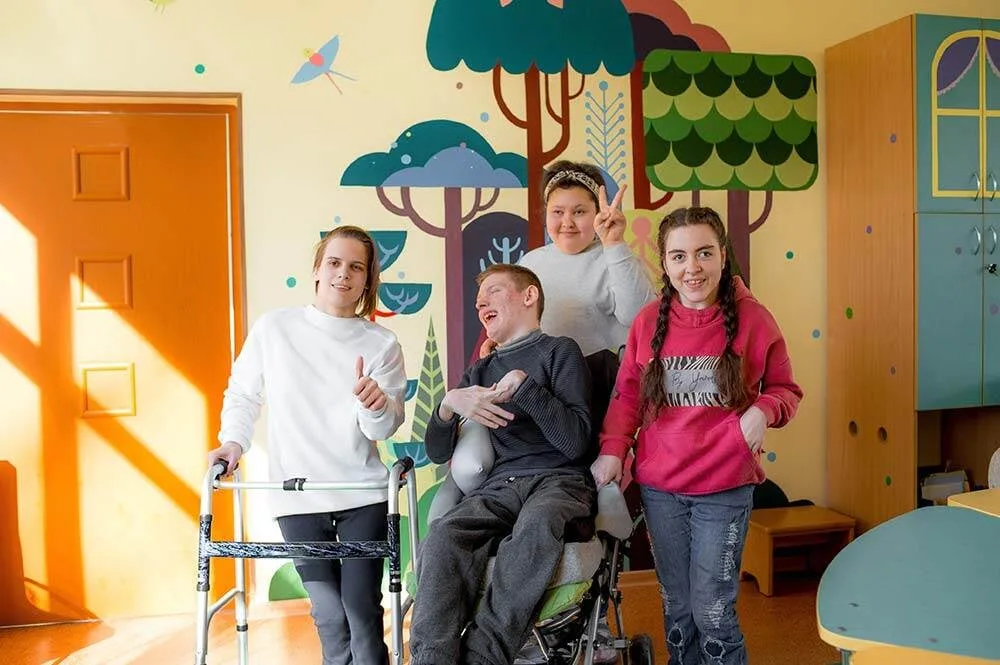
IDD Services
Technology for intellectual & developmental disability care providers.
IDD software →
Every Setting Has Different IT Needs
Post-acute care spans 14+ settings with different regulatory frameworks, payment models, and technology requirements. We build for each one, not a one-size-fits-all platform that fits none of them well.
Skilled Nursing (SNFs)
PDPM reimbursement tied to MDS accuracy. After-hours coverage gaps. Clinical data split across PointClickCare, MatrixCare and physician EHRs.
IT needs: MDS optimization, virtual care, ambient documentation, census management
Home Health (HHAs)
PDGM payment model. Mobile-first workflows. Nurses in rural areas with limited connectivity. OASIS assessments.
IT needs: Offline-capable mobile apps, visit verification, route optimization, remote documentation
Hospice
Medicare Hospice Benefit. Comfort-focused care plans. Family communication across multiple caregivers. IDG coordination.
IT needs: Symptom tracking, family portals, interdisciplinary team coordination, bereavement support
Assisted Living & Memory Care
State-regulated (not Medicare). Medication management. Cognitive decline monitoring. Family engagement expectations.
IT needs: eMAR, behavior tracking, wander management, simplified resident-facing interfaces, family portals
Adult Day Health
Daytime clinical and social programming for medically complex or cognitively impaired individuals. Attendance tracking. Health monitoring during program hours.
IT needs: Attendance management, health monitoring, activity tracking, caregiver communication
CCRCs / Life Plan Communities
Multi-level campuses spanning independent living through skilled care. Residents transition across levels. Different billing at each level.
IT needs: Cross-level care tracking, transition management, unified resident record, multi-payer billing
IRFs & LTACHs
Intensive therapy tracking (IRF). Medically complex patients with 25+ day stays (LTACH). FIM scores. Ventilator weaning protocols.
IT needs: Therapy outcome tracking, complex care coordination, specialized clinical documentation
PACE Programs
Integrated Medicare/Medicaid model for nursing-home-eligible individuals living in the community. Care coordination across every service.
IT needs: Integrated care management, dual-eligible billing, transportation coordination, day center operations
Care Transitions
Acute-to-post-acute handoffs. Medication reconciliation. Discharge planning. Readmission prevention across the continuum.
IT needs: ADT alerts, interoperability, care plan continuity, transition tracking, readmission risk scoring
Can seniors, adults with IDD and their families actually use it?
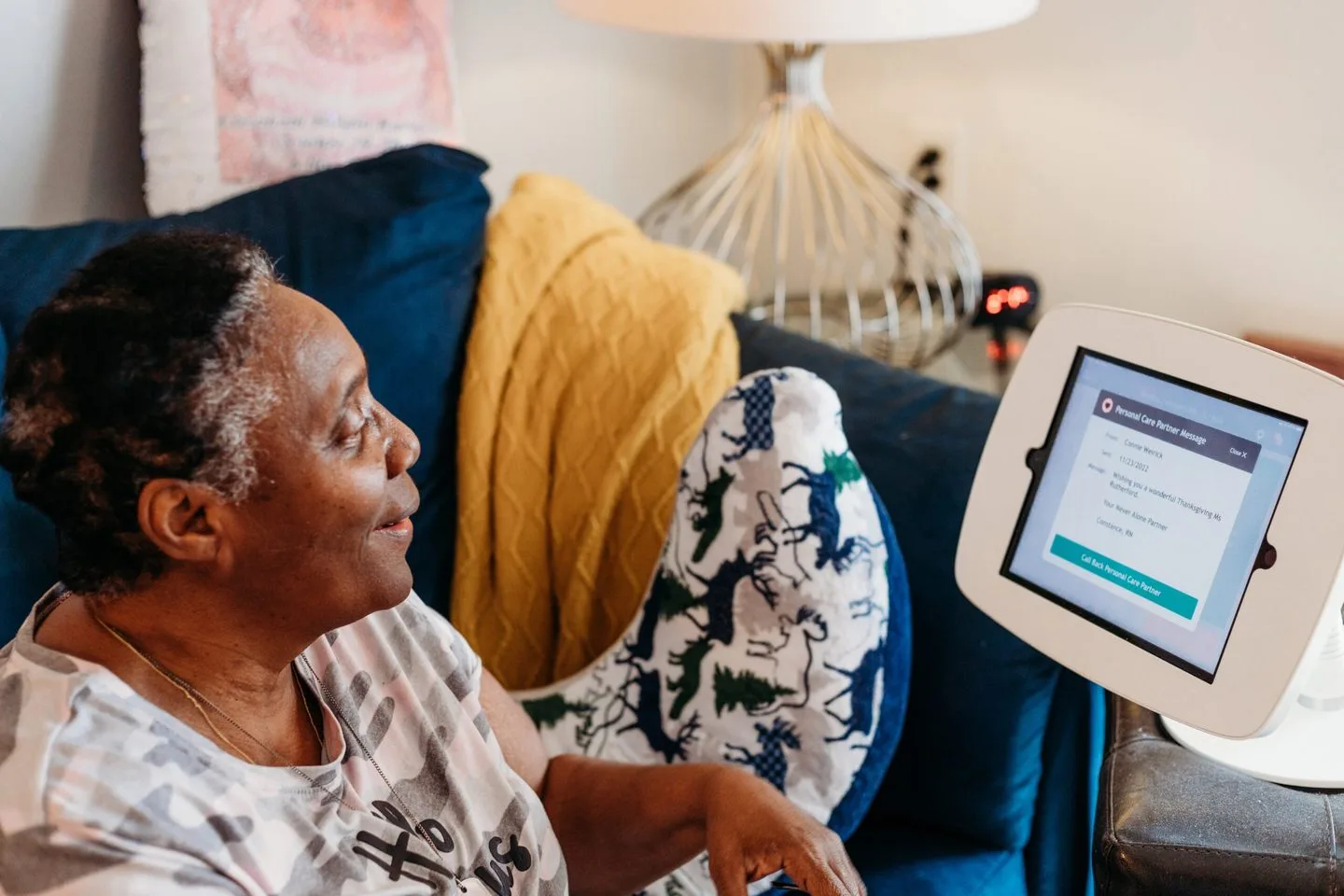
Yes, when it's designed for them from the first week. The NeverAlone tablet has no username and no password: a resident taps a large button and reaches a person by video.
We spent months with older adults in an independent living community before the first release, testing type size, contrast, button size and what happens when someone presses the wrong thing. The same design carried over to adults with intellectual and developmental disabilities, with Easterseals Arc of Northeast Indiana. Every tablet is a managed iPad, so nobody on staff troubleshoots settings.
In hospice and home care the person on the other end of the tablet is often a family member. When a provider wants a family-facing app or portal, we scope it in the Blueprint around who sees what, consent and the care team's workload.
- No login for residents and clients
- Large, high-contrast screens built for low vision and tremor
- Devices managed centrally, with no setup at the bedside
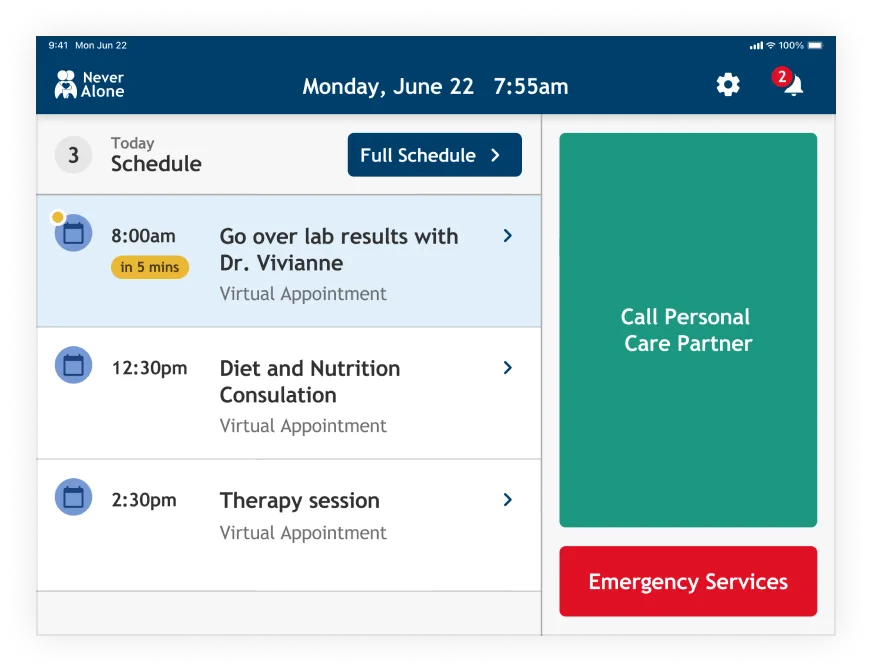
The NeverAlone tablet home screen, built for seniors and adults with IDD: today's appointments and one button to reach a person.
Post-acute technology we built and run
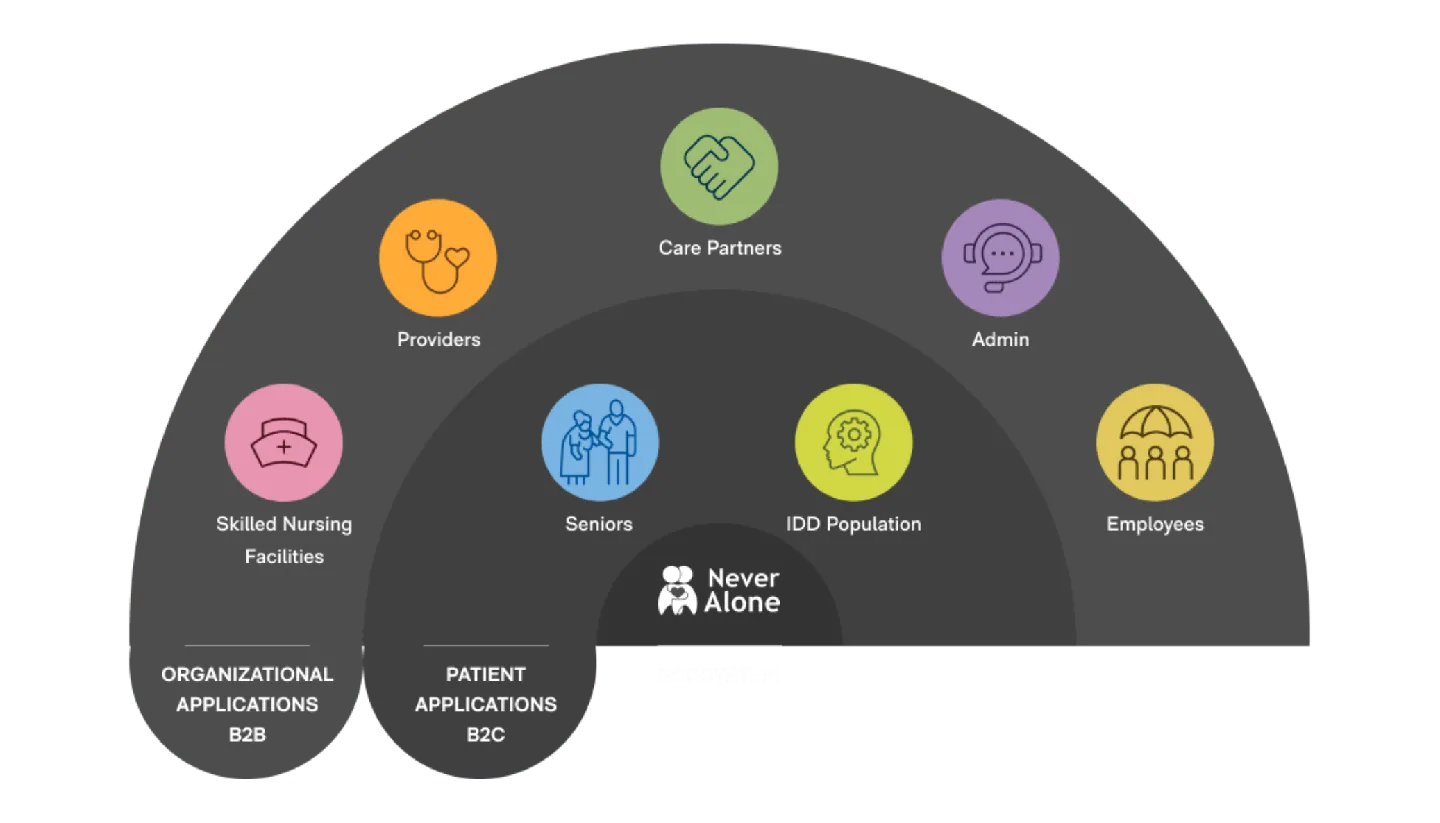
NeverAlone · CommuniCare
30,000 patients across six states
A 24/7 virtual care platform that began as a 90-day MVP, reached skilled nursing, IDD, behavioral health, home health and hospice, and runs today with a 96% treat-in-place rate.
See the work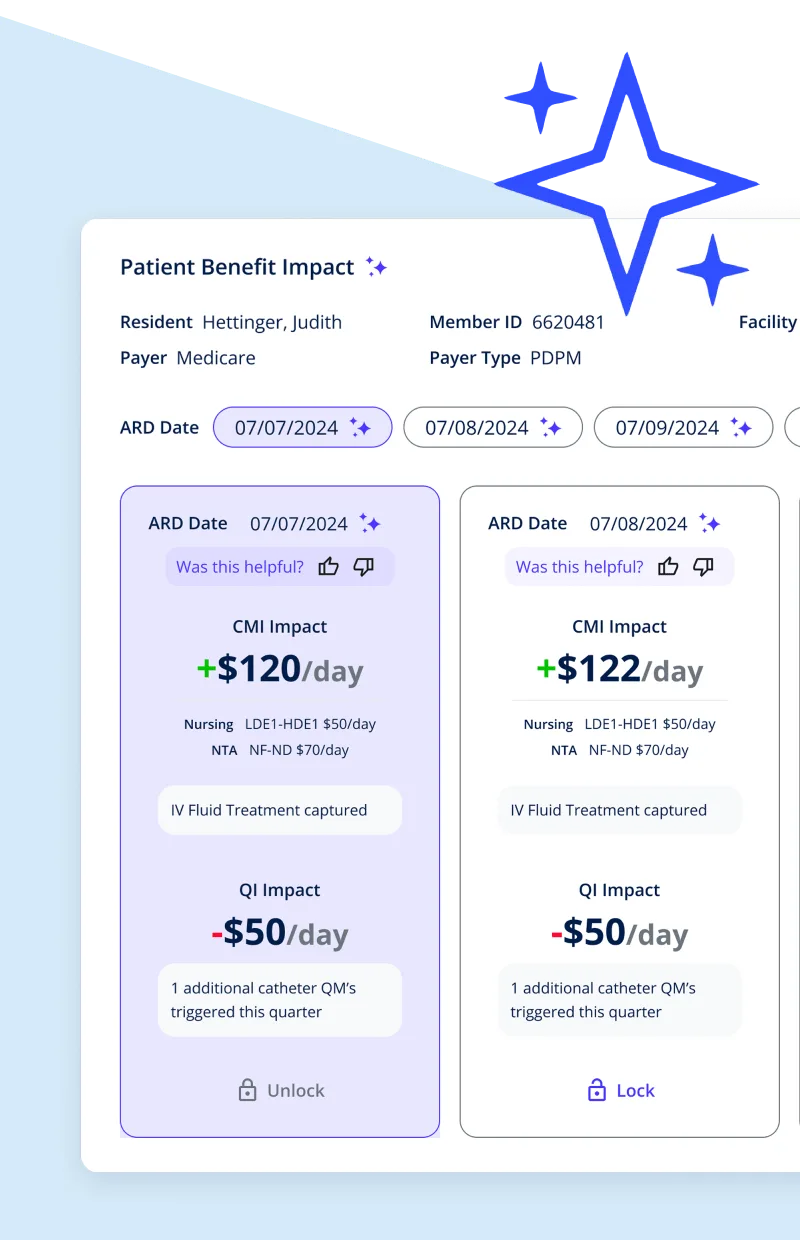
CommuniCare MDS · PointClickCare
$10M+ recovered to date; $24M+ forecast PDPM revenue
AI recommendations for MDS coordinators inside the PointClickCare workflow, built from April 2024 and handed to CommuniCare's own team.
See the work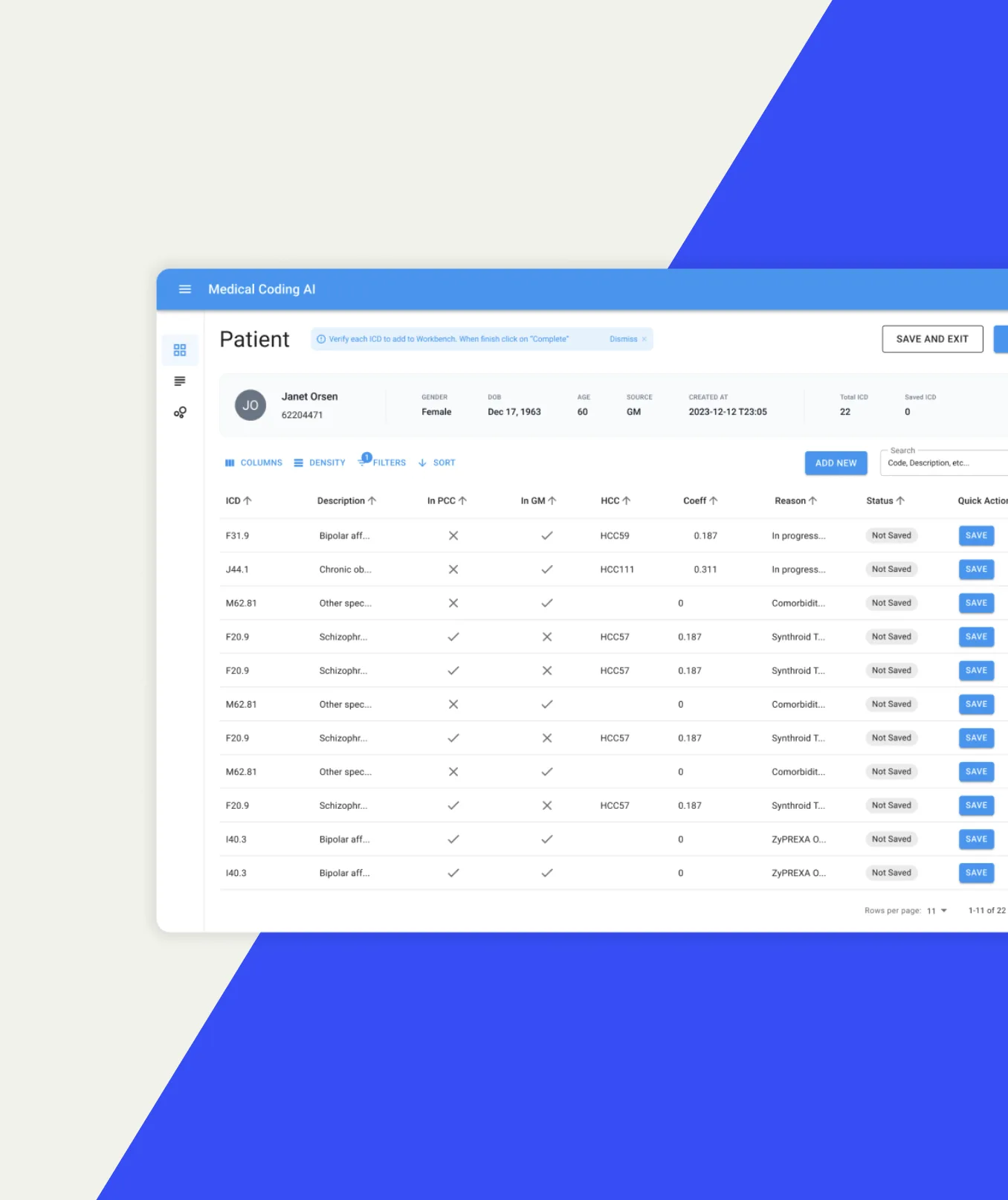
CommuniCare risk adjustment
$10M+ at 90%+ accuracy
An AI coding engine on GEHRIMED, PointClickCare and Acclivity data that covered 20K+ patients, 7 states and 245 providers.
See the workTrusted by healthcare leaders.
“I have worked with many technology teams during my career, and Digital Scientists is one of the best. They take the time to understand the customers' needs, deliver innovative solutions, are always professional, and work with your team as a true partner to achieve success.”
Amy Severino
Chief Innovation Officer, CommuniCare Health Services
“Digital Scientists provided immense value to our plan administrators, providers, and patients. The team was able to come in and understand our core needs, while remaining product agnostic. They helped identify the technical debt and pitfalls, and to get us to a point of stabilization and growth.”

Robert Hager
CEO, CommuniCare Advantage
Post-acute markets and the work behind them
Skilled nursing technology
Virtual care, MDS and PDPM, and PointClickCare data for SNF operators.
Skilled nursing technology →Home health and hospice software
Visit documentation, virtual visits and care at home.
Home health and hospice software →Senior living software
Resident-facing technology and operations for senior living and CCRCs.
Senior living software →IDD software
Technology for intellectual and developmental disability providers.
IDD software →Care management software
Care coordination platforms built around your teams.
Care management software →Platform operations
We run what we build, or hand it over.
Platform operations →
Questions about post-acute care technology
What is post-acute care technology?
Post-acute care technology is the software that supports patients after a hospital stay and older or disabled adults in long-term care: skilled nursing, home health, hospice, assisted living, memory care, rehabilitation and IDD services. It covers virtual care, MDS and PDPM tools, ambient documentation, EHR integration, care management and the apps residents, families and staff use.
How does virtual care work in a skilled nursing facility?
A nurse at the bedside starts a call on a tablet, the request is triaged as clinical or non-clinical, and a remote provider joins by video with the resident's history, medications and diagnoses on screen. Digital Scientists built and runs NeverAlone, which handles 100,000+ calls a year with a 96% treat-in-place rate.
Do you integrate with PointClickCare and MatrixCare?
PointClickCare, yes: it runs in production on platforms we operate, alongside Netsmart (GEHRIMED), with the same patient matched across both EHRs. MatrixCare isn't integrated today. We'd connect through its APIs or exports and prove the connection in the Blueprint before the build depends on it. We can integrate with any system that has an API, a standard interface or a reliable export.
Can families use the app?
NeverAlone was designed for residents first: a tablet with no username and no password, used by seniors and adults with IDD. In hospice and home care, families are often the ones at the tablet. A dedicated family app or portal is something we design to your program, and we scope it in the Blueprint around consent, who sees what and the care team's workload.
What is MDS optimization and how does AI improve it?
The MDS is the standardized assessment that drives PDPM reimbursement in skilled nursing. AI reviews the resident's full record against the MDS and flags diagnoses and events that appear in the chart but weren't captured, for the coordinator to validate. CommuniCare's MDS platform, which we built, has recovered $10M+ to date, with $24M+ in forecast PDPM revenue.
Do you work across the full post-acute continuum?
Yes. Our production work spans skilled nursing, independent living, home health, hospice, behavioral health and IDD services. We also design for assisted living, memory care, CCRCs, PACE and care transitions, where each setting has its own rules, payment model and users.
Who runs the software after launch?
We do, or your team does. We support platforms we built, with L2 and L3 support, and work alongside your IT provider or MSP. When you're ready, we hand over the code, cloud accounts and runbooks on a build-operate-transfer plan, as we did with CommuniCare's MDS platform.
Tell us what your care teams need
No commitment. No sales deck. We respond the same day, and you talk to senior leadership.
The virtual care platform we built handles 6,000+ calls a month for 130+ facilities. 96% of patients are treated in place.