Good technology decisions start with understanding the reality of care. Not the workflow on paper, but the people, constraints, relationships and workarounds that shape what happens every day.
As Rural Health Transformation Program investments turn into real technology initiatives, that understanding matters more, not less. The opportunity is not to introduce more technology into rural healthcare. It is to make sure those investments reflect how care is delivered and what rural communities need.
That is the work of discovery.
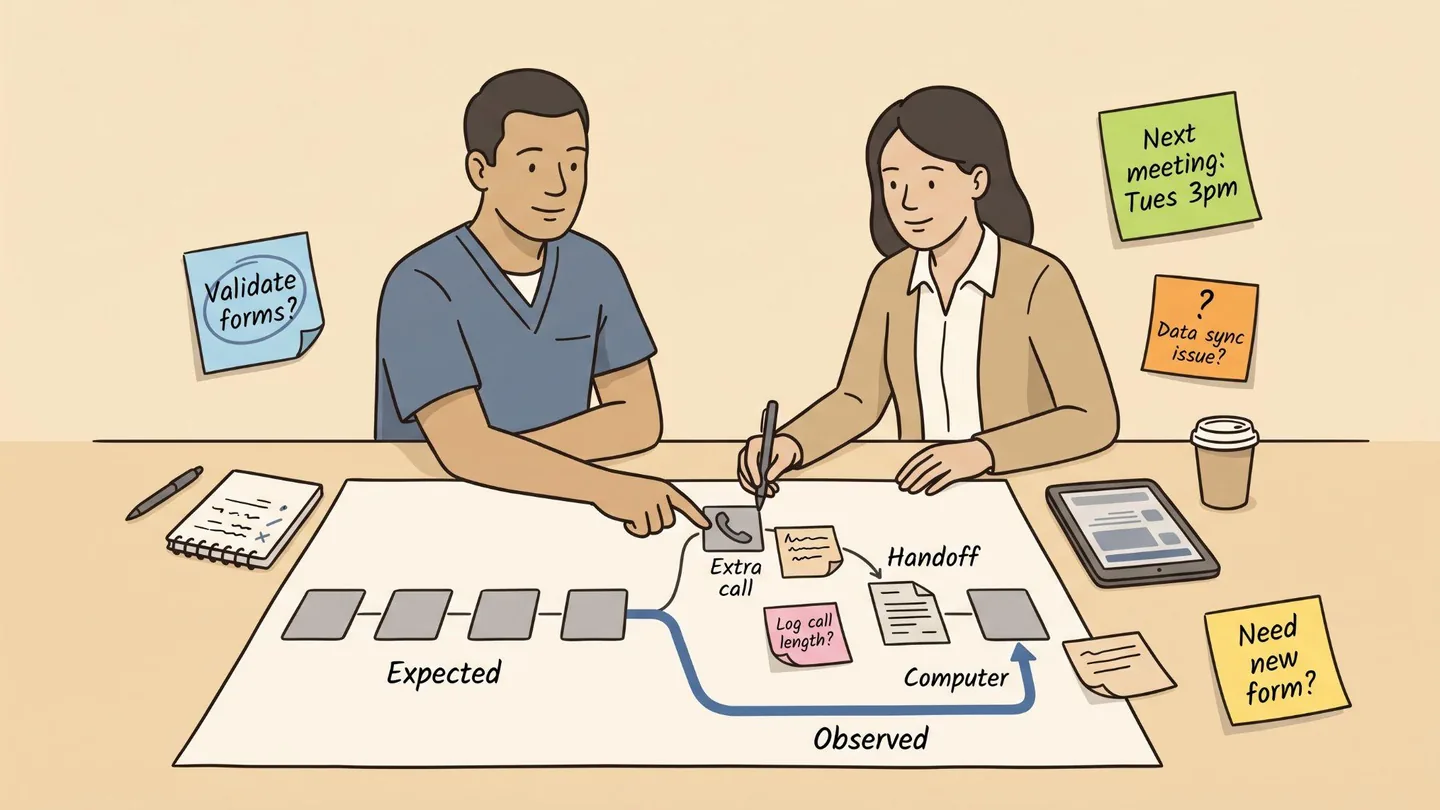
In rural healthcare it means getting out into the field, close enough to the work to see the difference between how a process is supposed to happen and how it happens.
Three practices ground our approach.
01. We observe care where it actually happens
A workflow diagram tells you what is supposed to happen during a home health visit. Spending time alongside the people delivering that care tells you something else.
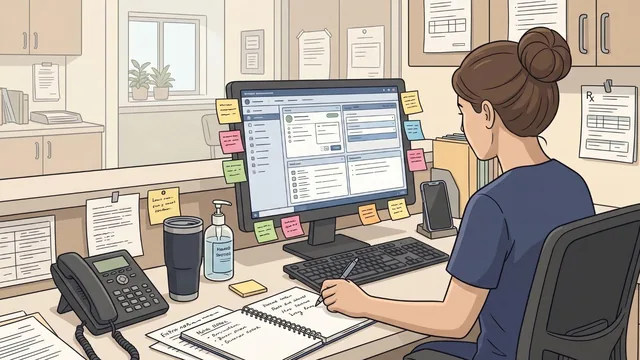
We have spent time alongside physicians, nurses, care coordinators, community health workers, practice managers and other frontline staff across a range of rural care settings, following their days through morning appointments and patient visits, seeing how documentation and handoffs happen, and noticing the small decisions and workarounds that shape the delivery of care.
We look at how patients interact with them, where documentation fits into the visit, where connectivity becomes unreliable, where staffing shortages create pressure, and where small friction points accumulate into operational burden.
We talk with the people doing the work, and we watch what happens between the steps they describe. That is where the most consequential design opportunities appear.
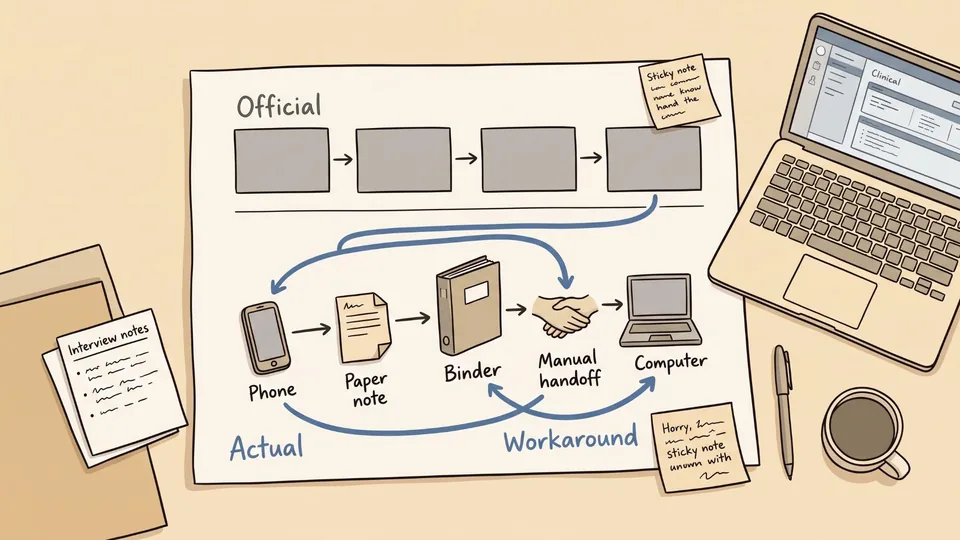
The goal is not observation for its own sake. It is to understand the system well enough to know which problems technology should solve and which problems another piece of technology will make worse.
We had that lesson handed to us in production. Ambient documentation running inside NeverAlone now cuts clinical documentation from 45 minutes to 5, and assessment time is down 40 to 60 percent for the coordinators who own it. Those numbers exist because someone sat with the documentation burden first and measured it in clinician hours rather than in features.
02. We prototype before we commit
One of the most expensive times to discover that an idea does not work is after it has been built.
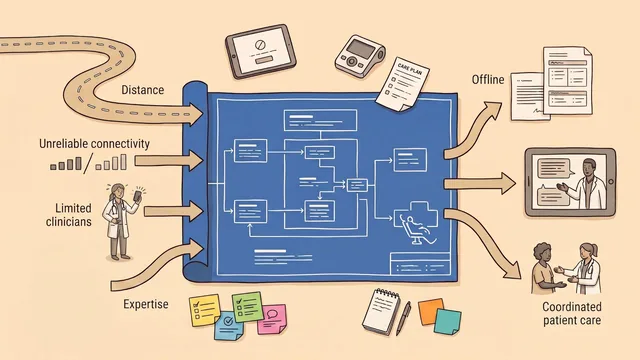
So we learn earlier. Before committing significant time and budget to development, we make ideas tangible enough to test: a clickable prototype, a redesigned workflow, a service blueprint, or a simulation of how a new model of care could operate.
Then we put it in front of the people who will use it: clinicians, care coordinators, schedulers, administrators, patients, and the teams responsible for making it work day to day.
What we learn changes the solution. A prototype tested in week three uncovers a workflow no one accounted for, a step that creates unnecessary burden, or an assumption about how patients will engage that does not hold up in practice.
That matters in any technology project. It matters more when organizations are working within grant timelines, defined budgets, procurement requirements and implementation milestones.
The goal is not to get everything right the first time. It is to learn while the cost of changing direction is still small, and before an assumption becomes an investment.
03. We design for the conditions that actually exist
Rural technology cannot be designed for the best-case environment.
It has to work with inconsistent connectivity. On older devices. Across organizations running different systems. During staffing shortages. For clinicians moving between facilities that are miles apart, into homes and vehicles. For patients with varying levels of digital access and confidence.
Those are not edge cases. They are the operating environment.
Good discovery makes those realities visible early enough to become design requirements rather than implementation surprises.
That changes fundamental decisions: what information needs to be available offline, how many steps a task should require, what happens when a connection disappears halfway through a workflow, which alerts require human attention, and whether a new tool is needed at all.
The objective is not to make technology resilient. It is to make the care model around the technology resilient.
Discovery is not the phase before the real work
There is a persistent temptation in technology projects to treat discovery as preliminary work, something to move through quickly so the real work of building can begin.
We think about it differently.
Discovery is where the highest-leverage decisions in the entire investment get made.
It is where a broad ambition like “expand access” becomes a specific understanding of who lacks access, why, and what would change that experience.
It is where “support the workforce” becomes an honest accounting of what is consuming clinicians’ time.
It is where “implement remote care” becomes a workable operating model: who enrolls patients, who watches the data, what deserves an alert, what happens next, and how the program fits into an already full day.
Budget for learning, not just building
The scale of RHTP creates pressure to move. There are plans to execute, funding windows to meet, technologies to evaluate, and communities that have waited a long time for investment.
Moving quickly matters. Speed and discovery are not opposites.
A small investment in understanding the environment, testing assumptions and involving the people who will use a solution prevents a much larger investment from being built on the wrong assumptions.
That is why discovery belongs in the technology budget, not as a step before the work but as part of the work itself.
RHTP is an opportunity to do more than deploy technology. It is a chance to make investments that improve how care is delivered and experienced in rural communities.
This is the kind of work our team at Digital Scientists is built for: bringing research, design, healthcare and technology expertise together to help organizations understand the problem, reduce uncertainty, and make better decisions about what to build.
Next: what would we build if we started with rural healthcare? →