Almost everything written about the Rural Health Transformation Program describes the same thing: fifty billion dollars, five years, all fifty states approved. That is the press release. It tells you nothing you can act on.
I spent a week inside the actual funding opportunity, CMS-RHT-26-001, and inside Georgia's full ninety-seven page application. What I found is that the money is divided by a specific, published formula, and that formula decides what your organization can realistically ask for. Most people spending this money have never seen it. Here it is.
If you already hold a subaward, the useful question is not how much your state won. It is what your state has to prove next, and whether your scope is one of the things it has to prove it with. The scoring decides that, which is why it is worth twenty minutes before anybody writes a statement of work.
The money splits twice, not once
The program is authorized by Section 71401 of Public Law 119-21 and runs ten billion dollars a year from federal fiscal year 2026 through 2030. States were the only eligible applicants, the single window closed on 5 November 2025, and CMS approved all fifty of them in December 2025. Every one of those awards was signed on the same day, 29 December 2025, and every one ends 30 October 2030.
The first split is even. Twenty-five billion is baseline funding, divided equally among approved states. Nobody competes for it.
The second twenty-five billion is workload funding, and it is allocated by points. That half splits again: 50 percent comes from rural score factors, and 50 percent from technical score factors. Those two halves behave completely differently, and confusing them is a common and expensive mistake.
Half the score your state cannot change
The rural score factors are pure data. CMS calculated them once, in the fourth quarter of 2025, and they do not move for the life of the program.
- Absolute size of the rural population, 10 percent
- Proportion of rural health facilities in the state, 10 percent
- Uncompensated care in the state, 10 percent
- Share of the state population in rural areas, 6 percent
- Metrics defining the state as frontier, 6 percent
- Total square miles, 5 percent
- Share of hospitals receiving Medicaid disproportionate share payments, 3 percent
If you work in Texas or Alaska you already know why those two states drew the largest Year 1 obligations. This is geography and demography. No initiative changes it, and no vendor can help with it. Stop thinking about it.
Half the score is earned, and this is the half that matters
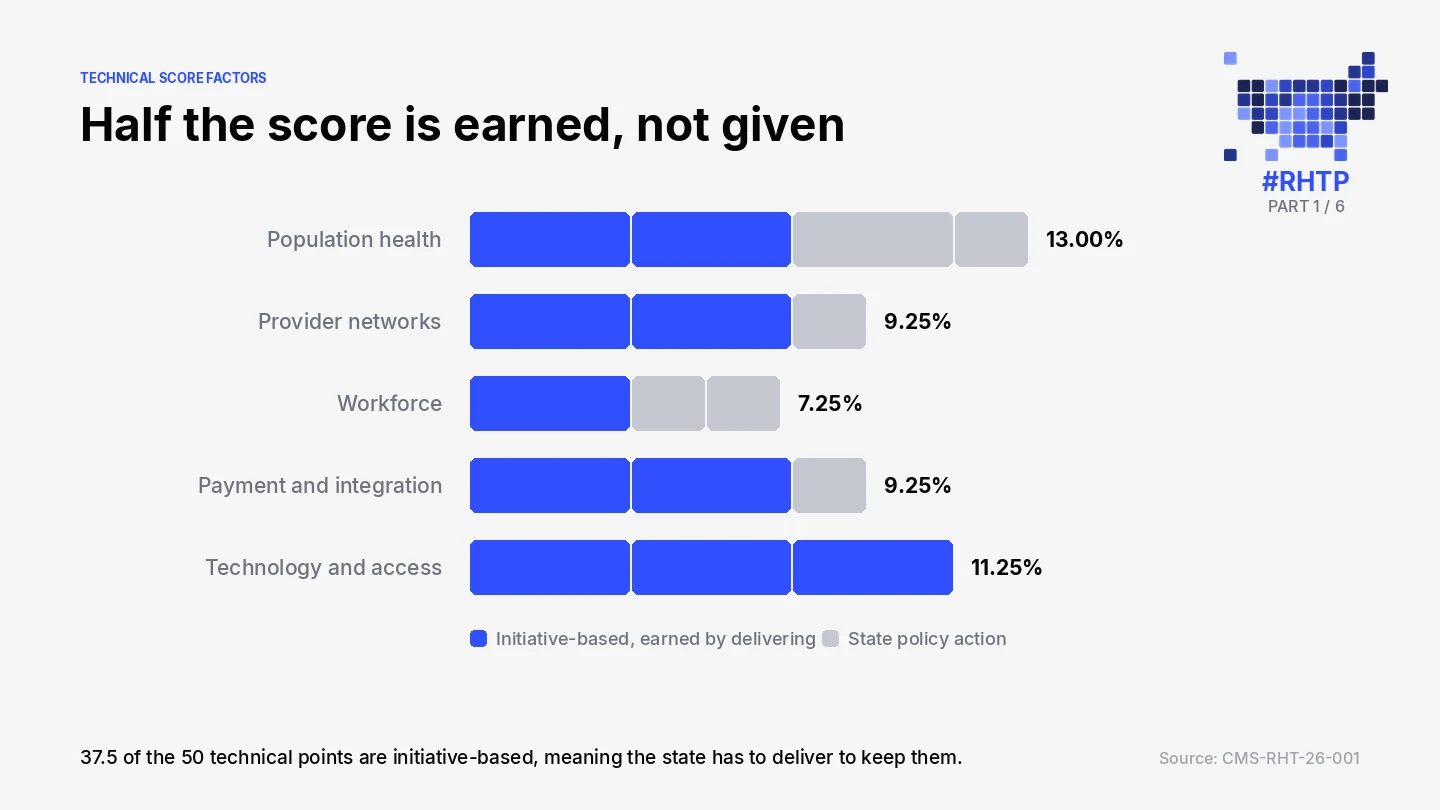
The technical score is sixteen factors across five groups. Here is the full table with the published weights.
| Group | Factor | Weight |
|---|---|---|
| Population health | Clinical infrastructure | 3.75% |
| Health and lifestyle | 3.75% | |
| SNAP waivers | 3.75% | |
| Nutrition continuing medical education | 1.75% | |
| Provider networks | Rural provider strategic partnerships | 3.75% |
| Emergency medical services | 3.75% | |
| Certificate of need | 1.75% | |
| Workforce | Talent recruitment | 3.75% |
| Licensure compacts | 1.75% | |
| Scope of practice | 1.75% | |
| Payment and integration | Medicaid provider payment incentives | 3.75% |
| Individuals dually eligible for Medicare and Medicaid | 3.75% | |
| Short-term, limited-duration insurance | 1.75% | |
| Technology and access | Remote care services | 3.75% |
| Data infrastructure | 3.75% | |
| Consumer-facing technology | 3.75% |
Read down the weight column and one thing stands out. Technology and access is the only group in which every factor carries the maximum 3.75 percent. There is no low-weight filler in it. Every other group contains at least one 1.75 percent factor.
CMS sorts these factors three ways, and the sorting is the real insight
This is the part I had to read the funding opportunity to find. CMS labels every factor as one of three types.
- Data-driven. Scored against your state's metrics compared to other states. You cannot influence it.
- State policy action. Scored on policy your legislature adopts. Certificate of need, licensure compacts, scope of practice, SNAP waivers, short-term insurance rules. A technology budget does nothing here.
- Initiative-based. Scored on the quality of the initiatives your state proposed and, critically, on subsequent follow-through.
Add up the initiative-based factors and you get 37.5 of the 50 technical points. Three quarters of the earned score is not about what your legislature passes. It is about whether the things your state said it would do actually get built and operated.
Eleven ways the money can be spent
The statute lists eleven approved uses of funds, labeled A through K, and a state must carry out activities in at least three of them: prevention and chronic disease, provider payments, consumer technology solutions, training and technical assistance, workforce, IT advances, appropriate care availability, behavioral health, innovative care, capital expenditures and infrastructure, and fostering collaboration.
Two constraints on that list shaped the state plans we reviewed. Provider payments under category B are capped at 15 percent of a state's annual award. And no RHTP money may replace payment for services that insurance would reimburse. Those two rules are why so much of this funding was pushed toward technology, infrastructure and technical assistance. There was nowhere else for it to go.
Category D is worth knowing by name. Training and technical assistance is an approved use, which means planning work, assessment and solution architecture can be paid for out of the grant rather than out of your operating margin.
The scoring repeats every year, and unspent money leaves
Rural score factors were assessed once. Technical score factors are recalculated annually, and states begin each year at 50 percent on the initiative-based factors, earning the remainder by implementing their initiatives and meeting milestones.
Three consequences follow, and they are the reason I think most organizations are underestimating this program.
It is a relative competition. Each factor is scored out of 100 across all fifty states, and a state's award equals its share of the total points every approved state earns. If your state holds still while others execute, your state's share falls.
Unspent money is redistributed to other states. Funds a state has not spent by the end of the following fiscal year go back into the pool. CMS is explicit that money earmarked for future spending is not considered spent. It has to be paid out. Anything unexpended or unobligated as of 1 October 2032 returns to the Treasury.
It is a cooperative agreement, not a grant. CMS retains substantial involvement after the award and may be in contact monthly or more often. Nobody is handing over a check and walking away.
How to find your own commitment
Every funded scope traces back to a Use of Funds letter and a technical score factor. Georgia's application tags all twenty-nine of its strategies this way, in public. If you hold a subaward, the fastest useful thing you can do this week is find the tag on your own scope, then ask one question: is this factor initiative-based? If it is, your state needs evidence that you delivered, not just evidence that you spent.
Terms used in this post
Program vocabulary and acronyms, in the order they appear. Skip it if you already know them.
- NOFO
- Notice of Funding Opportunity. The document that defines the rules. This one is CMS-RHT-26-001.
- Obligate versus expend
- Obligating is committing money under a signed agreement. Expending is actually paying it out. CMS counts them differently and the distinction decides whether money stays in your state.
- Subrecipient versus contractor
- A subrecipient receives a subaward and carries program responsibility, with federal terms flowing down to them. A contractor sells goods or services. Which one you are changes your compliance obligations.
- Baseline versus workload funding
- Baseline is the equal split. Workload is the scored portion.
- Initiative-based factor
- A scored factor earned through proposing initiatives and following through on them, as opposed to one earned through state policy or fixed data.
- Budget period
- The federal fiscal year against which funds are awarded and must be spent.
- Assistance Listing 93.798
- The federal program number. Every state award is searchable under it on USAspending.gov.
This money is divided three ways: by geography you cannot change, by policy your legislature controls, and by execution someone has to actually perform. Only the third is in your hands, and it is the largest share of the part that gets recalculated.
Which raises a more practical question. If execution is what moves the score, who actually owns the commitment, and who is allowed to spend money against it? That is the next post.
Sources for everything above: the CMS Rural Health Transformation Program Notice of Funding Opportunity, CMS-RHT-26-001, and Georgia's GREAT Health Year 1 application. Award-level figures are from USAspending.gov under Assistance Listing 93.798, pulled 16 August 2026.