If you have spent any time trying to sell into this program, or trying to buy against it, you have probably had the experience of talking to someone for twenty minutes and then realizing they cannot actually do the thing you are asking them to do. Not because they do not want to. Because the money does not sit where you think it sits.
That is worth sorting out before anything else. The Rural Health Transformation Program moves $50 billion through a specific chain of hands, and every link in that chain controls something different. Get the chain wrong and you spend a month pitching an entity that has no authority to say yes.
Here is the chain, and what each link actually controls.
Congress and CMS set the rules, not the projects
Congress appropriated the money under Section 71401 of Public Law 119-21. CMS administers it. What CMS controls is the score: it decides how much each state receives, it recalculates the technical portion of that score every year, and it can reduce, withhold or recover funds a state spends inconsistently with what it promised in its application.
What CMS does not do is pick your project. It never sees your organization. So there is nothing to sell CMS, and nobody at CMS to call. What CMS gives you instead is a scoring framework that tells you what your state has to prove, which I went through in detail in the first post in this series.
One detail people miss: this is a cooperative agreement, not a grant. CMS stays involved after the award and may be in contact with the state monthly or more often. Nobody wrote a check and walked away.
The state agency holds the award, and it was the only entity that could apply
This is the part that surprises people. Only states could apply. The single application window closed on 5 November 2025 and it is not reopening. Your health system could not apply. Neither could ours, and neither could any technology company.
A designated agency in each state holds the cooperative agreement. In Georgia it is the Department of Community Health, running the program as GREAT Health. In Florida it is the Agency for Health Care Administration. In Alabama it is the Department of Economic and Community Affairs, which is not a health agency at all, and that tells you something about how differently states have organized this. Tennessee is running parts of it through General Services procurement.
So the state controls the money and the terms. It decides who becomes a subrecipient, what the scope of each subaward is, and when the money moves. If you are trying to get something built, the state is the entity that decides whether your project exists at all. It is not, however, usually the entity that buys the software.
Program consultants run the process, not the build
Most states retained an outside firm to administer the program. In Georgia a national accounting and advisory firm serves as external grants manager and touches every subrecipient agreement. Alabama engaged a comparable management consulting firm as its program consultant. A separate firm holds actuarial evaluation in Georgia, which is a narrower role than people assume. The names are in each state's own program documents, and the scope of each engagement is defined there rather than by reputation.
This layer gets misread constantly. Where the scope is published, it covers process, compliance and reporting rather than building clinical software. Read the scope in the state's documentation before assuming what a given firm does or intends. Treating the program management layer as competition is usually the wrong read: it is the layer you build underneath, and it is the layer with visibility into which subrecipients are behind schedule.
Subrecipients hold the money and the promise
Below the state sit the subrecipients: rural hospitals, federally qualified health centers, EMS agencies, health information exchanges, universities, accountable care organizations. They receive a subaward and they carry program responsibility, which matters legally. Federal terms and conditions flow down to them under 2 CFR 200.101(b)(1). A contractor who simply sells goods or services does not carry that responsibility. A subrecipient does.
This is where the work is, and it is also where the problem is. These organizations now hold money against a spend clock and a scope they committed to, and most of them do not carry an engineering bench. That gap is the whole reason this series exists.
Aggregators are the layer almost everyone ignores
Here is the thing that changed how I think about this program. Georgia funded seventeen rural hospitals at roughly $380,000 each. Run that as seventeen separate procurements against seventeen separate designs and you will spend the money without leaving anything that connects to anything else. None of those awards is large enough to fund a real platform on its own.
Together they are. The entities that can make that happen are the aggregators: state offices of rural health, hospital associations, health information exchanges, rural health innovation centers, primary care associations. They already reach every one of those hospitals.
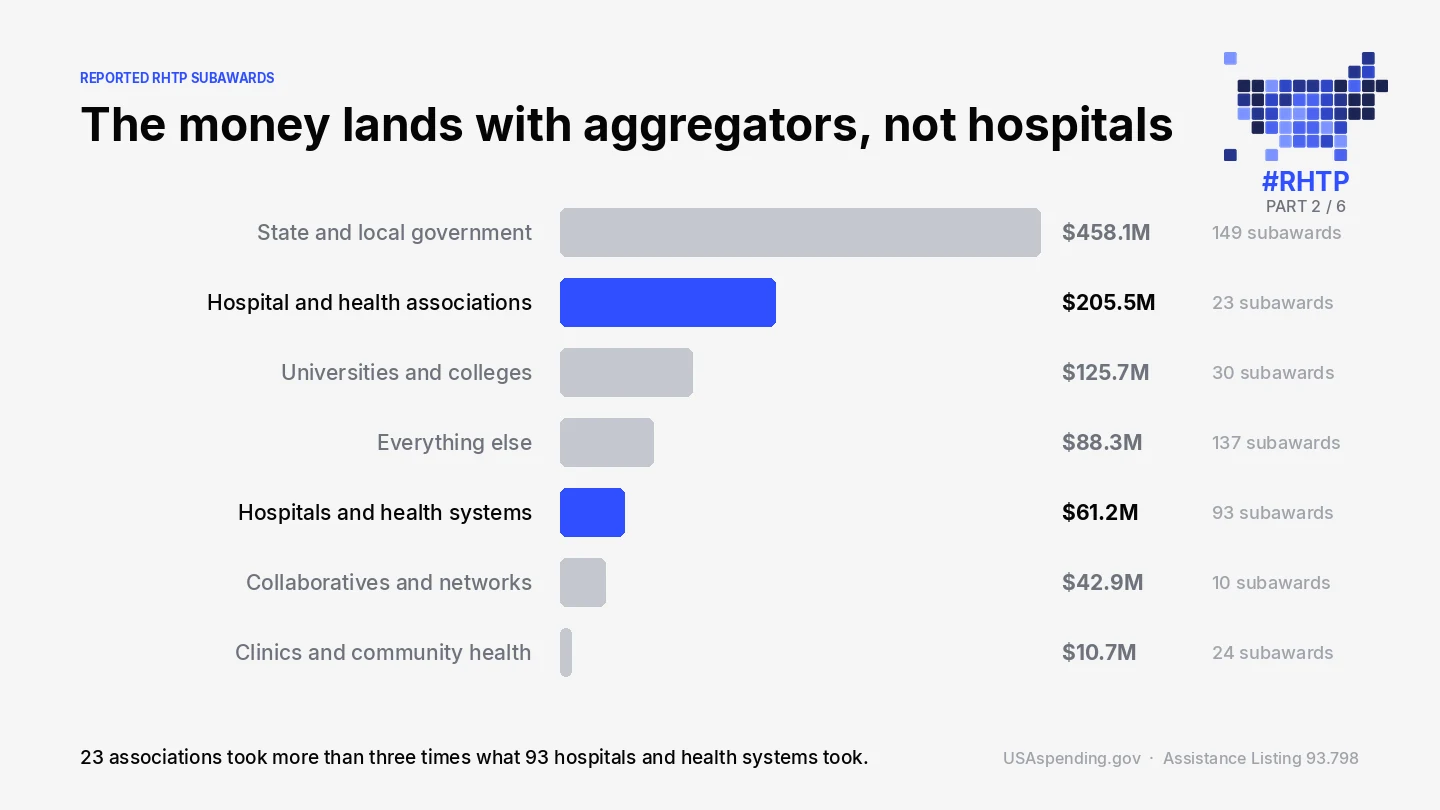
The federal record backs this up rather than just being a nice theory. We pulled every award under Assistance Listing 93.798 from USAspending.gov, and once you set aside states passing money sideways to sister agencies, the largest actual recipients are exactly these intermediaries: a care collaborative in Kansas at $99.0M, the University of Hawaii at $57.5M, the Washington State Hospital Association at $42.0M, the Hospital Association of Rhode Island, Invest Nebraska, two Illinois associations. Very little is reaching individual hospitals directly. Across the 471 subawards reported so far, twenty-three hospital and health associations account for $205.5 million, while ninety-three individual hospitals and health systems account for $61.2 million between them. The money is pooling one layer above the providers, and that is the layer to talk to.
Incumbent vendors are already inside, and that is fine
Every one of these organizations already runs an EHR, and many already run some telehealth or remote monitoring. Replacing that installed base is rarely the job and is usually a bad idea. It also works against you at score time, because interoperability is a scored factor and being genuinely technology agnostic counts for something. I get into that properly in the interoperability post.
Four routes to the work, and only four
Since no technology company could apply, every dollar that reaches a build reaches it through someone else's award. In practice there are four ways in.
- Named inside a subrecipient's application. Slowest, strongest. You are in the technical section before the money moves.
- Subcontracted to an organization that already holds an award. Fastest revenue, because the money already exists and the clock is already running.
- Subcontracted under a prime. Someone else holds the relationship and you deliver a component.
- Direct state procurement. Several states are buying through their own procurement systems. Tennessee posted RFPs through General Services in July. West Virginia is running a whole program of solicitations through its state portal.
One caution worth saying out loud. In some states, helping author a technical section and then bidding on the resulting work is restricted. Check the organizational conflict rules in that specific state before you do both. It is a cheap question to ask early and an expensive one to discover late.
Terms used in this post
Program vocabulary and acronyms, in the order they appear. Skip it if you already know them.
- Subrecipient
- Receives a subaward and carries program responsibility. Federal terms flow down.
- Contractor
- Sells goods or services. No program responsibility.
- Prime
- The organization holding the agreement directly above you.
- Cooperative agreement
- Like a grant, but the funder stays substantially involved after the award.
- Aggregator
- Not a federal term. Our shorthand for an entity that reaches many small awardees at once.
- Assistance Listing 93.798
- The federal program number. Every state award is searchable under it on USAspending.gov.
So who do you actually call
If you hold a subaward, nobody. You already have the money and the decision is yours.
If you are trying to reach many small awardees, call the aggregation layer, not the hospitals. One conversation with a hospital association is worth seventeen conversations with hospitals, and it produces something the seventeen can actually share.
If you are a vendor, stop pitching the state agency. It is not going to buy your software. Find the subrecipient with the scope that matches what you build, or find the prime that already won.