Every conversation about this program eventually arrives at the same question, usually near the end and usually in a lower voice. What happens in 2030?
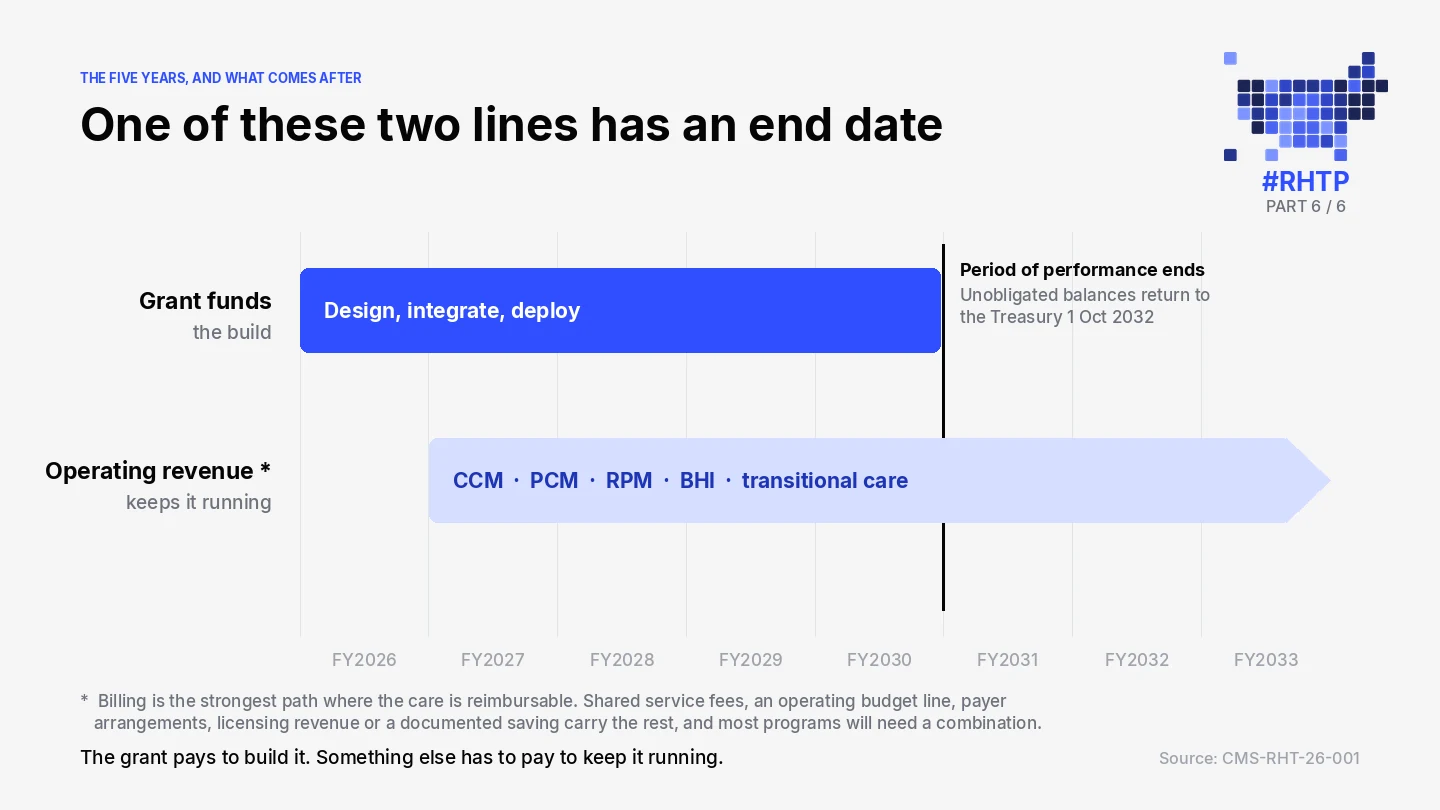
It is the right question and almost nobody's plan answers it. The program funds five federal fiscal years, 2026 through 2030, and then it stops. That boundary is the most important date in any plan being written today and the one least likely to appear in a vendor proposal.
Some states have already written the cliff into their own documents. Georgia's approach assumes staffing transitions onto other CMS funding in year three. That is a state saying out loud that the money runs out before the need does.
Three ways this ends, and you are choosing one right now
Rented. The capability stops at the boundary. Whatever the initiative achieved goes with it, the score it earned is not repeatable, and you have a set of screenshots for the final report. This is the default outcome of a subscription with no exit.
Bought. You own something, and you also own a maintenance obligation you now have to staff and fund alone. Hosting, licensing, support, and the upgrade that arrives in year four whether or not there is a budget line for it. Better than rented, and frequently underestimated.
Built and transferred. You own an asset, your team can run it, and the cost of ownership was budgeted before the first invoice. In the best case it earns revenue. That is the one worth aiming at, and it is the only one of the three that gets better after 2030 rather than worse.
The cost nobody puts in the budget
If you take one thing from this post, take this list. Total cost of ownership after the grant:
- Hosting and infrastructure. Modest, predictable, and permanent.
- Licensing. Any third-party component you did not build. Check the renewal terms now, not in 2029.
- Clinical staffing. Usually the largest line, and the one grant money most obviously stops paying for.
- Support. Someone answers when it breaks at 9pm. That is a role, not a goodwill gesture.
- The year-four upgrade. Standards move, dependencies age, and something will need replacing. It always does.
Add those up honestly and you get the number that decides whether the thing survives. If nobody has that number, the initiative does not have a sustainability plan, it has an intention.
The mechanism most plans are missing
Now the part I find genuinely interesting, because it is hiding in a restriction rather than a permission.
RHTP funds cannot duplicate or supplant existing federal, state or local funding. In plain terms, the program will not pay for a service Medicare already reimburses. People read that as a limitation. Read it the other way round and it points directly at how these programs survive.
The grant pays to build it: the platform, the devices, enrollment and consent workflow, contracting a credentialed provider network, staff training, and the coding and billing capacity most rural organizations do not have. All allowable, and much of it sits under training and technical assistance, which is Use of Funds category D.
Then the encounters themselves are billable, through mechanisms that already exist and do not expire in 2030: chronic care management, principal care management, remote physiologic monitoring, behavioral health integration.
CMS makes this argument itself. In its population health infrastructure example initiative it notes that providers often underuse payment mechanisms for care coordination services due to lack of awareness or capacity in coding and billing, and that collecting that additional revenue could help offset the costs of the community health providers and sustain these projects. Its rural health network initiative funds billing and coding support as a shared network service.
So the shape is: the grant builds it, and something else has to run it. For direct patient care that something is usually billing, and virtual care has the strongest path of any of it because the reimbursement already exists. For the rest of what states funded, the exchange infrastructure, the analytics, the shared services, the workforce tools, the operating model has to be named just as explicitly. A shared service fee across the organizations a network serves. A line in a health system's operating budget. A payer or per-member arrangement. Licensing revenue from operators outside the original network. A documented saving large enough that somebody keeps paying for it. Any of those can work. Leaving the question until 2029 cannot. That is why we treat the provider network, the documentation layer and the coding capacity as one system rather than three projects. A virtual care program that cannot produce billable, defensible documentation has an expiry date printed on it.
What to put in the contract today
You cannot negotiate this in year four. You have whatever leverage you have at signature and none afterwards. Four things belong in writing:
- Code. Who owns it, in a repository you control, from the first commit rather than at the end.
- Intellectual property. Yours, explicitly, including anything derived from your data.
- Roadmap authority. You decide what gets built next. Not a vendor committee.
- An exit that works. Data out in a standards-based format, on a defined cadence, with a defined process on termination. See the interoperability post for the four questions that make that real.
For what it is worth, this is how we contract by default. Client owns the code, the IP and the roadmap from the beginning. It is not generosity, it is the only arrangement that makes the 2030 question answerable.
What it looks like when it works
A concrete example rather than a principle. The platform we built for one operator is now licensed by facilities outside that original network. The organization that funded the build owns an asset that generates revenue from organizations it does not own.
That is the version of this that survives the boundary, and it did not happen by accident. It happened because ownership was settled at the start.
Terms used in this post
Program vocabulary and acronyms, in the order they appear. Skip it if you already know them.
- Supplant
- Using grant money to pay for something another program already funds. Prohibited here.
- CCM
- Chronic care management. Existing Medicare billing for non-face-to-face care coordination.
- PCM
- Principal care management. Similar, focused on a single condition.
- RPM
- Remote physiologic monitoring. Billing for device-collected clinical data and the time spent acting on it.
- BHI
- Behavioral health integration. Billing for behavioral care delivered alongside primary care.
So, what happens when the money stops. Whatever you decided at signature. Work out now what you intend to still own on 1 October 2030, get the billing path in place while the grant is paying for the build, and write the ownership terms down before the first invoice. That is the whole answer, and it is a decision rather than a forecast.
That is the end of this series. If you started here, the first post explains how the money is divided and why the score repeats every year, which is the context for everything above.