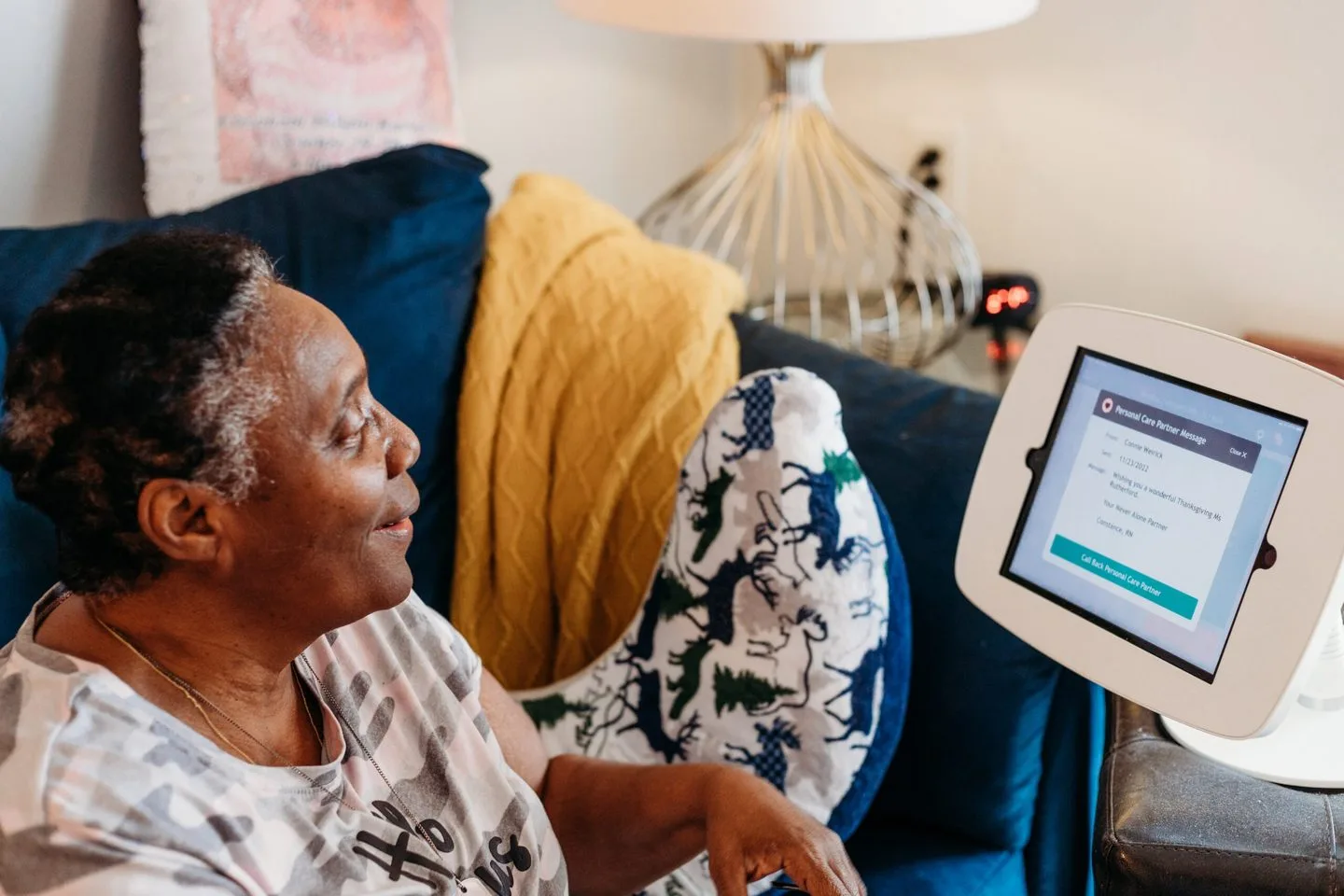
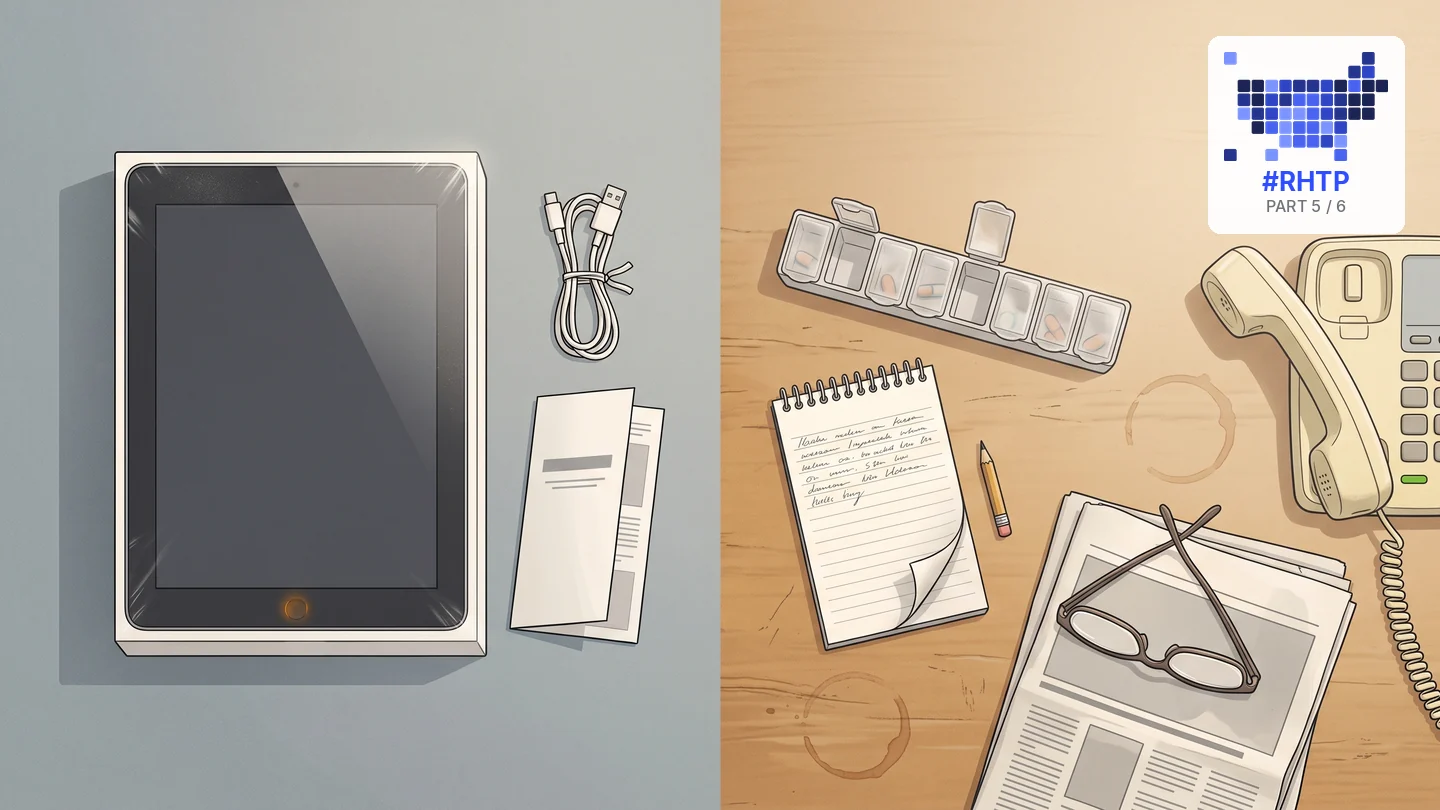
The tablet is still in its sleeve. Powered off, on a side table, next to a landline that gets used forty times a day and a paper calendar covered in handwriting. Somebody bought it, somebody delivered it, somebody filed the invoice. Nobody used it. That is a common enough outcome that it should be planned against rather than treated as bad luck.
That is the failure mode this post is about, and it is not a small one. Consumer-facing technology is one of the three CMS technology factors, worth 3.75 percent, and it is initiative-based. Your state starts at 50 percent of those points and earns the rest by showing follow-through. A deployed device with no usage earns nothing, and because the score is recalculated every year, the gap shows up.
So purchase is not the outcome. Adoption is. And in rural populations adoption fails for reasons that have very little to do with software quality.
Six reasons it actually fails
- Broadband that is real on a map and not in the house. County-level coverage data will tell you a household is served. The household will tell you something different.
- Device literacy, which is not the same as willingness. People are perfectly willing. They have not been given a reason to learn a new interface, and they have been burned before.
- Vision and dexterity. Small targets, low contrast, fiddly gestures. A design that tests fine with a 35-year-old product manager fails with a 78-year-old with arthritis.
- Trust in who is on the other end. A stranger on a screen is not the same as the nurse they have known for six years. That is a reasonable position, not an obstacle to be overcome.
- Ambiguity about who holds the device. Is it the patient's? The family's? The facility's? If nobody owns it, it ends up in a drawer, and this one accounts for a large share of unused devices.
- A support model nobody funded. When it does not work at 9pm, who does the resident call? If the answer is nobody, they stop trying after the second failure.
Read that list again and notice that only one item is really about the interface. The rest is context, ownership and support. Which is why buying a better product does not fix it.
What actually changes the outcome
Four design decisions, and none of them are exotic.
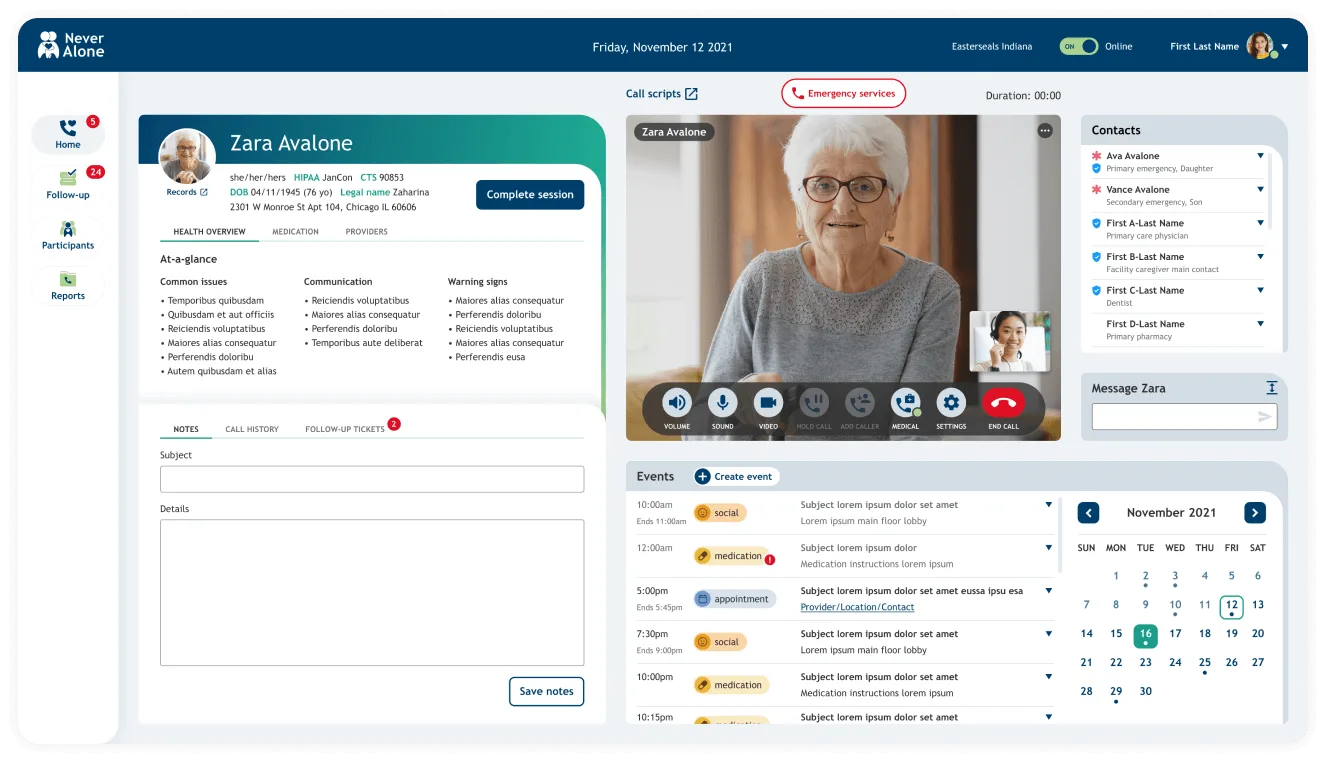
Passwordless, with no learning curve. The device we built and run does one thing well: one button connects you to a licensed provider. No account, no password, no menu tree. If somebody has to be taught it, the design has already lost.
The staff member as the operator, not the patient. In skilled nursing and assisted living, the person pressing the button is usually a caregiver or a nurse aide, not the resident. Designing as though the patient is the primary user gets the workflow wrong and the training plan wrong.
The caregiver as a first-class user. Family members and direct support professionals are not an afterthought audience. They are frequently the difference between a device that gets used and one that does not.
Fund the support model in the same budget line as the device. If the hardware is capitalized and the support is unfunded, you have built a two-year program with a two-month lifespan.
The populations this program funds are the ones most technology skips
This is worth saying plainly, because it is the whole reason we are any good at this. Older adults and people with intellectual and developmental disabilities are the populations most product teams design around rather than for. They are also exactly who RHTP money is aimed at.
We have done this work. The platform we built serves eight care populations, including IDD support, and it expanded into IDD care through a $2.8 million state-funded grant that we helped support from proposal through delivery. Not a pilot. A program that is still running.
What that taught us is unglamorous. The wins come from removing steps, not adding features. Every screen you delete is a screen somebody cannot get stuck on.
How to write an adoption target you can actually be measured against
If adoption is the outcome CMS scores, it has to be in the scope in a form somebody can verify. That means answering four questions before the money moves.
- Who is the denominator? Every resident, or the ones clinically appropriate for the program? These produce very different percentages.
- What counts as use? A completed encounter is a defensible unit. A device being switched on is not.
- Over what period? Monthly active use is meaningful. Ever-used is not.
- What is the ramp? Nothing hits target in month one. Say what month three and month twelve should look like, and be honest that the first sixty days are training, not performance.
Two more practical notes. Consumer technology solutions is Use of Funds category C, and it shows up across multiple state strategies, so this is not a niche line item. And training and technical assistance is category D, which means the work of getting people to actually use the thing is fundable from the award rather than out of your operating margin. Most organizations do not realize that and leave it out of the budget.
Terms used in this post
Program vocabulary and acronyms, in the order they appear. Skip it if you already know them.
- Consumer-facing technology
- CMS factor F.3. Technology used directly by patients, residents or their caregivers.
- IDD
- Intellectual and developmental disabilities. A funded population under this program.
- Direct support professional
- The staff member supporting someone with IDD day to day. Often the actual operator of the device.
- Adoption versus deployment
- Deployment is the device arriving. Adoption is it being used. CMS scores the second one.
- Use of Funds C and D
- Consumer technology solutions, and training and technical assistance. Both approved uses.
Rural patients do not use the healthcare technology bought for them because nobody funded the reason to. Purchase is a procurement event. Adoption is an operating program with an owner, a support path and a number attached. Fund the second one in the same line as the first, or the score never arrives and neither does the outcome.
That completes the three. A funded capability needs a clinical workflow that works, data that leaves the building, and people who use it. Miss any one and the other two do not save you. What is left is the question everyone asks last and should ask first: what happens to all of it when the money stops.