
For health plans, Medicare Advantage plans and risk-bearing groups
Digital Scientists designs, builds, integrates and runs software for health plans, Medicare Advantage plans, ACOs and risk-bearing provider groups: risk adjustment, quality reporting, payer APIs, claims and eligibility data, and the tools care teams and members use. For CommuniCare Advantage, a Medicare Advantage special needs plan, we audited 60+ systems, ran an 11-vendor EHR selection and had the plan back in CMS compliance in under six months. Most plans start with a 4-week Blueprint.
Updated
Systems audited for CommuniCare Advantage
Back to CMS compliance
RAF improvement at 90%+ accuracy
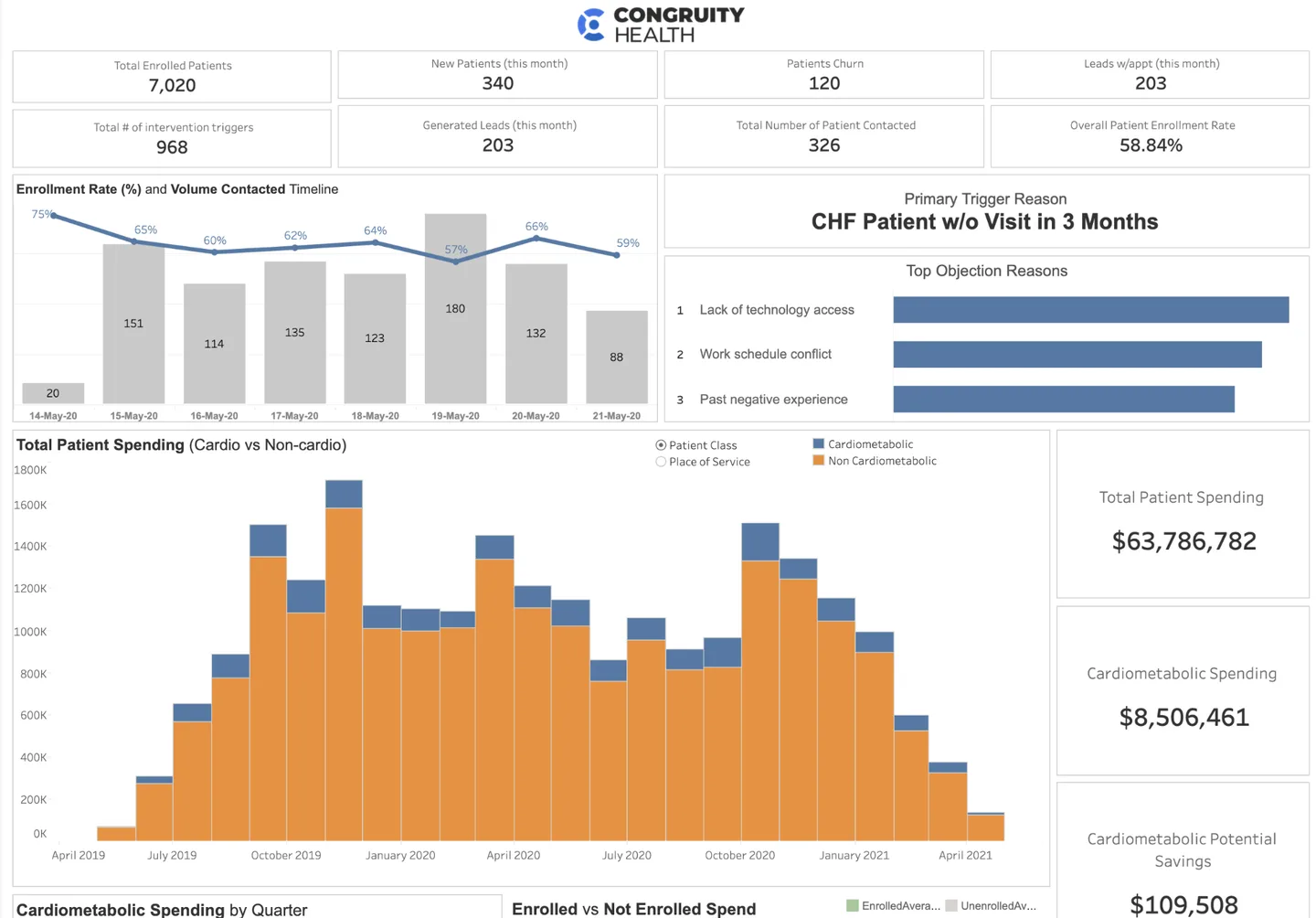
Patients tracked on Congruity Health's platform




What changes when a Medicare Advantage plan gets its systems under control?
CMS reporting gets back on track, and the plan stops paying for software it doesn't need. That's what happened at CommuniCare Advantage, a Medicare Advantage special needs plan that was also growing into an accountable care organization.
Years of growth had left the plan with more than 60 digital products, several EHRs that didn't meet its needs, and clinical and operational data in separate silos. CMS audit requirements weren't fully met, and missed billing was costing reimbursement.
We started with executive and staff interviews and an audit of every system, then mapped how data moved between members, providers, the EHR, care management and CMS. Next came an 11-vendor EHR selection, scored on 434 requirements across 15 categories, and a formal RFP. Then we built a SQL data mart as the single source of truth and a Power BI reporting suite, including the Universe Report for CMS audits.
The plan was back in CMS compliance in under six months, with a technology footprint 25% smaller. The engagement ran from late 2022 to March 2024. Read the CommuniCare Advantage case study.
Digital products audited and mapped
Requirements scored in an 11-vendor EHR selection
Back to CMS compliance
Smaller technology footprint
What problems are health plans and risk-bearing groups trying to solve?
Most of the Medicare Advantage plans, ACOs and value-based care groups we talk to bring one of six. Each one is a data problem before it's a software problem, which is why we start with where the data lives and who touches it.
Risk scores that don't match the chart
Conditions documented in progress notes never reach a coded claim, chronic conditions aren't recaptured each year, and a manual chart review takes about an hour per patient.
CMS reporting built by hand
Universe files, audit data and SNP reporting pulled from several vendors into spreadsheets the week they're due, with nobody sure which number is right.
Quality gaps found too late
HEDIS and Star measure gaps surface after the measurement year closes, with supplemental data spread across EHRs, labs and vendors.
Too many systems and no source of truth
Acquisitions and point tools leave dozens of products, more than one EHR and nobody who owns how they fit together.
An interoperability rule with a date on it
CMS-0057-F requires FHIR APIs for patient access, provider access, payer-to-payer exchange and prior authorization, mostly by 2027, and the core vendor's roadmap doesn't always match the plan's.
Care teams on tools built for something else
Care managers working in a sales CRM bent into a care platform, and members who need something simpler than a portal.
Can risk adjustment software find missed HCCs without adding audit risk?
Yes, if every suggested code links to the evidence behind it and a coder makes the call. That's how we built the risk adjustment engine for CommuniCare Health Services, delivered in 2023 and 2024 across more than 20,000 Medicare Advantage patients.
The engine read six sources for each patient: diagnoses, health risk assessments, medications, progress notes, lab results and claims. It surfaced missed ICD-10 codes with a confidence score and a link to the supporting documentation. Coders accepted, changed or rejected each one. A review that took an hour by hand took about 60 seconds.
Most of the work was data. We pulled from PointClickCare, Netsmart (GEHRIMED) and Acclivity, and found the same member under more than one Medicare Beneficiary Identifier across EHRs, so we built the matching that made one record per person. The result was a $10M+ RAF improvement at 90%+ accuracy, across 245 providers in 7 states. See RAF and HCC coding.
The same data work fed quality reporting. We extracted HEDIS MY2023 supplemental data against NCQA measure specifications, and mapped care management workflows to the NCQA SNP Model of Care, with evidence packages generated from the source data. See quality measures.
RAF improvement, at 90%+ accuracy
Patients, 245 providers, 7 states
Per patient review, down from about an hour
Where should a health plan or ACO start with an outside team?
With one paid, time-boxed step that ends in a decision. What that step is depends on what's hurting most: reporting and systems, a risk or quality gap, or something new to build.
Every step is scoped before it starts, and you own what it produces: the maps, the scoring, the code. You find out in a few weeks, on real work, whether we're the right team.
For plans, mapping the systems usually comes first, because a report can't be right until the data behind it is connected. CommuniCare Advantage started the same way: an audit and a map before any build.
Common starting points for plans and risk-bearing groups
| What's usually true | Common first step | What you get | Time and investment |
|---|---|---|---|
| CMS reporting is at risk, an EHR or core system decision is coming, or nobody can say what you run. | Blueprint | A review of the systems and data you run, current and target-state maps, and a phased plan with a budget. | 4 or 6 weeks. $25K, or from $50K with a working prototype |
| A risk adjustment, quality or prior authorization workflow where AI looks promising, and vendors pitching tools. | Blueprint | The workflow, the data and a working prototype on your numbers, with the business case for building it. | 6 weeks. From $50K with a working prototype |
| Something new to build: payer APIs, a care management tool, a member app or a value-based care dashboard. | Blueprint | Scope, architecture, compliance requirements, user stories and a milestone budget. | 4 or 6 weeks. $25K, or from $50K with a working prototype |
| You already know the first integration, data feed or report. | Build with Us | A senior solution architect working in your systems on that piece of work. | $10K for two weeks, then $20K a month |
These are common starting points, not rules. Many clients combine them or change course, and the first conversation is where we work out the right one. See all ways to start.
What do you build, connect and run for health plans and ACOs?
Everything from the data underneath to the tools on top, and we run what we build. We integrate with any system that has an API, a standard interface or a reliable export, and we've run PointClickCare, Netsmart and Acclivity data in production.
Strategy and vendor selection
Ecosystem audits, vendor-neutral EHR and core system selection, RFPs and roadmaps. See healthcare IT consulting.
Payer APIs and interoperability
FHIR APIs built to CMS-0057-F, connected to the claims, clinical and authorization data behind them. See payer APIs and healthcare integrations.
Claims and eligibility data
Claims and eligibility files loaded, checked and matched to members. Congruity Health's platform ingests claims and eligibility data from TPAs. See claims and X12.
Risk adjustment and value-based care
HCC gap finding with linked evidence, RAF analytics and population health dashboards that show where intervention pays. See RAF and HCC coding and value-based care.
Quality and back-office automation
HEDIS, Star and SNP reporting from source data, and back-office AI agents for chart prep and intake, running on Bedrock and Claude inside your own AWS account. See quality measures.
Data platforms and operations
Data marts, pipelines and reporting your auditors accept, then L2 and L3 support for platforms we built, or a build-operate-transfer handover. See healthcare data engineering and platform operations.
Work for plans and risk-bearing groups

CommuniCare Advantage
Back to CMS compliance in under six months
A Medicare Advantage special needs plan: an audit of 60+ systems, an 11-vendor EHR selection, then a data mart and Power BI reporting, with a 25% smaller technology footprint.
See the work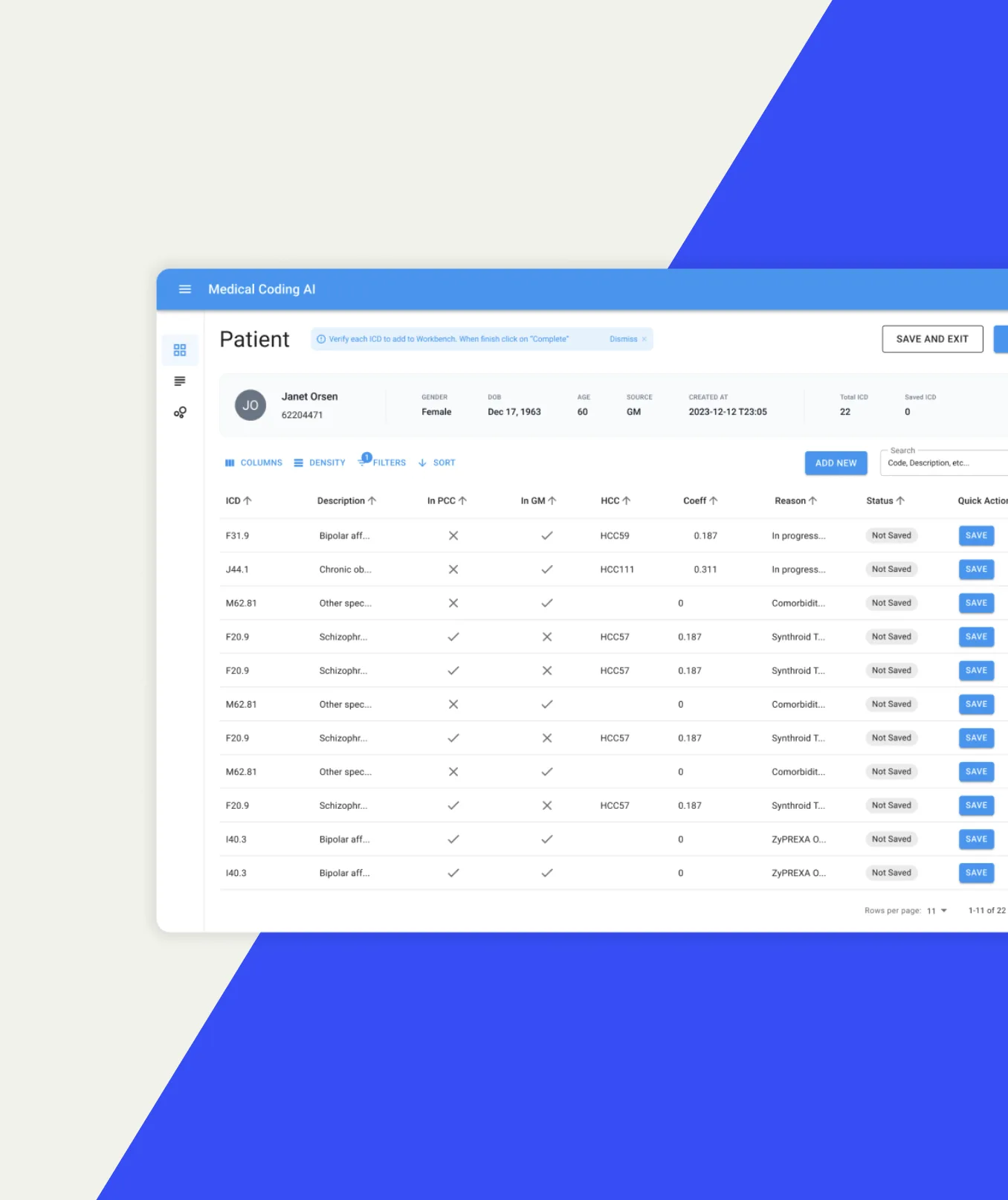
CommuniCare Health Services
$10M+ RAF improvement at 90%+ accuracy
A risk adjustment engine that found missed HCCs across 20K+ Medicare Advantage patients, 245 providers and 7 states, with every suggestion linked to the chart.
See the work
Congruity Health
7,020 patients tracked
A population health analytics platform that turns claims and eligibility data into intervention triggers for chronic disease, for self-funded employer plans.
See the workTrusted by healthcare leaders.
“I would highly recommend Digital Scientists. Their ability to work seamlessly with us, understand our needs, and deliver solutions that drive our mission forward is exceptional. They have not just been a service provider, but a partner in our journey towards improving care for special needs individuals and vulnerable populations.”

Robert Hager
CEO, CommuniCare Advantage
“The team at Digital Scientists was a huge help in not only developing our analytics platform, but understanding the competitive space and defining our true value proposition for our customers.”

Justin Davis
CEO, Congruity Health
What we build for plans and risk-bearing groups
RAF and HCC coding
Risk adjustment AI with every code linked to the chart.
RAF and HCC coding →Value-based care
Analytics and tools for ACOs and risk-bearing groups.
Value-based care →Quality measures
HEDIS, Star and SNP reporting from source data.
Quality measures →Payer APIs
FHIR APIs built to CMS-0057-F.
Payer APIs →Healthcare IT consulting
Ecosystem audits, EHR selection and roadmaps.
Healthcare IT consulting →Post-acute and senior care
For providers that also carry risk.
Post-acute and senior care →


Questions health plans and ACOs ask
Can you help with CMS-0057-F APIs?
Yes. CMS-0057-F, the CMS Interoperability and Prior Authorization rule, requires Medicare Advantage organizations, Medicaid and CHIP programs and plans, and exchange plans to run FHIR APIs for Patient Access, Provider Access, Payer-to-Payer exchange and Prior Authorization, mostly by January 2027. We build to those specifications and connect the APIs to your claims, clinical and authorization data. We start by checking what your core vendor already covers, so you only build the gap.
Do you work with SNPs?
Yes. CommuniCare Advantage is a Medicare Advantage special needs plan. We audited its 60+ systems, ran its EHR selection and built the reporting that brought it back to CMS compliance in under six months. We've also mapped care management workflows to the NCQA SNP Model of Care.
Do you sell risk adjustment software, or build it?
We build it, on your data and in your environment, and you own the code. The engine we built for CommuniCare read six clinical sources per patient, linked every suggested HCC to its evidence and left the decision with a coder. It delivered a $10M+ RAF improvement at 90%+ accuracy.
Do you work with ACOs and value-based care groups?
Yes. CommuniCare Advantage was growing from a Medicare Advantage plan into an accountable care organization when we started. For Congruity Health we built a platform that turns claims and eligibility data into intervention triggers and shows employers what the interventions saved.
Can you connect to our core admin system and vendors?
Yes. We integrate with any system that has an API, a standard interface or a reliable export. We've run PointClickCare, Netsmart (GEHRIMED) and Acclivity data in production, including matching the same member across EHRs.
How do you handle member data?
We sign a BAA before we touch PHI. Each client gets a security plan mapped to NIST CSF 2.0 and a security addendum, with encryption, access controls and audit logging designed in from the start. AI runs inside your own cloud account, so member data stays there.
Talk it over
Tell us what you are trying to do. A senior person from our Atlanta team replies within one business day, and you can book a 30-minute call right after you send this.
- We tell you if we're the right fit, and if we're not, who is.
- Most work starts small, so you see how we work before you commit to more.
- We sign a BAA before we touch patient data.