Digital Scientists prepared this guide and is one of the eight companies profiled; descriptions use each firm's public information, linked below.
What changes for software buyers in 2027
The question facing buyers in 2027 is no longer whether a firm can write custom software. Many firms now use AI to generate code, automate tests, or add intelligent features. The useful questions are: Who can understand the business problem? Who is accountable for architecture and quality? Who has delivered comparable systems to production? And who can manage the privacy, security, reliability, and change risks that continue after launch?
Atlanta has firms serving quite different needs. Some emphasize AI transformation. Others specialize in product development, large engineering programs, or customized business applications. A good shortlist follows the work, not a generic top-ten ranking.
AI changes the development process, not the need for engineering judgment
Coding assistants and engineering agents speed up software creation, but generated code still needs architecture decisions, careful integration, review, meaningful tests, and an accountable owner. The right measure is not lines of code or the number of developers assigned. It is useful, secure, working software delivered against business needs.
Ask a prospective firm to walk through one recent project: how requirements became acceptance criteria, how AI coding tools were controlled, how changes were reviewed, how quality was tested, and who resolved issues once the software ran in production.
AI features are different from AI-assisted coding
A firm may use AI to help its programmers and still have little experience deploying an AI agent into a live workflow. A firm with sophisticated AI strategy may not be the best fit for an ordinary customer portal. Separate how a vendor builds from what it has built.
A shorter starting commitment reduces uncertainty
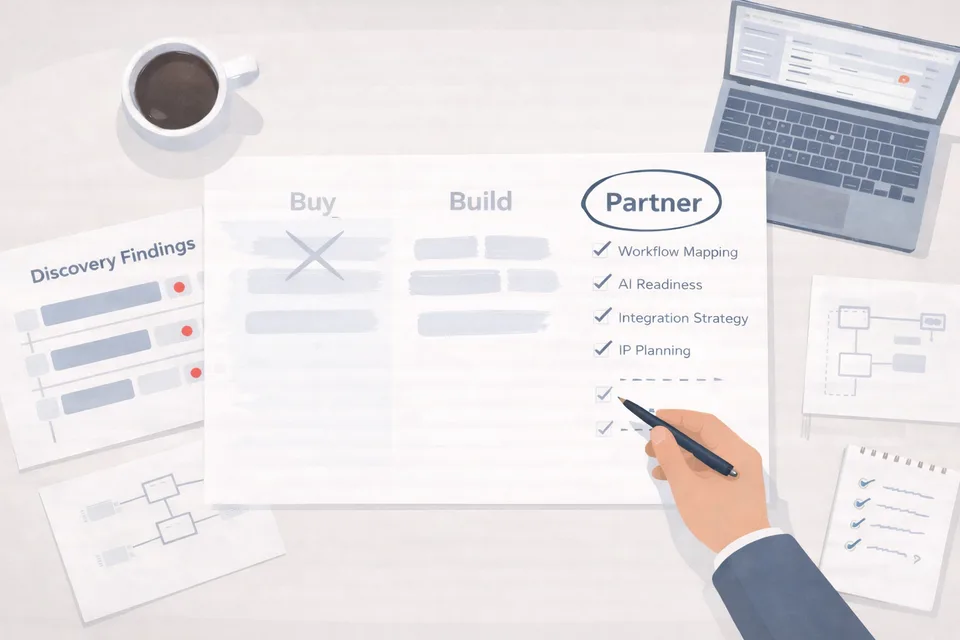
Some buyers already know the first useful piece of work. Others need to validate workflows, users, and architecture. Ask vendors about the smallest useful engagement, deliverables, decision points, code ownership, and what continuing work would cost.
Production operation is a different level of evidence
A demonstration shows that a concept might work. A deployed system shows that real users, real integrations, privacy obligations, incident response, support, and changing requirements have been managed. Favor case studies that say what changed in the business and what happened after launch.
The risk of building the wrong thing still matters
Poorly defined business ownership, unstable requirements, inadequate testing, missed security obligations, and vendor lock-in erase any savings from faster code generation. The vendor should explain how its process reduces each of these risks.
Comparison matrix
The table summarizes public positioning. "Ask vendor" means this guide did not verify a comparable published claim, not that the company cannot do the work.
| Company | Core orientation | AI services | Product / UX scope | Regulated work: public evidence | How to start |
|---|---|---|---|---|---|
| Digital Scientists | Custom products, applied AI, healthcare platforms, forward-deployed AI engineering | Yes: AI/ML, agents, ambient documentation, AI coding | Product strategy, UX, development, and operations | Healthcare AI in production, EHR integration, published PHI controls | Build with Us: $10K for two weeks; Blueprint |
| HatchWorks AI | AI and data transformation | Central positioning | AI-native products and delivery | Ask vendor | Consult vendor |
| SOLTECH | Custom software, consulting, AI/data, staffing | Yes | Web and mobile applications, advisory | Ask vendor | Projects or staffing; quote |
| 7Factor Software | Cloud-native and data engineering, integrations | Ask vendor | Engineering, mobile, modernization | Ask vendor | Custom engagement |
| KMS Technology | Product engineering at scale | Yes | Engineering, QA, modernization | Ask vendor | Custom engagement |
| Sparq | Enterprise digital engineering and modernization | Yes | Engineering and operational platforms | Ask vendor | Custom engagement |
| Bellwood | Focused custom business software | Ask vendor | Custom applications and architecture | Ask vendor | Custom engagement |
| Black Airplane | Design-led digital products and software | Ask vendor | Product design and development | Ask vendor | Confirm current terms |
First pass: shortlist by type of work. A mid-market organization testing one operational AI workflow should not use the same selection criteria as an enterprise replacing a decades-old platform.
Second pass: demand evidence. Have each shortlisted company provide two directly relevant projects, named technical leadership, proposed security controls, a testing approach, and the expected customer commitment.
Evidence, not marketing labels
Use this table in a procurement conversation.
| Evidence | What to request | Digital Scientists public evidence |
|---|---|---|
| Live production system | Who operates it, volume, support model | NeverAlone: 130+ facilities, 7 states, operated by DS |
| Regulated data | Data classification, contracts, security controls | Published PHI and HIPAA security controls |
| Complex integration | Named systems, data flows, failure handling | PointClickCare and Gehrimed in production; CommuniCare Advantage |
| Business outcome | Baseline, result, time period | 4.8M+ designs from Mailchimp Creative Assistant; GoFan built in 75 days, now serving 10,000+ schools; $24M PDPM revenue forecast for CommuniCare |
| AI in production | Tool and data policy, evaluations | Ambient AI documentation running inside NeverAlone |
| Delivery continuity | Support, transfer, ownership | Multi-year operation of NeverAlone; client owns code, data, IP |
| Price transparency | Minimum start, assumptions, exclusions | Build with Us: $10K for two weeks, then $20K a month |
Risk, security, and regulated industries
For healthcare, insurance, finance, energy, and critical logistics systems, risk cannot be an afterthought. An AI feature that works in a demo can still fail in production because it relies on inappropriate data access, untested edge cases, or unreviewed automated decisions.
| Risk area | Why it matters | Questions to ask |
|---|---|---|
| Privacy and data residency | Sensitive client, patient, or employee data may reach third-party tools | What data enters AI models? Which vendors and regions process it? Can production data be excluded? |
| Security engineering | Fast code generation can introduce unsafe patterns or dependencies | Are changes peer-reviewed? How are secrets, permissions, and dependencies scanned? |
| AI model behavior | Outputs can be inaccurate or manipulated | What evaluations, thresholds, fallbacks, and human approvals are used? |
| Regulatory obligations | Requirements depend on the industry and the exact data flow | Which laws and contracts apply? Who signs BAAs? |
| Reliability and availability | Downtime or broken integrations interrupt operations | Who monitors the product? What are the recovery goals and escalation paths? |
| Change control and traceability | Scope drift and opaque automated changes create financial and compliance risk | Who approves scope changes and releases? Can decisions be audited? |
| Ownership and exit | A project should not strand code, infrastructure, or knowledge with one vendor | Who owns repositories, accounts, data, documentation, and IP? How does transfer work? |
Experience, controls, and certification are different things
A firm can have deep healthcare experience without holding a specific third-party certification, and a certification does not establish that every product meets its legal and security requirements. Compare the precise scope: applicable laws, documented controls, independent assessments, contract terms, and the product's own implementation.
Digital Scientists publishes its PHI safeguards, BAAs, risk analysis, secure software development, access control, and production operations on its healthcare security and PHI page. For independent reference points, use the NIST AI Risk Management Framework, the NIST Secure Software Development Framework, and HHS HIPAA Security Rule guidance.
Match the first project to the risk
A brief engineering test on synthetic data does not need the same scope as a clinical workflow that handles live protected health information. Define the boundary before work begins.
Company profiles
1. Digital Scientists
Website: digitalscientists.com
Location: Atlanta, Georgia (office in Alpharetta)
Established: 2007
Core focus: Custom software and AI, product strategy and design, healthcare platforms, forward-deployed AI engineering, and production operations.
Digital Scientists sells solved business problems, not developer hours. Clients come with one of three problems: a new product to build, a prototype or pilot to take into production, or a platform the business has outgrown. Its services span planning, product development, AI, forward-deployed AI engineering, and production support.
Why it belongs on a 2027 shortlist
- AI in production across industries: Mailchimp's Creative Assistant, governed AI in Medley's coaching platform, AI that optimizes skilled nursing MDS (Minimum Data Set) assessments, and an AI agent swarm that cut grant screening time by more than 90%.
- Healthcare depth when you need it: ambient AI documentation running inside NeverAlone and EHR integrations with PointClickCare and Gehrimed in production.
- Prototype to production: a defined path for AI pilots, proofs of concept, and vibe-coded apps built in Lovable, Cursor, or Replit. See taking an AI prototype to production.
- Long-term product ownership: products developed and operated over many years, not handed off after launch.
- AI and UX together: a portfolio spanning AI, mobile, web, product design, research, and data.
- Client ownership: clients own the code, data, IP, and infrastructure.
Published case-study evidence
AI in production
- Mailchimp Creative Assistant: AI-generated designs and ML content services that produced 4.8M+ designs in 8 months.
- Medley SGOS: six rented tools retired into one coaching platform Medley owns: about 100 backend services and 7 rubric-backed AI recipes, with governed AI in the live session.
- MDS optimization: AI that reviews the Minimum Data Set (MDS), the federally required resident assessment that sets Medicare payment in skilled nursing facilities, identifying $24M in forecast PDPM revenue and $2M in quality incentives.
- AI agent swarm: an n8n agent platform for SBIR grant work that cut screening time by more than 90%.
- HealthContext.AI: ambient AI documentation running in production inside NeverAlone.
New products, built and operated
- NeverAlone: a 24/7 virtual care platform DS built and operates, serving 130+ facilities in 7 states, with 100,000+ calls in 2024 and a 96% treat-in-place rate.
- GoFan: a digital ticketing platform built in 75 days, with DS as ongoing product partner as Huddle grew it into a national platform serving 10,000+ schools.
- RoadNinja: the #1 road trip app, with 1M+ downloads, built for Lamar Advertising.
- MyUS.com: the company's first iOS and Android app, an MVP with one-click shipping delivered in under 90 days.
Platform modernization
- OneShield: an enterprise insurance platform modernized across 500+ screens.
- Leica Geosystems Safeload: a rail compliance app rebuilt across iOS, Android, and Windows with compliance preserved.
- Apex HCM: a 200-screen payroll process reduced to 6 steps.
Atlanta companies
- DS has built for Atlanta companies including Cox 2M, Atlanticus (Fortiva), Genuine Parts (NAPA), AmericasMart Atlanta, Gables Residential, and Mailchimp, its innovation partner for nearly a decade with 16+ products shipped.
More in the case-study library.
How to start: Build with Us is $10K for two weeks with a senior solution architect who builds, then $20K a month. Buyers who need a plan first start with a Blueprint.
Best fit: Mid-market and enterprise buyers in healthcare, retail, logistics, financial services, insurance, and media who need technical leadership; new products and platforms; AI prototypes that have to reach production; teams that want forward-deployed AI engineers inside their operations.
2. HatchWorks AI
Website: hatchworks.com
Location: Atlanta, Georgia
Established: 2016
Core focus: AI and data transformation, AI-native products and automation.
HatchWorks AI states that AI is the company's primary focus rather than an added service line. It describes a Generative-Driven Development method and emphasizes applying AI to business outcomes, which makes it relevant to buyers with a substantial AI agenda rather than a single feature.
Potential fit: An enterprise or growth company seeking a broad AI initiative, an AI-centric platform, or a data-and-AI delivery partner.
Questions to ask: What is your most comparable live AI case? How is data quality handled? What evaluation process controls agent behavior? What are the minimum terms?
Source: HatchWorks AI.
3. SOLTECH
Website: soltech.net
Location: Atlanta, Georgia
Established: 1998
Core focus: Custom web and mobile software, technology consulting, AI and data, and staffing.
SOLTECH is one of Atlanta's longest-running development providers. Its services cover AI strategy, AI application development, analytics, software rescue, business intelligence, custom applications, and technology staffing, so buyers can scope a project or add capacity to an internal team.
Potential fit: Businesses modernizing an internal process or application, and organizations that need a mix of consulting and development capacity.
Questions to ask: Are we buying a managed outcome or added capacity? Who owns technical architecture? Which case is closest to our workflow and data constraints?
Sources: SOLTECH, custom software, company history.
4. 7Factor Software
Website: 7factor.io
Location: Atlanta, Georgia
Core focus: Cloud-native software and data engineering, integrations, mobile apps, and modernization.
7Factor positions itself around engineering-heavy builds: cloud platforms, data engineering, integrations, and managed software delivery. It is a useful comparator when the hardest part of the project is the infrastructure and the integrations rather than the product definition.
Potential fit: Buyers with cloud migration, data platform, or integration-heavy work and an internal product owner.
Questions to ask: Who owns product decisions? What comparable work is in production? How is post-launch support handled?
Source: 7Factor Software.
5. KMS Technology
Website: kms-technology.com
Location: Atlanta, Georgia headquarters; confirm where the proposed team works
Core focus: Product engineering, testing and quality, data, AI, and modernization.
KMS Technology serves clients that need ongoing engineering capacity and structured delivery. Evaluate its specific product engineering practice, QA approach, the location of proposed resources, and its governance model rather than treating overall scale as a proxy for project quality.
Potential fit: Established SaaS businesses or larger organizations that need scalable capacity and formal QA.
Questions to ask: Who owns architectural decisions? How senior is the assigned team? Where will client data and code be accessed?
Source: KMS Technology.
6. Sparq
Website: teamsparq.com
Location: Atlanta area
Core focus: AI-enabled digital engineering, modernization, operational platforms, and data.
Sparq's positioning emphasizes enterprise systems and operational performance. It is a useful comparator for interconnected systems, substantial modernization, or a company-wide AI and data effort.
Potential fit: Mid-market or enterprise buyers with critical operational platforms or a large modernization roadmap.
Questions to ask: How will existing operations be protected during migration? What are the cutover and rollback plans? Who owns post-launch support?
Source: Sparq.
7. Bellwood
Website: bellwood.io
Location: Atlanta area
Core focus: Custom business applications, engineering, and technology assessment.
Bellwood centers its approach on understanding the business problem and building custom systems where commercial software does not fit. A focused team suits projects where senior technical participation and quick decisions matter more than scale.
Potential fit: A business with unusual workflows that needs a reliable custom application or an assessment of an existing product.
Questions to ask: Which engineers would be involved? What comparable work is in production? Which AI capabilities are already proven?
Source: Bellwood.
8. Black Airplane (with Tyrannosaurus Tech)
Website: blackairplane.com
Location: Atlanta metro
Core focus: Digital product design and custom software development.
Black Airplane, which acquired Atlanta's Tyrannosaurus Tech, emphasizes product design, engineering, and continued evolution of the product. It is a relevant option when usability and a polished customer-facing experience are central to success.
Potential fit: Startups and established businesses creating a new digital product or modernizing a customer experience.
Questions to ask: What user research is included? What is the first production milestone? What are current project minimums?
Source: Black Airplane.
Which firms to evaluate by project type
| Buyer problem | Firms to evaluate | What should drive the decision |
|---|---|---|
| Build a new custom product or business application | Digital Scientists, SOLTECH, Bellwood, Black Airplane | Workflow understanding, UX, integration, ownership, cost |
| Take an AI prototype, pilot, or vibe-coded app to production | Digital Scientists | A real prototype that became a production product; security review; who owns it after launch |
| Embed forward-deployed AI engineers in your operations | Digital Scientists | Who is embedded, what systems they touch, what you own at the end |
| Add AI to live business operations | Digital Scientists, HatchWorks AI, Sparq | Live AI examples, evaluation, permissions, fallback design |
| Build healthcare or post-acute software | Digital Scientists | Clinical workflow proof, PHI controls, EHR integrations, references |
| Modernize a legacy platform | Digital Scientists, Sparq, KMS Technology, SOLTECH, 7Factor | Architecture, migration plan, service continuity, testing |
| Run a large product engineering program | KMS Technology, Sparq, HatchWorks AI | Team scale, governance, QA, senior leadership, continuity |
| Start with a short, bounded engineering effort | Digital Scientists | Exact scope, price, IP ownership, next-step choices |
| Product-led customer experience | Black Airplane, Digital Scientists | Research methods, UX, instrumentation, production outcomes |
| Cloud, data, and integration-heavy work | 7Factor, Digital Scientists, Sparq, SOLTECH | Integration references, recovery behavior, data quality |
Delivery models, pricing, and ownership
Planning and architecture
Useful when business needs, target users, integration assumptions, or regulatory obligations are uncertain. The output should help the sponsor decide what to build, what to defer, the likely cost, and who owns the risks.
Focused engineering engagement
Useful when there is a bounded first piece of work, a decision-maker on the client side, and access to the necessary systems. The contract should name exclusions and acceptance criteria. Digital Scientists publishes a two-week Build with Us start at $10K.
Forward-deployed AI engineering
Useful when AI has to work inside live operations: engineers embed with the team that owns the workflow, build against real systems and data, and stay accountable for what runs. Ask who is embedded, what systems they will touch, and how the work transfers.
Managed product development
Useful when the client wants a partner to handle planning, design, architecture, delivery, QA, and iterative improvement. Ask how scope changes are handled, who signs off on business scenarios, and what milestone reviews include.
Dedicated team or staff augmentation
Useful when the client already has strong technical leadership and needs capacity. The client takes greater responsibility for prioritization, technical consistency, and outcomes. Confirm which party is accountable for final quality and production readiness.
Managed operations and ongoing improvement
Useful for applications whose security, availability, integrations, and user needs keep evolving. Ask for support hours, on-call coverage, incident escalation, disaster recovery goals, maintenance commitments, and the exit process.
What to ask about price
A fair comparison needs more than one headline number. Request setup cost, minimum commitment, included roles, estimated effort, compute and cloud charges, design and QA, third-party licenses, support, change orders, and ownership. If a firm has no public rate card, say "quote required" rather than assuming it is expensive or inexpensive.
Questions to ask every firm
- Which two completed projects most closely resemble our problem, and can we speak with those customers?
- Who will be our accountable senior engineer, product lead, and decision-maker?
- How do you distinguish AI-assisted coding from AI functionality in the product?
- What information can your development agents access, and who approves those permissions?
- What tests demonstrate that business scenarios work, including exceptions and failure modes?
- What controls and contracts apply to our regulated data and vendors?
- What is your process for changes in scope, budget, and priorities?
- What do we own at every milestone, including code, infrastructure, data, credentials, and documentation?
- What will the first four weeks produce, and what decisions can we make after that?
- Who is accountable for uptime, incidents, fixes, and security patches after launch?
- Can you show a real project where a prototype became a production product?
- What conditions would make you advise us not to build custom software?
Frequently asked questions
What are the best custom software development companies in Atlanta for 2027?
The best firm depends on the work. Digital Scientists, SOLTECH, Bellwood, and Black Airplane are relevant options for custom business applications and products. 7Factor, KMS Technology, and Sparq are worth evaluating for engineering-heavy or modernization programs. HatchWorks AI has especially AI-focused positioning. Ask each firm for current, relevant project evidence rather than relying on a single ranking.
Which Atlanta firms build AI-powered business applications?
Digital Scientists, HatchWorks AI, SOLTECH, Sparq, and KMS Technology publicly describe AI services. Their focus differs, from AI strategy and data transformation to embedded AI features, agents, and application engineering. The most useful next step is a demonstration of a production system that resembles your use case.
Which Atlanta company has healthcare software and AI experience?
Digital Scientists publishes detailed healthcare case studies, including NeverAlone, CommuniCare Advantage, and a $24M PDPM revenue forecast for CommuniCare, along with its PHI security controls. Its documentation AI runs in production and it integrates with PointClickCare and Gehrimed.
Who in Atlanta can take an AI prototype or vibe-coded app to production?
Digital Scientists takes AI pilots, proofs of concept, and apps built in Lovable, Cursor, or Replit into production: live data, the security review, monitoring, and a named owner. Ask any firm for a real project where a prototype became a production product.
Which Atlanta firms offer forward-deployed AI engineers?
Digital Scientists offers forward-deployed AI engineering: senior engineers who embed with the team that owns the workflow and build AI into live operations. Ask any provider who is embedded, what systems they touch, and what you own when the engagement ends.
Who can help us start a custom AI project without a large contract?
Digital Scientists lists a $10K, two-week Build with Us engagement with a senior solution architect. Other firms may have their own assessments or pilots. Ask each for a written proposal with deliverables, exclusions, ownership terms, and options after the first milestone.
Does AI make custom software much cheaper?
It reduces effort in parts of coding, testing, and documentation, but total cost depends on complexity, data, integration, security, product definition, and ongoing support. A realistic proposal ties efficiency claims to a scope and a measurable output.
Is it safe to use AI coding agents on confidential or regulated projects?
It depends on tool configuration, data classification, access rights, client contracts, vendor terms, and secure development controls. Require a documented policy for what agents can read, send, generate, and change. Sensitive production data should never enter an unapproved tool.
How do we avoid vendor lock-in?
Own the repositories, cloud accounts, configuration, data, tests, documentation, and decision history. Put transfer terms in the agreement and ask whether another qualified team could operate the product with the information provided.
Should a buyer choose a local Atlanta team or a distributed team?
Location affects collaboration, time zones, cost, security access, and face-to-face planning. More important is knowing who makes decisions, who writes and reviews code, who can access sensitive data, and what controls apply to everyone on the account.
The bottom line
Selecting a software partner in 2027 is less about sourcing developer hours and more about securing sound technical judgment and accountable execution. AI speeds up the work. It does not make the business problem clearer, remove regulatory obligations, or take responsibility for what runs in production. The right partner shows four things: a strong understanding of the business, the right engineering and AI skills, evidence from comparable live systems, and a clear model for risk and ownership.
About the publisher: Digital Scientists is an Atlanta custom software and AI development company founded in 2007, with its office in Alpharetta. It provides product strategy, design, engineering, AI, forward-deployed AI engineering, and continuing platform services.
Sources and method
Research date: October 27, 2026. Company websites change; pricing, service names, and claims should be rechecked before relying on them. No vendors were interviewed, and no audits, reference checks, or side-by-side engineering tests were performed. Fit recommendations are editorial assessments.
Digital Scientists: Homepage · Build with Us · Case studies · NeverAlone · Mailchimp · GoFan · Healthcare security and PHI · Software engineering approach · Atlanta custom software
Other vendors: HatchWorks AI · SOLTECH · 7Factor Software · KMS Technology · Sparq · Bellwood · Black Airplane