
Find the first revenue-cycle workflow where AI can prove ROI.
It starts with a strategy consultation. From there, Digital Scientists works from your existing claims and financial data to identify one practical improvement, with a conservative ROI range and a measurement plan. No platform license. No speculative AI engagement.
Want the deeper diagnostic instead? Start with the Revenue Integrity Audit.
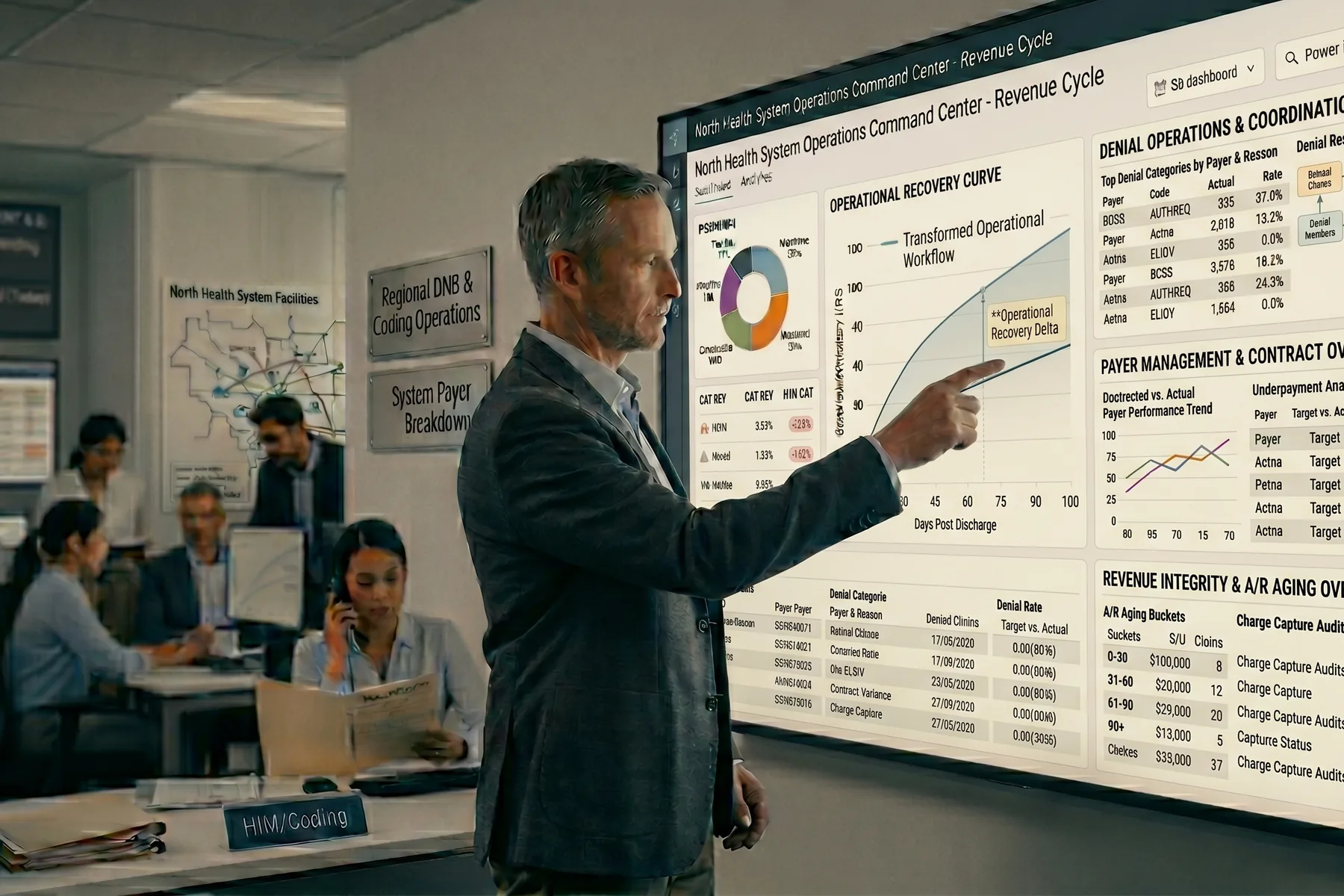
Decision sprint
Pilot result
RCM proof point
Client-owned IP, no platform fees
You may need this if…
Hospital CFOs, CEOs, COOs, Revenue Cycle Directors, PFS Directors, and CIOs. Revenue-cycle partner firms co-selling AI to hospital clients. If any of the signals below sound familiar, the assessment is built for you.
Leadership is asking for an AI plan, but there is no clear ROI case
Your team has more claim follow-up work than capacity
A/R aging or write-offs are creating financial pressure
Denials are hard to prioritize by value or preventability
Payer-specific knowledge lives with a few experienced staff
You want to prove value before committing to a larger AI initiative
The Model Hospital walkthrough.
The Model Hospital is a live, interactive simulation of a financially constrained hospital. Built so revenue-cycle leaders can see how AI prioritization changes the recovery curve, without anyone sharing real patient or financial data. Walk through it in 5 to 7 minutes, then bring your own data to the assessment.
Open claims
Daily collector touches
Day horizon
Measurement baseline
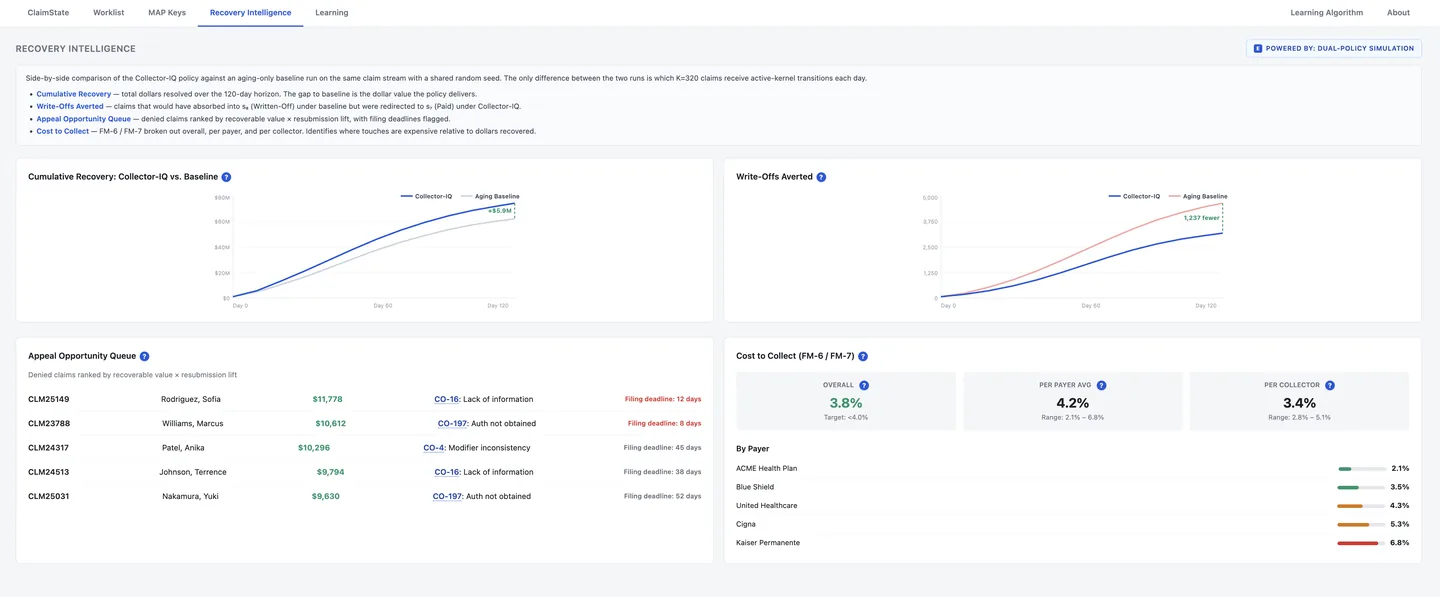
Open the Model Hospital
Walk through the prioritization workflow, the recovery curve, and the learning dashboard. 5 to 7 minutes.
Open in a new tab →- Why aging-only worklists leave recoverable dollars on the table
- How prioritization changes the recovery curve over a 120 day horizon
- How a holdout group lets you measure lift against a real baseline
- How payer patterns and rejection reasons feed back into the model
The simulation is the visualization of the operating model. The assessment finds your version of it.
Four ways revenue-cycle improvement creates value.
Every workflow the assessment recommends has to map to at least one of these four levers. Anything else is theater.
Recover more
Capture dollars that would otherwise be delayed, denied, underpaid, or written off.
Recover faster
Accelerate cash by helping teams act earlier and prioritize the accounts most likely to pay.
Use capacity better
Focus limited revenue-cycle staff time on the work most likely to create value.
Prevent loss
Reduce preventable denials, underpayments, write-offs, and rework upstream.
The RCM AI ROI formula
Incremental cash recovered + avoidable loss reduced + staff capacity redirected, minus deployment and operating cost.
Start with a decision, not a commitment.
Two fixed-window stages. The first ends with a decision. The second ends with a measured result against a baseline.
1 to 2 weeks · Scoped on a call
The Deployment Assessment
Digital Scientists works with your team to determine whether one revenue-cycle workflow has enough value and readiness to justify a deployment.
We look at
- ·A/R aging and claims history
- ·Denial reason codes and payer mix
- ·Remittance and write-off patterns
- ·Underpayment indicators
- ·Staff workflows and work queues
You receive
- First workflow recommendation, with rationale
- ROI hypothesis with a conservative range
- Data and workflow readiness snapshots
- Success metric and measurement approach
- Governance and risk considerations
- Proceed, wait, or fix-readiness recommendation
8 to 14 weeks · Fixed-window
Build one workflow. Measure the result.
Digital Scientists builds one practical, human-in-the-loop workflow improvement. The goal is not to launch a broad AI program. The goal is to prove whether one workflow can improve cash, reduce avoidable loss, or free team capacity.
Pilot phases
- 01Confirm baseline and success metric
- 02Design the workflow with operators
- 03Build the workflow intelligence layer
- 04Run with human review
- 05Measure lift against the baseline
- 06Scale, stop, or adjust decision
PHI handled under BAA. The CIO is the governance counterpart from day one.
$24M+ in documented revenue impact.
CommuniCare MDS Optimization is the post-acute revenue-cycle proof point. The operating model translates to acute hospital revenue cycle: workflow intelligence layered on existing systems, measured revenue lift, client-owned IP.
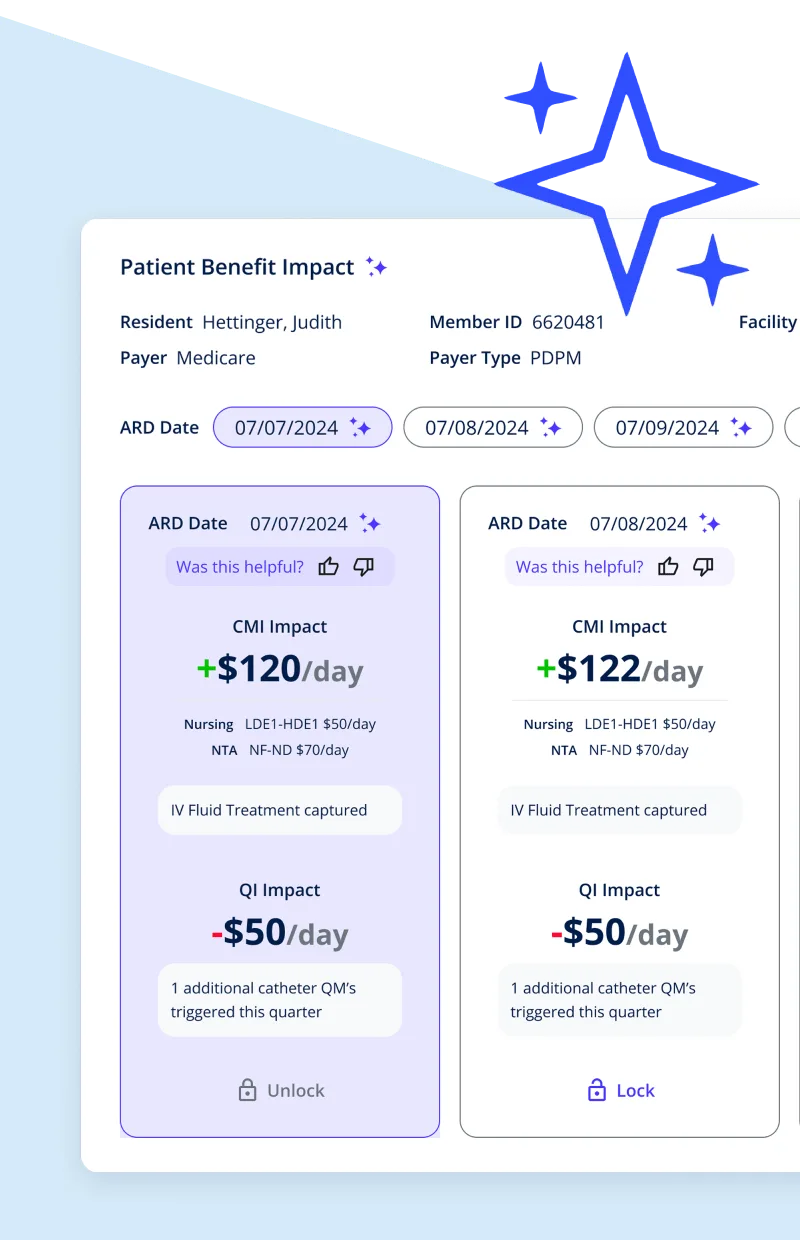
CommuniCare MDS Optimization
AI-powered MDS coding for one of the nation's largest post-acute care providers, across 350+ facilities. Workflow intelligence layered on the existing EHR, measured revenue lift, IP that stays with the client.
Revenue Impact
Facilities
Client-owned IP
I have worked with many technology teams during my career, and Digital Scientists is one of the best. They take the time to understand the customers' needs, deliver innovative solutions, are always professional, and work with your team as a true partner to achieve success.

Amy Severino
Chief Innovation Officer, NeverAlone (CommuniCare)
Find the first workflow.
A 30 minute conversation to understand your revenue-cycle pressure and decide where to start. No pitch deck.
Or call: 404.654.3855
How is this different from the Revenue Integrity Audit?
Two tiers. The Revenue Integrity Audit is a 2 to 4 week deep diagnostic of 12 to 18 months of claims and remittance data, with a full revenue-cycle scorecard, denial taxonomy, and intervention briefs. The Deployment Assessment is a lighter 1 to 2 week decision sprint focused on whether one specific workflow has enough value and readiness to justify building. Pick the audit if you want a full map. Pick the assessment if you want a decision.
What if the assessment says we should not proceed?
That is a successful assessment. You leave with a workflow opportunity map and a clear view of readiness gaps to address before any AI investment.
How is PHI handled?
Under BAA, with documented chain of custody. The CIO is included from day one as the governance counterpart. PHI does not leave agreed boundaries. See our security approach for detail.
Who delivers the assessment?
A small, senior Digital Scientists team. Product, workflow, AI, and engineering. Embedded with your operators. Not staff augmentation. Forward Deployed AI Engineering is the delivery model.