
Healthcare contact center and telephony platforms
Digital Scientists builds and runs healthcare contact center and telephony platforms: care-team consoles, video visits, triage, 911 calling with location, and AI call summaries. NeverAlone, the 24/7 virtual care platform we built and still operate, handles 100,000+ calls a year, reaches a provider in under three minutes and treats 96% of residents in place. Phone access, IVR and call routing are capabilities we scope with you. Most clients start with a Blueprint that maps the call flow, the integrations and the build plan.
Updated
Calls a year on NeverAlone
To reach a provider, 24/7
Treat-in-place rate
Live, run by us since




What does generic healthcare call center software miss?
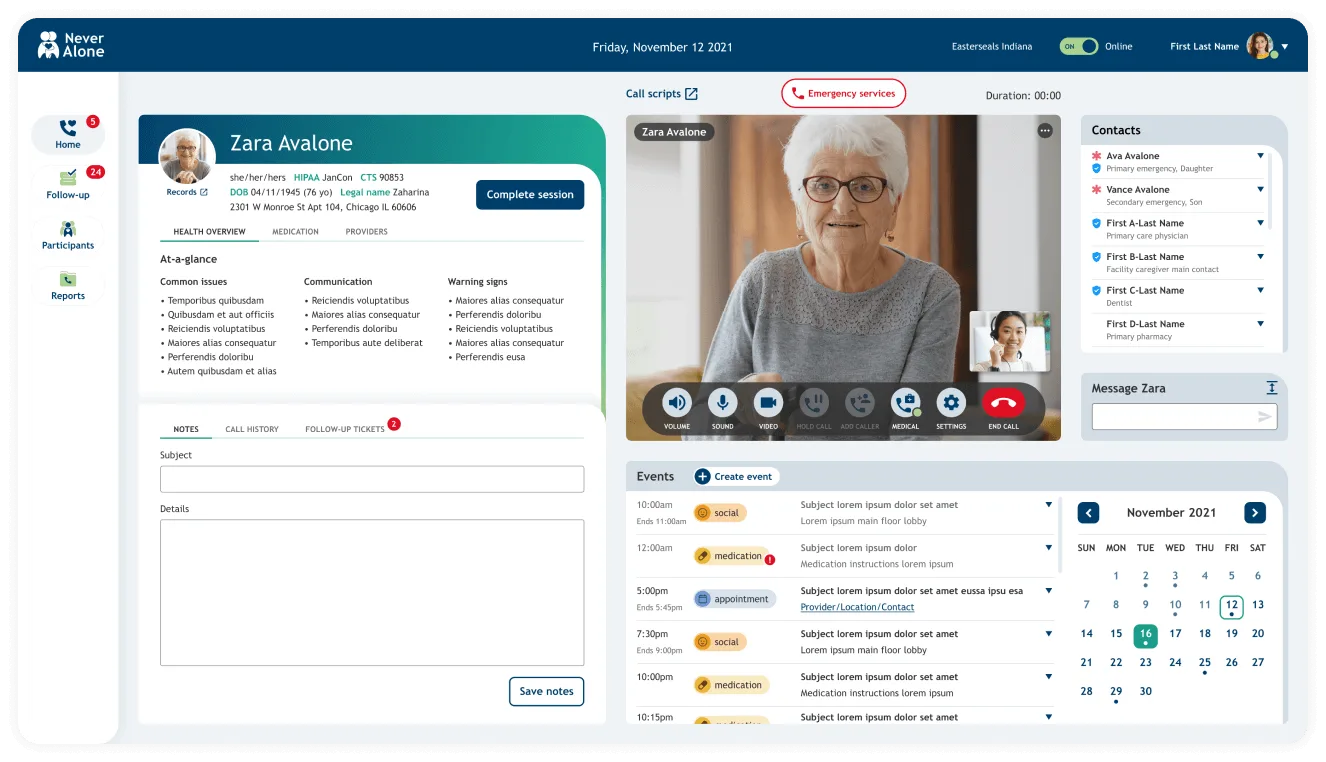
The clinical part. A general contact center tool routes calls and records them. It doesn't know which provider is licensed in the patient's state, what the clinician needs on screen, or what happens when the call turns into an emergency.
Those gaps land on the night nurse. NeverAlone, the care platform Digital Scientists built for CommuniCare and still runs, closes them for skilled nursing, senior living, IDD and home health teams. It's a telemedicine and virtual care platform with a contact center built in, and it connects to the systems around it like any of our healthcare integrations.
Clinical triage
Every request is sorted clinical or non-clinical first, so the right person picks it up and nobody re-asks the same questions.
License-aware routing
A call goes only to providers certified for that patient's state. The platform tracks each provider's licenses.
The record beside the call
History, medications and diagnoses sit next to the video, so the provider starts with context.
Emergency calling with location
When it's a 911 call, the address and callback number for that device go with it.
Notes that write themselves
Calls are summarized and drafted into notes for the clinician to review, with consent rules built in.
Can phone, video and emergency calling run in one platform?
Yes. On NeverAlone, video visits, the care-team console, 911 calling with location and call summaries run in production together. Phone dial-in, IVR menus and AI call handling are capabilities we design and scope per project; we don't claim them as live.
Telephony is where honest status matters most, so here it is line by line. Production means it runs on a platform we built and operate today. Capability means we know how to build it, on the same stack, and we scope it with you in the Blueprint.
We can integrate with any system that has an API, a standard interface or a reliable export, including the EHR, a CRM or an existing phone system.
Contact center features and their status
| Feature | How we build it | Status |
|---|---|---|
| Video visits | AWS Chime SDK, HIPAA-eligible AWS account under a BAA | Production (NeverAlone) |
| Care-team console and queue | Live queue, multi-way calling, resident record and schedule on one screen | Production (NeverAlone) |
| 911 with location | Bandwidth E911: validated address and callback number per device | Production (NeverAlone) |
| Call summaries and notes | HealthContext.AI transcription and draft notes for clinician review | Production (NeverAlone) |
| Text messages and one-time codes | Twilio | Production (other platforms we built) |
| Phone number into a video visit | Public phone network into the same Chime session | Capability, scoped per project |
| IVR menus and call routing rules | Menus, business hours, after-hours paths and overflow | Capability, scoped per project |
| AI answering some calls | Agent handles a narrow set of requests and hands off to a person | Capability, person in the loop |
Status as of November 2026. We update this table when a capability goes live on a platform we run.
What does a nurse triage and care-team console need to show?
Who's waiting, why, and everything the provider needs to act without switching screens. On NeverAlone, that console connects a nurse to a licensed provider in under three minutes, 24 hours a day.
Nurse triage software fails when it adds clicks at 3 a.m. So the console is built around the call, not the record. The queue shows each request and its triage category. One click joins the video. The resident's history, medications, diagnoses and schedule sit beside it, pulled from PointClickCare and Netsmart (GEHRIMED) with patient matching across both EHRs.
For an after-hours nurse line, routing is the hard part. Calls go only to providers certified in the patient's state, and a supervisor sees the whole queue. If the call turns into an emergency, the provider escalates to 911 from the same screen, with the device's address attached. 96% of NeverAlone residents are treated in place, so most after-hours problems end without a transfer.
Queue
Live requests, wait time, triage category
Triage
Clinical or non-clinical, then the right responder
Routing
Providers certified in the patient's state
Patient context
History, medications, diagnoses from PointClickCare and Netsmart
Escalation
Bandwidth E911 with address and callback number
After the call
Summary, draft note, follow-up tasks
Can calls be recorded, transcribed and analyzed?
Yes. HealthContext.AI, an ambient documentation product we built that runs inside NeverAlone, transcribes calls, summarizes them and drafts clinical notes for review. It cut note time from 45 minutes to 5.
HealthContext.AI captures the conversation with speaker labels, identifies diagnoses, medications and procedures, and drafts a structured note with suggested codes. The clinician reviews and signs. Nothing goes to the chart without a person.
Consent comes first. Some states require every party to agree before a call is recorded, so the platform tells each participant and captures their agreement before transcription starts. Substance use treatment records fall under 42 CFR Part 2 as well as HIPAA, and we build those rules into who can see a transcript. Audio and transcripts stay in your AWS account.
Call data also feeds reporting: volume by hour and facility, wait times and outcomes, so operations leaders staff to real demand. For AI that handles the documentation itself, see ambient scribes.
Minutes of note time per call with HealthContext.AI
Calls a year on the platform it runs in
Audio and transcripts stay in your AWS account
Where do most healthcare contact center projects start?
Most start with a Blueprint that maps the call flow, the triage rules, the integrations and the telephony pieces that carry risk. These are common starting points, not rules.
Telephony is full of details nobody wrote down: which numbers ring where after hours, which state rules apply to recording, what the 911 address is for a device that moves. A Blueprint pulls those forward so the build plan reflects them. Once it's live, we run it as part of platform operations.
Common starting points for a healthcare contact center platform
| Starting point | When it fits | What you get |
|---|---|---|
| Blueprint | A new telehealth call center, or replacing a tool that no longer fits | Call flow, triage and routing rules, telephony and integration plan, architecture and a build plan |
| MVP | The call model is clear and you need real callers on it | A working console and video path for one population, on production foundations |
| Add telephony to a platform we built | Your care platform is live and you need phone access, IVR or AI call handling | The new piece designed, built and tested against your live call flow |
| Run or transfer | The platform is live | 24/7 operations with L2/L3 support, or a planned handover to your team |
Contact center work we built and run
NeverAlone · CommuniCare
100,000+ calls a year
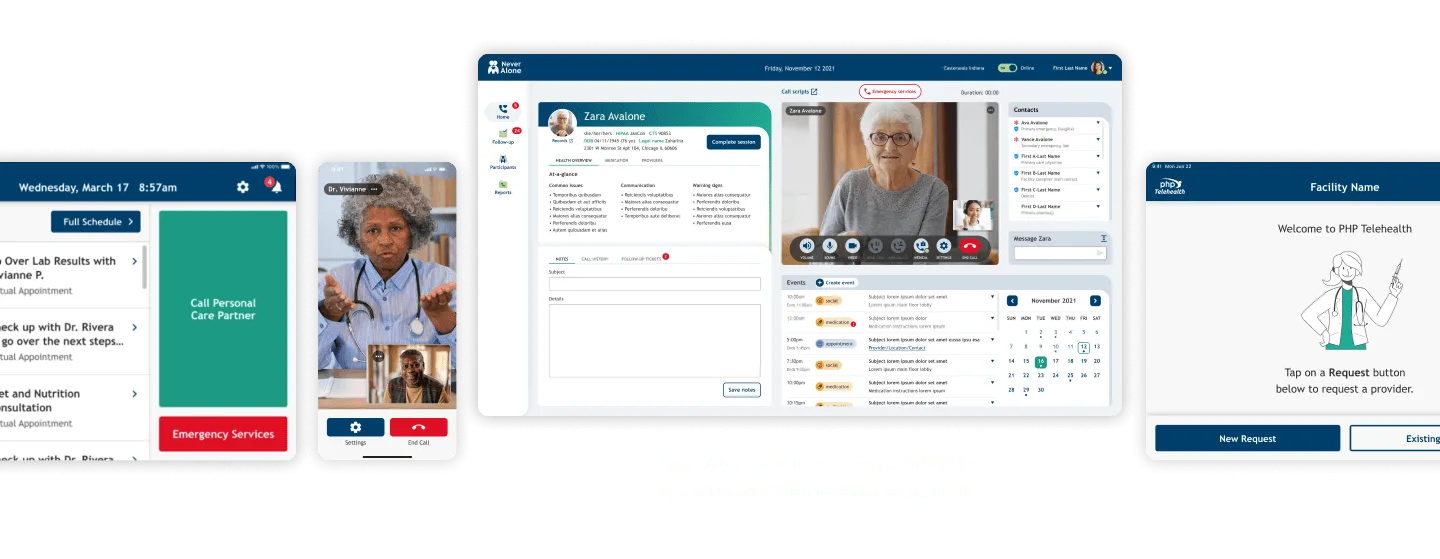
A 24/7 care-team contact center on AWS Chime video and Bandwidth E911. A provider in under three minutes and 96% treat-in-place. We still run it.
See the work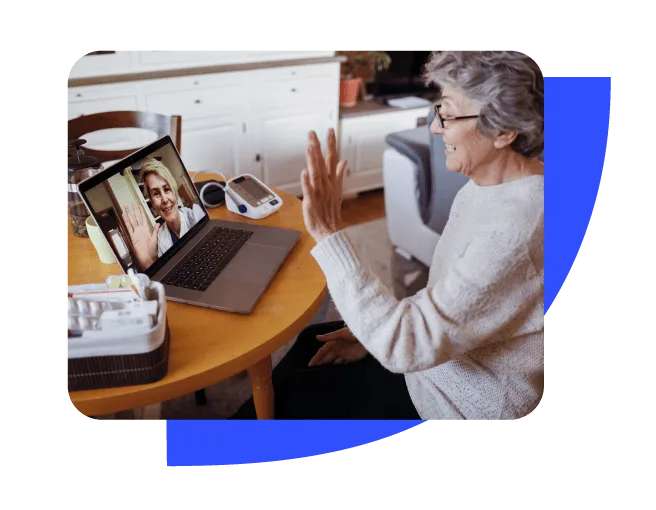
HealthContext.AI
Note time from 45 minutes to 5
Our ambient documentation product, running inside NeverAlone: it transcribes calls, summarizes them and drafts notes for clinician review.
See the work
Star Leasing
From phone queue to app in under seven months
Outside healthcare, the same problem: a 24/7 breakdown service that ran on dispatcher calls. We moved requests, status and technician ETAs into a mobile app and API.
See the workTrusted by healthcare leaders.
“NeverAlone has transformed how we deliver care at CommuniCare Health Services, enabling us to provide better patient care and achieve stronger clinical outcomes.”

Dr. Matthew Wayne
Chief Medical Officer, CommuniCare Health Services
“NeverAlone has made our processes more efficient, reducing onsite visits and helping our members gain a greater sense of independence. What truly sets the team apart is their commitment to understanding the specific needs of our community. They took the time to learn about our challenges and tailored their solution to fit our goals. The partnership has been invaluable in empowering both our members and our staff.”

Donna K. Elbrecht
CEO, Easterseals Arc of Northeast Indiana
Related services
Telemedicine and virtual care
The virtual care platform the contact center sits inside.
Telemedicine and virtual care →Platform operations
We run what we build, or hand it over.
Platform operations →Ambient scribes
AI that drafts the clinical note from the call.
Ambient scribes →Chatbots and assistants
HIPAA-compliant assistants that hand off to a person.
Chatbots and assistants →Healthcare integrations
EHR, telephony and data interfaces we build and keep running.
Healthcare integrations →Post-acute and senior care
Where NeverAlone's care-team contact center started.
Post-acute and senior care →
Questions about healthcare contact center platforms
Can patients call a phone number and reach video?
Yes, as a capability we scope per project. The AWS Chime stack we build on supports bringing a caller from the public phone network into the same session as a provider on video. We scope the numbers, call routing and after-hours paths in the Blueprint. On NeverAlone today, residents reach a provider by one-touch video from a managed tablet.
Do you record and transcribe calls?
Yes. On NeverAlone, HealthContext.AI transcribes and summarizes calls and drafts notes for clinician review, cutting note time from 45 minutes to 5. Recording follows consent rules: in states that require every party's agreement, each participant is told and agrees before capture starts. Substance use records also follow 42 CFR Part 2. Audio and transcripts stay in your AWS account.
Can it dial 911 with location?
Yes. NeverAlone uses Bandwidth E911 in production. Each device carries a validated address and a callback number, so a 911 call from the platform reaches the right dispatch center with the right location. We keep that integration current as Bandwidth changes its side.
Can AI answer some calls?
Yes, as a capability, with a person in the loop. An AI agent handles a narrow set of requests, such as scheduling questions or routing, and hands off to a person the moment a call is clinical or unclear. We start with one call type, measure it, and widen it only when the results hold up.
Do you replace our existing phone system?
Not necessarily. We can integrate with any system that has an API, a standard interface or a reliable export. Some clients keep their phone system for general calls and route care-team calls into the platform we build. The Blueprint decides which pieces to keep and which to build.
Who runs the contact center platform after launch?
We do, for platforms we build: monitoring, releases, security updates and L2/L3 support, alongside your IT team or MSP. NeverAlone has run 24/7/365 since March 2021. When you want to own it, build-operate-transfer hands over the code, the accounts and the runbooks.
Talk it over
Tell us what you are trying to do. A senior person from our Atlanta team replies within one business day, and you can book a 30-minute call right after you send this.
- We tell you if we're the right fit, and if we're not, who is.
- Most work starts small, so you see how we work before you commit to more.
- We sign a BAA before we touch patient data.