The cost of implementing AI in healthcare is mostly not the model. You pay for the data work, the integrations, the screen where a person reviews each output, accuracy testing on your own cases, the audit log and running it after launch. You don't pay for AI you aren't ready for, or to rent back a model trained on your data. At Digital Scientists, most work starts with a Blueprint at $25K for 4 weeks, or from $50K for 6 weeks with a working prototype. CommuniCare's MDS platform has recovered $10M+ to date, with $24M+ in forecast PDPM revenue.
What do you actually pay for when you implement AI in healthcare?
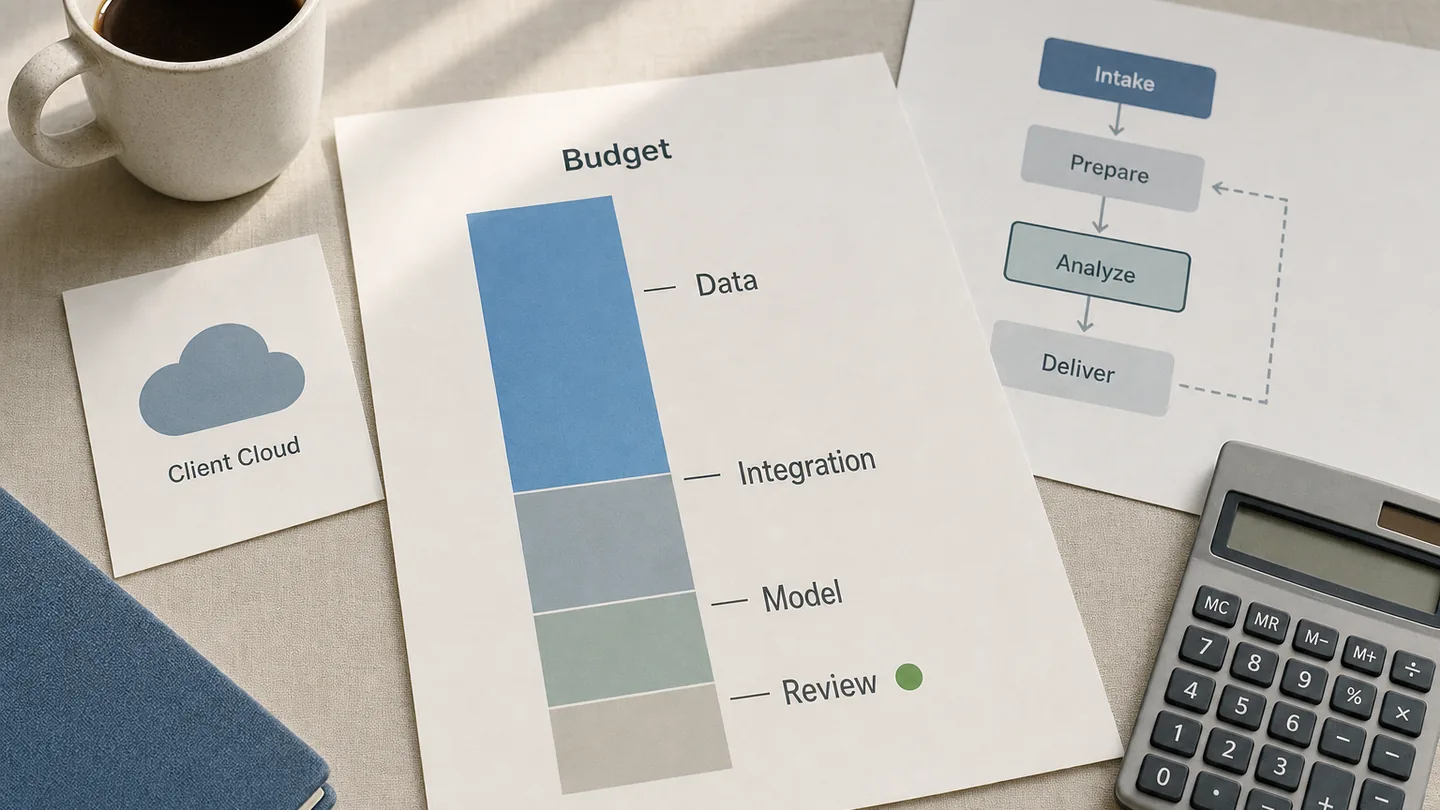
You pay for six pieces of work, and the model is the smallest of them. Every healthcare AI development project we run has the same line items, whatever the workflow:
- Data. Getting clean feeds out of the EHR and other systems, and matching patients who show up under different IDs.
- Integration. Reading from and writing back to the systems your staff already use, so nobody logs in to a separate tool.
- The review workflow. The queue or screen where a clinician, coder or MDS coordinator accepts, changes or rejects each output, with the source attached.
- Accuracy testing. Running the system on historical cases your team already worked and comparing the answers, before go-live and after.
- Logging. A record of what the model saw, what it suggested, the source it cited, the model version and what the reviewer did. That's your audit trail.
- Running it. Monitoring, rule and model updates, and fixes once real users depend on it.
A vendor quote that only prices the model leaves out most of the bill. Ask where each of these six lines sits before you compare numbers.
Why is the model the cheapest line?
Because most of the work in a healthcare AI system isn't a language model. We use the simplest model that does the job, and plenty of steps don't need one.
The risk adjustment agent we built for CommuniCare is the clearest example. About 79% of its logic was SQL against structured clinical data, 20% was generative AI and 1% was clustering. That mix kept it fast, cheap to run and explainable to an auditor. It reviewed a patient in about 60 seconds, down from about an hour for a manual chart audit.
On new builds, the model runs inside your own AWS account through Amazon Bedrock, with Claude where we use it. Model usage lands on your own AWS bill, next to the rest of your infrastructure, and patient data stays in your environment under your BAA with AWS. A person approves every output before it reaches a chart, a claim or a patient, and every output is logged.
What don't you pay for?
You don't pay to rent back your own system. Clients keep the code, the IP and the roadmap, and any model we tune on your data is yours and runs only for you. Bedrock doesn't use your prompts or outputs to train its foundation models, so your data doesn't improve a product someone else sells.
You also shouldn't pay for AI in a workflow that isn't ready for it. If the data isn't clean, nobody owns the workflow or there's no number to move, a model adds cost and risk before it adds value. We say so in the first conversation. The fix is usually work you'd need anyway, like a healthcare data engineering foundation. On CommuniCare's risk adjustment work, cleaning up patients with more than one Medicare ID came before any model.
And you don't pay for a big rewrite of the systems you already run. The AI reads from them and puts its suggestion in front of the person who already does the work.
How do the stages of a healthcare AI project compare on cost?
Each stage ends with a decision, so you never commit the next dollar without evidence from the last one. These are common starting points, not rules.
| What you get | Cost | Time | What you decide at the end | |
|---|---|---|---|---|
| Blueprint | Workflow, metric, data and integration plan, architecture, and the investment it takes | $25K | 4 weeks | Build, change course or stop |
| Blueprint with prototype | Everything above, plus a working prototype users can touch | From $50K | 6 weeks | Whether the workflow holds up in front of real users |
| MVP | The smallest version your reviewers run on real data, with the review queue and logging | $75K to $250K | 8 to 16 weeks | Whether accuracy and the metric hold against the baseline |
| Build with Us | A senior team shipping the next workflow or the next release | $10K for the first two weeks, then $20K a month | Ongoing | What to build next |
| Run | L2/L3 support on what we built, or a build-operate-transfer handover | Scoped to the system | After launch | Who owns operations, and when |
Where an MVP lands in its range comes down to how many systems it touches, how messy the data is and how many roles review its output.
What drives the cost up or down?
Data readiness and integrations move the number most. A model on one clean feed is a short build. A model that needs patients matched across two EHRs, with output written back into each, is a longer one.
- Data shape. Key fields in scanned PDFs or free text cost more than structured fields in a system with an export.
- Number of systems. Each system the AI reads from or writes to is its own piece of work. On CommuniCare's MDS platform, that meant PointClickCare data and checks on 200+ clinical events.
- Who reviews. One reviewer role with one queue is simpler than three roles with different screens.
- Accuracy bar. The more the output touches money or a clinical record, the more testing it needs before go-live.
- How many workflows. One at a time is cheaper and faster. Start with one, prove it, then add the next.
We integrate with any system that has an API, a standard interface or a reliable export. The Blueprint names each one up front, and tests the riskiest in the first weeks.
Why won't we fixed-bid your AI spec?
Because client AI specs are full of holes, and a fixed bid prices the holes as risk. Nobody knows how clean the data is, how often the model will be right on your cases or which exceptions your staff handle today until someone looks.
A bid on an unexamined spec ends one of two ways: padded to cover the unknowns, or argued over when the unknowns show up. Neither helps you. The Blueprint is how we fill the holes first. At the end you have a workflow, a metric, a data plan and an investment figure built on what we found, and you decide whether to go ahead.
How do you know the money paid back?
You measure a baseline before the build and report against it after. Hours per case, backlog or dollars missed: pick the number the workflow should move, write it down, then compare.
Our production results came that way. CommuniCare's MDS platform, built from April 2024 and handed to CommuniCare's own team, has recovered $10M+ to date, with $24M+ in forecast PDPM revenue. The risk adjustment work in 2023 to 2024 drove $10M+ in RAF improvement at 90%+ accuracy across 20K+ patients. HealthContext.AI took note time from 45 minutes to 5.
For how to choose the workflow, see how to pick the AI workflow that pays back. For what changes between a pilot and a live system, see healthcare AI in production.
Where should you start?
Start with one workflow that has real volume, a number you can count today and a person who already reviews the result. MDS assessments, risk adjustment coding, clinical notes and back-office queues are where our builds have paid back first.
A 4-week Blueprint at $25K settles the workflow, the metric and the cost. If your reviewers need to see it working before you commit, the 6-week version from $50K adds a prototype. Sometimes the answer is to fix the data first, and that's a good result for the spend. If you want to price a specific workflow, talk it over with us.
Frequently asked questions
How much does it cost to implement AI in healthcare?
With Digital Scientists, most projects start with a Blueprint at $25K for 4 weeks, or from $50K for 6 weeks with a working prototype. An MVP runs $75K to $250K over 8 to 16 weeks. Data readiness, the number of systems involved and who reviews the output set where you land.
What is the biggest cost in a healthcare AI project?
Usually data and integration, not the model. Getting clean feeds, matching patients across systems and writing results back into the tools staff use takes more work than the model. Our risk adjustment agent was about 79% SQL and 20% generative AI.
Who pays for the model usage?
You do, on your own AWS bill. On new builds, models run inside your own AWS account through Amazon Bedrock, so usage sits next to the rest of your infrastructure and patient data stays in your environment.
Do you give a fixed bid for a healthcare AI project?
No. AI specs are full of holes until someone checks the data, the integrations and accuracy on your own cases. A Blueprint does that first, and ends with an investment figure built on what we found.
How long before healthcare AI pays back?
It depends on the volume and cost of the workflow, so we measure your baseline before we quote a return. For reference, CommuniCare's MDS platform has recovered $10M+ to date, with $24M+ in forecast PDPM revenue.
Who owns the AI system you build?
You do. Clients keep the code, IP and roadmap, and any model we tune on your data runs only for you. We run it with L2/L3 support or hand it to your team on a build-operate-transfer plan.