
EHR and practice management software development, built around how your team delivers care
Digital Scientists builds custom EHR and practice management software, extends the EHR you already run, and handles practice management software integration with billing, video and messaging tools. For Fathers' UpLift, a Boston mental health program that pairs clinicians with coaches, we delivered a Blueprint and a working custom EHR in eight weeks, bringing notes, caseloads and charge capture into one hub that syncs billing to Tebra. Most clients start with a 4 or 6 week Blueprint that tests build, buy or extend before anyone commits.
Updated
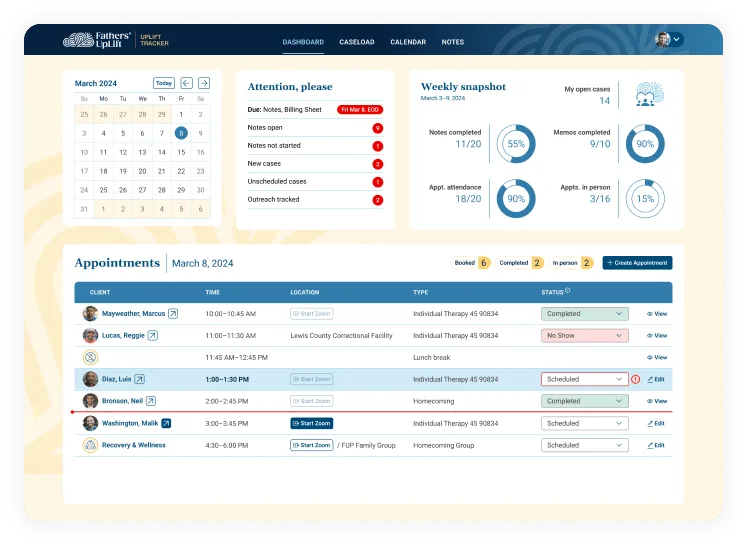
Fathers' UpLift EHR, Blueprint + MVP
Fathers served by the program since 2011
Patients on NeverAlone, which we run
Building software, senior team in Atlanta






What does a custom EHR look like when no off-the-shelf system fits?
It looks like the UpLift Tracker. Fathers' UpLift pairs licensed clinicians with trained coaches, and no EHR on the market was built for that model, so we built one around it in eight weeks.
Before, the team worked across three tools: Tebra, an EHR designed for medical offices, plus Google Sheets for tracking and JotForm for intake. Notes didn't reflect coaching work, nothing gave a full view of a caseload, and complicated documentation meant billable sessions slipped through. Fathers' UpLift had spent two years with another agency and wanted a working system fast.
We ran workshops with leadership, clinicians, coaches and admin staff, defined five user roles, mapped the client journey from referral to outcomes, and put a clickable prototype in front of providers before writing code. The MVP covered notes, service plans, caseload dashboards, charge capture, templates and Zoom sessions. It replaced the spreadsheets and the intake forms, and it syncs demographics, claims and charges to Tebra, which stays the billing system of record. Read the Fathers' UpLift case study.
Blueprint and MVP together
User roles, from clinician to admin
In place of spreadsheets, intake forms and EHR workarounds
Should you build, buy or extend an EHR?
Buy if your care model looks like the ones the market already serves. Extend if the EHR is right but a workflow around it isn't. Build only when your model is different enough that staff spend their day working around the software.
Most organizations should not build a full EHR. Certified products handle billing rules, e-prescribing and regulatory reporting that took their vendors years. The question is where your work stops fitting. We answer it in the Blueprint, with your staff, before you spend on code.
When to build, buy or extend an EHR
| Option | Choose it when | Watch out for | Example from our work |
|---|---|---|---|
| Buy | Your workflows match a mainstream specialty and you need certified features such as e-prescribing and quality reporting on day one. | Configuration limits. Staff adapt to the software, not the other way round. | We ran an 11-vendor EHR selection for CommuniCare Advantage. |
| Extend | The EHR is your system of record and works, but one workflow costs time or revenue. | Vendor API limits and how long access approval takes. Plan it in week one. | MDS coordinator tools inside the PointClickCare workflow, with no separate login. |
| Build | Your care model is new, the people doing the work aren't in a standard EHR's role list, or the product is the EHR. | Scope. Keep billing, claims and e-prescribing in proven systems and integrate with them. | Fathers' UpLift: a custom EHR that syncs billing to Tebra. |
| Build on open source | You need EHR depth you control, such as a health tech product or a niche specialty. | Upgrades, certification scope and who maintains the fork. | We work inside our own fork of OpenEMR; see below. |
These are common patterns, not rules. Many clients end up with a mix: buy the core, extend around it and build the one piece nobody sells.
How does practice management software integration work?
We connect your EHR or practice management system to the tools around it, so a session, a charge or a reminder is entered once and shows up everywhere it's needed.
For Fathers' UpLift the custom EHR syncs with Tebra's SOAP API for patient demographics, billing claims and charge capture, so billing stays where it was and providers capture every encounter as they work. Video sessions start from the platform through Zoom. Reminders, assessment invitations and sign-in links go out by SMS through Twilio and email through SendGrid. Staff sign in through their Google accounts, and clients complete assessments through secure magic links with no password to forget.
On platforms we operate, PointClickCare and Netsmart (GEHRIMED) data is in production, including matching patients across both EHRs. Our Epic work is in a sandbox environment. We can integrate with any system that has an API, a standard interface or a reliable export. See EHR integrations and FHIR and HL7 interfaces.
Practice management and billing
Tebra (SOAP API): demographics, claims, charge capture
EHR data
PointClickCare, Netsmart (GEHRIMED), Epic sandbox
Video sessions
Zoom, AWS Chime
Messaging
Twilio SMS, SendGrid email
Sign-in
Google OAuth2, magic links for clients
Standards
FHIR R4, SMART on FHIR, C-CDA
What EHR and practice management software do we build?
We build the parts of clinical and practice operations that off-the-shelf software handles badly, for organizations whose care model doesn't fit a standard EHR.
Custom EHRs
Notes, service plans, templates, assessments and outcomes built around your roles, as with the UpLift Tracker for clinicians, coaches, ambassadors, fellows and admin staff.
Practice management
Scheduling, caseload views, encounter tracking and charge capture tied to the session, so billable work isn't lost between systems.
EHR extensions
Tools that sit beside the EHR you keep and read its data, like the MDS tools coordinators use inside PointClickCare.
Dashboards and impact reporting
Provider activity, client outcomes and program metrics for leadership, boards and funders.
Client-facing pieces
Intake, assessments by secure link and reminders, connected to the record instead of a separate form tool. See patient portals.
Who it's for
Behavioral health and SUD providers, community programs, specialty groups and health tech companies whose product is the EHR.
Can you add to the EHR we already have instead of replacing it?
Yes, and that's usually where we start. Extending the EHR keeps your system of record and fixes the one workflow that costs the most time or money.
For CommuniCare we built tools for MDS coordinators that work inside the PointClickCare workflow. That platform has recovered $10M+ to date, and the forecast PDPM revenue it supports is $24M+.
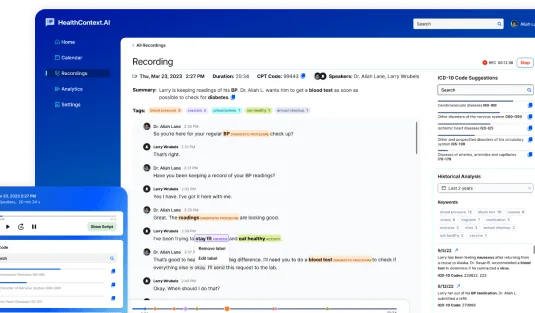
HealthContext, shown here, is an ambient scribe we built into NeverAlone. It turns a visit into a draft clinical note with suggested codes, and the clinician reviews and signs it. Note time fell from 45 minutes to 5. AI in an EHR follows three rules with us: staff review the work, no patient data goes into any tool without a BAA, and new models run inside your own cloud account. We start with back-office work such as documentation and coding before anything touches a clinical decision.
What do you do with OpenEMR and EHR certification standards?
We maintain our own fork of OpenEMR, the open-source EHR and practice management system, and use it to work hands-on with the standards a certified EHR has to meet.
SMART on FHIR
OpenEMR's FHIR R4 API follows US Core and supports SMART app launch with OAuth 2.0 and OpenID Connect. We use it to build and test apps that launch from inside an EHR.
ONC Inferno testing
We run Inferno, the test kit certification labs use, so gaps show up in development. We haven't taken a product through ONC certification, and certification itself runs through an authorized lab.
C-CDA documents
OpenEMR generates and validates C-CDA summaries, the document format most EHRs still exchange.
E-prescribing and prior authorization
The fork includes OpenEMR's e-prescribing, claims and prior authorization modules, which we work inside rather than rebuild.
What this means for you
If you're building on OpenEMR or need an EHR to pass these tests, we already know the codebase, its test tooling and its limits. Most of the fork's code is upstream OpenEMR, and we say so.
How does an EHR or practice management project start, and what does it cost?
Most start with a Blueprint: 4 to 6 weeks to decide build, buy or extend, map the workflows, plan the integrations and set a budget. Then an MVP in front of real providers, then the full build in milestones.
A Blueprint is $25K, or from $50K for the 6-week version with a working prototype. An MVP typically runs 8 to 16 weeks and $75K to $250K, depending on roles and integrations. Fathers' UpLift did both in eight weeks because the scope was tight and the team made decisions quickly.
These are common starting points, not rules. After launch we support platforms we built, usually at L2 and L3 while your team handles first-line questions, or we hand everything over on a build-operate-transfer plan. You own the code and the IP. See healthcare product development for the full path.
Blueprint: build, buy or extend, plus a plan
Typical MVP
Support for what we built, or a planned handover
EHR and practice work in production
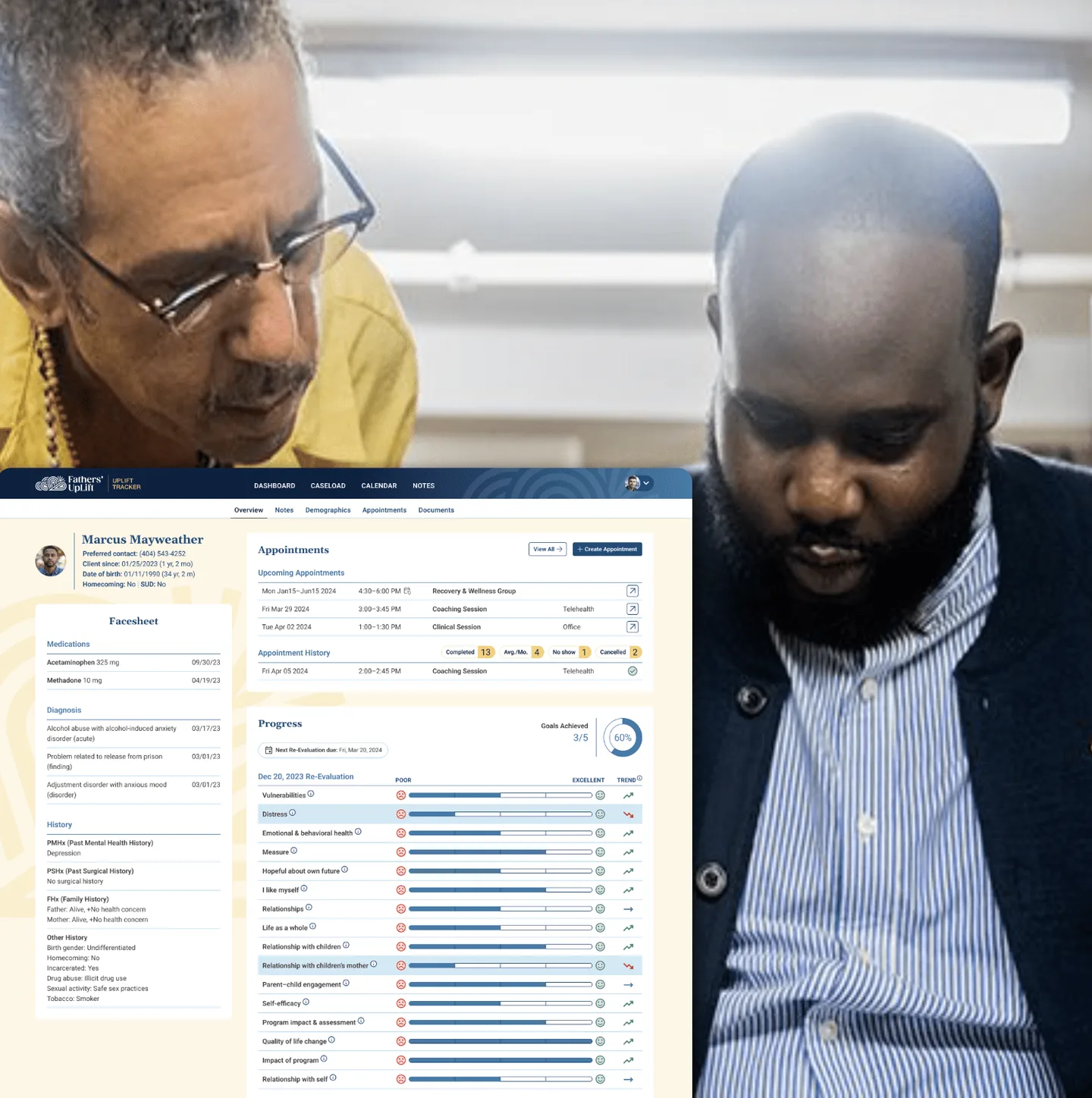
Fathers' UpLift
8 weeks to a custom EHR
A Blueprint and MVP for a Boston mental health program: notes, caseloads, charge capture synced to Tebra, and Zoom sessions in one hub.
See the work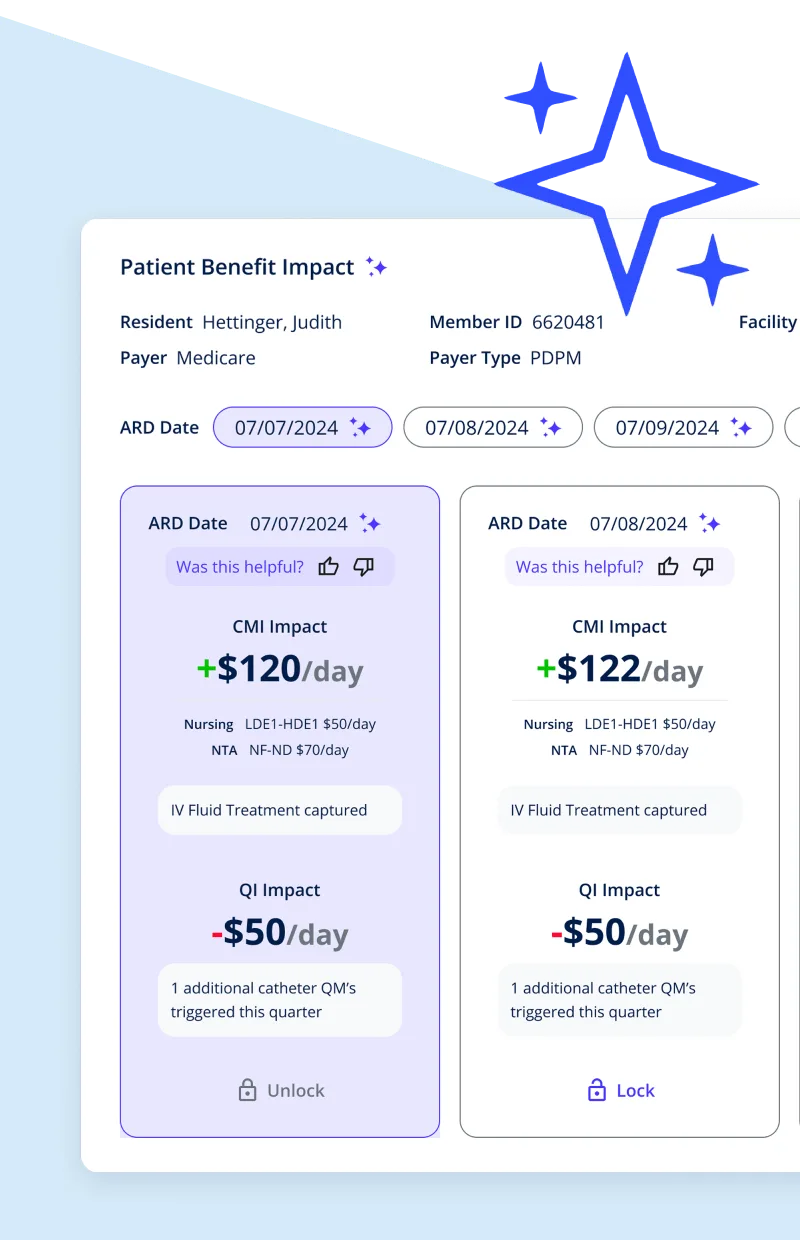
CommuniCare MDS · PointClickCare
$10M+ recovered to date; $24M+ forecast PDPM revenue
Tools for MDS coordinators inside the PointClickCare workflow, with no separate login.
See the work
HealthContext
Note time from 45 minutes to 5
An ambient scribe built into NeverAlone that drafts the clinical note for the clinician to review and sign.
See the workTrusted by healthcare leaders.
“Thank you to the Digital Scientists team, this has been a long time coming! We finally have something that will be useful for our team so I want to take this opportunity to thank you for your hard work and your diligence. You took an idea and made it come to life!”

Dr. Charles Clayton Daniels Jr.
CEO & Founder, Fathers' UpLift
“I have worked with many technology teams during my career, and Digital Scientists is one of the best. They take the time to understand the customers' needs, deliver innovative solutions, are always professional, and work with your team as a true partner to achieve success.”

Amy Severino
Chief Innovation Officer, CommuniCare Health Services
Related healthcare work
Healthcare product development
From Blueprint to MVP to a product in production.
Healthcare product development →EHR integrations
PointClickCare and Netsmart in production, with patients matched across both.
EHR integrations →FHIR and HL7 interfaces
Standards-based data exchange, SMART on FHIR and Inferno testing.
FHIR and HL7 interfaces →Behavioral health and SUD providers
Software for behavioral health, including the Fathers' UpLift EHR.
Behavioral health and SUD providers →Behavioral health EHR integration
Connections to behavioral health and SUD EHRs.
Behavioral health EHR integration →Claims and X12 EDI
837, 835 and eligibility, for practices that bill.
Claims and X12 EDI →Latest thinking on EHRs and practice software


Questions about EHR and practice management software
Do we need to replace our existing EHR?
Usually not. Most clients keep their EHR as the system of record and we extend it or integrate around it. We recommend a custom EHR only when your care model doesn't fit any product, as with Fathers' UpLift, and even then billing stayed in Tebra.
Which EHR and practice management systems do you integrate with?
PointClickCare and Netsmart (GEHRIMED) are in production on platforms we operate, including matching patients across both. The Fathers' UpLift EHR syncs with Tebra for demographics, claims and charge capture. Our Epic work is in a sandbox environment. We can integrate with any system that has an API, a standard interface or a reliable export.
How long does a custom EHR take to build?
Fathers' UpLift went from Blueprint to a working MVP in eight weeks. A typical MVP runs 8 to 16 weeks after a 4 to 6 week Blueprint, depending on user roles and integrations. The full build then runs in milestones.
Can you build an ONC-certified EHR?
We build to the certification criteria, including FHIR R4, US Core and SMART on FHIR, and we run the Inferno test kit from the first sprint. We haven't taken a product through ONC certification yet, so we won't promise a pass. Certification runs through an authorized lab, and your company holds it.
Do you work with OpenEMR?
Yes. We maintain our own fork of OpenEMR and work inside it, including its FHIR and SMART on FHIR APIs, Inferno tests, C-CDA, e-prescribing and prior authorization modules. If you're building on OpenEMR, we already know the codebase.
How do you handle HIPAA?
We sign a BAA with every covered entity before we touch patient data, our security plan is mapped to NIST CSF 2.0, and each client gets a security addendum. Encryption, role-based access and audit logging are in the architecture from the first sprint. See security and PHI.
Tell us what you're trying to do
No commitment. No sales deck. We respond the same day, and you talk to senior leadership.
Four programs for one health system, CommuniCare, as its innovation partner: virtual care, a Medicare Advantage plan, risk adjustment AI and MDS coding.