I've watched the same thing happen in company after company, including my own. In almost 20 years of running Digital Scientists, we've bought SaaS platforms for nearly everything: Jira for delivery, QuickBooks for accounting, Gusto for payroll, Pipedrive for sales, plus a pile of spreadsheets. Most are good at what they do, but few work well together, and our people carry the work between them.
In mid-sized and large companies, the same problem plays out across more departments, more systems and more people, and it costs a lot more. They have long faced a difficult choice. Customize too much and your software becomes brittle and expensive to upgrade. Customize too little, often because the funding wasn't there, and your employees develop their own workarounds. In many cases, companies changed the way they worked to accommodate the software they bought. That made sense for commodity business functions, but not necessarily for the ways of working that made their businesses different.
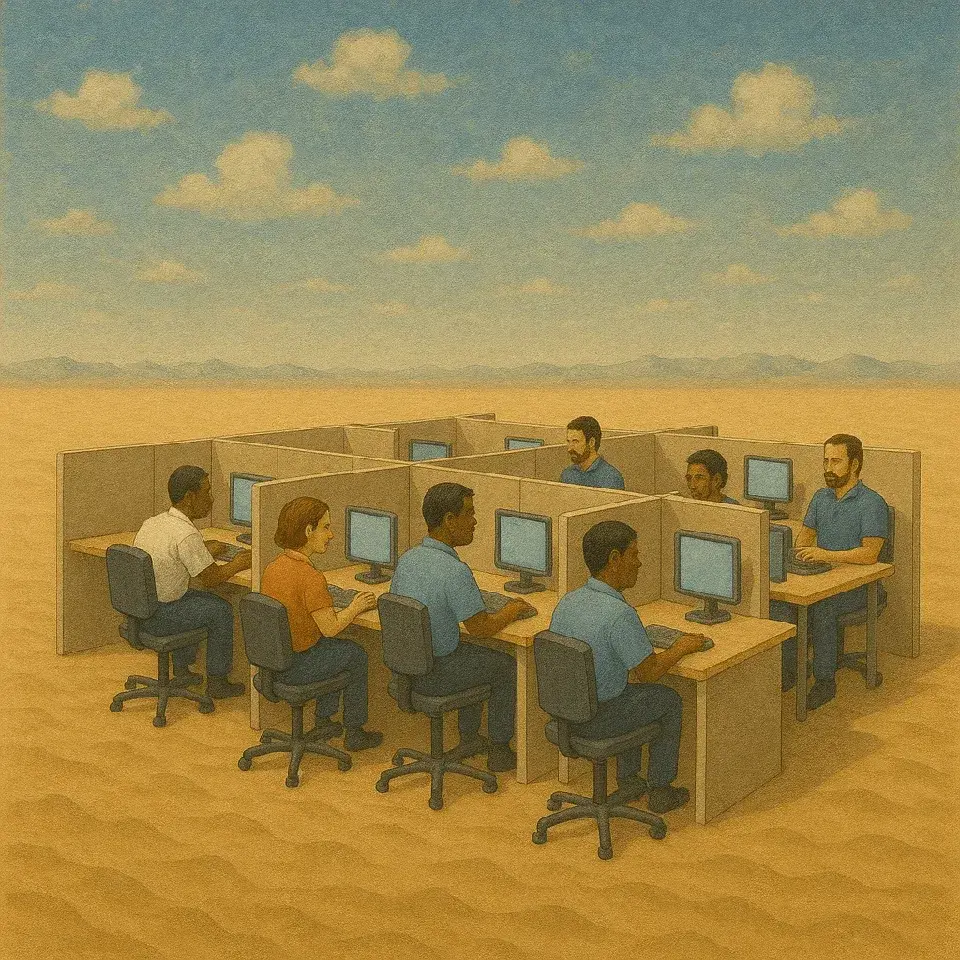
We've been here before. The promise of ERP, in the spirit of Michael Hammer and James Champy's Reengineering the Corporation, was to rethink how the company operates. I think SaaS reintroduced many of the same silos. Every department bought its best-of-breed tool, and the people in between carried the work. Employees became the integration.
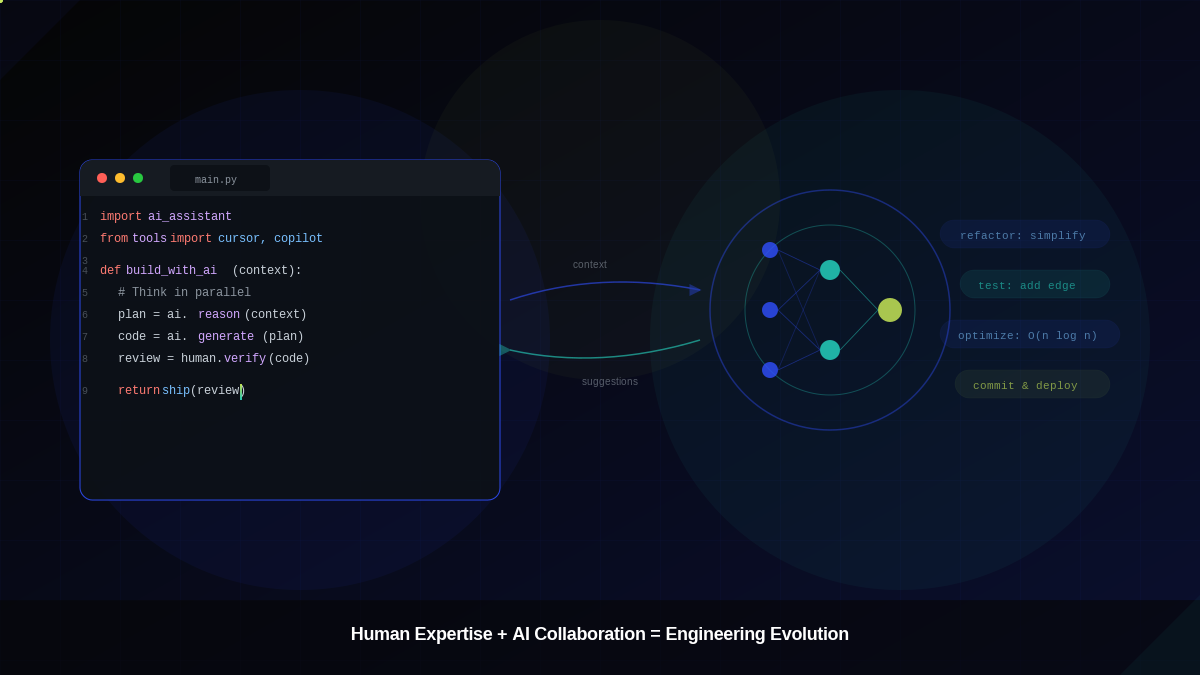
What's different now is both the economics of building software and what software is capable of doing. We can revisit workflows that couldn't previously justify the investment. And we can build software that does the work, not just helps someone do it. That doesn't mean ripping out every platform you own. Often the opportunity is to build around the systems you already have.
Getting to operational intelligence
Nick, our COO, and I have been talking quite a bit about what it means to achieve operational intelligence. How intelligent can a company really be if it has to wait until the month closes to understand its financial performance?
So much information is trapped in process. We have batch processes that are almost invisible, and workflows we don't fully understand until someone produces a report. By then, we've often lost the opportunity to influence the outcome.
Take project profitability. We close our books every month, and we should. But I'd like a reliable estimate of how a project is doing this week, while there's still time to change it. The close tells us what happened. I also want to know what's happening.
I want software that informs and advises us as the business operates. I want to know when something changes, why it matters and what we might do about it. I don't want to have to know the right question to ask or wait for someone to build a report.
That's what I mean by operational intelligence. It's the ability to understand and influence the operation as the work happens. It's about seeing the work, not watching the people doing it.
Software has to do the work
Increasingly, we're helping companies build platforms through which they deliver outcomes to their clients.
I hold these platforms to a simple standard. Software has to do real, measurable work, and it needs to know what work it has done.
That doesn't mean AI agents do everything. Delivering a service involves people, clients, software platforms and agents working together. The opportunity is to connect them in a way that gives us visibility into the work, control over how it's delivered and the ability to improve it.
Einar Vollset made an important point at MicroConf in Sell the Outcome, Not the Tool. The cost of the labor required to operate software is often far greater than the cost of the software itself. Sequoia has made a similar argument about selling the work rather than the tool. Instead of charging for access to software, you charge for the value of the outcome it delivers.
A company that uses AI only to reduce costs becomes more efficient. A company that uses AI to deliver better outcomes has an opportunity to grow.
Einar's talk left me with a set of questions I now ask about any piece of software, ours or someone else's. I've adapted them a little:
- Does it do the work?
- Does it know what work it has done?
- Does it know whether the work achieved the desired outcome?
- Can what it learns improve future outcomes? Including across customers or sites, where that's appropriate and permitted.
- Does the accumulated learning stay with your company, so your platform gets smarter over time?
The last question may be the most important. The learning I mean isn't data sitting in a software tool. It's the know-how to deliver the outcome: what works, for which clients and under what conditions. In most companies that know-how lives in people's heads and leaves when they do. When it's captured in the platform through which you deliver the work, every engagement makes the next one better, and that know-how becomes something your company owns.
None of these are pass or fail. A system that advises people without acting can still be valuable. And a completed task isn't the same as a good outcome. The point is to capture the result, measure it and use what you learn to improve the workflow. That learning doesn't happen on its own. You have to design for it, and you need the right to use the data.
If we want to consistently deliver better outcomes to our clients, we need to rethink how we deliver them inside our own four walls. That's where the four I's come in.
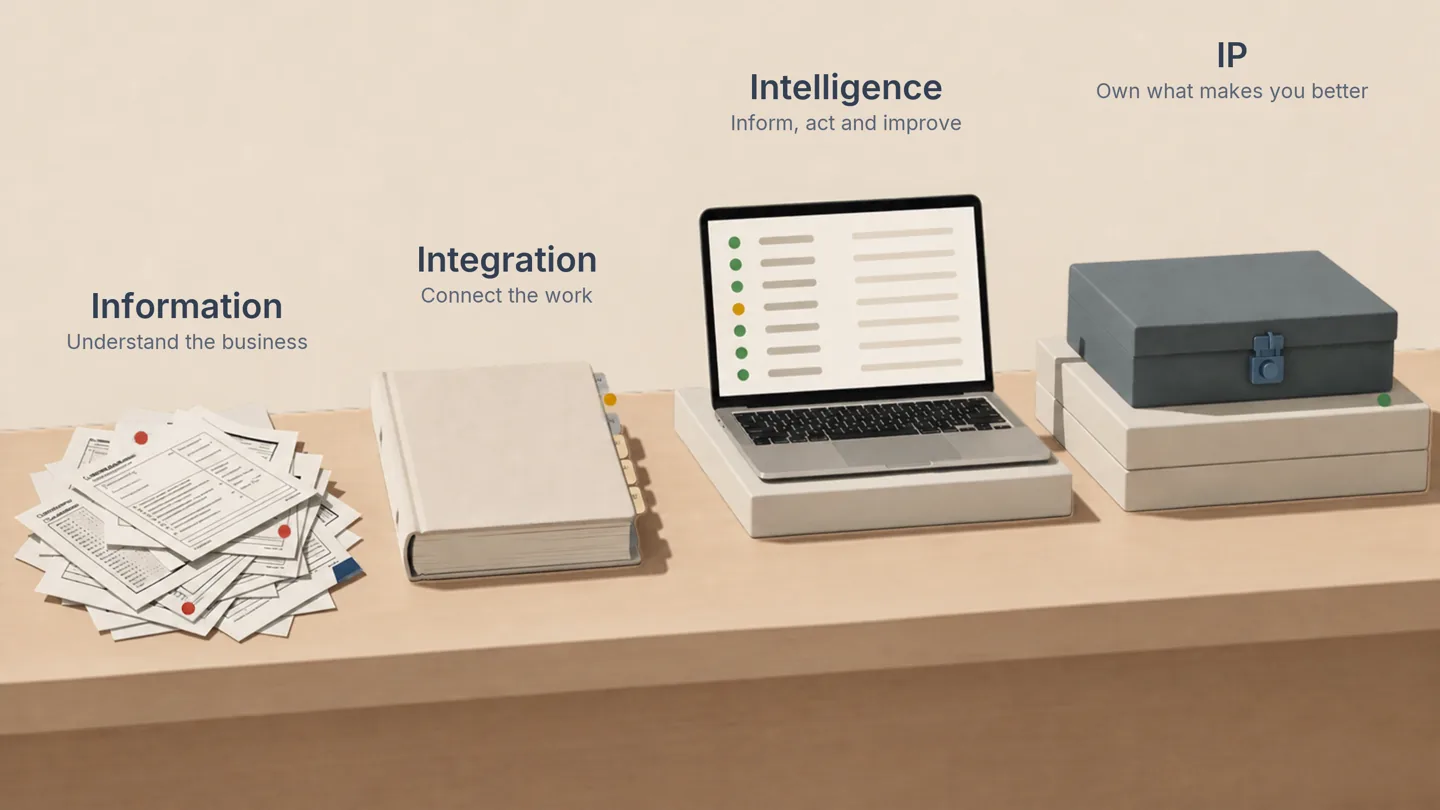
The four I's
I sketched this on a whiteboard in September as three I's. It's four now. We call it the operational arc. It's a loose framework, not a methodology, and few companies move through it in a straight line.
Information: understand the business
Understand the information and knowledge that run your operation, inside and out. Much of it resides in disconnected systems, spreadsheets, documents and people's heads. Understand how your core workflows actually get delivered and make reliable information available when it's needed.
Integration: connect the work
Connect the workflows, not just the systems. Bring off-system processes into view and capture important transactions and events as they happen. Make the work visible, measurable and manageable, with a way to handle exceptions when things go wrong.
Intelligence: inform, act and improve
Achieve operational intelligence. Software should inform and advise people in real time and increasingly participate in the work itself. Measure the results, understand what works and make those improvements part of your standard way of operating. Think of it as an AI-enabled form of Kaizen, the practice of continuous improvement where small changes that work become the standard.
IP: own what makes you better
As software becomes easier to build, more of the value lies in what your company knows and how it delivers outcomes. The knowledge, data, methods and capabilities you accumulate can become proprietary business assets. They can help you deliver existing services more profitably and create new ones. Some of it may be IP in the legal sense. Much of it is simply how you operate better than anyone else. Either way, contracts and data rights matter, so be deliberate about what you keep.
What this means for a services company like ours
Put the first three I's together and you begin to create what I think of as a digital twin of your business.
For a services company like Digital Scientists, that means a live, connected representation of how our people, clients, software platforms and AI agents work together to deliver outcomes. It would give us the ability to see the work as it happens, understand how well it's being delivered and influence what happens next.
We've spent almost 20 years developing our own ways of delivering software products for clients. How much of that knowledge could become part of a platform through which we deliver our services? How could we make sure that what we learn on one engagement makes us better at delivering the next?
We don't necessarily need to become a software product company. But I think we need to reconsider how much of our service delivery can happen through a platform we own and continuously improve.
That's an opportunity I'm thinking about for our own business as much as for our clients.
Three kinds of companies
The four I's look a little different depending on where you start. The goal is a better business, not necessarily a different kind of business. These are possibilities, not prescriptions, but each one ends at the same place: a business that delivers better outcomes for its clients.
Services companies can build platforms through which people and agents deliver services more effectively, improving capacity, consistency, margins and client outcomes. Building a standalone software product is optional.
Physical product companies can connect their products to the people who use them, gaining a better understanding of how their products perform in the field. That knowledge can help them improve their products and create ongoing services that deliver outcomes such as uptime, yield or safety.
SaaS companies can move beyond selling tools toward completing work and delivering measurable value to their customers.
From our clients
Medley runs cohort-based group coaching that helps organizations grow their leaders. Its coaching operation ran on six disconnected tools, and the same participant lived in six places. Today it runs on one platform Medley owns. The 400-task launch checklist is generated and assigned automatically for every cohort, and Medley's own group-matching method is connected as a service rather than rebuilt. It has run 427 coaching sessions in production. In the case study's words, the platform, the data and the method belong to Medley.
NeverAlone started at CommuniCare in 2021 as a simplified tablet for independent-living seniors. Today it serves 130+ facilities in six states, and CommuniCare licenses it to facilities outside its own network. It handled more than 100,000 calls in 2024 and now takes more than 8,000 calls a month with zero dropped, and 96% of patients are treated in place. An operator took what it knew about delivering care, built it into a platform and turned that into a new commercial service.
If you want to see what an AI-native platform looks like when it's built that way from day one, take a look at Tinyspark, which we're building with its founding team. More on that soon.
I don't see this as a technology project with an end date. It's a different way of thinking about how we operate and improve our businesses. The software becomes part of that continuous improvement.
Start with one workflow
You don't have to transform your entire company at once.
Start with one workflow that matters to your business. One that requires people to move between several systems. One that depends on spreadsheets or knowledge trapped in people's heads. Or one where you struggle to understand how well you're performing until someone produces a report.
Understand the work. Connect it. Make it intelligent. Measure the outcome. Own what you learn.
Then move on to the next workflow.
I'll explore each of the four I's in more depth in subsequent posts, including what we're learning as we apply these ideas inside Digital Scientists and with our clients.
Sources
- Einar Vollset, Sell the Outcome, Not the Tool, MicroConf.
- Sequoia Capital, Services: The New Software.
- Michael Hammer and James Champy, Reengineering the Corporation (1993).
- Masaaki Imai, Kaizen: The Key to Japan's Competitive Success (1986).