
Experiment · Phase 2
Minimum Viable Product (MVP) Development Services
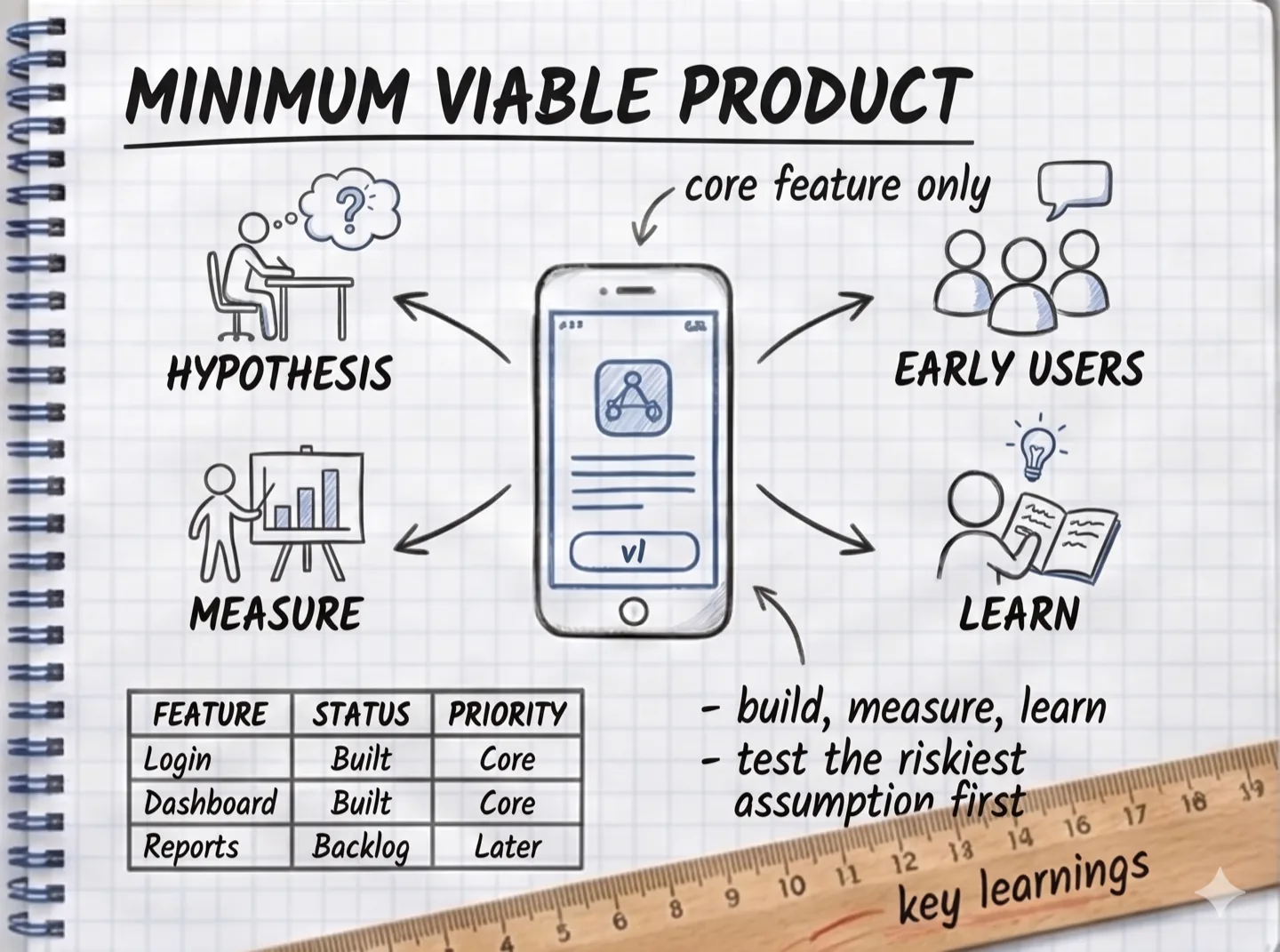
The goal isn’t to ship fast. It’s to learn fast. We build minimum viable products that answer the question that matters: is this worth building?
Products Shipped
Building Products Since
Avg Engineer Experience
Build-Measure-Learn
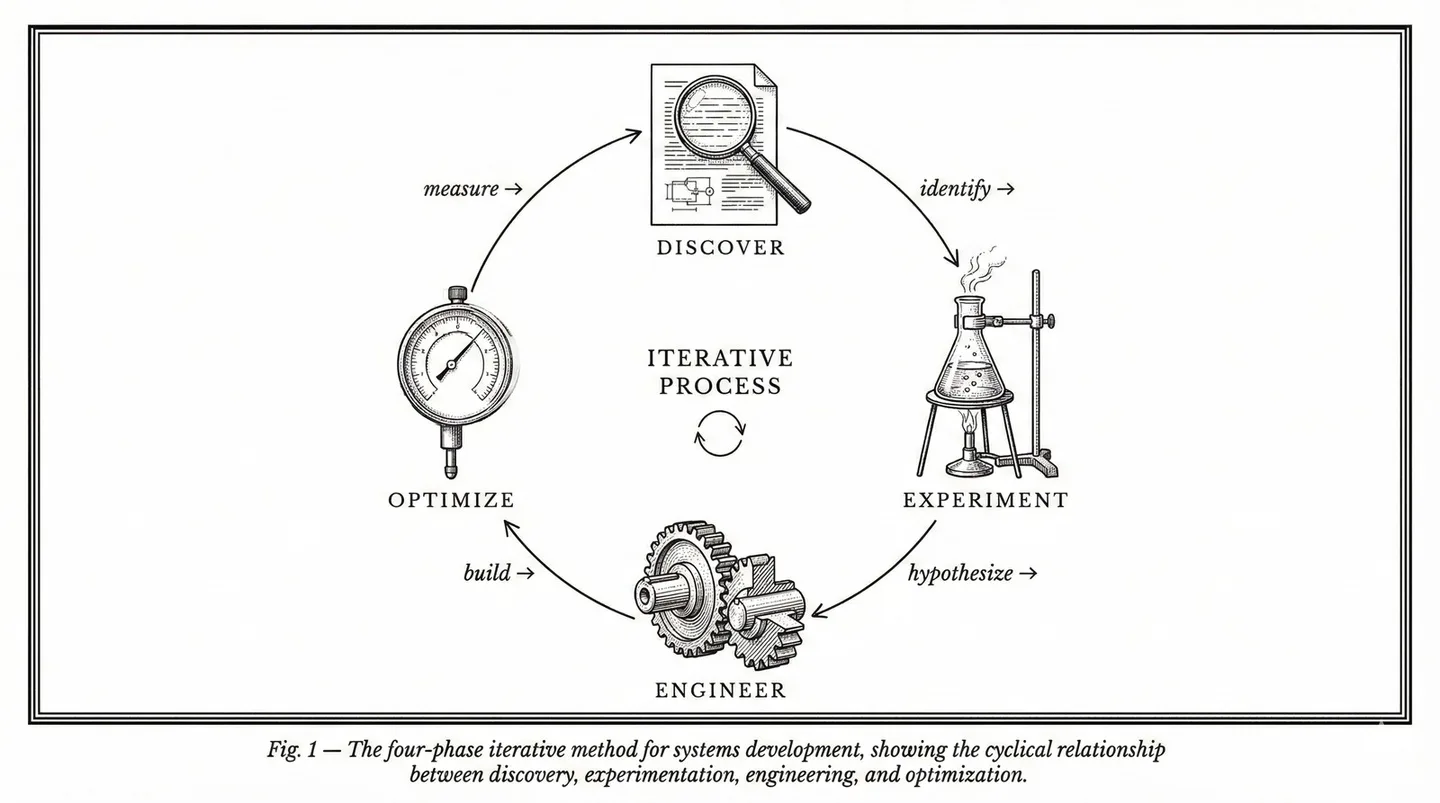
Every engagement follows our method: Discover → Experiment → Engineer → Optimize
Most MVPs Test Whether Something Can Be Built, Not Whether It Should Be
Teams skip the market work and jump straight to coding. The result: a working product nobody uses. MVP development without validated learning is just building faster in the wrong direction.
Building without asking the right question.
The MVP gets built, launched, and... nothing. Usage is flat. The team built what they assumed users wanted instead of instrumenting the product to learn what users actually do. Six months and significant investment later, they still don’t know if the idea is sound.
Treating the MVP as a shrunken version of the full product.
An MVP is not a feature-reduced product. It’s a learning instrument. When teams try to cram the full vision into a smaller budget, they get a product that does many things poorly instead of one thing well enough to generate validated learning.
No instrumentation, no learning.
If you don’t measure what users do with the MVP, you haven’t built an MVP, you’ve built a demo. The entire point of MVP development is the Build-Measure-Learn loop. Without the Measure step, there is no Learn step.
MVP development is a market test
An MVP, in Eric Ries’s Lean Startup framing, is the version of a new product that lets a team collect the most validated learning about customers with the least effort. The MVP isn’t a technical proof. It’s a market test, the real test of whether customers want what you’re building, at the scale and price that supports a business.
The 2026 challenge: AI tools generate code fast. They don’t run the market test. Most clients show up with something, a Bolt or Lovable prototype, design specs, a pitch deck, or a deeply-considered idea, and need the harder work done: defining what the market test actually answers, then running it with rigor.
Our Discover, Experiment, Engineer, Optimize methodology is built around that work. The senior team, PM, UX research, data architect, technical architect, engineering, does the judgment work. AI accelerates the engineering. The pairing matters: speed without judgment ships features nobody uses.
MVP Development Built on Validated Learning
Build-Measure-Learn, the validated-learning loop Eric Ries defined in The Lean Startup, is the engine of our MVP development services. Every MVP we build is instrumented from day one, not as an afterthought, but as the entire point. We take a product management approach: measure what’s used, turn off what isn’t, and let real user data drive every decision.
✓ 200+ products shipped since 2007, including successful exits
✓ Senior US engineers, 15-20 year average experience
✓ Build-Measure-Learn instrumented from day one
✓ You own all the IP, always
Build the right thing.
30 minutes with a senior engineer. We’ll surface the right first engagement, Blueprint, Experiment, or MVP, for your situation. No pitch deck.
Build
Our senior product team challenges your assumptions, diagnoses problems, and builds the smallest thing that answers your most important question. AI accelerates the engineering, experienced architects make the decisions that matter.
Measure
We instrument the MVP for usage tracking from day one. You get quantitative adoption data alongside qualitative user feedback. What do users actually do? Which features do they ignore? Where do they struggle? The data tells the story.
Learn
Validated learning is the outcome. Did the MVP confirm or refute your key assumptions? Should you iterate, pivot, or scale? We help you make this decision based on real-world evidence, not projections, not opinions, not gut feelings.
Whether it’s a web application, mobile app, or a new AI model, our U.S.-based team, with Mailchimp R&D roots and 19+ years of experience, helps clients go from concept to validated MVP development. We’re experts at going from nothing to something testable, and then using what we learn to build the right thing.
MVP Development Services, Pick the Size That Fits Your Question
Our experienced team guides you through a repeatable process to bring your product to market. We adapt the scope to match the complexity of what you need to validate. Each tier is designed around validated learning, getting the product into real users’ hands as quickly as possible.
Small
Proof of Concept
Core features to validate a hypothesis in the shortest time period. One focused question, one clear answer.
Medium
Startup
Broader set of use cases to test product-market fit with real users across multiple workflows.
Large
Enterprise
Broadest set of use cases with higher complexity. Multiple personas, integrations, and AI requirements.
See full details on scope, deliverables, and what every tier includes on our Minimum Viable Product page. Not sure which size? Talk to us, we’ll scope the right approach together.
Discover → Experiment → Engineer → Optimize
Validated learning defines what to build. Our method defines how we build it. You don’t have to start at the beginning, most clients enter at the phase that matches where they are today. AI accelerates every phase, but the thinking still requires experienced engineers and product managers.
“What should we do?”
Define the Question
Research, opportunity mapping, and prioritization to find the highest-ROI starting point. You leave with a clear plan, not a vague roadmap.
Strategy Workshop · 1 day
Strategic Planning · 4 weeks
Product Blueprint · 1-4 weeks
“Does it actually work?”
Validate Before You Build
Working prototypes and MVPs tested on your data, your workflows, your users. Build, pivot, or stop, with proof, not opinions.
Proof of Concept · 1 day
Functional Prototype · 5 days
4-16 weeks
“Make it real.”
Build with AI Leverage
Validated experiments become production systems. Sprint-based delivery, senior-staffed teams, and architecture designed for scale, security, and integration.
Production Engineering · 3-12 months
AI Workflow Deployment · 8-16 wks
Architecture Review · Ongoing
“Make it better.”
Learn and Iterate
Ongoing support, monitoring, and continuous improvement. We stay until the KPIs are hit, and keep the system performing after launch.
Managed Services · Ongoing
DevOps / SRE · Ongoing
We help clients prioritize the MVP platform to show product-market fit. On this page, MVP refers to Minimum Viable Product, Phase 2’s Minimum Viable Product, a 4-16 week validated experiment. The MVP is not the full production engineering version of the platform; that’s Phase 3 / Full Build, which begins only if the MVP validates.
How We Scope an MVP
Every MVP needs to answer a specific question, run under a specific engagement model, and be estimated against specific drivers. Here’s how we approach all three.
What MVPs actually test
Functionality
Right feature set?
Access
Right users?
Adaptability
Fits how they work?
Pricing
What will they pay?
The Blueprint identifies which the MVP needs to run first and what evidence will count as an answer.
Engagement models
Fixed-price
Scope, timeline, and feature set defined at Blueprint signoff.
Best when
Scope is well-defined and you want budget predictability.
Time-and-materials
Priced monthly or per sprint based on team composition.
Best when
Complex ecosystem, real technical uncertainty that may require pivoting mid-build, or novel IP that’s difficult to estimate up front.
The Blueprint determines which fits.
What drives MVP estimates
✓ Use cases (and their complexity)
✓ Number of personas
✓ Workflows (and their complexity)
✓ Integration count (and complexity)
✓ IP development scope
✓ AI / Data engineering requirements
✓ Form factors (web, mobile, IoT, embedded, etc.)
The Blueprint quantifies each of these so the estimate has evidence behind it, not guesswork.
Started as an MVP. Now in Production.
These products started as minimum viable products built on validated learning. Each one used the Build-Measure-Learn loop to prove the concept, then scaled into production software serving real users at scale.

From MVP to 7-State Virtual Care Platform
NeverAlone started as an MVP to test whether remote patient monitoring could keep older adults safely at home. The validated learning was clear: users adopted it, providers valued it, and outcomes improved. The MVP became a production platform now serving 26,000+ patients across 130+ facilities in 7 states.

From MVP to Millions of Tickets Sold
GoFan began as an MVP to validate digital ticketing for high school sports. The Build-Measure-Learn approach proved the concept quickly. Validated learning showed strong adoption among athletic directors and fans. The MVP evolved into a full ticketing, fundraising, and concessions platform processing millions of transactions, and exited via merger with KKR-backed PlayOn! Sports in 2022.
MVP Development in Action
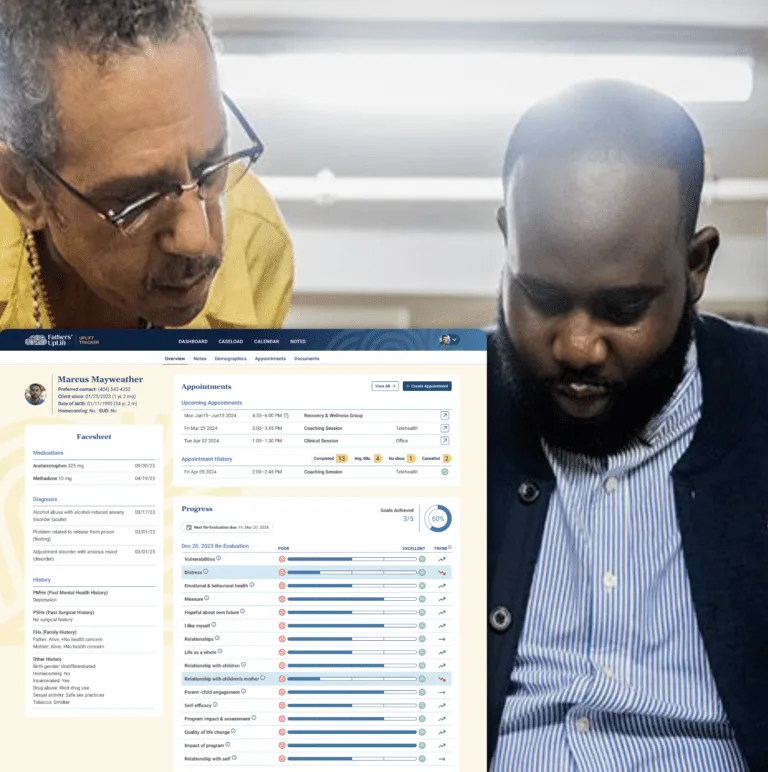
Fathers’ UpLift
Custom EHR built from concept to accelerate program growth and deliver future insights
View Case Study →
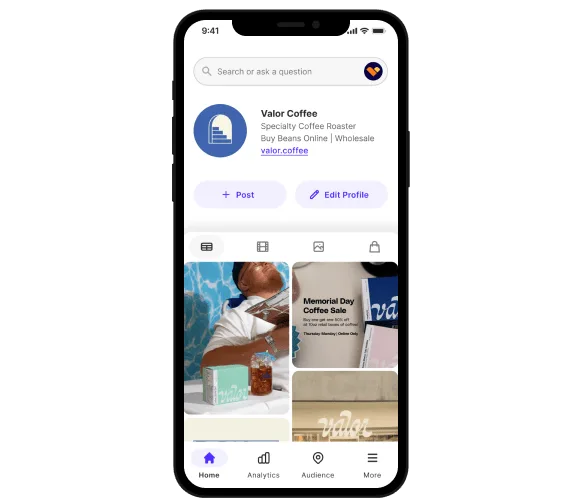
TinySpark
Social marketing platform built from MVP to help small businesses grow
View Product →
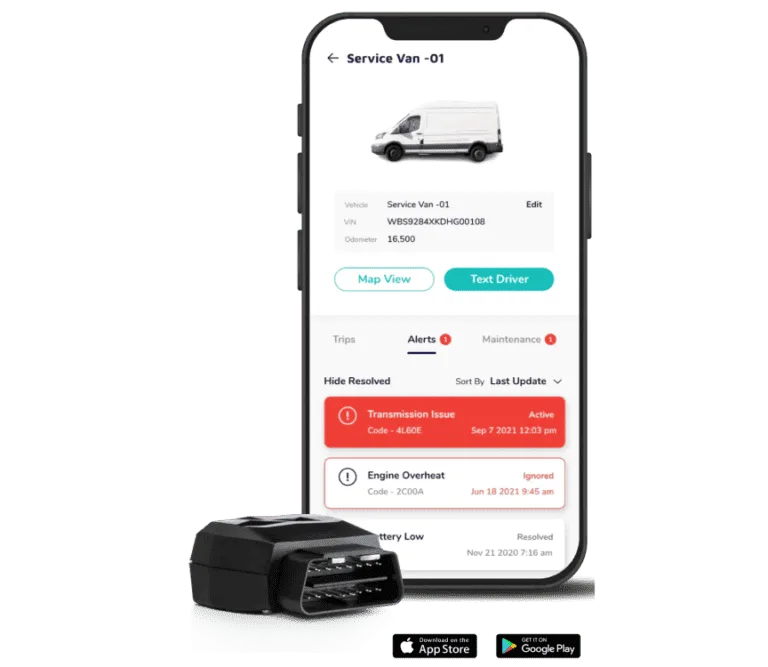
Kayo
Smart vehicle management, from MVP through connected device ecosystem
View Product →
MVP Development Deliverables
Every MVP development engagement is designed around learning outcomes. You don’t just get a product, you get the validated learning, usage data, and evidence to make informed decisions about what comes next.
See Minimum Viable Product DetailsWhere to Start, and Where to Go Next
Blueprint
Define the market problem, interview users, and plan the product, before you build. 1-4 weeks.
Learn more →Minimum Viable Product
Get your product into real users’ hands and measure what happens. MVP development in 4-16 weeks.
See full details →How We Engineer
Senior architects, AI-accelerated delivery, 170+ combined years of experience.
Learn more →New Product Development
From market problem to production product. Full lifecycle product development.
Learn more →MVP Development Insights
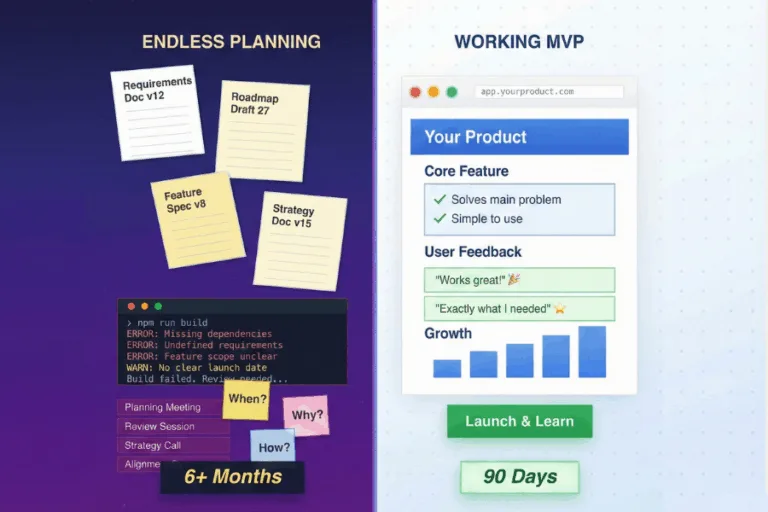
MVP Development Success: What Actually Works
The most competitive companies today are moving fast, validating early, and letting real users guide their strategy.
Read More →

A Guide to Finding Product Market Fit
The discipline of validating market fit, before you scale.
Read More →
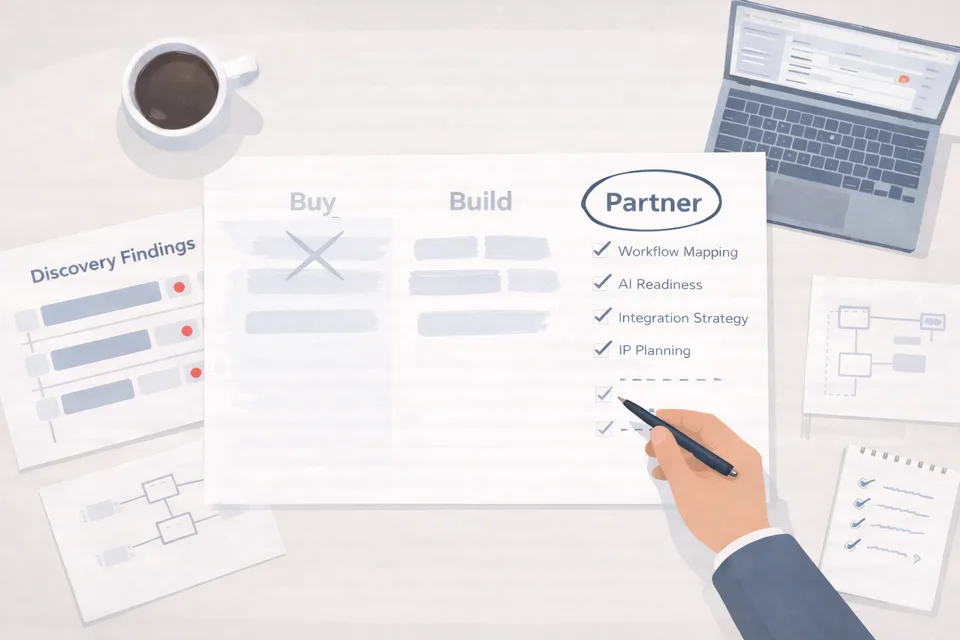
Buy, Build, or Partner? Handling Software Discovery Gaps
How to make the right build-buy-partner decision when gaps emerge during software discovery.
Read More →
MVP Development FAQ
Schedule an MVP Strategy Call
Tell us what you’re trying to validate. We’ll help you define the right MVP development approach, the smallest thing that answers your biggest question.
Since 2007 · 200+ products launched · Build-Measure-Learn