A biometric smart pill bottle that securely delivers medication on schedule
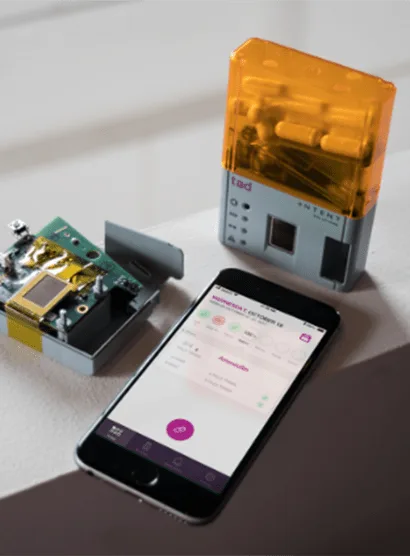
Digital Scientists partnered with Intent Solutions to design and develop Take As Directed (tad), an IoT medication dispensing platform that uses biometrics and Bluetooth Low Energy to ensure the right patient gets the right dose at the right time.
3
Companion Apps Delivered
4
Stakeholder Personas
15+
Competitors Researched
HIPAA
Compliant AWS Platform
From concept to connected healthcare: designing an IoT medication compliance ecosystem
Intent Solutions sought to improve patient outcomes by ensuring medications are taken exactly as directed -- at the right time, at the right dose, and by the right person. Digital Scientists partnered with Intent Solutions and electronics developer Milestone Consulting to design and build tad (Take As Directed), a smart medication dispensing device with companion mobile and web applications.
The engagement spanned the full product lifecycle: stakeholder assessment and persona development, customer journey mapping, competitive research across 15+ medication adherence products, information architecture, wireframes, visual design, and full-stack development of a React Native patient app, pharmacist tablet interface, and Ruby on Rails admin portal -- all built on a HIPAA-compliant AWS platform.
The tad platform collects real-time behavioral and compliance data, enabling doctors, clinical researchers, and caregivers to monitor medication adherence with precision -- a critical capability for clinical trials, pain management, and chronic disease programs. As a connected healthcare device with companion software, tad is a compelling example of software as a medical device in action.

Medication non-adherence costs the US healthcare system $300B annually
Intent Solutions needed a streamlined patient experience in a mobile app (MVP) with the ability to collect real-time behavioral and compliance data for use by doctors and clinicians. The challenge was multi-dimensional: connect a physical dispensing device via Bluetooth to companion apps, design for multiple stakeholder types with different needs, and ensure HIPAA-compliant data handling throughout.
Adherence Tracking
Doctors and clinical researchers had no reliable way to confirm whether patients actually took medication at the correct time or at all, compromising trial integrity and treatment outcomes.
Multiple Stakeholders
The ecosystem spans patients, caregivers, pharmacists, doctors, clinical researchers, and administrators -- each with distinct workflows, devices, and security requirements.
Device Integration
The physical tad pill box had proprietary hardware from Milestone Consulting. Digital Scientists needed to connect a mobile app via Bluetooth Low Energy to this existing device.
Biometric Security
Controlled substances require verification that the right person is taking the medication. The system needed fingerprint enrollment, PIN backup, and secure identity confirmation.
Medication Diversion
For pain management and opioid prescriptions, preventing diversion (selling or distributing pills) and addiction through improper use was a critical requirement.
Clinical Trial Data
Clinical research firms needed reliable, exportable adherence data from trials, with the ability to set up programs, regimens, and participant-specific prescriptions through an admin portal.
What patients and clinicians needed to accomplish
Receive the right medication at the right dose, at the right time, verified by biometric identity
Track adherence history with daily scores, missed doses, and calendar views for self-monitoring
Set up clinical trials with custom regimens, participant groups, and prescription parameters through an admin portal
Load prescriptions into devices via BLE and hand off to patients with regimen files pre-configured
Remotely dispense medication via the app when the physical device is unavailable or malfunctioning
Export raw adherence data as CSV and view filtered analytics for clinical research reporting
Four personas across the medication compliance ecosystem
Digital Scientists conducted stakeholder assessment and persona development to understand the distinct needs, pain points, and platforms of each user type in the tad ecosystem. This research informed every design decision from information architecture to notification logic.
Patient (End User)
Mobile · Primary user
Person taking medication, participating in a study or taking daily/regimented medication.
Pain Points
- •Difficult to remember to take medication on schedule
- •Cannot recall times medication was taken
- •Fear of addiction with controlled substances
Clinical Researcher
Desktop · Customer admin
Conducting clinical research on new drugs with a need for reliable methods of tracking adherence and participation.
Pain Points
- •Not sure if participants actually took medication
- •No reliable way to collect adherence data
- •Accuracy of self-reported information is questionable
Pharmacist
Desktop / Tablet · Device setup
Loads medications and prescription instructions into the tad device before handing it off to the patient.
Pain Points
- •Patients taking medications at incorrect times
- •Costly medication wastage from non-compliance
- •Complex device onboarding via QR code and BLE
Pain Management / Hospice
Desktop · Customer admin
Helping patients with pain management through prescription opioids, where the risk of addiction and diversion is significant.
Pain Points
- •Patients taking medication improperly
- •Risk of addiction and abuse of medication
- •Diversion: selling or distributing prescribed pills
Mapping the end-to-end journey from trial setup to data analysis
Digital Scientists mapped both the customer (clinical research firm) journey and the participant (patient) journey to understand every touchpoint in the tad ecosystem. These journeys informed the application architecture and feature prioritization for the MVP.
Awareness
Customers hear about tad through NIH referrals, face-to-face meetings, and word of mouth
Trial Setup
Portal training, participant setup, medication configuration, device setup, prescription loading
Onboarding
Participant biometric setup, device training, app installation, BLE pairing, PIN creation
Active Trial
Notifications, dispensation, surveys, data transmission, support, refills, prescription changes
Data Analysis
Device return, data export as CSV, analytics review, adherence reporting
A React Native app for medication tracking, dispensation, and adherence monitoring
The patient app is the primary daily interface for users. Built in React Native for iOS and Android, it connects to the tad device via Bluetooth Low Energy and provides medication scheduling, remote dispensation, adherence scoring, and caregiver access.

Today (Home Screen)
Daily medication schedule with adherence score, dispensation history, and remote dispense via swipe gesture with biometric verification.

My Medications
Medication list with real-time stats -- adherence percentage, doses remaining, and time since last dose -- for both device and non-device medications.

Medication Detail
Detailed view with adherence stats, dispensation schedule, and configurable reminders -- 30 minutes before, at dispense time, and 30 minutes after if not taken.
Biometric Dispensation
Remote dispensation via Touch ID or PIN backup. Swipe a medication card to dispense, with biometric verification ensuring only the authorized patient can trigger dispensation.
Smart Notifications
Multi-modal alerts including push notifications, device temperature and battery warnings, survey requests from clinical trials, and prescription refill reminders when doses run low.
Caregiver Support
Patients can add caregivers with configurable access levels, switch between patient profiles (for nurses managing multiple patients), and share adherence data with family members.
Four-tab architecture designed for daily medication workflows
The patient app information architecture was organized around four primary sections, each mapped to a core user workflow. The structure prioritizes the daily interaction pattern -- checking today's schedule, reviewing medications, reading notifications, and managing device settings.
Today
Next dispensation time, schedule, history, adherence score, remote dispense, calendar view, notes
My Meds
Medication information, dispensation time settings, reminder configuration, personal notations
Notifications
Device alerts, doctor/trial messages, custom questionnaires, survey responses
Settings
PIN management, account details, caregivers, registered devices, notification preferences, support


Three purpose-built interfaces for every role in the ecosystem
Digital Scientists designed and built individual solutions for each stakeholder: a Rails-based Customer Admin portal for clinical researchers, a pharmacist tablet app for device provisioning, and the patient mobile app for daily medication management.
Customer Admin Portal (ActiveAdmin / Rails)
Manage programs, participants, medications, devices, regimens, and prescriptions. Create reusable regimen templates, download regimen files, export adherence data as CSV, and set up patient questionnaires.
Pharmacist Tablet App (React Native)
Onboard devices via QR code, prescribe medications, generate regimen files through BLE, re-initialize returned devices, import logs, and run tad diagnostics.
Patient Mobile App (React Native)
Daily medication management with biometric dispensation, adherence tracking, notifications, caregiver access, and device status monitoring across iOS and Android.
Bluetooth Low Energy integration with a HIPAA-compliant cloud backend
Intent Solutions came to Digital Scientists with a physical device built with proprietary hardware and software by Milestone Consulting. The team needed to connect mobile apps via Bluetooth to the existing device while ensuring all data flowed through a HIPAA-compliant AWS infrastructure.
The solution architecture connects three front-end applications to a centralized backend: the React Native patient app (for patients, caregivers, and nurses), the React Native pharmacist tablet app, and the ActiveAdmin desktop portal (for Intent Solutions admins and customers).
Data flows include user preferences and dispensation logs from the patient app, pharmacist preferences and prescriptions from the tablet, and prescription/regimen data from the admin portal -- all synchronized through real-time APIs with device status notifications.
Solution Architecture
Patient Phone App
React Native · Roles: Patient, Caregiver, Nurse
Data: User preferences, dispensation logs
Pharmacist Tablet App
React Native · Roles: Customer, Pharmacy
Data: Pharmacist preferences, prescriptions, logs
TAD Portal Desktop App
ActiveAdmin (Rails) · Roles: IS Admin, Customer, Pharmacy
Data: Prescription/regimen data, logs
HIPAA-Compliant AWS Backend
Ruby on Rails API · Bluetooth Low Energy · Real-time device status · Notification services
15+ medication adherence products analyzed to inform differentiation
Digital Scientists conducted extensive competitive research across smart dispensers, tracker systems, reminder apps, and delivery services to identify opportunities for tad to differentiate. Key learnings shaped the product's feature set and user experience.
Smart Dispensers
Pillo, Hero, Vitality GlowCap, MedMinder -- ranging from anthropomorphized home units to connected bottles with cellular modems.
Smart Trackers
Pillsy, DoseSmart, TinyLogics, MemsCap, AdhereTech -- BLE-enabled caps and containers that passively track when a patient opens a bottle.
Reminder Apps
MediSafe, Care4today, Round Refill, MedicineWise -- software-only solutions with scheduling, streak counting, and Apple Watch integration.
Delivery Services
PillPack, ScriptDrop, CareOf -- pharmacy delivery and subscription services that package medication by dose.
Key Learnings from Competitive Analysis
Multi-modal alerts are critical: notifications, wearable integrations, visual, audible, SMS, email, and timed/sequenced alerts
Positive confirmation for "Did I take my medication?" is an essential question to answer in the interface
Scheduling medications and data entry is inherently difficult -- simple interfaces win
App should work independently of the device, and many competitors target caregivers as key users
Understanding the real-world obstacles to medication compliance
Through persona development and research, Digital Scientists catalogued the specific barriers that prevent patients from taking medication as directed -- and the device-specific obstacles that could undermine tad adoption. Each barrier informed a design decision.
Patient Barriers
Device Adoption Barriers (Addressed in Design)
Frequent Charging
Device requires daily charging -- addressed with battery-level notifications and status indicators
Biometric Inconsistency
Fingerprint not always working -- addressed with backup PIN and remote dispense fallback
Complex Enrollment
Onboarding is hard -- addressed with 5-step guided flow with skip options at non-critical steps
Device Malfunction
Jams and technical issues -- addressed with app-independent usage and remote dispense capability




"Digital Scientists took a holistic approach to the project, determining how the product fit into the overall market. They collaborated closely with the internal team, even presenting new features. We've received positive feedback from numerous end users on the UX/UI of the apps."
John Kidd
CTO, Intent Solutions
A comprehensive IoT medication compliance platform from research to production
Research & Design
Stakeholder assessment and 4 detailed personas
Competitive research across 15+ medication adherence products
Customer and participant journey mapping
Information architecture, wireframes, and visual design
Feature prioritization and user stories for MVP scoping
Development & Delivery
React Native patient app (iOS & Android) with BLE integration
React Native pharmacist tablet app for device provisioning
Ruby on Rails admin portal with ActiveAdmin
HIPAA-compliant AWS backend with real-time APIs
Bluetooth Low Energy device integration with Milestone Consulting hardware
A secure, biometric medication compliance ecosystem
Digital Scientists delivered a comprehensive IoT ecosystem -- a smart medication dispensing device with companion mobile apps for patients, pharmacists, and administrators -- built on a HIPAA-compliant AWS platform. The Take As Directed (tad) system uses biometrics and Bluetooth Low Energy to ensure medications are dispensed to the right person, at the right dose, at the right time, while collecting real-time behavioral and compliance data for clinicians.
The platform received positive feedback from end users on the UX/UI of the apps. Digital Scientists' holistic approach -- from competitive research across 15+ products to stakeholder persona development to full-stack development -- delivered a market-ready MVP that addresses medication non-adherence across clinical trials, pain management, and chronic disease programs.
3
Purpose-built apps: patient, pharmacist, and admin portal
2
Platforms: iOS and Android via React Native
15+
Competitors analyzed in medication adherence space
100%
HIPAA-compliant data handling on AWS
Building an IoT healthcare product?
Digital Scientists designs and develops connected healthcare devices, HIPAA-compliant platforms, and companion mobile apps. Let's discuss how we can bring your product to market.