
A purpose-built EHR that lets providers focus on fathers, not paperwork
Fathers' UpLift needed to replace fragmented tools with a single hub, enabling coaches and clinicians to serve 16,000+ fathers without fighting their software.
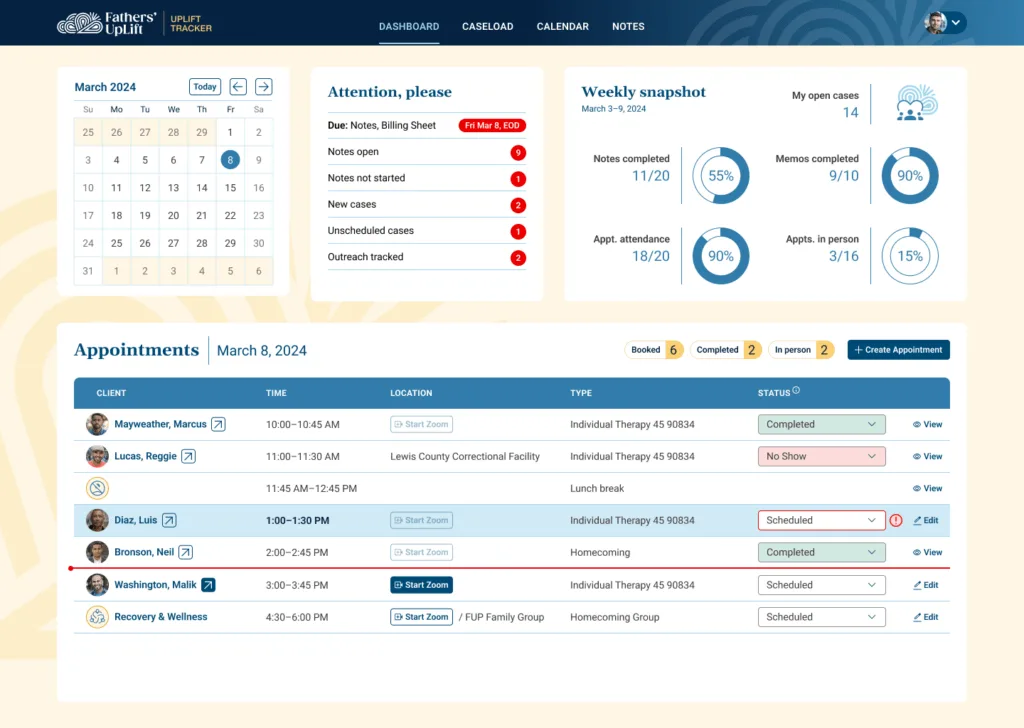
The first mental health facility designed specifically for fathers
Fathers' UpLift is a pioneering mental health organization founded by Dr. Charles Clayton Daniels Jr. in Boston. Since 2011, they have served over 16,000 fathers through coaching, clinical therapy, and community outreach, with a 96% client confidence rate. Their model pairs licensed clinicians with trained coaches to address the unique mental health challenges fathers face, including those navigating the justice system.
But their growth was being held back by their tools. Providers juggled Tebra (a legacy EHR designed for medical offices), Google Sheets for tracking, and JotForm for intake, none of which were built for their coaching-centered model. After two years with a previous agency that delivered little progress, Fathers' UpLift turned to Digital Scientists.
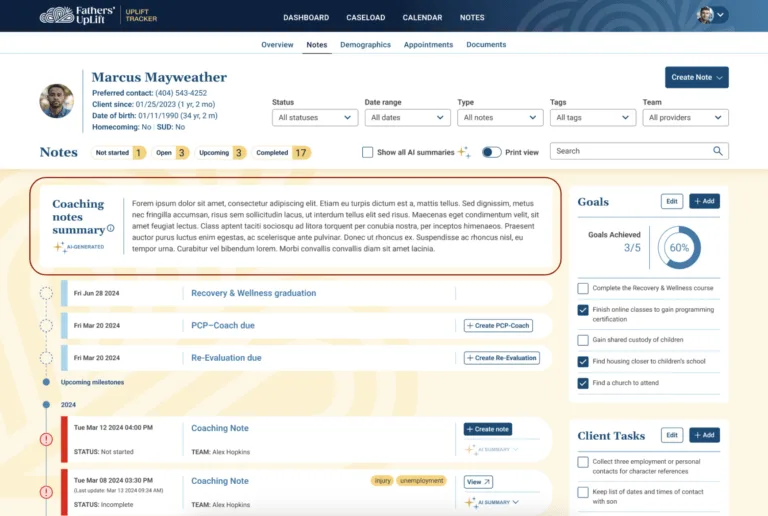
We partnered with FUL for an 8-week engagement: a Product Blueprint to align stakeholders and define the vision, followed by rapid MVP development of the UpLift Tracker, a custom EHR and practice management solutions platform purpose-built for their unique provider model.

Fathers Served
Blueprint to MVP
Client Confidence
Unified Platform
Off-the-shelf EHRs weren't built for a coaching model
Fathers' UpLift's provider model, pairing licensed clinicians with trained coaches, didn't fit any existing EHR. Their team was forced to piece together multiple disconnected tools, creating friction at every step of the care journey.
EHR Mismatch
Tebra was designed for medical offices, not coaching workflows. Providers felt the documentation was cumbersome and didn't reflect their work.
Fragmented Tools
Tebra for billing, Google Sheets for tracking, JotForm for intake, no single source of truth across the organization.
Under-Billing
Complicated documentation workflows caused missed charges. Providers couldn't easily capture billable encounters in real time.
Lost Trust
After 2+ years with a previous agency and little progress, the executive board had lost confidence that technology could solve their problem.
What providers needed
A single hub to track all client progress and interactions
Easy billing and charge capture tied to encounters
Visibility into full caseload with dashboard metrics
Notifications and reminders on their phone
Impact metrics to inform strategy and demonstrate outcomes
Ease of note-taking so providers can focus on people, not paperwork

"Thank you to the Digital Scientists team, this has been a long time coming! We finally have something that will be useful for our team so I want to take this opportunity to thank you for your hard work and your diligence. You took an idea and made it come to life!"
Dr. Charles Clayton Daniels Jr.
CEO & Founder, Fathers' UpLift
From stakeholder alignment to product vision in weeks
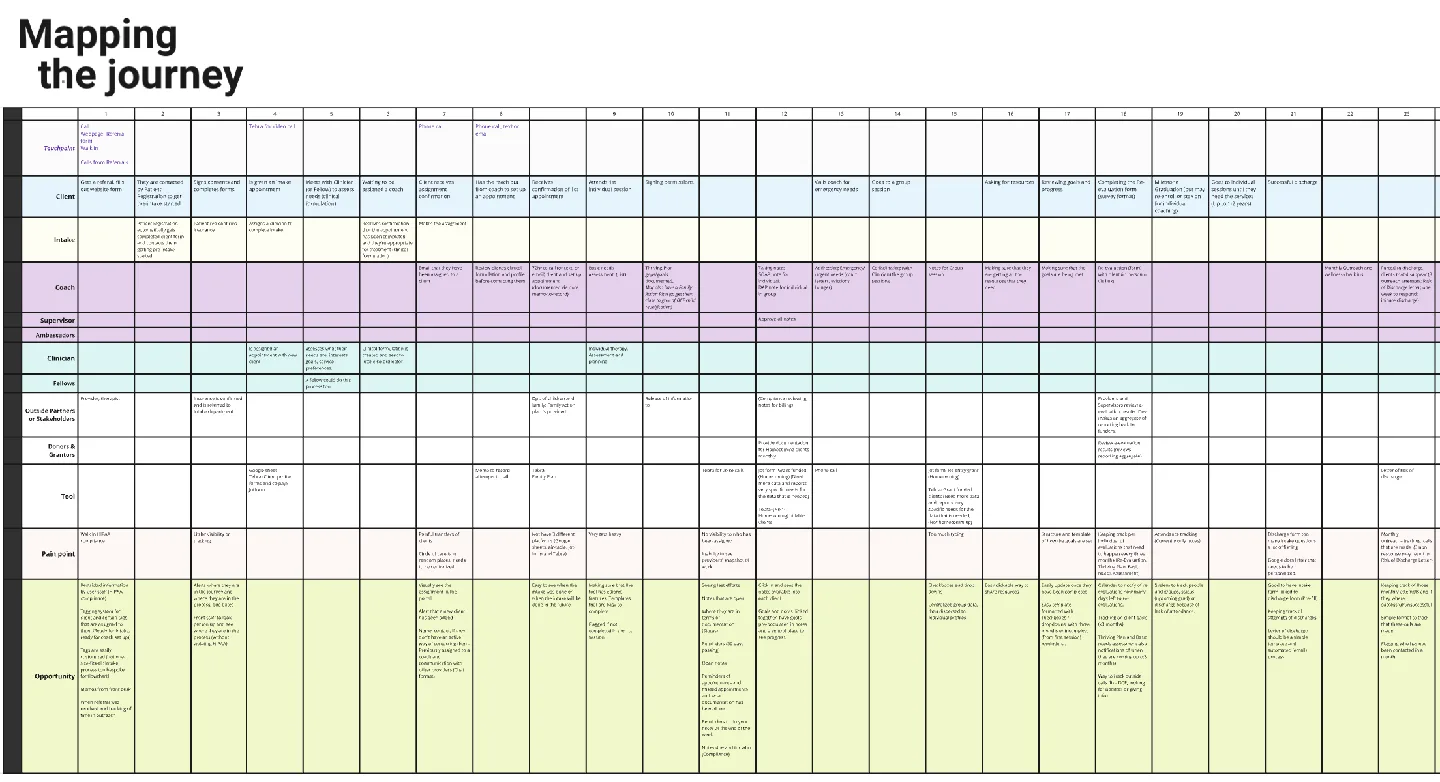
We began with co-creation workshops that brought together FUL's leadership, clinicians, coaches, and administrative staff. Together, we documented the team's journey, aligned on vision, goals, and objectives, and defined what success would look like.
Stakeholder Alignment Workshops
Co-creation sessions with leadership, providers, and admin to document the team's journey and align on product vision.
User Research & Persona Development
Defined five user roles, Clinicians, Coaches, Ambassadors, Fellows, and Admin, and mapped their needs, responsibilities, and platform behaviors.
Product Vision Statement
Co-authored with the FUL team: "The UpLift Tracker is a web-based application that allows providers to manage their workflows, make billing and the sharing of impact easy, so that providers can focus on the people."
Journey Mapping
Mapped the complete client lifecycle, from referral through intake, assessment, coaching sessions, and outcomes tracking, embodying the patient engagement and digital front door approach.
Clear requirements lead to rapid MVP delivery

MSCW Prioritization
Using our co-creation workshop outputs, we prioritized features into Must, Should, Could, and Won't categories to keep the aggressive 8-week timeline on track.
Must-haves: Note-taking, service plans, dashboard, full caseload view, charge capture, encounter visibility, templates, Zoom integration, and easy onboarding.
High-Fidelity Prototype
After gathering user recommendations, we built a clickable prototype based on agreed-upon workflows, wireframes, and visual design. Users tested the prototype and provided valuable feedback for refinement before a single line of code was written.
Solution Architecture
We partnered with FUL to evaluate their current technology landscape, planned integration points, and organizational preferences. This resulted in a comprehensive solution definition documenting critical system behaviors, technology choices, and deployment strategy.
Rapid Agile Development
We assembled a Tiger team to build the application with parallel workstreams: API development and front-end component library. Regular stakeholder check-ins ensured priority features shipped on time and drove user adoption from day one.
A custom EHR designed around the care model, not the other way around
Rather than force FUL's coaching model into an off-the-shelf EHR, we designed a purpose-built system that integrates with existing tools where they add value and replaces them where they don't.
System Context View
How UpLift Tracker connects to the broader ecosystem

Tebra Integration
Syncs with Tebra's SOAP API for patient demographics, billing claims, and charge capture, keeping the billing system of record intact.
Zoom Telehealth
Native Zoom integration enables coaches and clinicians to conduct HIPAA-compliant video sessions directly from the platform.
AI Summarization
OpenAI-powered assessment comparison and summarization helps coaches quickly review client progress before check-ins.
Google OAuth2
Staff authenticate via Google OAuth2 with domain-restricted access. Clients use secure magic links for passwordless assessments.
Communications
SendGrid for transactional email and Twilio for SMS enable automated appointment reminders, assessment invitations, and magic-link delivery.
File Storage
AWS S3 provides scalable, durable storage for client documents, assessment files, and uploaded media with 256-bit AES encryption.
Built for scale on modern cloud infrastructure
The UpLift Tracker runs on a Kubernetes-based AWS infrastructure designed for reliability, security, and horizontal scaling as Fathers' UpLift expands to new locations.
ReactJS SPA
Built with Vite, shadcn/ui components, and state management via jotai and zustand. Served from S3 via CloudFront CDN.
Ruby on Rails API
Rails 7 API chosen for rapid development velocity. Handles authentication, business logic, and all third-party integrations.
Aurora PostgreSQL
AWS-managed PostgreSQL for application data, rollup tables, and client records. Encrypted at rest with automated backups.
Workers + Redis
Async processing for billing sync, email delivery, and AI summarization. ElastiCache Redis for caching and job queuing.
Technology Stack
Frontend
ReactJS, Vite, shadcn/ui, jotai, zustand, TanStack React Query
Backend
Ruby on Rails 7, PostgreSQL, Redis, Sidekiq
Infrastructure
AWS EKS, S3, CloudFront, ECR, Aurora, ElastiCache, GitHub Actions, Argo CD
A platform built for impact
AI-Enhanced Summarization
Compare and analyze client assessments to summarize changes over time. Gives coaches a quick reference before check-ins and predictive ability to plan resources.
Accurate Revenue Capture
Real-time encounter documentation with automated Tebra billing sync ensures every session is captured and reimbursed correctly.
Operational Efficiency
A single hub replaces Tebra, Google Sheets, and JotForm, eliminating context-switching and enabling scalability across new locations.
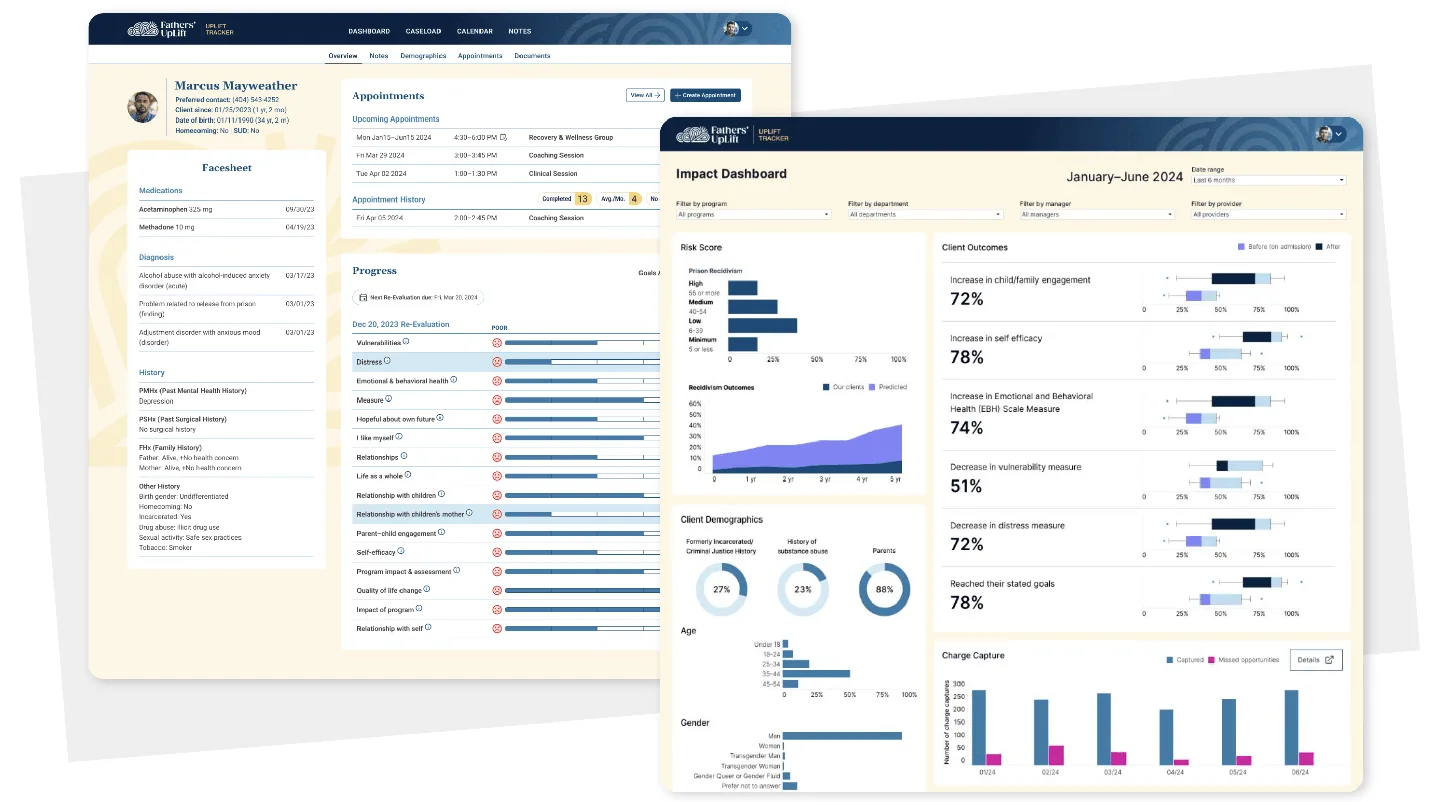
Impact Metrics Dashboard
Executive-level dashboards measuring client outcomes, provider activity, and program impact, enabling data-driven decisions for stakeholders and funders.
Reduced Reincarceration
Individual scoring and progress tracking demonstrates reduced reincarceration rates, a critical metric for FUL's justice-involved population.
HIPAA-Compliant Security
256-bit AES encryption, HTTPS everywhere, role-based access control, and WCAG 2.1 AA accessibility, built for healthcare from day one.
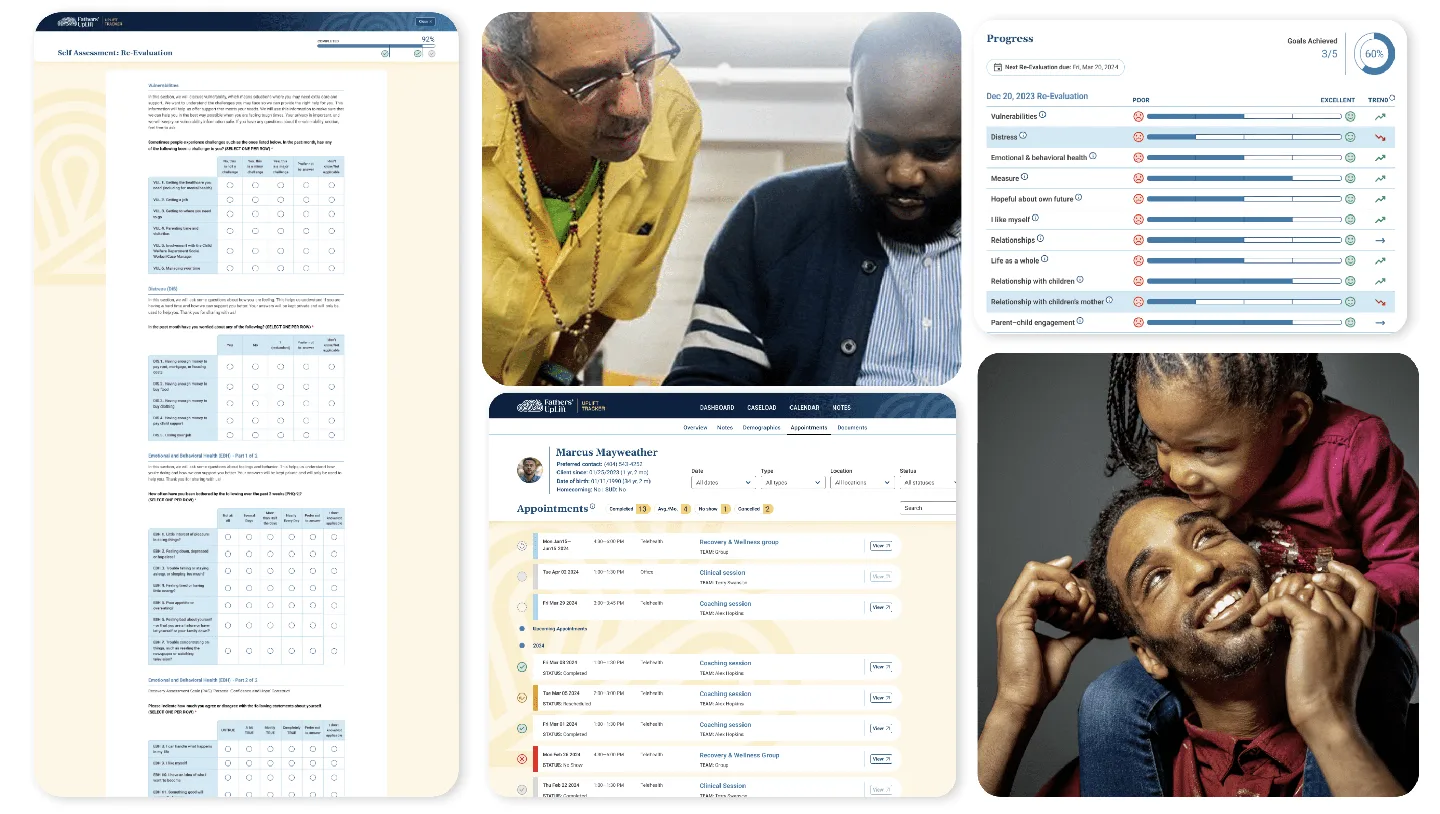
From fragmented tools to a unified platform
Before UpLift Tracker
- Multiple disconnected systems (Tebra + Sheets + JotForm)
- Under-billing due to complex documentation workflows
- No visibility into program impact or provider activity
- Executive board lacked confidence in technology investment
- No ability to scale to new locations
After UpLift Tracker
- Single platform with full caseload visibility and ease of use
- Optimized reimbursements through real-time charge capture
- Clear, actionable insights for stakeholders and funding partners
- Rebuilt trust with executive board through delivered results
- Cloud-native architecture ready for multi-location expansion
More Healthcare Work


Discuss your project
Let's talk about how Digital Scientists can help with your next project.