
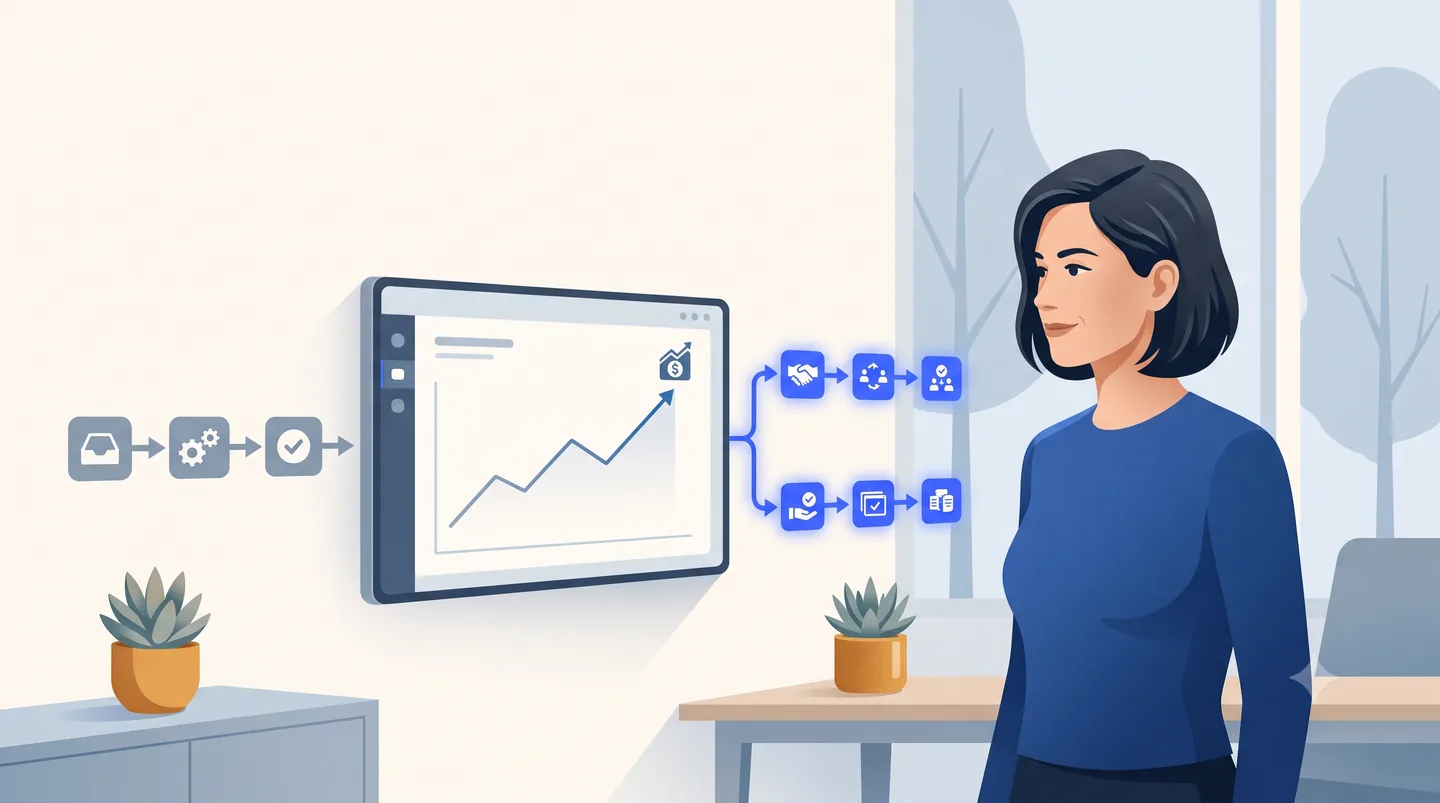
The board's question is the right one: what is the return. Here is the honest answer, including the parts most vendors leave out.
What one workflow returns
The problem. A nonprofit runs recuperative-care beds: medical respite for homeless patients leaving the hospital. Hospitals send the same referral to four or five facilities at once, and the first to respond wins the patient. The operator's window was about fifteen to twenty minutes. Before, a staffer had to notice the email, open a dozen pages of attachments, read them, and decide. Every empty bed is lost revenue against a fixed payroll.
What we built. About a month after their first email to us, they had a live system running one workflow end to end:
The AI reads the packet in minutes and never guesses. A fixed rulebook, not the model, applies the operator's own admission policy, so every decision can be explained. A person makes the final call, with the source document on screen. Beds filled is the number it moves.
How the ROI shows up
ROI on a workflow is not an AI metric. It is a number the business already tracks. Walk it through the case. Before, a person had to notice a referral, open it, read a dozen pages, and decide, and many arrived faster than a busy staffer could keep up with. Referrals that missed the window went to another facility, and every empty bed is lost revenue against a payroll that does not change. After, the reading and checking happen in minutes, so more referrals get a decision inside the window and more beds get filled. The return is straightforward: additional beds filled, times the revenue per bed, against a fixed cost base, which means almost all of it drops to the bottom line. That is the number the CFO was already watching.
In general, the return shows up in one of three places:
- Revenue you were losing and now capture, from speed or coverage.
- Cost you avoid, in hours not spent or a hire you do not make.
- Risk you reduce, through fewer errors and a decision you can audit.
The discipline is to name which one before you start, write down the baseline number, and measure against it. Do that and the result is not a matter of opinion.
How big can it get? In a larger operation, the same approach applied to the revenue cycle recovered more than $10 million. That is not what a first workflow should expect. It is what one can grow into once the approach is proven.
The honest answer on headcount
It is your call, and we have seen it go both ways. Sometimes automating a workflow makes a role redundant. Sometimes the hours it frees up go to quality and growth work that never got done before. We build the capability. What you do with the freed-up capacity is a leadership decision, not one we make for you.
What one workflow becomes
The first workflow is not the finish line. The trust you earn and the system you build carry into the next one, and over time the workflows connect into a single live view of how the business runs. Do enough of them and you are no longer automating tasks one at a time. You are redesigning how the company operates, one step at a time, with full transparency and control. That is the business case, and it starts with one workflow.