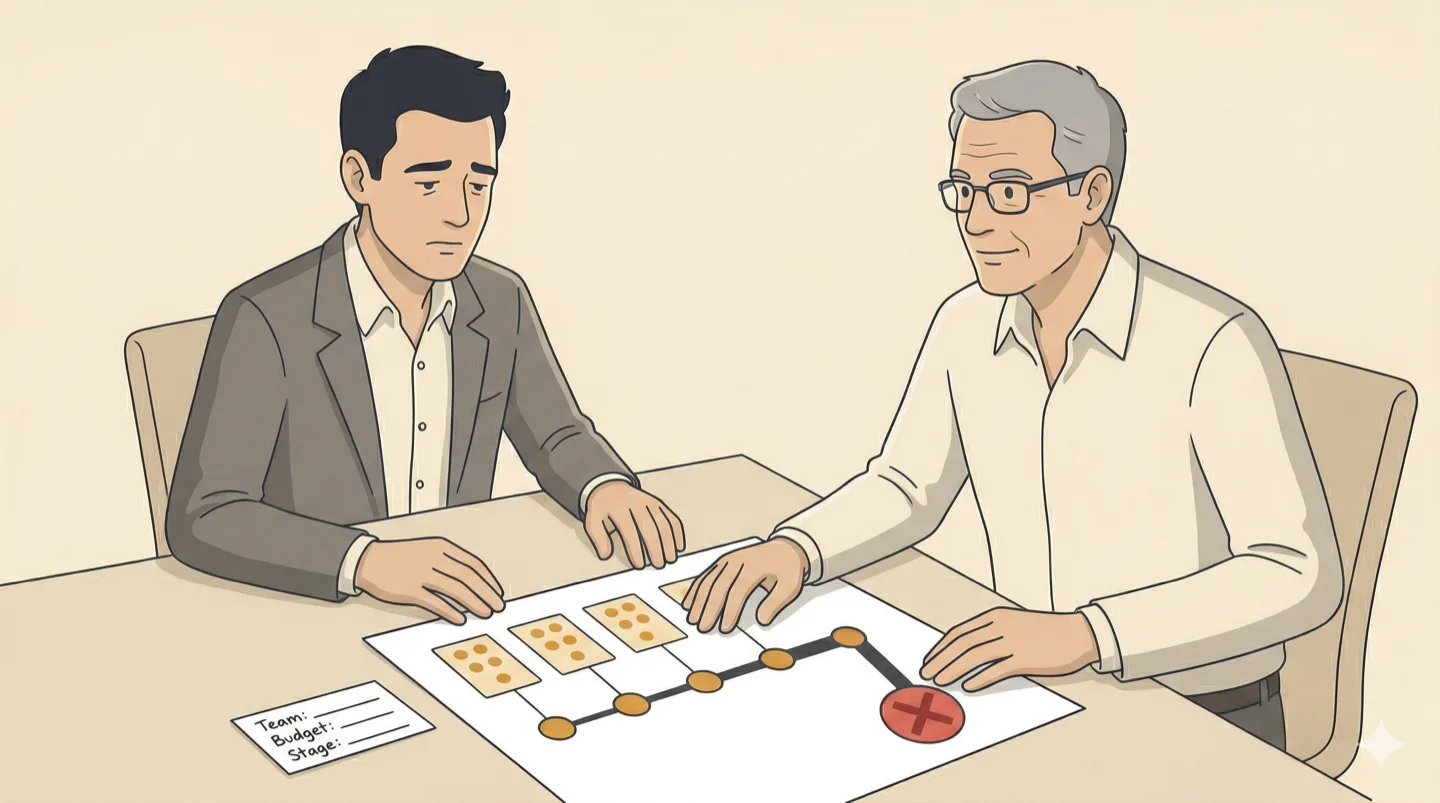
Here is something we see constantly: a founder uses an AI tool to make a technical decision. The answer looks thorough. It's well-organized. It sounds like it was written by someone who knows what they're talking about. So the founder sends it to their developer and says, "build this."
Six months later, the engineering team is drowning.
Not because the AI was wrong, exactly. The recommendations were technically sound. They would have been appropriate for a company with fifty engineers and a thousand customers. The problem is that this company has four engineers and twelve customers, and the architecture is now the single biggest thing slowing them down. What AI gets wrong about early-stage architecture isn't the technical accuracy. It's the assumption about who you are.
We have been building production software at Digital Scientists for 19 years. We use AI tools on every engagement. We think they're genuinely transformative. But we've also spent the last two years watching a very specific failure pattern play out across startups we talk to, and it's worth naming clearly.
Why AI Architecture Is Too Complex for Early-Stage Startups
When you ask an AI tool an architecture question, "how should we set up our database," "what's the right way to handle payments," "how should we structure our API", it gives you an answer optimized for a system at scale. It assumes you have the team to maintain what it recommends. It assumes you need the flexibility it's designing for. And it assumes the complexity it introduces is worth the tradeoff.
Those assumptions are usually wrong for an early-stage company.
Here's why this matters even if you're not technical: every component in a software system is something that has to be configured, monitored, updated, and debugged by a human being. When the AI recommends five components and you only needed one, it hasn't saved you time. It has created four new things your team has to manage, four new things that can break, and four new vendor relationships or open-source dependencies you're now responsible for.
That complexity doesn't announce itself. It accumulates quietly. Your engineers spend more time wiring things together than building features. Deployments that should take an hour take a day. A bug that should be in one obvious place could be in any of five services. And the founder, who isn't in the codebase, has no way to see any of this happening until the team starts missing deadlines.
We call this the Build to Horizon gap: the distance between what AI recommends for an abstract production system and what your team actually needs for the next 18 months. The AI has no way to close that gap without context you almost certainly didn't provide, and most founders don't know enough about the internals to know what context to give.
AI Architecture Over-Engineering in Practice
Here's a real scenario we see regularly, simplified to show the pattern.
The database decision
A B2B SaaS company is in pilot with two customers and in conversations with a third. They ask Claude how to structure their database so that each customer's data is properly separated.
For a B2B SaaS, I'd recommend a hybrid approach combining schema-per-tenant with a shared metadata layer:
- A shared area for login, billing, and audit logging
- A separate database schema for each customer's data
- Row-Level Security as a defense layer
- A connection pooler to manage database connections at scale
- Cross-tenant reporting views on a read replica for analytics
If you're not an engineer, that probably looks like a thorough, professional answer. And it is, for the wrong company. Here's what Claude never asked and never told you:
- How many engineers do you have?
- Who manages your database day to day?
- What is your realistic timeline to ten customers?
- With separate schemas, every future database update now has to run once per customer, that overhead grows with your customer count, not your engineering capacity
- The connection pooler it recommended is a new piece of infrastructure your team has to learn, configure, and troubleshoot when it breaks
- The simpler approach, one shared database with a customer identifier on each row, enforced with Row-Level Security, takes about three hours to set up. The recommended approach takes one to two weeks.
- You can always migrate to the more complex setup later, when you actually need it. That migration is well-documented. But you can't easily get back the weeks you spent building something you didn't need yet.
Not sure if your architecture is right for your stage?
Our technical advisory gives you senior engineering guidance without the full-time hire, architecture review, risk identification, and honest recommendations.
Learn About Technical Advisory →Why AI Tools Keep Over-Engineering for Startups
Claude isn't trying to mislead you. It's doing exactly what it was trained to do: give you the most comprehensive, technically defensible answer to the question you asked. The problem is that the question you asked was missing context Claude can't infer, your team size, your runway, your actual near-term growth, your engineers' experience with the tools being recommended.
A senior engineer with startup experience would have asked those questions before answering. They would have pushed back. They would have said, "you don't need that yet", the YAGNI principle. Claude doesn't push back. It builds for the eventual scale you described in your prompt, not for the reality you're operating in today.
And every unnecessary component it recommends creates real, ongoing cost, not just in dollars, but in engineering attention. Your team has a finite number of hours. Every hour spent maintaining infrastructure they don't need yet is an hour not spent on the product.
Warning Signs Your AI Architecture Is Over-Built
The answer includes tools or services you've never heard of. If your team can't recognize a component, they can't maintain it, debug it, or hire someone who can. Multiple unfamiliar tools in a single recommendation is a significant commitment disguised as a setup step.
The answer uses phrases like "for scalability" or "production-ready." These signal that Claude is optimizing for a fully mature system, not your actual stage. You're not wrong to want those things eventually, but building for them now, before you need them, is where the cost hides.
You forwarded the AI output to your engineer without reviewing it with them. This is the most common way architectural decisions get made by accident. The engineer builds what was specified. Nobody evaluated whether the specification was right for your stage.
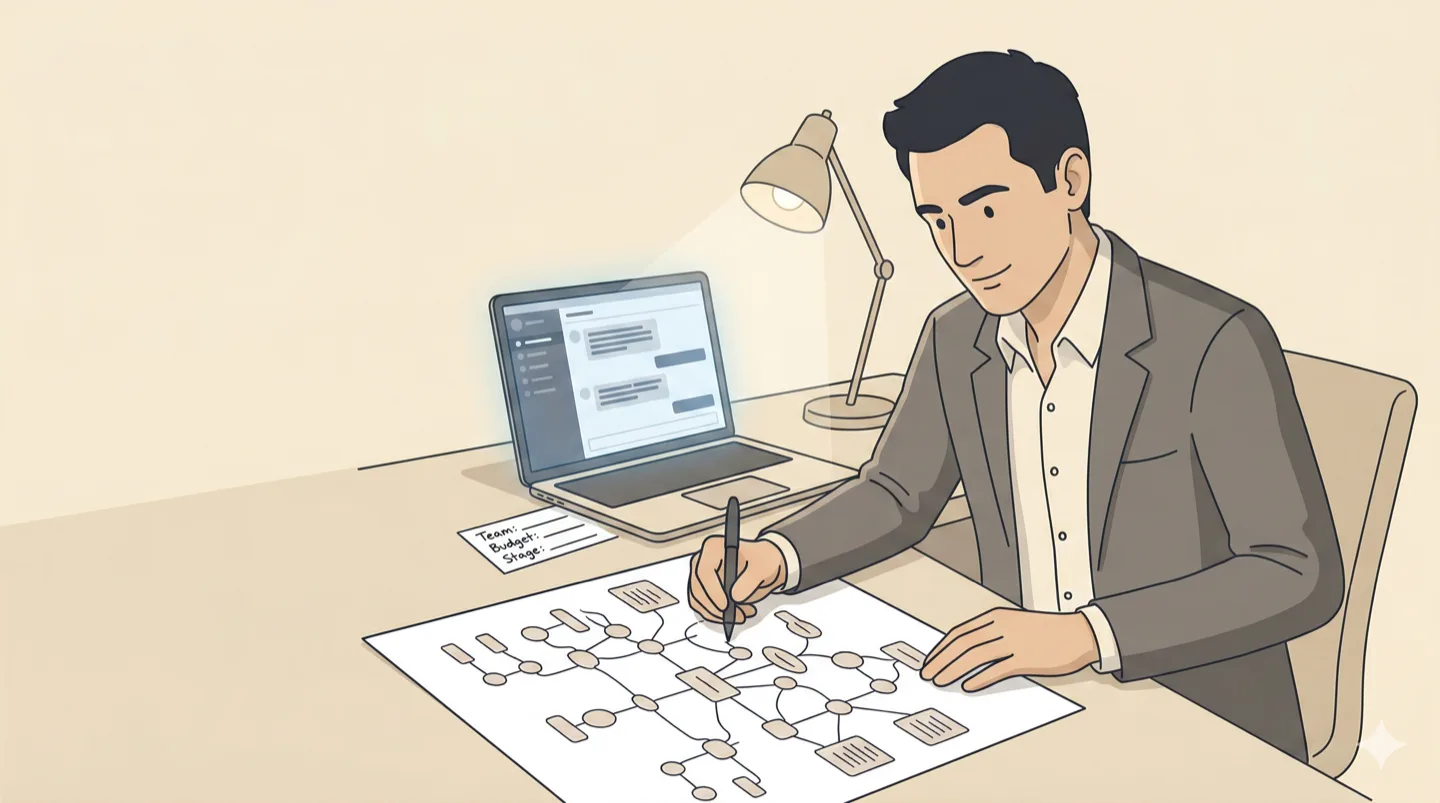
Your prompt didn't include context about your team or timeline. "What's the best way to handle X?" produces a very different answer than "We're a four-person team, six months from our next milestone, what's the best way to handle X?" Claude can't factor in what you don't tell it. But even with perfect context, it still tends to over-build. That's the gap a human architect closes.
The takeaway is not to stop using AI tools. We use them constantly and they make us faster. The takeaway is that architectural recommendations need engineering review, by someone who knows your stage, your team, and your actual constraints. Treat the AI output as a first draft, not a spec.
We review your architecture decisions, find where the Build to Horizon gap is largest, and tell you what to build now versus later.
30 minutes · A real architect, not a salesperson