How We Work
Evidence before investment. Always.
Four phases. Twelve offerings. One principle: each phase produces proof that earns the next investment. No phase is skipped, no budget is wasted on assumptions.
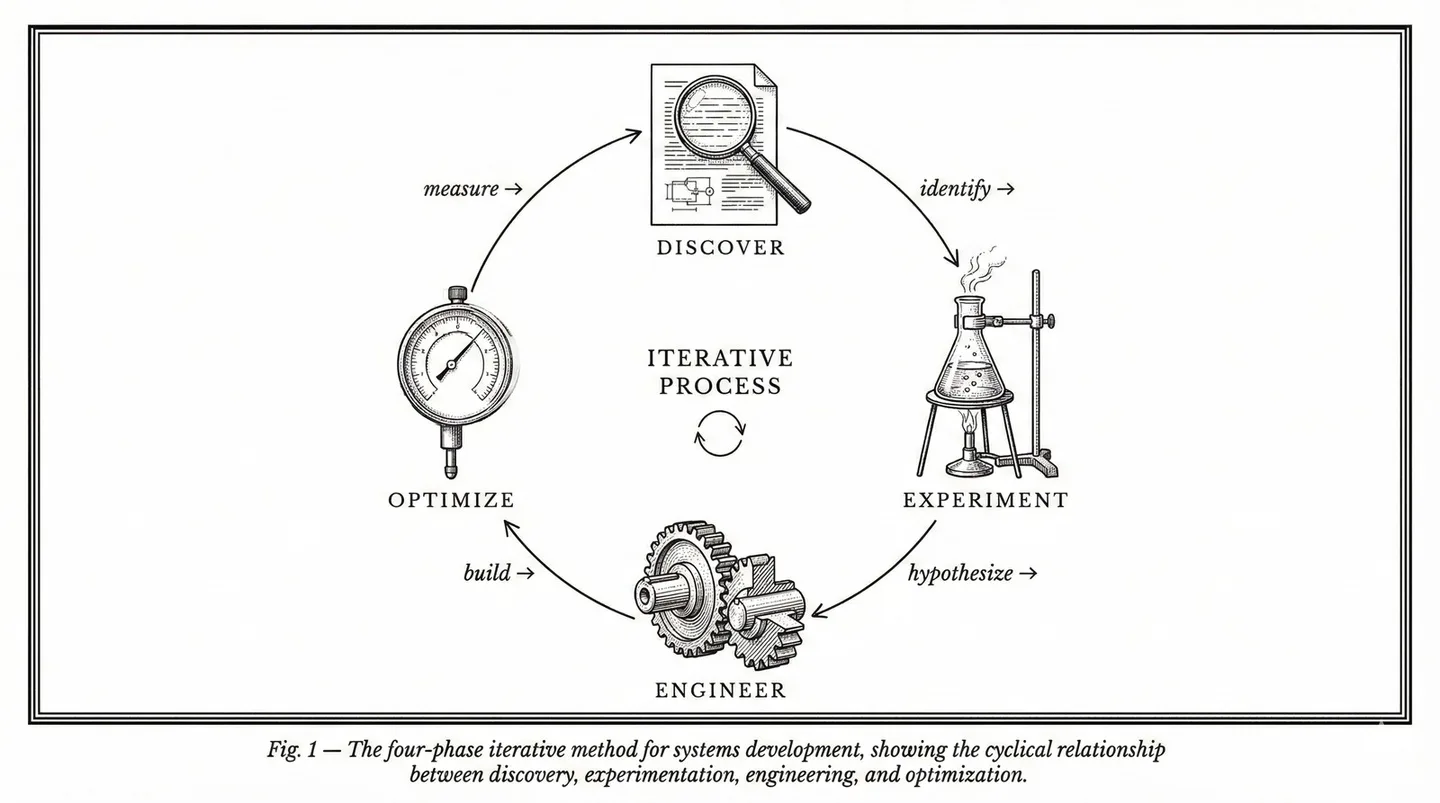
The Scientific Method,
Applied to Software
Most software fails because teams build before they understand. We apply the scientific method to product development: observe, hypothesize, experiment, measure. Every dollar invested produces evidence—not assumptions.
Evidence earns the next investment
Each phase produces proof—working software, validated hypotheses, or measurable outcomes—before the next phase begins.
Small bets, fast answers
A one-week experiment tells you more than a six-month build. We compress the learning cycle so you can decide with confidence.
Stopping is a valid outcome
If the evidence says stop, we stop. That's not failure—it's the methodology working. You saved months and hundreds of thousands.
Every Engagement Follows the Same Logic
You don't have to start at the beginning. Most clients enter at the phase that matches where they are today.
Discover
“What should we do?”
Research, opportunity mapping, and prioritization to find the highest-ROI starting point. You leave with a clear plan—not a vague roadmap.
Experiment
“Does it actually work?”
Working prototypes and MVPs tested on your data, your workflows, your users. Build, pivot, or stop—with proof, not opinions.
Engineer
“Make it real.”
Validated experiments become production systems. Sprint-based delivery, senior-staffed teams, and architecture designed for scale, security, and integration.
Optimize
“Make it better.”
Ongoing support, monitoring, and continuous improvement. We stay until the KPIs are hit—and keep the system performing after launch.
“The biggest risk in software isn't building the wrong thing. It's building the wrong thing for six months before finding out.”
Three Disciplines. One Team.
Every engagement is staffed with all three disciplines from day one. No handoffs between departments, no lost context, no “that's not my job.”
Strategy & Product
Product managers who define what to build and why. Market research, user research, roadmap prioritization, and business case development. They keep the build pointed at the right problem.
Technology & Engineering
Senior engineers who build production software. Architecture, cloud infrastructure, AI/ML, integrations, and security. They know when AI is right—and when a simpler solution is better.
Design & Go-to-Market
UX/UI designers and growth strategists who make software people actually use. Interface design, usability testing, launch planning, and adoption strategy.
Three Ways AI Creates Value
AI isn't a service line. It shows up in three ways across every engagement—and none of them require jargon to explain.
Does the Work for You
“I don't have to hire three more people.”
Software handles tasks your team currently does manually—reading intake forms, extracting data, routing to the right person, flagging exceptions.
Agentic AI & Automation
Helps You See What's Happening
“I finally know what's going on.”
Software surfaces patterns, answers questions in plain English, and flags what matters—before you have to ask.
LLM-Powered Insights
Built Faster
“That was supposed to take six months.”
AI tools let our engineers build production software in weeks, not months. A dashboard that took 3 months now takes 3 weeks.
AI-Accelerated Development
You Own Everything We Build
When you rent SaaS, the vendor owns the IP and the roadmap. When you build with Digital Scientists, you own the software, the code, and the competitive advantage.
Build & Own
100% IP ownership—code, designs, architecture
Software shaped to your exact workflows
Competitive moat—nobody else has what you built
No per-seat fees, no vendor lock-in, no roadmap you can't control
Rent SaaS
Vendor owns the IP and the roadmap
Your workflows adapt to the software, not the other way around
Your competitors buy the same tool
Per-seat pricing scales with headcount, not value
Where Are You Today?
Pick the starting point that matches your situation. Every path leads to working software.
“I have an idea but I'm not sure where to start.”
Start with a Working Session or Diagnostic to find the highest-ROI path forward.
Discover →“I know what I want to build. I need to prove it works.”
The Experiment: a working prototype on your data in 5 days.
See How It Works →“We've validated the idea. We need a production build.”
Full Build: sprint-based production engineering with a senior team.
Start Building →“We have software in production. We need it to perform better.”
Optimize: ongoing support, monitoring, and continuous improvement.
Level Up →Start a Conversation
30 minutes. No pitch. We'll help you figure out the right starting point.
Or call: 404.654.3855