Experiment · Phase 2
Field Trial
Minimum Viable Product
4–16 weeks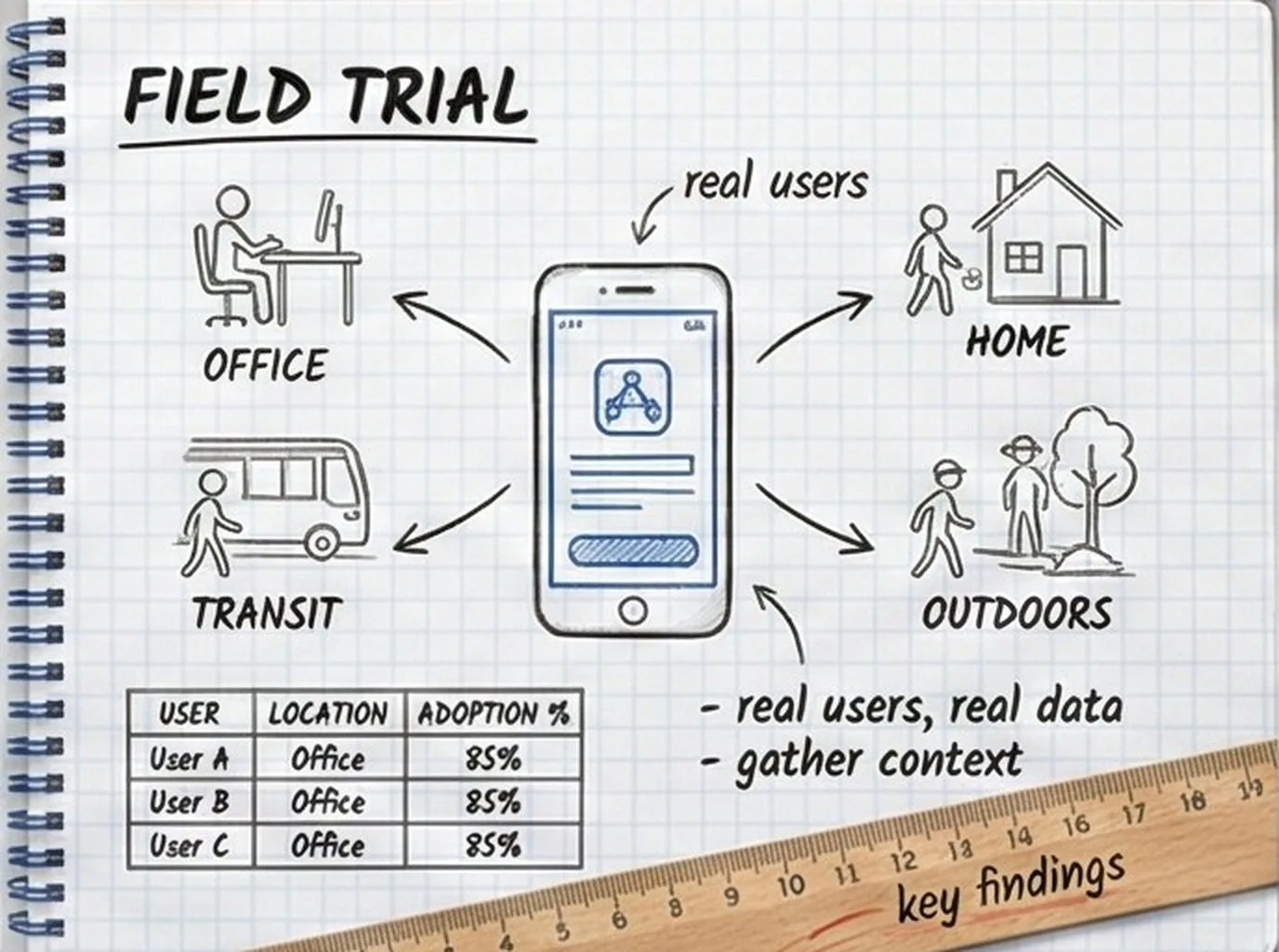
Get your product into real users' hands—and measure what happens.
A Field Trial takes a validated concept and turns it into a production-quality minimum viable product that real users can test in a real environment. This is not a demo—it is functional software deployed to actual users, instrumented to measure whether people adopt it and get value from it. Using a rapid design and development process, our senior product team will challenge your assumptions, diagnose problems, and accelerate feedback through a build-measure-learn loop.
Whether it's a web application, mobile app, or a new AI model, our U.S.-based team has 17+ years of experience helping clients go from validated concept to testable product in the shortest possible timeframe. We instrument the MVP for usage tracking from day one, so you get quantitative adoption data alongside qualitative user feedback. At the end, you know whether to scale, pivot, or stop—based on real-world evidence, not projections.
Already ran The Experiment or a Rapid Experiment? A Field Trial is the natural next step—it takes the concept you validated and puts it into the hands of real users to prove adoption before you commit to a full production build.
Pick the Size That Fits Your Question
Our experienced team will guide you through a repeatable process to bring your product to market. We adapt the scope to match the complexity of what you are trying to validate.
Small
Proof of Concept
Core features to validate a hypothesis in the shortest time period.
Medium
Startup
Broader set of use cases to test product-market fit.
Large
Enterprise
Broadest set of use cases with higher complexity.
Not sure which size? Start with a Working Session to scope the right approach. We also support the development of proprietary AI models that may require a Diagnostic for data governance and opportunity assessment.
What Every Field Trial Delivers
Real software tested by real users, with the data to prove it works.
Production-Quality MVP
A deployed, functional product that real users can access and use in their actual workflow—not a prototype, not a mockup.
Usage Analytics
Quantitative adoption data: who used it, how often, which features, where they dropped off, and how engagement trended over time.
User Feedback Report
Qualitative insights from real users: what they loved, what frustrated them, what they wished it did, and how it compared to their current process.
Build-or-Scale Recommendation
A clear recommendation backed by evidence: scale it, pivot the approach, or stop. The data your stakeholders need to make the call.
Build. Measure. Learn.
The Build-Measure-Learn loop is the engine at the heart of Lean Startup methodology. You start with a hypothesis about your customer or market—not a fully-baked product—then move through three phases.
Build
Create the simplest possible version of your product that tests your hypothesis. The goal isn't to ship something polished—it's to ship something learnable. Just enough to provoke a meaningful customer reaction.
Measure
Collect data on how real customers interact with what you built. Focus on actionable metrics—cohort analysis, split testing, and behaviors that indicate real value—not vanity metrics like total signups or page views.
Learn
Based on what you measured, determine whether to persevere or pivot. This is validated learning—knowledge backed by real customer data, not intuition or conference room debates.
Why This Is the Core MVP Methodology
Most founders think their job is to build a product. The deeper insight is that the job is to produce validated learning about what customers actually want—and the product is just a vehicle for that learning.
- 01 Inverts the planning instinct. Instead of “figure out what to build,” it says “figure out what you need to learn, then build the cheapest thing that teaches you that.”
- 02 Minimizes wasted effort. Every feature you build before validating demand is potentially wasted. The loop keeps you honest.
- 03 Makes failure productive. A “failed” MVP that disproves your hypothesis isn't a failure—it saves you months of building the wrong thing.
- 04 Speed is the advantage. The team that cycles through the loop fastest accumulates validated learning faster than competitors.
Build-Measure-Learn in Practice
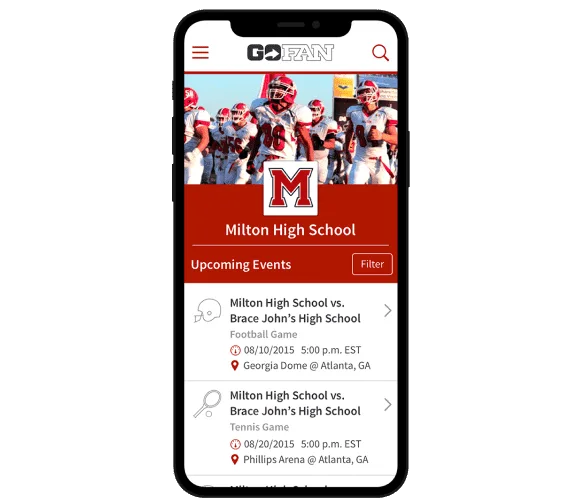
When Huddle needed to prove that high school fans would buy digital tickets, we didn't build a full ticketing platform. We built an MVP in 75 days, launched it at 6 high schools in metro Atlanta for a single football weekend, and measured what happened.
The result: 50% adoption with minimal advertising and $34K in digital gate revenue at a single playoff game. That validated loop became GoFan—now serving 10,000+ schools, 20M+ tickets sold, and selected as the exclusive NFHS national partner.
The MVP isn't a product strategy—it's a learning strategy.
MVP Development Deliverables
Depending on scope, your Field Trial may include:
- Competitive analysis
- User interview insights and research
- User personas
- Customer journey maps
- UX designs, prototypes, and design systems
- Solution architecture documentation
- Product requirements
- Business and technical roadmap
- Testable application launched to beta group
- Usability testing results
- All code written during the engagement
- Inline code-level documentation
Started as an MVP. Now in Production.




Why Choose Us
We don't just build MVPs—we build businesses with AI-driven innovation. Senior leadership is directly involved in every engagement.
Lean, Senior Teams
The best digital products are created by hands-on teams of experts with extensive experience crafting and deploying products at scale. We get close to your problems and your users. We aren't training our team with your investment.
Prototyping & Validation
We prioritize user research and product discovery, completing design cycles and prototypes early on. Testing and validation occur at every phase, informing hypotheses and ensuring the final product delivers utility for users.
Long-term Partners
We serve as strategic partners. Together, we co-create, prototype new concepts, and transition services into tangible solutions. Our collaborative approach empowers clients to bring ideas to market faster. Once validated, we partner through commercialization.
Is a Field Trial the Right Next Step?
A Field Trial is the right move when you have a validated concept that needs real-world proof before committing to a full build.
You've validated the concept
You ran The Experiment or a similar prototype, got a green light from stakeholders, and now need to know whether real users will actually adopt it in their daily workflow.
Stakeholders need adoption data
Your stakeholders need to see actual users using the product—not just a demo. Real adoption numbers, engagement rates, and user feedback are the evidence that justifies moving to production.
You need evidence before a full build
You need hard adoption metrics—engagement rates, feature usage, retention—to build the business case for a full production commitment. A Field Trial delivers exactly the data to justify the investment.
Frequently Asked Questions
Lean Startup is a methodology focused on building products through rapid experimentation, validated learning, and iterative development. The goal is to minimize risk by launching quickly, learning from user feedback, and making data-driven decisions.
An MVP (Minimum Viable Product) is the simplest version of a product that allows for quick testing and learning, minimizing risk and investment.
Starting with an MVP helps validate assumptions, gather real customer feedback, and iterate rapidly, saving time and resources.
Prioritize features that solve the most critical problem for users and align with your core business goals. Focus on delivering value with the least effort to test assumptions quickly.
JTBD helps prioritize features by focusing on the user's main goal—what job they need the product to accomplish. It ensures that the MVP solves a real problem, improving user adoption and feedback quality.
User research helps identify the needs, pain points, and behaviors of target users. It informs feature prioritization and ensures the MVP addresses real user problems, improving its chances of success.
MVP development focuses on quickly building the simplest product to test a hypothesis, while Agile development is a methodology for continuously building and improving products in iterative cycles.
A market test is a method of introducing an MVP to a small group of users to assess demand, gather feedback, and determine whether the product resonates with its target audience.
MVP development reduces risk by validating product assumptions early, limiting financial and time investments, and allowing for adjustments based on real user feedback before scaling.
Many successful apps began as MVPs. Dropbox started with just a demo video to gauge interest, while Airbnb began with the founders renting out air mattresses in their apartment to test the concept. Twitter launched as a simple status-sharing tool before evolving into a full-fledged social platform.
The timeline varies based on scope and complexity. A small proof-of-concept MVP can be built in 4 weeks. A medium-scope startup MVP typically takes 8 weeks. Enterprise MVPs with higher complexity may require 12–16 weeks.
Use feedback from users to iterate and improve the product, pivot if needed, or scale based on validated learning. A Full Build engagement can take a validated MVP into production-grade software.
MVP success is measured by validated learning—did the MVP confirm or refute key assumptions about your users or the market? Additionally, speed to market is a key metric, as faster launch allows for quicker feedback and earlier adjustments, maximizing opportunities.
Ready to put your idea in front of real users?
30 minutes. No pitch. We'll help you figure out the right MVP size—or recommend a Rapid Experiment or The Experiment if you need to validate the concept first.
Schedule a Free MVP Strategy Call →